The Same Building, Counted Twice: Eliminating Ghost Assets From Intragroup Leases in Property Groups
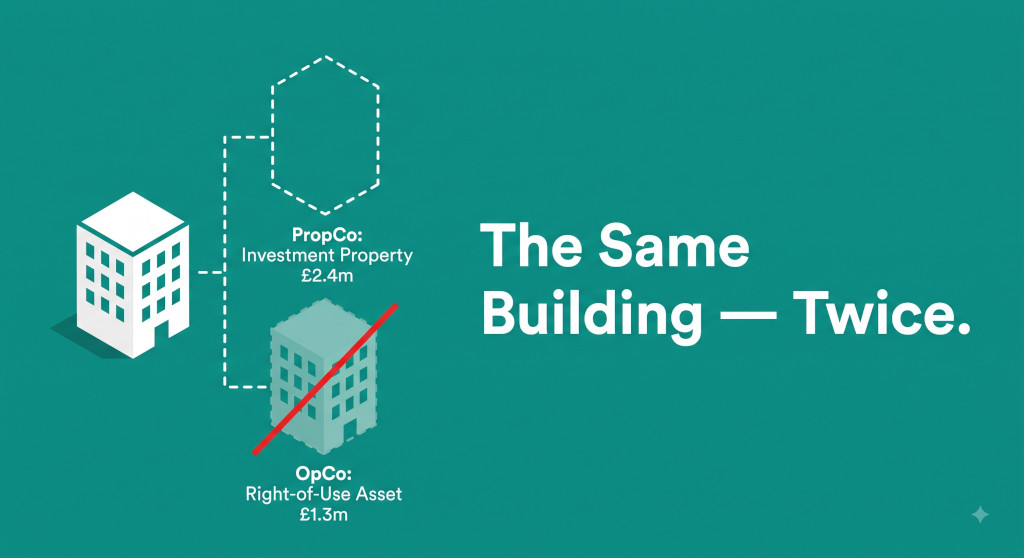
Rachel is the group finance director of Meridian Property Holdings, a group that owns eight commercial properties across separate SPV entities. When her auditor queried the December consolidation, he pointed to a line Rachel had not flagged: £1,251,000 of right-of-use assets sitting on the consolidated balance sheet. “But we don’t lease any properties from third parties,” she told him. She was right. Every lease in the group was between a PropCo SPV and Meridian Operations Ltd, the group’s management company — two entities she owned 100%.
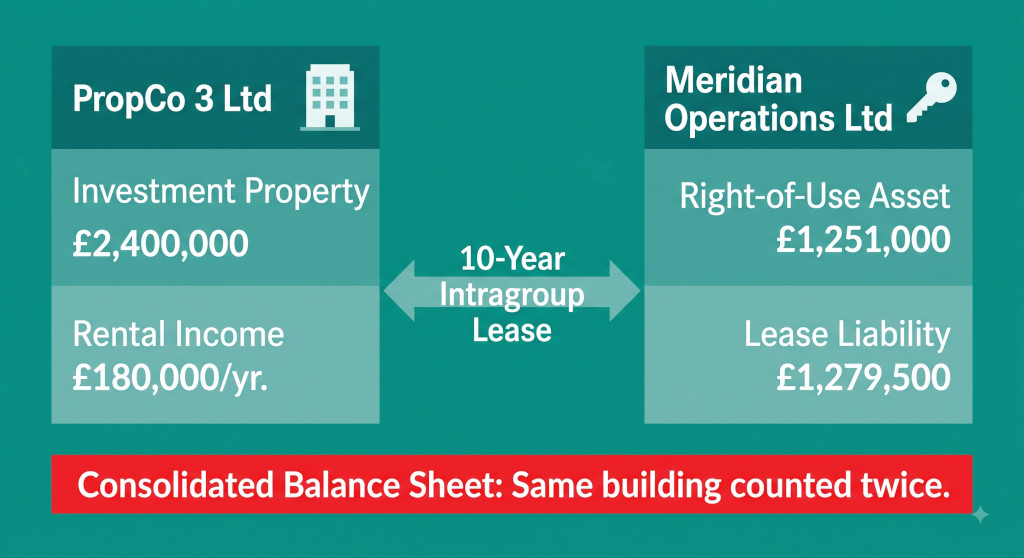
The right-of-use asset was entirely intragroup. At entity level, each set of accounts looked correct: PropCo 3 Ltd held Warehouse Unit 4 as investment property, and Meridian Operations Ltd had properly recognised a right-of-use asset and lease liability under IFRS 16. But at group level, the same physical building was appearing on the consolidated balance sheet in two forms simultaneously — as a £2,400,000 investment property in PropCo, and as a £1,251,000 right-of-use asset in OpCo.
This is the ghost asset problem. It is invisible at entity level and only surfaces at consolidation. For property groups structured with PropCo SPVs leasing to an operations or management entity, it is extremely common — and the elimination is more involved than a standard intercompany receivable/payable match because IFRS 16 means the lessee’s P&L charges (depreciation plus interest) do not match the lessor’s rental income in the same period.
Stop building consolidations in spreadsheets.
BrizoConsol automates multi-entity consolidation — setup in minutes, reports the same day.
Why the PropCo / OpCo Structure Creates This Problem
The standard property group structure exists for good legal and financing reasons. Each property sits in its own SPV (PropCo), ring-fencing liability and making individual asset disposals clean. The group’s operations — property management, staff, contracts — sit in a separate entity (OpCo). The OpCo occupies or manages properties under lease from the PropCos and pays them rent.
Before IFRS 16, this was straightforward to consolidate. The OpCo had a rent expense; the PropCo had rental income. At consolidation, you eliminated both. Net effect: zero. The balance sheet was unaffected because the OpCo had no lease asset — just a note about operating lease commitments.
IFRS 16 changed that. Now the OpCo must recognise a right-of-use asset equal to the present value of future lease payments, and a corresponding lease liability. Both are real entries in the OpCo’s standalone accounts. Both are correct in isolation. But at group level, the group does not actually lease a building — it owns it. The right-of-use asset in the OpCo is a ghost: it represents a future commitment to pay rent to a company the group also owns. Once you consolidate, that commitment disappears, and so must the asset.
The test is simple: would this asset exist if the group had only one entity? If PropCo and OpCo were merged into a single company, there would be no lease, no right-of-use asset, and no lease liability. The ghost appears only because the group is structured across two entities.
Quantifying the Ghost: A Worked Example
Take PropCo 3 Ltd, which owns Warehouse Unit 4. It holds the property as investment property at fair value of £2,400,000. PropCo 3 leases the warehouse to Meridian Operations Ltd (the OpCo) under a 10-year lease at £180,000 per year. Meridian Operations uses an incremental borrowing rate of 5% to measure the lease liability.
At lease commencement, the OpCo calculates the initial right-of-use asset and lease liability as the present value of the 10 annual payments:
| Annual lease payment | £180,000 |
| Lease term | 10 years |
| Discount rate (IBR) | 5.0% |
| Annuity factor (PV of £1 p.a. for 10 yrs at 5%) | 7.722 |
| Initial ROU asset / Lease liability | £1,390,000 |
After the first year, the balances in each entity’s standalone accounts look like this:
| Item | PropCo 3 Ltd | Meridian Operations Ltd |
|---|---|---|
| Investment property (FV) | £2,400,000 | — |
| Right-of-use asset (net of depreciation) | — | £1,251,000 |
| Lease liability | — | (£1,279,500) |
| Rental income (P&L) | £180,000 | — |
| Depreciation on ROU (P&L) | — | (£139,000) |
| Finance cost on lease liability (P&L) | — | (£69,500) |
When you aggregate these two entities in the consolidation workings — before any eliminations — the balance sheet shows both £2,400,000 of investment property and £1,251,000 of right-of-use asset relating to the same building. The P&L shows rental income of £180,000 and total occupancy charges of £208,500. Neither figure should appear in the consolidated accounts at all.
Why the ROU Depreciation Schedule Matters
The ROU asset in the OpCo is depreciated straight-line over the lease term:
| Initial ROU asset | £1,390,000 |
| Depreciation: Year 1 (÷ 10 years) | (£139,000) |
| Closing ROU asset (net) | £1,251,000 |
The lease liability moves differently — it unwinds on an effective interest basis:
| Opening lease liability | £1,390,000 |
| Interest accrued (5% × £1,390,000) | £69,500 |
| Lease payment made | (£180,000) |
| Closing lease liability | £1,279,500 |
Notice that the ROU asset (£1,251,000) and the lease liability (£1,279,500) are already £28,500 apart after one year. This gap exists because IFRS 16 front-loads the finance cost — interest is highest in early years when the liability balance is largest. As a result, the P&L charge in the OpCo (£208,500) exceeds the cash rent paid (£180,000) in year one. This mismatch is the source of the retained earnings difference you will encounter when you prepare the elimination journals.
The Two Eliminations You Need
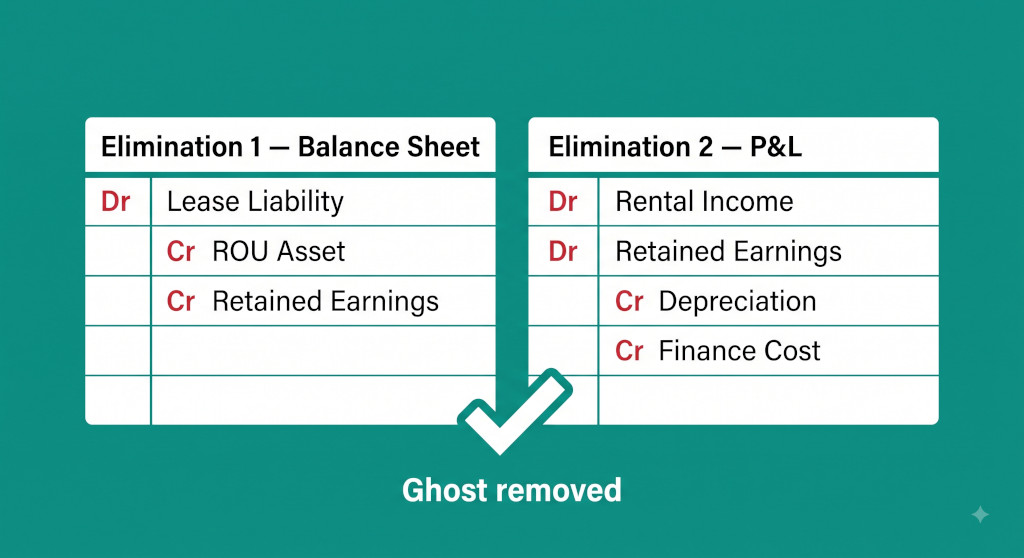
Eliminating intragroup lease balances under IFRS 16 requires two separate journal entries: one to remove the balance sheet ghost, and one to remove the intragroup income and expense from the P&L. You cannot do it with a single entry.
Elimination 1: Remove the ROU Asset and Lease Liability
This entry removes the ghost asset from the consolidated balance sheet entirely:
| Account | Dr | Cr |
|---|---|---|
| Lease liability (OpCo) | £1,279,500 | |
| Right-of-use asset — net (OpCo) | £1,251,000 | |
| Retained earnings / equity | £28,500 |
The £28,500 credit to retained earnings reflects the cumulative timing difference between the IFRS 16 finance cost profile and the straight-line rent. This reverses fully over the 10-year lease term — by year 10, depreciation and interest together will have been less than cash rent in later years, and the retained earnings balance will unwind to zero.
Elimination 2: Remove Intragroup Rental Income and OpCo Lease Charges
This entry clears the intercompany income and the related P&L charges from the consolidated profit and loss statement:
| Account | Dr | Cr |
|---|---|---|
| Rental income (PropCo) | £180,000 | |
| Retained earnings / equity | £28,500 | |
| Depreciation expense — ROU (OpCo) | £139,000 | |
| Finance cost — lease liability (OpCo) | £69,500 |
The £28,500 debit to retained earnings in Elimination 2 is the mirror of the credit in Elimination 1 — they offset each other, so the net retained earnings impact of both eliminations combined is zero. The group’s cumulative profit is unchanged; only the presentation differs.
Common mistake: Trying to eliminate only the rental income against the total IFRS 16 charge and netting the difference to P&L. This leaves a ghost profit or loss in the consolidated accounts. You must eliminate the rental income and each OpCo charge separately, and route the balancing figure through retained earnings — not through P&L as a residual.
The Net Effect on the Consolidated Accounts
After both eliminations, the consolidated accounts for this property arrangement show:
| Line item | Pre-elimination | Eliminated | Consolidated |
|---|---|---|---|
| Investment property | £2,400,000 | — | £2,400,000 |
| Right-of-use asset (net) | £1,251,000 | (£1,251,000) | — |
| Lease liability | (£1,279,500) | £1,279,500 | — |
| Rental income (P&L) | £180,000 | (£180,000) | — |
| Depreciation — ROU (P&L) | (£139,000) | £139,000 | — |
| Finance cost — lease (P&L) | (£69,500) | £69,500 | — |
The result is what the consolidated accounts should always have shown: the building appears once, as an investment property in PropCo, at its fair value. There is no lease-related asset, liability, income, or expense — because at group level, the group owns the building outright and does not “pay” itself to use it.
Tired of tracking intragroup lease eliminations manually?
BrizoConsol handles intercompany eliminations automatically — including the IFRS 16 timing differences that trip up manual workings. See It In Action
What Happens in Year 2 and Beyond
The retained earnings balancing figure changes each year as the IFRS 16 timing difference accumulates and then unwinds. In early years of the lease, the OpCo’s total charge (depreciation + interest) exceeds the cash rent — so the retained earnings credit in Elimination 1 grows year by year. From roughly the mid-point of the lease term onward, interest becomes small enough that the total charge falls below the cash rent, and the retained earnings balance starts to reverse.
By the final year of the lease, the cumulative retained earnings balance will be zero. Over the full 10 years, the total depreciation plus interest in the OpCo exactly equals the total cash rent paid — the timing is the only difference. This means the ghost asset problem does not affect the group’s total lifetime profit, only its year-by-year profile.
You should carry the opening retained earnings balance from the prior period’s elimination forward into each new period’s consolidation workings, updating it for the current year movement. If you build a lease amortisation schedule for each intragroup lease, you can pre-calculate the retained earnings balance for every year of the lease term and incorporate it directly into your consolidation adjustment schedule.
Deferred Tax on the Elimination
In most jurisdictions, the right-of-use asset and lease liability in the OpCo create temporary differences for deferred tax purposes at the entity level. When you eliminate both at consolidation, you remove those temporary differences from the group’s perspective — but you may introduce a new one.
Specifically, if the jurisdiction taxes the lease payments (cash rent) as a deductible expense rather than allowing depreciation and interest separately, then the OpCo’s tax base may differ from the group’s accounting treatment. You should review whether the elimination of the ROU asset and lease liability triggers a deferred tax asset or liability at group level, and whether the retained earnings timing difference has a tax consequence.
For most property groups where the lessor and lessee are both in the same tax jurisdiction and the group files a tax-consolidated return, the intragroup lease is simply ignored for tax — which simplifies matters considerably. Where the entities file separately, take advice on whether the elimination produces a deferred tax balance that needs to be recognised in the consolidation.
If your group files a UK tax consolidation (group relief) or an Australian tax-consolidated group, the intragroup lease is typically disregarded for tax. In that case, no deferred tax entry is needed on the elimination — but confirm this with your tax adviser for your specific structure.
How to Find Every Intragroup Lease in a Property Group
The ghost asset problem multiplies quickly in property groups with many SPVs. A group with eight PropCo entities, each leasing to the same OpCo, could have eight separate ROU assets to eliminate — all correctly recognised in the OpCo’s standalone accounts, all of them ghosts at group level. Finding them requires a systematic search, not a spot check.
Start from the OpCo’s right-of-use asset schedule. For each ROU asset, identify the counterparty. Any ROU where the lessor is another entity within your consolidation perimeter is an intragroup lease and must be eliminated. Do not rely on the OpCo’s accounts team to flag this — from their perspective the lease is real, the accounting is correct, and there is nothing to report.
The same check should be run from the PropCo side: any entity in your group that holds property and recognises lease income should be tested to determine whether the tenant is also a group entity. If it is, both the income in the lessor and the ROU/liability in the lessee need to be eliminated.
A Practical Checklist for Property Group Consolidations
Run through the following steps each period when consolidating a property group with intragroup lease arrangements:
- Extract the OpCo’s full ROU asset register. Obtain the schedule showing each ROU asset, the underlying property, the lessor entity, lease term, and current carrying value (net of accumulated depreciation).
- Identify intragroup leases. Mark any ROU where the lessor appears in your consolidation perimeter. These are your ghost assets.
- Obtain the lease liability balance for each intragroup lease. Cross-reference the OpCo’s lease liability amortisation schedule to the same leases. Note the closing balance and the current-year split between interest and principal repayment.
- Confirm the PropCo’s rental income. For each intragroup lease identified above, confirm the rental income recognised in the relevant PropCo. It should equal the annual cash rent under the lease agreement.
- Prepare Elimination 1 (balance sheet). Debit lease liability, credit ROU asset (net of accumulated depreciation), and route the difference to retained earnings. Update the retained earnings balance carried from the prior period.
- Prepare Elimination 2 (P&L). Debit rental income (PropCo), debit retained earnings for the timing difference, credit depreciation on ROU, and credit finance cost on lease liability.
- Verify the net retained earnings impact is zero. The debit to retained earnings in Elimination 2 should equal the credit in Elimination 1 for the current year. If they do not agree, recheck the lease amortisation schedule.
- Review for deferred tax. Assess whether the eliminated balances create any deferred tax consequence at group level, particularly where entities are tax-registered separately.
- Update your consolidation workings for the next period. Carry forward the opening retained earnings balance from the current elimination so that next period’s journals build correctly on this period’s position.
Start consolidating your property group without the manual workings
BrizoConsol automates intercompany eliminations across all your SPVs — including IFRS 16 lease eliminations that trip up spreadsheet-based consolidations. Start Free Trial