Account Mapping Errors in Group Consolidation: Why Your Consolidated Gross Margin Is Wrong When Every Entity’s P&L Looks Fine
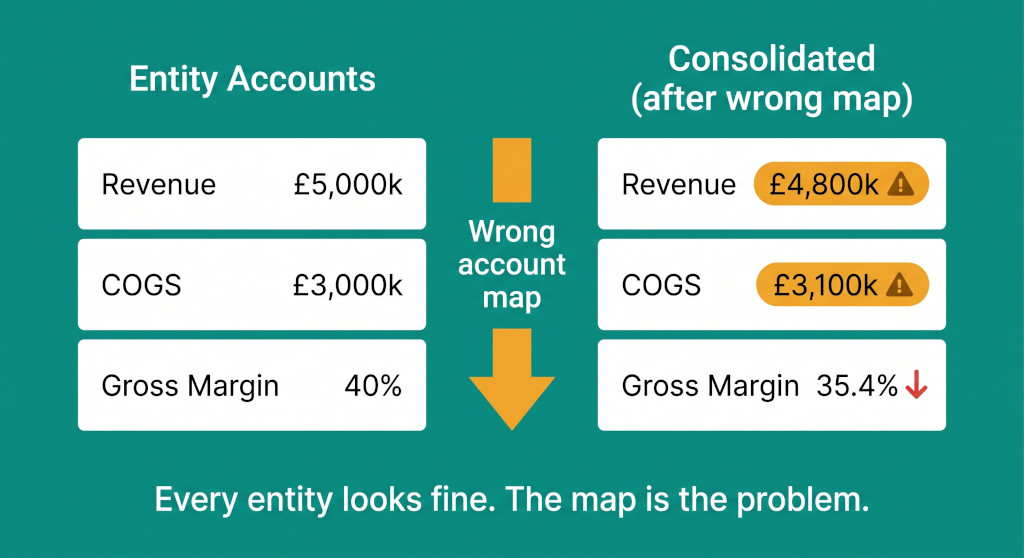
Dan is the group financial controller at Meridian Group, a services business with five operating subsidiaries. The March consolidated P&L has just landed. Gross margin is 35.4%. Last month it was 40.1%. Dan calls each subsidiary finance manager. Every entity’s own P&L looks exactly as expected: revenue is on budget, cost of sales is normal, margins are consistent with prior months. Nobody has reclassified anything. No unusual costs have been posted. The entity-level accounts contain no anomaly.
The problem is not in any entity’s accounts. It is in the account mapping — specifically, in the mapping that was set up three months ago when Subsidiary C was onboarded. Two accounts were mapped incorrectly. One mapped a revenue line into “Other income” rather than “Revenue.” The other mapped an operating cost into “Cost of Sales” rather than “Operating expenses.” In isolation, each error is invisible. At the entity level, the accounts are right. The mapping is wrong. And the consolidation translates the wrong map faithfully into the group P&L every single month, silently compressing the consolidated gross margin while leaving net profit untouched.
This is a problem that cannot exist in a single-entity business. A company with one set of accounts has one chart of accounts, one P&L, and no mapping layer between entity accounts and group accounts. It is only when multiple entities with different account structures are mapped to a common group chart of accounts — a CCOA — that a mapping error becomes possible. And it is only at consolidation that the error becomes visible, because that is the only place where the entity accounts and the group classification meet.
Stop building consolidations in spreadsheets.
BrizoConsol automates multi-entity consolidation — setup in minutes, reports the same day.
How Account Mapping Works in a Multi-Entity Group
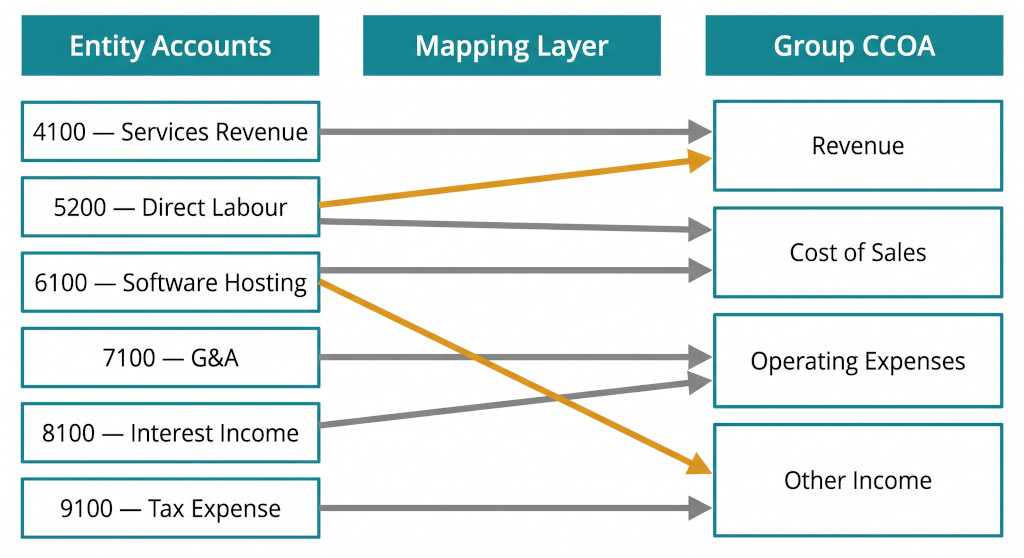
Every entity in a multi-entity group maintains its own chart of accounts, structured according to its accounting system, industry conventions, and local requirements. Subsidiary A might use account code 4100 for “Professional services revenue.” Subsidiary B might call the same economic item “Consulting fees” under code 50200. Subsidiary C, recently acquired from a private equity portfolio, uses an entirely different numbering system inherited from its former parent.
The CCOA — Common Chart of Accounts — is the group-level classification structure that all these entity accounts must translate into before they can be consolidated. It typically has ten to thirty P&L lines covering revenue, cost of sales, operating expenses, finance costs, and tax. When Subsidiary A’s account 4100 is mapped to the CCOA’s “Revenue — Professional services” line, and Subsidiary B’s account 50200 is mapped to the same line, the consolidation software combines them correctly. The consolidated P&L revenue line reflects all professional services revenue across all entities.
The mapping itself is usually maintained in a reference table — often called an account map or mapping schedule — that links each entity account code to its corresponding CCOA line. This table is configured when a new entity is onboarded. It must be reviewed whenever an entity restructures its chart of accounts, adds new account codes, or changes the nature of what is posted to an existing code. If the table is not maintained, or if it was set up incorrectly in the first place, every consolidation produced from that point forward will contain the error — silently, with no warning flag.
The account map is the translation layer between entity truth and group truth. If the translation is wrong, the consolidated accounts are wrong — even if every entity’s own accounts are perfectly correct. The error lives in the map, not in the ledger.
The Two Mapping Errors in Dan’s Consolidation
When Dan traces the March gross margin collapse to its source, he finds two specific mapping errors in Subsidiary C’s account map, both introduced at onboarding:
Error 1 — Revenue mapped to Other income. Subsidiary C has an account called “Implementation and onboarding fees” (entity code 4350). This account records fees charged to clients for setting up the service — it is a revenue line. When the account map was configured, whoever set it up classified it as “Other income” in the CCOA rather than “Revenue.” Subsidiary C has been posting £200,000 per month to account 4350. In the consolidation, this £200,000 flows to “Other income” — below the gross profit line — rather than to “Revenue.” The consolidated revenue is understated by £200,000 per month. The consolidated gross profit is also understated by the same £200,000, because the cost associated with delivering those implementations flows correctly to “Cost of Sales” — but the revenue that should offset it does not appear above the gross profit line.
Error 2 — Operating cost mapped to Cost of Sales. Subsidiary C has an account called “Software platform and hosting” (entity code 6210). This account records the monthly cloud hosting costs for the group’s software platform — an infrastructure cost that supports the whole business, not a direct cost of any specific client delivery. It should map to “IT & technology expenses” within Operating expenses. Instead, it was mapped to “Cost of Sales.” Subsidiary C posts approximately £100,000 per month to account 6210. In the consolidation, this £100,000 inflates the cost of sales line. The consolidated gross profit is reduced by a further £100,000 each month.
Combined effect: consolidated revenue is understated by £200,000, consolidated cost of sales is overstated by £100,000, and consolidated gross profit is understated by £300,000 every month. The net profit is unaffected — the £200,000 appears in “Other income” below the gross profit line, and the £100,000 cost is in Cost of Sales rather than Operating expenses, but neither changes the total P&L result. Only the gross margin, and the line items above it, are distorted.
The Numbers: How a 4.6-Point Margin Drop Happened
The following table shows the consolidated P&L for March, comparing the correct position to what Dan’s consolidation actually reported:
| Consolidated P&L — March | Correct | Reported (wrong map) | Difference |
|---|---|---|---|
| Revenue | £5,000,000 | £4,800,000 | (£200,000) |
| Cost of Sales | (£3,000,000) | (£3,100,000) | (£100,000) |
| Gross Profit | £2,000,000 | £1,700,000 | (£300,000) |
| Gross Margin % | 40.0% | 35.4% | (4.6 pts) |
| Operating expenses | (£1,200,000) | (£1,100,000) | £100,000 |
| Other income | — | £200,000 | £200,000 |
| Operating profit | £800,000 | £800,000 | — |
The operating profit is identical in both versions. This is the key characteristic of a mapping error as opposed to a genuine trading issue: it redistributes P&L items between lines without changing the bottom line. It is also what makes mapping errors easy to overlook — if management attention is on net profit, the error is invisible. It is only when someone looks at gross margin, or at the revenue line, or at the operating expense structure, that the distortion becomes apparent.
Why mapping errors are particularly dangerous for SaaS, services, and distribution businesses. Any business where gross margin is a key performance metric — and is monitored closely by the board, investors, or lenders — is exposed to material misreporting if a mapping error shifts items across the gross profit line. In a business with covenant ratios tied to EBITDA, the gross margin distortion will also affect EBITDA reporting even though net profit is correct. Check covenants carefully when correcting historical mapping errors.
Finding the Errors: A Systematic Audit Approach
Once Dan knows to look at the account map rather than the entity accounts, the diagnostic process is straightforward. For any consolidated P&L movement that cannot be explained by entity-level trading changes, the investigation should follow this sequence:
Step 1: Identify which entities are contributing to the unexpected movement. A well-structured consolidation workbook or tool will show the contribution of each entity to each consolidated P&L line. Dan filters the consolidated revenue movement by entity. Subsidiaries A, B, D, and E show no change. Subsidiary C’s contribution to consolidated revenue is £200,000 lower than expected. Subsidiary C’s contribution to “Other income” is £200,000 higher than expected, and its contribution to Cost of Sales is £100,000 higher than expected. The source entity is confirmed.
Step 2: Compare the entity P&L to the CCOA P&L for that entity. Pull Subsidiary C’s own trial balance alongside what that trial balance produces in the consolidated CCOA. For each account code in Subsidiary C’s trial balance, check: where has this balance been mapped, and is that the correct CCOA line? The mapping for account 4350 shows “Other income” — but the account description says “Implementation and onboarding fees,” which is clearly revenue. The mapping for account 6210 shows “Cost of Sales” — but the account description says “Software platform and hosting,” which is infrastructure, not a direct delivery cost.
Step 3: Confirm the correct classification with the entity finance team. Before changing a mapping, confirm with the entity’s finance team what the account actually records. Account descriptions can be misleading. Some entities name accounts generically (“Services income”) when the content could span multiple CCOA lines. The entity finance manager for Subsidiary C confirms: account 4350 is indeed revenue, and account 6210 is indeed an infrastructure cost that should not be in cost of sales.
Step 4: Check the full account map for the entity, not just the two identified accounts. Once one mapping error is found, check the entire map. Where there is one error, there are often others — particularly for recently onboarded entities or entities whose account maps were set up by someone unfamiliar with the group’s CCOA structure. Dan runs through all sixty-two of Subsidiary C’s account codes and finds one further low-value error: a depreciation account mapped to “Cost of Sales” rather than “Operating expenses.” He corrects all three at once.
Catch account mapping errors before they reach your board pack
BrizoConsol’s AI Auto-Map flags accounts that appear incorrectly classified, and your mapping is versioned and auditable — so you always know what changed and when. See It In Action
Correcting the Map and Restating the Affected Periods
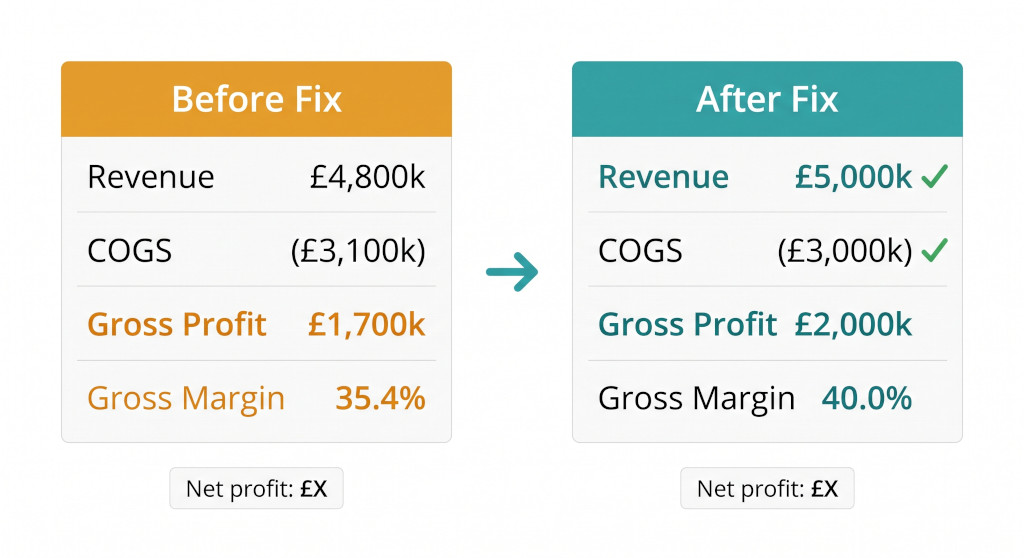
Fixing a mapping error involves two actions: correcting the map going forward, and restating any periods that were produced using the wrong map.
The map correction is a configuration change — updating the mapping table so that account 4350 now maps to “Revenue” and account 6210 now maps to “IT & technology expenses” within Operating expenses. Once the map is corrected, any future consolidation run will produce the right output automatically.
The restatement covers the three months since Subsidiary C was onboarded. For each affected period, the consolidation must be re-run with the corrected map, or manual reclassification journals must be posted to move the misclassified amounts to the correct lines. If the consolidation tool supports map versioning and period re-run, this is straightforward. If it does not, reclassification journals are the practical alternative:
| Account | Dr | Cr |
|---|---|---|
| Other income (consolidated P&L — current period) | £200,000 | |
| Revenue — Implementation fees (consolidated P&L) | £200,000 |
Reclassifies Subsidiary C’s implementation fees from “Other income” to “Revenue” for the current period. Repeat for each prior period affected by the mapping error. No net P&L impact — this is a classification correction only.
| Account | Dr | Cr |
|---|---|---|
| IT & technology expenses — Operating expenses (consolidated P&L) | £100,000 | |
| Cost of Sales (consolidated P&L) | £100,000 |
Reclassifies Subsidiary C’s hosting costs from “Cost of Sales” to “IT & technology expenses” within Operating expenses. Again, no net P&L impact — gross profit increases by £100,000, operating expenses increase by £100,000, operating profit is unchanged.
Where the affected periods have already been presented to the board or filed externally, the materiality of the mapping error determines whether a formal restatement is required. A mapping error that shifts £300,000 per month from the correct classification to an incorrect one is likely material to gross margin reporting and should be restated, with a brief note to the board explaining the nature of the correction. Because the net profit is unaffected, the error will not trigger a restatement of any filed statutory accounts — but management accounts, board packs, and covenant compliance reports based on gross margin should all be updated.
Structural Fixes: Preventing Mapping Errors From Recurring
The root cause of Subsidiary C’s mapping errors was that the account map was set up by the entity’s own finance manager rather than by the group finance team. The entity finance manager was familiar with the entity’s accounts but had never worked with the group’s CCOA before. They made reasonable-looking guesses about which CCOA line each account belonged to, but guessed wrong on two accounts that were ambiguously named.
Three structural changes can prevent this from recurring. First, account maps for new entities should always be reviewed by the group finance team, not just the entity, before the first consolidation is run. The group team understands the CCOA structure and can spot classification errors that are invisible to someone who has never used the group P&L format.
Second, the group should maintain a mapping policy document that defines, for each CCOA line, what types of costs and revenues should be mapped to it. Without written guidance on what belongs in “Cost of Sales” versus “Operating expenses,” different people setting up different entity maps will inevitably make inconsistent choices. The design principles behind the CCOA — which the CCOA design guide covers in detail — should inform explicit mapping rules that are shared with all entity finance teams.
Third, a mapping audit should be part of the new-entity onboarding checklist, run before the first live consolidation and again at the first month-end after onboarding. The audit compares the mapped consolidated output for the new entity against the entity’s own trial balance, line by line, to confirm that each material account has been classified correctly. Any account where the entity description does not obviously match the CCOA line it has been mapped to should be flagged for review.
The Ongoing Map Maintenance Problem
Even a correctly set-up account map can degrade over time. Entities add new account codes. Staff change, and the finance manager who understood the mapping rationale leaves. An entity restructures its P&L and moves costs between accounts without telling the group. An acquisition brings in a new set of accounts that look superficially similar to existing ones but cover different things.
The most reliable way to catch mapping drift before it reaches the board pack is to build a monthly mapping review into the group close process. This does not require a line-by-line audit every month — it requires a review of any new account codes that appeared in the current period’s trial balances and have not yet been mapped, plus a check of any accounts where the balance has moved significantly and the CCOA classification seems inconsistent with that movement. A systematic monthly check takes twenty minutes and prevents the kind of three-month accumulation that Dan discovered.
An account map is not a one-time configuration. It is a live document that reflects the accounting structure of every entity in the group. Treat it like any other control that requires periodic review — not like a setup task that is done once and forgotten.
Account Mapping Audit Checklist
- Run a mapping completeness check before every consolidation. Confirm that every account code with a balance in the current period has been mapped to a CCOA line. Unmapped accounts either drop out of the consolidation entirely or flow to an “unclassified” catch-all — both outcomes are wrong.
- Review all new account codes introduced since the last period. Any new code added to an entity’s chart of accounts in the current period is unmapped by default. Identify the new codes, classify each one per the mapping policy, and add the mapping before running the consolidation.
- For new entities, audit the full account map before the first live consolidation. Run a dry consolidation of the new entity’s trial balance and compare the consolidated output line by line against the entity’s own P&L. Investigate any line where the CCOA classification does not match the account description.
- Flag accounts where the entity description and CCOA line do not obviously align. “Software and hosting” mapped to “Cost of Sales,” “Consulting fees” mapped to “Other income,” “Depreciation — vehicles” mapped to “Revenue” — any description/classification mismatch should be reviewed before it reaches the board pack.
- Compare consolidated gross margin trend against entity-level gross margins. If the consolidated gross margin moves in a direction that no individual entity’s margin explains, the mapping is the first place to investigate — not entity trading performance.
- When a mapping error is found, check the entire map for the affected entity. Mapping errors rarely occur in isolation. If one account is wrong, review all accounts for the same entity before closing the investigation.
- Restate affected prior periods when a material mapping error is corrected. Identify every period that was consolidated using the wrong map. Re-run the consolidation with the corrected map, or post reclassification journals, and update any board packs, covenant reports, or management accounts based on the affected line items.
- Document the mapping rationale for ambiguous accounts. For any account where the CCOA classification requires judgement — where reasonable people could disagree about whether a cost is “Cost of Sales” or “Operating expenses” — record the rationale in the mapping notes. This prevents the classification from being changed inadvertently when a new finance manager reviews the map.
One consolidated P&L, correctly classified, every month
BrizoConsol maps every entity’s accounts to your group chart of accounts, flags unmapped codes automatically, and maintains a full audit trail of every mapping change — so your consolidated gross margin is always right. Start Free Trial