Three Consolidation Problems That Only Exist When Your Factory Is in a Different Currency
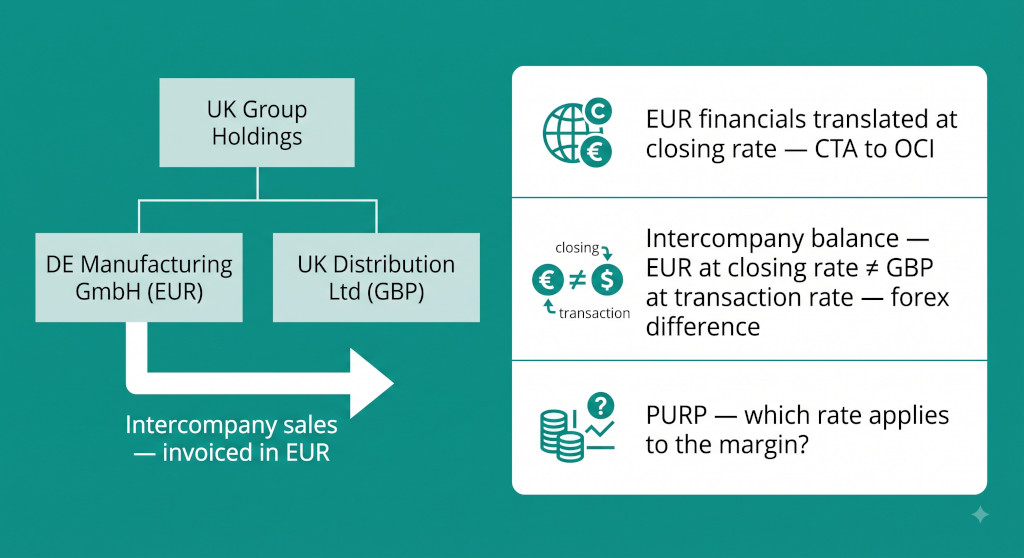
The finance director had consolidated the UK group’s two domestic subsidiaries without difficulty every quarter for years. When the board acquired a manufacturing facility in Germany, the consolidation suddenly produced numbers nobody could fully explain. The German entity’s P&L had been translated and aggregated, an intercompany elimination had been posted — but there was a small forex difference sitting in a suspense account that nobody had signed off, the group’s unrealised profit provision didn’t look right, and a balance had appeared in OCI that the board was asking questions about.
None of these problems existed before the German acquisition. All three arose purely at the consolidation stage — they were invisible in every entity’s individual accounts, and they could not be resolved by the German or UK finance teams working in isolation. They were consolidation problems in the strictest sense: issues that exist only because two entities with different functional currencies are being combined into a single set of group accounts.
When a manufacturing group has a foreign-currency production entity supplying a domestic distribution entity, three distinct consolidation mechanics collide simultaneously. Each is manageable on its own. The difficulty is that they interact — and understanding how they interact is what separates a clean group close from one that produces unexplained residuals every period.
Stop building consolidations in spreadsheets.
BrizoConsol automates multi-entity consolidation — setup in minutes, reports the same day.
Setting Up the Example
UK Group Holdings Ltd is the parent. DE Manufacturing GmbH has a EUR functional currency and sells finished goods to UK Distribution Ltd, which has a GBP functional currency. The group presents its consolidated accounts in GBP. The key exchange rates for the period are:
| Rate | EUR : GBP |
|---|---|
| Opening rate (1 Jan) | 0.86 |
| Average rate (for the year) | 0.85 |
| Transaction rate (when goods were invoiced — mid-year) | 0.84 |
| Closing rate (31 Dec) | 0.83 |
DE Manufacturing sold goods to UK Distribution invoiced at €1,000,000 during the year. UK Distribution recorded the purchase at the transaction date rate: £840,000. At year-end, UK Distribution holds €150,000 worth of goods (at transfer price) still unsold in closing stock — recorded in its books at £126,000 (at the transaction date rate). DE Manufacturing’s production cost for the full year’s intercompany sales was €800,000, giving a 20% margin on EUR cost (20/120 margin fraction on the invoice price).
Problem One: Translating DE Manufacturing’s Financials
Under IAS 21, DE Manufacturing’s financial statements are translated into GBP using these rules: P&L items at the average rate for the period; assets and liabilities at the closing rate; share capital and pre-acquisition reserves at historical rates; and the resulting translation difference goes to other comprehensive income (OCI) as the cumulative translation adjustment (CTA).
DE Manufacturing’s P&L in EUR and GBP after translation:
| P&L item | EUR | Rate | GBP |
|---|---|---|---|
| Intercompany revenue | €1,000,000 | 0.85 (avg) | £850,000 |
| Cost of sales | €(800,000) | 0.85 (avg) | £(680,000) |
| Gross profit | €200,000 | £170,000 |
DE Manufacturing’s intercompany receivable on the balance sheet at year-end:
| Intercompany receivable (DE Manufacturing) in EUR | €120,000 |
| Translated at closing rate (0.83) | £99,600 |
This is the first consolidation-only number: £99,600 is the GBP equivalent of DE Manufacturing’s intercompany receivable. It did not exist in that form in any entity’s books — it is the product of the IAS 21 translation applied at consolidation.
The IAS 21 translation produces a CTA for the year — the balancing figure that absorbs the difference between translating the P&L at average rate and the balance sheet at closing rate. This CTA sits in OCI, not in the consolidated P&L. It is not a gain or loss — it is a translation arithmetic difference that will reverse when DE Manufacturing is eventually disposed of. This is why the board sees a number in OCI they didn’t see before the German acquisition: it is structural, not an error.
Problem Two: The Intercompany Balance Forex Mismatch
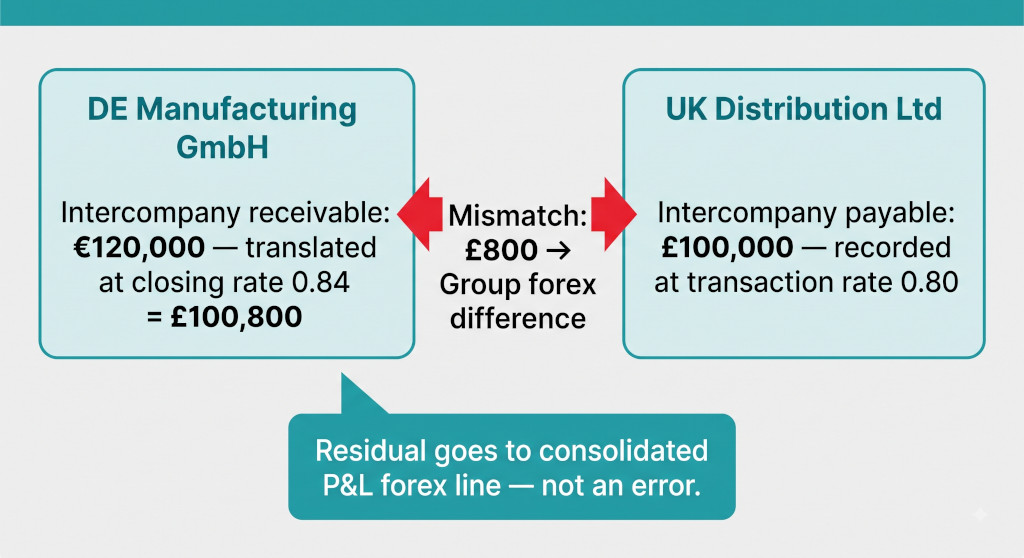
Now the intercompany elimination. UK Distribution’s payable to DE Manufacturing was recorded at the transaction date rate of 0.84: £100,800 (€120,000 × 0.84). DE Manufacturing’s receivable, after IAS 21 translation at the closing rate of 0.83, is £99,600. These two numbers — both representing the same €120,000 intercompany balance — are not equal in GBP.
| DE Manufacturing receivable (€120,000 × 0.83 closing rate) | £99,600 |
| UK Distribution payable (€120,000 × 0.84 transaction rate) | £100,800 |
| Mismatch to account for | £1,200 |
This £1,200 difference is not an error. It is a real foreign exchange difference — the movement in the EUR/GBP rate between the transaction date (when UK Distribution recorded the payable at 0.84) and the year-end (when DE Manufacturing’s receivable translates at 0.83). The elimination journal removes both balances but cannot make them equal — the residual is posted to the consolidated forex line in the P&L.
| Account | Dr | Cr |
|---|---|---|
| Intercompany payable (UK Distribution) | £100,800 | |
| Intercompany receivable (DE Manufacturing — translated) | £99,600 | |
| Foreign exchange gain (consolidated P&L) | £1,200 |
Eliminates the intercompany balance. The £1,200 credit to forex arises because GBP strengthened against EUR between the transaction date and year-end — UK Distribution’s GBP payable is larger than DE Manufacturing’s translated receivable. The forex gain is a genuine group-level outcome: the group effectively “won” on the currency movement between invoicing and year-end.
This forex residual belongs in the consolidated P&L, not in a suspense account. It is the most commonly mishandled element of multi-currency intercompany eliminations. Some consolidators try to force-match the two balances by adjusting one entity’s figures — which is wrong. Others park the difference in a suspense account indefinitely — which is also wrong. The difference is a real foreign exchange outcome, and it must be recognised in the group’s forex line for the period.
Problem Three: The PURP Calculation Breaks Across Currencies
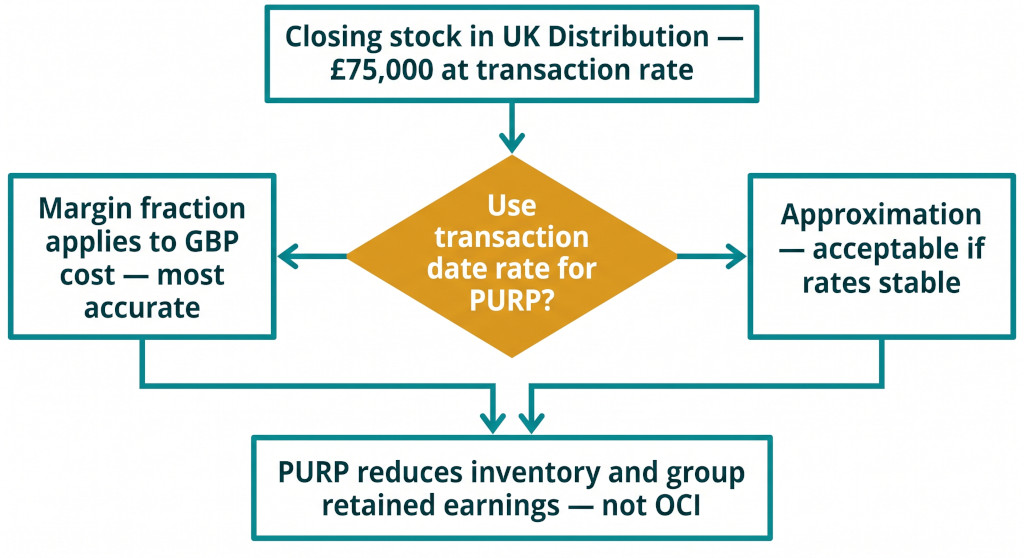
UK Distribution holds £126,000 of intercompany goods in closing stock, recorded at the transaction date rate (0.84) when the goods were purchased. These goods were manufactured by DE Manufacturing at a EUR cost of €105,000, giving a transfer price of €126,000 (20% margin on EUR cost, or 20/120 margin fraction on the invoice price).
To calculate the unrealised profit provision (PURP), you need to establish how much of the £126,000 closing stock value represents margin rather than production cost. The margin in this transaction originated in euros — DE Manufacturing earned it in EUR. But the closing stock is now sitting in UK Distribution’s GBP books.
The correct approach is to apply the margin fraction to the GBP closing stock value — because that is the value that appears in the consolidated balance sheet and that needs to be reduced to the group’s cost:
| Closing stock in UK Distribution (at transaction date rate) | £126,000 |
| Margin fraction (20 ÷ 120) | 16.67% |
| PURP — unrealised profit in GBP closing stock | £21,000 |
The PURP journal reduces UK Distribution’s inventory and increases the consolidated cost of sales:
| Account | Dr | Cr |
|---|---|---|
| Cost of sales (consolidated P&L) | £21,000 | |
| Inventory (UK Distribution) | £21,000 |
Eliminates the unrealised profit embedded in UK Distribution’s closing stock. After this journal, closing inventory is carried at the group’s cost — the GBP equivalent of DE Manufacturing’s EUR production cost (£105,000 × 0.84 = £88,200, the remaining £16,800 being the eliminated margin at transaction rate).
Why the PURP does not go to OCI
A common question is whether the PURP on foreign currency intercompany stock should be split between the P&L and OCI — since exchange movements on the EUR-denominated goods are normally a translation matter. The answer is no. The PURP is an elimination of unrealised profit, not a currency translation adjustment. It goes entirely to the consolidated P&L (as an increase in cost of sales), and the exchange element is already handled by the IAS 21 translation of DE Manufacturing’s financials and the forex difference on the intercompany balance. Routing any part of the PURP to OCI would double-count the currency element.
Putting the Three Problems Together: The Consolidated P&L Effect
It helps to see how the three adjustments land in the consolidated accounts once all the working has been done. Before any consolidation adjustments, the aggregated P&L includes DE Manufacturing’s translated revenue of £850,000 and UK Distribution’s cost of sales that includes £840,000 of intercompany purchases (at transaction rate). After the standard intercompany elimination, those cancel. What remains is purely the group’s trading with external parties. Then the PURP and forex adjustments sit on top:
| Consolidation adjustment | P&L impact | Balance sheet impact | OCI impact |
|---|---|---|---|
| IAS 21 translation of DE Manufacturing | — | Assets/liabilities at closing rate | CTA (balancing figure) |
| Intercompany revenue / cost elimination | −£850,000 revenue / −£840,000 cost | — | — |
| Intercompany balance elimination + forex | +£1,200 forex gain | Receivable and payable removed | — |
| PURP on closing stock | −£21,000 cost of sales | Inventory reduced by £21,000 | — |
| Net P&L effect of all three adjustments | £(10,000 + forex + PURP net) | Clean group position | CTA in OCI |
Multi-currency manufacturing group? Your consolidation needs more than a spreadsheet.
BrizoConsol handles IAS 21 translation, intercompany eliminations, and forex residuals across all your entities automatically — so your overseas factory doesn’t mean a week of manual reconciliation at every close.See It In Action
The CTA: What Goes Into OCI and Why
The IAS 21 translation produces a cumulative translation adjustment (CTA) for the year. This is the balancing figure that absorbs all the arithmetic differences between translating P&L items at average rate and balance sheet items at closing rate. In a year where EUR weakened against GBP (the closing rate moved from 0.86 to 0.83), DE Manufacturing’s net assets are worth fewer pounds at the year-end than at the start — and that reduction is the CTA.
The CTA is not a P&L item — it sits in OCI and accumulates in the CTA reserve. It will remain there until DE Manufacturing is disposed of, at which point the accumulated CTA is recycled through the P&L as part of the disposal gain or loss. This is the correct treatment under IAS 21 and IFRS 10: currency movements on the net investment in a foreign operation are not income or expense of the period — they are a consequence of holding an asset denominated in a foreign currency, and their recognition in profit or loss is deferred until the investment is realised.
For a detailed breakdown of how the CTA is calculated and tracked period by period across a multi-currency group, the worked examples in How to Calculate the Cumulative Translation Adjustment (CTA) in Group Consolidation cover the mechanics in full.
What Changes When the Transfer Price Is in GBP Instead of EUR
Some manufacturing groups denominate their intercompany invoices in the parent currency (GBP) rather than the manufacturing entity’s functional currency. If DE Manufacturing invoices UK Distribution in GBP, the intercompany payable in UK Distribution is already in GBP — no translation is needed on that side — and there is no forex mismatch at year-end on the intercompany balance. The PURP calculation is also simpler, because the closing stock is already at a GBP transfer price with a GBP margin fraction.
The trade-off is that DE Manufacturing now holds a GBP-denominated receivable in its EUR books. Under IAS 21, that monetary asset is a foreign currency item in DE Manufacturing’s individual accounts — it must be retranslated at the closing rate, and the resulting exchange difference goes to DE Manufacturing’s own P&L (not OCI, because this is a transaction-level forex movement in the entity’s own accounts, not a translation of its net assets). That forex movement in DE Manufacturing then flows into the consolidated P&L through the aggregation of entity results.
Neither approach is universally correct — both are permitted under IAS 21. The choice affects where the forex exposure sits (entity P&L vs. consolidation residual) and which team manages it. What matters is consistency: the same invoicing currency convention applied to all intercompany transactions between the same pair of entities, period after period.
Practical Checklist for Multi-Currency Manufacturing Group Consolidation
- Translate the foreign manufacturing subsidiary’s P&L at the average rate for the period and its balance sheet at the closing rate. Calculate the CTA as the balancing figure and post it to OCI.
- Identify the intercompany trading balance on both sides — the translated receivable in the manufacturing entity (at closing rate after IAS 21 translation) and the payable in the distribution entity (at the transaction date rate it was originally recorded at).
- Post the intercompany balance elimination and route the residual forex difference to the consolidated P&L forex line. Do not force-match the two balances or park the difference in suspense.
- Eliminate the intercompany revenue and cost — manufacturing entity’s revenue (translated at average rate) against distribution entity’s cost of goods sold (at transaction date rate). The mismatch between these two GBP figures is a further forex element that also belongs in the consolidated forex line.
- Calculate the PURP on the distribution entity’s closing stock using the GBP closing stock value and the margin fraction applicable to the intercompany transfer price. The PURP goes to the consolidated P&L cost of sales — not to OCI.
- Confirm the OCI line contains only the CTA from the IAS 21 translation. The forex mismatch on the intercompany balance and the PURP are both P&L items.
- At the opening of the next period, reverse the prior PURP and calculate a new closing PURP based on the updated closing stock balance and the rates applicable at the new period end.
- Document the exchange rates used — average, closing, and transaction date — in the consolidation workings. These are the rates that will be tested by auditors and must be consistently applied period to period.
The three problems described here — IAS 21 translation, intercompany balance forex mismatch, and PURP across currencies — each have straightforward solutions. The difficulty is that they must be performed in the right sequence, using consistent exchange rates, and with a clear understanding of what goes to P&L, what goes to OCI, and what is simply eliminated. Groups that get this right at the first close after an overseas acquisition rarely struggle with it again. Groups that get it wrong tend to accumulate unexplained residuals that grow every period until someone finally maps the mechanics from first principles.
For the broader framework of how multi-currency subsidiaries are translated and their net assets carried in the consolidated balance sheet, Currency Translation Under IAS 21, ASC 830 and FRS 102 covers the standard-by-standard comparison. And for the intercompany elimination mechanics in a single-currency manufacturing group, the PURP walkthrough in Financial Consolidation for Manufacturing Groups provides the foundation.
Stop rebuilding your multi-currency consolidation from scratch every quarter
BrizoConsol handles IAS 21 translation, intercompany eliminations, and CTA tracking across all your entities — so your overseas manufacturing subsidiary adds capability, not close complexity. Start Free Trial