Partially Disposing of an Associate: How to Calculate the Gain, Adjust the Carrying Value, and Handle a Drop Below Significant Influence
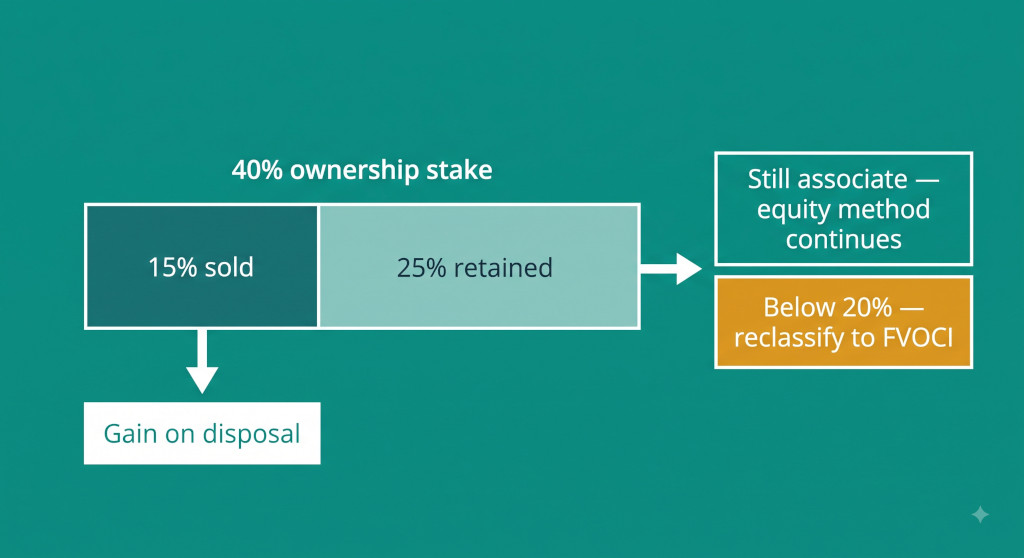
David is group FD at a holding company that has held a 40% stake in TechAssoc Ltd for four years. The investment has been accounted for under the equity method throughout, and the carrying value has grown steadily as TechAssoc has posted consistent profits. A third-party buyer has now approached the group and offered to acquire a 15% stake at an attractive price. The board has approved the sale. The group will retain the remaining 25%, which still constitutes significant influence.
David knows he needs to derecognise part of the investment and recognise a gain. What he is less sure about is the exact mechanics: how to calculate what proportion of the carrying value to derecognise, where the gain lands in the P&L, and what the investment account looks like the morning after the disposal completes. He is also aware that if the group had sold a larger stake — dropping below 20% — the accounting would have looked quite different.
This post works through both scenarios in full: a partial disposal that retains significant influence, and a disposal that causes significant influence to be lost. Both involve precise sequencing that trips up many finance teams.
Stop building consolidations in spreadsheets.
BrizoConsol automates multi-entity consolidation — setup in minutes, reports the same day.
Before the Disposal: Complete the Equity Pickup to the Disposal Date
The first step is one that is easily skipped but must not be. Before recording the disposal, the equity pickup must be brought up to date to the date of the transaction. The carrying value of the investment used in the disposal calculation must reflect the group’s share of any profits, losses, dividends, or other comprehensive income earned by the associate from the start of the period to the disposal date.
If TechAssoc’s year runs to December and the disposal completes on 30 September, the group must calculate nine months of equity pickup and post it before computing the gain. Using a stale year-end carrying value as the starting point produces an incorrect gain figure.
Common mistake: Groups sometimes calculate the gain on disposal using the carrying value at the most recent year-end without first updating for the current-period equity pickup to the transaction date. This understates the carrying value of the disposed portion, and therefore overstates the gain. Auditors will request evidence that the carrying value at disposal date is current.
For the purposes of this example, assume the equity pickup to disposal date has already been processed and the carrying value of the 40% investment in TechAssoc Ltd is £800,000 at the point of disposal.
Calculating the Gain on Partial Disposal
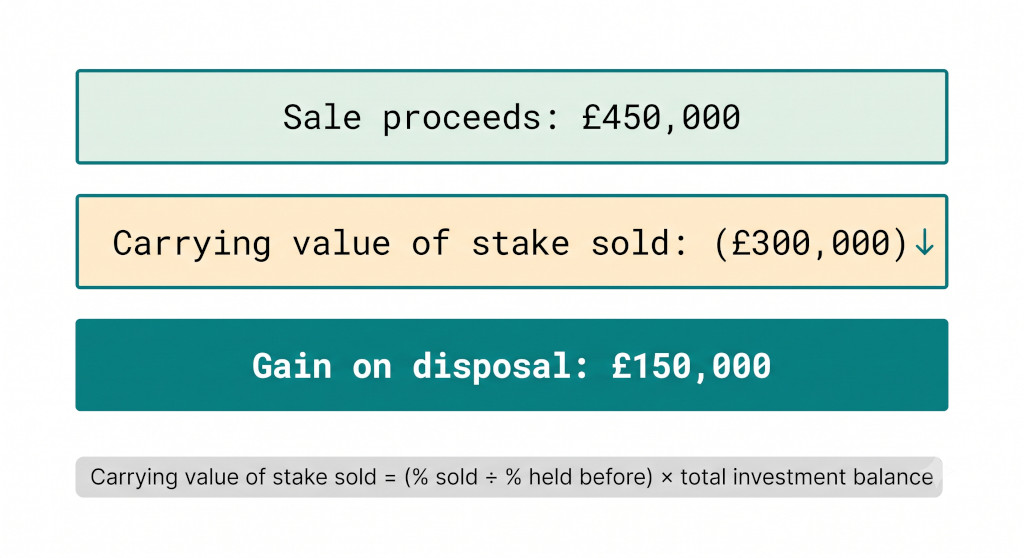
The gain is the difference between the proceeds received and the carrying amount of the portion of the investment derecognised. The portion derecognised is calculated by reference to the fraction of the total stake being sold.
David’s group is selling 15% of a 40% stake, so the fraction being disposed of is 15/40 = 37.5%. Applied to the total carrying value of £800,000, the carrying amount of the stake being sold is:
| Total carrying value of investment before disposal | £800,000 |
| Fraction disposed (15% sold ÷ 40% held) | 37.5% |
| Carrying value of stake disposed | £300,000 |
| Sale proceeds received | £450,000 |
| Gain on partial disposal | £150,000 |
The journal entry to record the disposal:
| Account | Dr | Cr |
|---|---|---|
| Cash / Receivable (sale proceeds) | £450,000 | |
| Investment in TechAssoc Ltd | £300,000 | |
| P&L — Gain on partial disposal of associate | £150,000 |
Derecognises 37.5% (15/40) of the carrying value. Remaining carrying value: £800,000 − £300,000 = £500,000, representing the retained 25% stake. Equity method continues on the retained stake.
Carrying the Retained Stake Forward
After the disposal, the group holds a 25% stake in TechAssoc with a carrying value of £500,000. The equity method continues without interruption, because 25% still confers significant influence. The carrying value does not need to be rebased or remeasured — it is simply the residual of the pre-disposal investment balance after derecognising the disposed portion.
From the disposal date onward, the equity pickup is calculated on 25% of TechAssoc’s profits, not 40%. If the disposal occurs partway through the year, the annual equity pickup is split: 40% for the pre-disposal period, 25% for the post-disposal period. This is typically presented as a blended figure in the P&L rather than two separate line items, but the underlying workpapers should show the split clearly.
The FV schedule — maintained to track fair value uplifts and embedded goodwill at acquisition — does not need to change in structure, but the annual amortisation charges must be recalculated to reflect the reduced ownership percentage from the disposal date. If the group originally amortised £7,000 per year based on 40%, the post-disposal charge is 25/40 × £7,000 = £4,375. Update the schedule at the time of disposal.
When You Drop Below Significant Influence
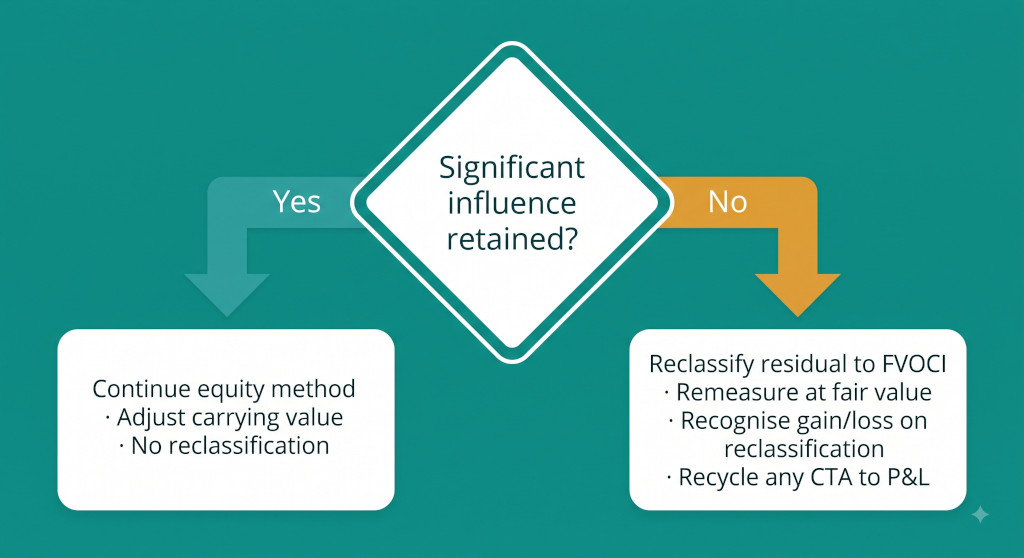
The accounting changes fundamentally if the disposal causes the group to lose significant influence — typically when the retained stake falls below 20%, or where other facts and circumstances indicate influence no longer exists despite a holding above that threshold.
IAS 28 paragraph 22 is explicit: when the equity method is discontinued because significant influence is lost, the group remeasures the retained interest at fair value at the date significant influence is lost. That fair value becomes the new cost basis for the retained interest, which is then classified and accounted for under IFRS 9 — typically as a financial asset measured at fair value through other comprehensive income (FVOCI) or, in some cases, fair value through profit or loss (FVTPL).
The gain or loss on losing significant influence is calculated in two parts and recognised entirely in P&L on the date of disposal:
| Sale proceeds on the portion disposed | £600,000 |
| Fair value of retained interest at disposal date | £320,000 |
| Total consideration (proceeds + FV of retained interest) | £920,000 |
| Less: total carrying value of investment before disposal | (£800,000) |
| Total gain recognised in P&L on loss of significant influence | £120,000 |
In this scenario, the group sells 30% of the 40% stake (leaving 10%), receiving £600,000. The fair value of the retained 10% stake at disposal date is independently assessed at £320,000. The journal entries are:
| Account | Dr | Cr |
|---|---|---|
| Cash / Receivable (sale proceeds on 30% disposed) | £600,000 | |
| Financial asset — TechAssoc Ltd (FVOCI, at fair value) | £320,000 | |
| Investment in TechAssoc Ltd (equity method, derecognised) | £800,000 | |
| P&L — Gain on disposal / loss of significant influence | £120,000 |
Full derecognition of equity method investment. Retained 10% stake recognised at fair value (£320,000) as the new cost basis under IFRS 9. Total gain £120,000 = (£600,000 proceeds + £320,000 FV of residual) − £800,000 carrying value.
Going forward, the 10% stake is measured at fair value under IFRS 9. Changes in fair value flow to OCI if the FVOCI election has been made (which is irrevocable), or to P&L if classified as FVTPL. The group no longer applies the equity method and no longer picks up a share of TechAssoc’s profits or losses.
Recycling the CTA on Loss of Significant Influence
Where the associate reports in a foreign currency, a cumulative translation adjustment (CTA) will have accumulated in OCI over the life of the equity method investment, representing the group’s share of exchange differences on the associate’s net assets. When significant influence is lost, IAS 21 paragraph 48C requires that the accumulated CTA attributable to the associate be reclassified from OCI to P&L as part of the gain or loss on disposal.
This recycling is often forgotten because the CTA balance sits quietly in equity and is not part of the equity method carrying value. But it forms part of the total return on the investment, and its release to P&L on disposal is mandatory. The journal is:
| Account | Dr | Cr |
|---|---|---|
| Foreign currency translation reserve (OCI) — associate | £XX | |
| P&L — Gain / (loss) on disposal of associate | £XX |
Recycles the cumulative CTA attributable to the associate from OCI to P&L on loss of significant influence. Where the CTA balance is a debit (cumulative loss), the entry is reversed and reduces the gain on disposal.
Partial disposals where significant influence is retained do not trigger CTA recycling — the investment continues under the equity method and the CTA continues to accumulate in OCI. Recycling only occurs on full disposal or on the event that causes the equity method to be discontinued.
Managing multiple associate disposals this year-end?
BrizoConsol tracks equity method investment balances, FV amortisation schedules, and CTA allocations so your disposal calculations are accurate and reconcilable from day one.See It In Action
Partial Disposal Where Significant Influence Was Never Held
One related scenario worth addressing: where the group has been accounting for a stake under IFRS 9 (say, a 15% holding) and makes an additional purchase to reach 25%, acquiring significant influence for the first time. This is the mirror image of what is described above — a step acquisition rather than a step disposal.
On the date significant influence is acquired, the previously held interest is remeasured to fair value, and any gain or loss on that remeasurement is recognised in P&L. The equity method then commences on the full combined stake (both the newly acquired shares and the pre-existing holding), with the cost of the investment being the fair value of the pre-existing stake plus the cost of the newly acquired shares. This is sometimes called a deemed disposal of the IFRS 9 asset and re-acquisition at fair value.
This scenario is the subject of a dedicated post in this series. The mechanics of step acquisitions and first-time equity method adoption are covered in full there, including the fair value exercise required at the point of transition.
FRS 102 Position
The principles under FRS 102 section 14 are broadly consistent with IAS 28 on partial disposals — the group derecognises the proportionate carrying value, recognises the gain or loss in P&L, and continues the equity method on the retained stake if significant influence is maintained. Where significant influence is lost, the retained stake is reclassified as a financial asset under FRS 102 section 11 or 12, and measured at cost less impairment (for unlisted investments) or at fair value. There is no FVOCI election in FRS 102 — the classification depends on the nature of the instrument and whether a reliable fair value is available.
CTA recycling on disposal follows a similar logic under FRS 102 section 30, with exchange differences attributable to the associate reclassified from the translation reserve to P&L when significant influence is lost. The mechanics are the same; the journal structure is identical.
Practical Checklist: Partial Disposal of an Associate Stake
- Update the equity pickup to the disposal date. Calculate and post the share of profits, losses, and OCI from the start of the period to the exact date of disposal. The carrying value used in the gain calculation must be current as of the transaction date, not the prior year-end.
- Determine whether significant influence is retained after disposal. Consider both the quantitative threshold (20% presumption) and qualitative factors — board representation, participation in policy decisions, material transactions with the associate. Document your conclusion.
- Calculate the fraction of the investment being derecognised. This is always the percentage sold divided by the percentage held before disposal (e.g. selling 15% from a 40% stake = 15/40 = 37.5% of the carrying value).
- Compute the gain on disposal. Proceeds minus carrying value of the derecognised portion. Where significant influence is lost, the total consideration also includes the fair value of the retained interest at disposal date.
- Post the disposal journal. Debit cash for proceeds, credit the investment for the derecognised carrying value, credit P&L for the gain (or debit for a loss). Where significant influence is lost, simultaneously debit the new IFRS 9 financial asset at fair value.
- Check for CTA recycling. If the associate reports in a foreign currency, locate the cumulative CTA balance attributable to it in OCI. On loss of significant influence, recycle it to P&L. On a partial disposal with retained significant influence, no recycling occurs.
- Update the FV amortisation schedule. Reduce the annual FV amortisation charges proportionately from the disposal date to reflect the reduced ownership percentage. Ensure the embedded goodwill balance is also reduced pro-rata.
- Split the current-year equity pickup in the P&L note. Disclose the pre-disposal pickup (at the higher ownership %) and the post-disposal pickup (at the lower %) separately, or reconcile the blended figure clearly in the workpapers.
- Reassess impairment on the retained interest. The disposal event is often an indicator worth considering — if the group is selling because the investment is underperforming, an impairment test on the retained carrying value may be warranted regardless of whether significant influence is retained.
Partial disposals attract close auditor scrutiny because they involve both a derecognition calculation and a gain recognition, and because the gain figure is often material. The carrying value at disposal date is the number that drives everything — and that number is only correct if the equity pickup to the transaction date has been posted first. Getting the sequencing right is as important as getting the arithmetic right.
For the full picture of how the equity method is applied from acquisition through to full disposal, the other posts in this series cover equity method fundamentals, fair value adjustments at acquisition, loss suspension, and unrealised profit eliminations. For how acquisition accounting works when you move from associate to full control, see our guide to acquisition accounting under IFRS 3.
Ready to take the complexity out of associate accounting?
BrizoConsol manages equity method investments end-to-end — from acquisition date FV schedules through to partial disposal gain calculations — as part of your group consolidation workflow. Start Free Trial