Best Intercompany Elimination Software in 2026: BrizoConsol, BlackLine, Joiin, Reach Reporting, and Konsolidator Compared
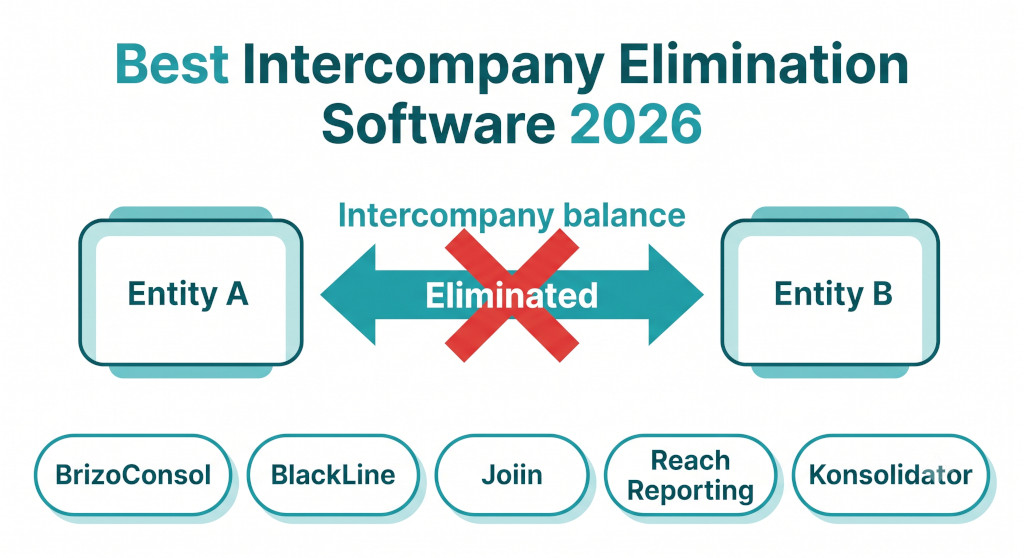
Intercompany elimination is one of the most technically precise requirements in group accounting — and also one of the most ambiguous terms in the software market. Buyers searching for “intercompany elimination software” may be looking for tools that manage intercompany transactions during the period, tools that produce elimination journal entries at period-end consolidation, or tools that net intercompany balances in a management report. These are three meaningfully different problems, and the five tools in this comparison address different points on that spectrum.
This comparison covers BrizoConsol, BlackLine, Joiin, Reach Reporting, and Konsolidator — across the questions that actually matter for a group finance team: what type of elimination does the tool handle, how much is automated, is there an audit trail, and what does it cost.
⚡ Quick Reference — Top Picks by Use Case
Selections are based on the evaluation criteria outlined below.
Intercompany eliminations without the manual work.
BrizoConsol identifies and eliminates intercompany balances automatically at consolidation.
- Best for enterprise intercompany transaction management: BlackLine
- Best for automated consolidation-layer eliminations: BrizoConsol
- Best for statutory eliminations at an accessible price: Konsolidator
- Best for management reporting with basic eliminations: Joiin
- Best for client report packs with intercompany netting: Reach Reporting
Three Tiers of Intercompany Elimination
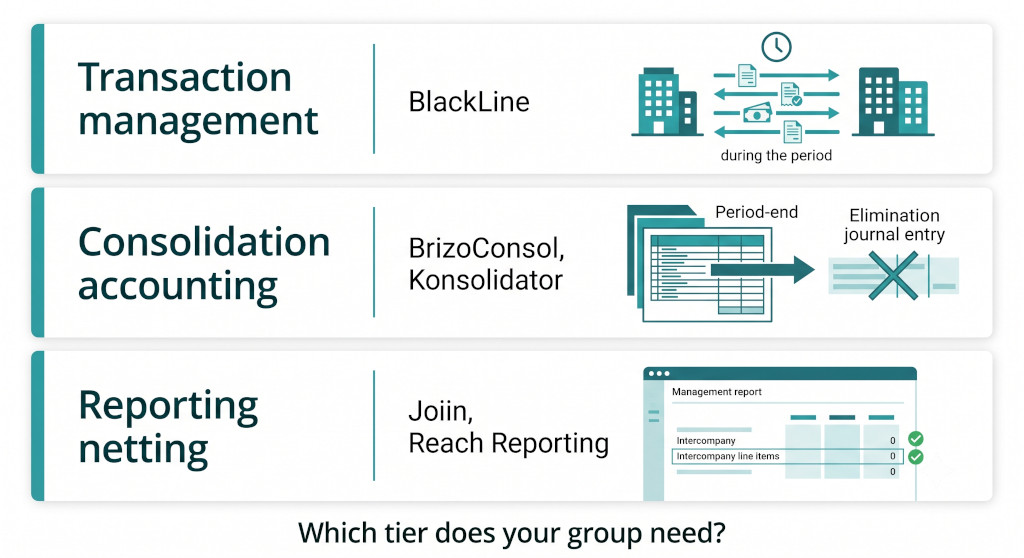
| Tier | Focus | When it runs | Tools in this comparison |
|---|---|---|---|
| 1 — Transaction management | Create, approve, net, and settle intercompany transactions; resolve discrepancies before close | Throughout the accounting period | BlackLine |
| 2 — Consolidation accounting | Produce elimination journal entries with GAAP-specific treatment as part of the statutory consolidation run | At period-end consolidation | BrizoConsol, Konsolidator |
| 3 — Reporting netting | Net intercompany balances in the consolidated management report output | At report generation | Joiin, Reach Reporting |
Before comparing tools, it is useful to understand what distinguishes each tier:
Tier 1 — Transaction management (during the period). At this tier, the focus is on managing intercompany transactions as they occur — creating intercompany agreements, routing approvals, matching positions between entity pairs, and resolving discrepancies before the period closes. BlackLine’s Intercompany Hub operates at this tier. The goal is to ensure that by the time the period ends, Entity A and Entity B agree on the balance between them.
Tier 2 — Consolidation accounting (at period-end). At this tier, the focus is on producing the elimination journal entries that remove intercompany balances from the consolidated financial statements. Intercompany revenue and the corresponding cost, intercompany receivables and payables, and unrealised profits on intragroup transactions all need to be eliminated before the consolidated accounts can be presented. BrizoConsol and Konsolidator operate primarily at this tier.
Tier 3 — Reporting netting (in the management report). At this tier, the tool matches intercompany accounts across entities and nets them out in the consolidated management report. The output is a cleaner management view, but the process typically does not produce auditable elimination journal entries with GAAP-specific treatment. Joiin and Reach Reporting provide intercompany elimination at this tier.
Many groups need all three approaches — but they may not need all three from a single tool. Understanding which problem is most urgent narrows the comparison significantly. Groups with a discrepancy problem during the period look at transaction management software. Groups with a statutory consolidation problem at period-end look at consolidation-layer tools. Groups producing management accounts and not yet concerned with statutory compliance may find reporting-layer software sufficient for now.
Scope of This Comparison
These five tools were selected to cover the full range of approaches to intercompany elimination accessible to mid-market groups and accounting firms — from enterprise transaction management through to budget statutory consolidation. Tools not covered here include SAP Financial Consolidation, Oracle FCCS, OneStream, and NetSuite’s Automated Intercompany Management, which are designed for large enterprise structures with dedicated finance-systems administration teams, ERP-centric data models, and implementation budgets typically above the mid-market range. Dedicated intercompany transaction platforms such as Trintech’s Cadency are also outside the scope of this comparison. Buyers evaluating for enterprise-scale requirements — groups significantly above 20 entities, or organisations running SAP or Oracle as their core ERP — should include those platforms in a parallel shortlist.
How We Evaluated These Tools
We evaluated each tool against seven criteria relevant to groups managing intercompany balances across multiple entities. Assessment draws on publicly available vendor documentation, official pricing pages, G2 and SoftwareAdvice aggregate user ratings, product demonstrations where available, and consolidation-specific functionality relevant to group finance teams and accounting firms:
| Criterion | What we looked at |
|---|---|
| Elimination tier | Whether the tool addresses transaction management (Tier 1), consolidation journal entry production (Tier 2), or management report netting (Tier 3) — or a combination |
| Automation | How much of the identification, matching, and posting of intercompany eliminations is automated versus requiring manual setup or review |
| Discrepancy handling | What happens when two entities disagree on the intercompany balance — whether the tool surfaces mismatches, routes them for resolution, or requires manual reconciliation |
| Audit trail | Whether elimination entries are traceable — with supporting detail showing which accounts were matched, what journal entries were produced, and who approved them |
| GAAP treatment | Whether the elimination process applies standard-specific rules (IFRS 10, ASC 810) or performs generic account netting without GAAP awareness |
| Source system integration | Which accounting platforms the tool connects to natively, and whether intercompany positions are pulled automatically or require manual data export |
| Pricing | Whether pricing is published and predictable; how it scales with entity count, user count, or transaction volume |
Pricing figures are based on publicly available pricing information at the time of publication.
Comparison at a Glance
| Tool | Elimination tier | Automation | Audit trail | GAAP treatment | Source integration | Best for | Pricing |
|---|---|---|---|---|---|---|---|
| BrizoConsol | Tier 2 — consolidation journal entries | Automated detection and posting (BrizoElim); manual override available | ✅ Full audit trail per elimination entry | ✅ IFRS, US GAAP, UK GAAP, SFRS (Pro plan) | Xero, QuickBooks, MYOB, Zoho Books — native sync | SME groups and accounting firms, 3–20 entities | From $15/entity/month (Standard); $35 (Pro) [1] |
| BlackLine | Tier 1 — intercompany transaction management + elimination | Automated matching, netting, and settlement; elimination entry production | ✅ Enterprise-grade audit trail | ✅ Multi-GAAP enterprise configuration | ERP connectors (SAP, Oracle, and others) | Large enterprises, multi-entity global structures | Custom enterprise pricing; no public list price |
| Joiin | Reporting netting; elimination journals available; reporting-layer audit trail | Elimination journals configured per entity pair; largely automated in reporting | ⚠️ Reporting-layer output; limited journal audit trail | ⚠️ Framework-agnostic netting | Xero, QuickBooks, Sage, spreadsheets — native sync | SME groups; management accounts | From $23/month; volume pricing for 100+ companies |
| Reach Reporting | Tier 3 — reporting netting; eliminations available | Multi-company consolidation includes intercompany elimination settings | ⚠️ Report-layer output; not a consolidation journal audit trail | ⚠️ Framework-agnostic netting | QuickBooks, Xero, Sage, others — native sync | Accounting firms; client report packs | From USD 149/month [3] |
| Konsolidator | Tier 2 — statutory consolidation elimination entries | Automated statutory elimination including minority interests | ✅ Audit-compliant output | ✅ GAAP and IFRS compliance focus | Xero, Sage, QuickBooks (native 1-click sync); file import for any other ERP or accounting system | SME to mid-market; statutory consolidation | From €200/month; unlimited users [4] |
BrizoConsol
Best for: SME groups and accounting firms needing automated consolidation-layer intercompany eliminations with GAAP-specific treatment
Consolidation-layer elimination built into the core consolidation engine — intercompany balances are identified and eliminated as part of every consolidation run.
Strengths
- BrizoElim automated elimination engine detects intercompany balances across entity pairs and posts elimination journal entries as part of each consolidation run — no manual matching step required for confirmed account pairs
- Manual elimination override available for complex or non-standard intercompany transactions (management fees, dividend eliminations, unrealised profit on intragroup stock)
- Full audit trail per elimination entry — each adjustment is traceable with supporting detail visible in the Eliminations & Journals report
- GAAP-specific elimination treatment available on the Pro plan: IFRS, US GAAP, UK GAAP (FRS 102), and SFRS — per entity configuration
- Native integrations with Xero, QuickBooks, MYOB, and Zoho Books — intercompany positions are pulled directly from source accounting systems rather than requiring manual export
- Designed for groups of 3–20 entities; accounting firms can manage multiple client group structures under one account [5]
Limitations
- Standard plan covers single-currency consolidation with basic intercompany eliminations; GAAP-specific treatment, multi-currency eliminations with CTA, and NCI require the Pro plan [1]
- Does not address Tier 1 intercompany transaction management — groups with discrepancies arising during the period (Entity A and Entity B disagree on the balance) need to resolve those outside BrizoConsol before consolidation runs
- Direct ERP connectors not available; cloud accounting platform integrations only
- Designed for groups up to approximately 20 entities; larger enterprise structures may require a platform with more configuration depth
Pricing: from $15/entity/month — Standard; $35/entity/month — Pro [1]
BrizoConsol handles intercompany elimination at the consolidation accounting layer — the elimination journal entries are produced as part of the consolidation run, with a traceable audit trail, rather than being applied only to a management report view. This means the elimination is part of the same dataset as the consolidated P&L, balance sheet, and cash flow statement, rather than a report-layer overlay applied on top of uneliminated numbers.
BrizoConsol is not the right fit for every group. Consider alternatives if: the group runs SAP, Oracle, or another ERP not on the supported list (Xero, QuickBooks, MYOB, Zoho Books); intercompany discrepancies routinely arise during the period because Entity A and Entity B disagree on balances before close — BlackLine addresses that upstream problem better; the group has more than approximately 20 entities at enterprise scale with dedicated finance-systems administrators; or the primary output needed is a polished management report pack rather than a statutory consolidated account with an elimination journal audit trail — Joiin or Reach Reporting may be faster and more cost-effective for that deliverable.
BlackLine
Best for: large enterprises managing high volumes of intercompany transactions across complex global structures, with discrepancy resolution before period-end
An enterprise financial close platform with a dedicated Intercompany Hub — manages intercompany transactions, agreements, netting, and settlement during the period, and produces elimination entries at close.
Strengths
- Intercompany Hub manages the full lifecycle of intercompany transactions — creation, posting, approval, netting, and settlement — meaning discrepancies are typically identified and resolved before the period closes rather than discovered during consolidation
- Automated matching of intercompany positions across entity pairs; exceptions are surfaced for resolution with full supporting documentation
- Trade and non-trade transaction coverage; handles intercompany loan interest, management fees, dividends, and intragroup sales with tax defensibility features [6]
- Enterprise-grade audit trail across the full intercompany lifecycle, not just the elimination entry
- G2 rating: 4.5/5 from 1,102 verified reviews [7]
- Connects to major ERP systems (SAP, Oracle, and others); suited to organisations running complex ERP landscapes
Limitations
- No public list price; BlackLine requires a direct quote. Third-party procurement benchmark data suggests average contracts around $77,000 per year with a wide range ($17,500–$340,000), and the Intercompany Hub specifically at $50,000–$200,000 annually depending on transaction volume and entity count — these are benchmark estimates only and should be verified with BlackLine directly [2]
- Steep learning curve and dependence on implementation partners are commonly noted across user reviews; realising the platform’s full value requires dedicated internal resource for configuration and maintenance, with implementation timelines measured in months [7]
- Not designed for accounting firms managing separate client group structures; primarily for single-organisation enterprise finance teams
- Not a standalone consolidation tool — BlackLine’s consolidation module is separate from the Intercompany Hub and may require additional licensing
Pricing: custom enterprise contract; no public list price — contact BlackLine directly for a quote
BlackLine operates at a different tier than the other tools in this comparison. Its Intercompany Hub is designed to prevent intercompany discrepancies from reaching consolidation by managing the transactions during the period — creating a centralised process for intercompany agreement, approval, netting, and settlement. For large enterprises where the root cause of elimination complexity is disagreement between entity pairs during the period, BlackLine addresses the problem upstream. For groups where the primary need is producing elimination journal entries with GAAP-specific treatment at period-end consolidation, BlackLine’s intercompany module is one part of a broader platform that may exceed the actual scope of the requirement. For enterprise finance teams with the scale, ERP infrastructure, and implementation resource to deploy it, BlackLine is a well-established platform in this category with 1,102 G2 reviews and a strong track record in enterprise financial close.
Joiin
Best for: accounting firms and SME groups needing intercompany elimination in consolidated management accounts from Xero, QuickBooks, or Sage
Multi-entity consolidation and reporting with intercompany elimination journals — designed for management accounts and group dashboards rather than statutory consolidation.
Strengths
- Intercompany elimination journals can be configured per entity pair — identified intercompany accounts are netted out in the consolidated management report
- Fast setup — connects to Xero, QuickBooks, Sage, and spreadsheets; elimination configuration typically completed within the setup day
- Multi-currency support with consolidation across different base currencies — relevant for groups with foreign subsidiaries
- Supports financial, sales, and KPI data in a single group view alongside the elimination layer
- Winner of the Xero Global App Awards 2025 — Small Business App of the Year (Canada) [9]; Intuit Platinum App Partner [10]
- G2 rating: 4.7/5 from 79 verified reviews [11]
Limitations
- Elimination operates at the reporting layer — the tool nets intercompany accounts in the consolidated management report view; groups requiring a distinct set of auditable elimination journal entries as part of their statutory accounting record should verify this capability directly with Joiin
- GAAP-specific elimination treatment (IFRS 10, ASC 810) is not a feature of the platform; elimination is framework-agnostic netting
- Groups with formal statutory consolidated account requirements — particularly where the auditor will review the elimination workings — should evaluate whether the elimination depth meets their obligations
- CTA and NCI mechanics are limited relative to Tier 2 consolidation tools
Pricing: from $23/month; volume pricing for 100+ companies; 14-day free trial
Joiin’s intercompany elimination is well-suited to accounting firms producing consolidated management accounts where the primary need is a clean group view without double-counting of intercompany transactions. The output is a management report that reflects the eliminations, well-suited to management accounts where report quality is the primary goal; groups with statutory audit requirements for intercompany elimination workings should confirm the tool’s capabilities directly with Joiin.
Reach Reporting
Best for: accounting firms producing client-facing group report packs that require intercompany balance netting as part of the consolidated view
A financial reporting platform with multi-company consolidation that includes intercompany elimination settings — primarily oriented around producing polished client-facing report packs.
Strengths
- Multi-company consolidation with intercompany elimination available — balances can be netted across entity pairs in the consolidated report output
- Filtering by company, class, or department allows the consolidated view to reflect the right scope at the right level
- Drag-and-drop report builder and client portal delivery make it well-suited to producing professional, branded report packs that include consolidated (eliminated) figures
- AI-enhanced analysis adds variance commentary to the consolidated output automatically
- G2 rating: 4.9/5 from 27 verified reviews [12]
- Starting at USD 149/month with all features included; pricing decreases per company at volume [3]
Limitations
- Intercompany elimination is a feature within a reporting platform, not the core function — the tool is primarily designed for report design and client delivery rather than the consolidation accounting mechanics
- The elimination process produces a cleaner consolidated report view oriented around report delivery; groups that require auditable elimination journal entries as part of their statutory accounting record should verify this capability directly with Reach Reporting
- Groups with formal statutory intercompany elimination requirements should evaluate whether the elimination depth satisfies their auditor’s expectations before relying on Reach Reporting as the system of record for eliminations
- Multi-dimensional reporting not available in the financial form spreadsheet module, as noted in user reviews [13]
Pricing: from USD 149/month; pricing decreases per company at volume [3]
Reach Reporting’s intercompany elimination capability fits naturally into its report-focused workflow — the elimination is one setting that produces a consolidated view ready for client presentation. For accounting firms whose primary deliverable is a professional report pack showing clean group figures, this is practical and sufficient. Groups with statutory audit requirements should verify whether Reach Reporting’s elimination workings meet their auditor’s specific expectations before relying on it as their primary elimination system.
Konsolidator
Best for: SME to mid-market groups needing GAAP/IFRS-compliant statutory elimination entries at an accessible price, without a live accounting system integration
A statutory consolidation platform where intercompany elimination — including minority interest elimination and currency effects — is a core automated function rather than a reporting overlay.
Strengths
- Automated intercompany elimination of actuals, budget, and forecast — elimination rules are defined once and applied across every consolidation run [4]
- Minority interest elimination included as standard — the elimination engine handles both full and partial ownership structures
- Designed around GAAP and IFRS statutory consolidation requirements; positioned for groups producing audit-compliant statutory accounts [4]
- Elimination entries form part of the statutory consolidation output, not a separate reporting layer
- SaaS model with unlimited users; no per-seat cost — straightforward to give audit teams or client contacts access
- Starts at €200/month — accessible price point for groups needing statutory elimination depth without an enterprise contract [4]
Limitations
- Native integration with Xero, Sage, and QuickBooks (1-click sync via Xero App Store); for entities on other systems — SAP, Oracle, Dynamics, legacy ERPs — elimination data is loaded via file import rather than live sync
- Intercompany transaction handling has been noted as an area for improvement by users with high intercompany transaction volumes [14]
- Reporting and visualisation layer is functional rather than client-presentation-ready; groups needing polished management dashboards typically connect Konsolidator output to a separate BI tool
- Does not address Tier 1 intercompany transaction management — discrepancies between entity pairs need to be resolved before data is imported
Pricing: from €200/month; unlimited users; free trial available [4]
Konsolidator’s elimination process is statutory-grade: the elimination journal entries are part of the consolidation output, with minority interest and currency effects handled within the same automated run. The limitation is the absence of live accounting platform integration — the group needs to export trial balances from each entity’s system and import them into Konsolidator, which adds a recurring manual step that the integration-first tools avoid.
Which Tool Is Right for Your Group?
| Buyer profile | Recommended tool | Why |
|---|---|---|
| Large enterprise with high intercompany transaction volumes and recurring entity-pair discrepancies before close | BlackLine | Intercompany Hub manages the transaction lifecycle during the period — discrepancies are identified and resolved upstream rather than discovered at consolidation |
| SME group or accounting firm needing automated consolidation-layer elimination with GAAP-specific treatment and native cloud accounting integration | BrizoConsol | BrizoElim produces elimination journal entries as part of the consolidation run, with a full audit trail; Pro plan adds GAAP-specific treatment and multi-currency elimination |
| Mid-market group needing GAAP/IFRS-compliant statutory elimination entries without live cloud accounting integration | Konsolidator | Statutory elimination at €200/month with unlimited users; automated including minority interests; supports audit-compliant output from imported trial balance data |
| Accounting firm producing consolidated management accounts from Xero, QuickBooks, or Sage with intercompany netting | Joiin | Fast setup; elimination journals per entity pair; well-suited to management account workflows where the primary output is a clean group view rather than a statutory account |
| Accounting firm producing client-facing group report packs with intercompany balances netted in the presentation | Reach Reporting | Elimination available within the consolidation settings; report design and client portal delivery are well-suited to this specific deliverable |
Where Competitors Have an Edge Over BrizoConsol
Where BlackLine is stronger. For groups where intercompany discrepancies arise during the period — Entity A records a management fee that Entity B has not yet posted, or loan interest calculations differ between entity books — BlackLine’s Intercompany Hub resolves those disagreements before the period closes. BrizoConsol’s elimination engine assumes the entities have agreed on their intercompany positions before the consolidation run; it automates the elimination entry but does not manage the upstream transaction lifecycle. For large enterprise structures running SAP or Oracle with high intercompany transaction volumes, BlackLine’s ERP connectivity and enterprise-grade workflow automation also make it significantly better suited to that infrastructure. BlackLine’s audit trail spans the full transaction lifecycle — creation through to settlement — rather than covering only the period-end elimination step.
Where Konsolidator is stronger. Konsolidator’s flat monthly pricing can become more cost-effective than BrizoConsol’s Pro plan as entity count increases. Its source system compatibility is also broader than BrizoConsol’s: while Konsolidator integrates natively with Xero, Sage, and QuickBooks (as BrizoConsol does with Xero and QuickBooks), it additionally accepts trial balance file imports from SAP, Oracle, Dynamics, and any other ERP — meaning groups with mixed-system structures, including entities on platforms BrizoConsol does not connect to, can still use Konsolidator for their statutory consolidation. Groups that have already invested in a BI tool for dashboards and need only the statutory consolidation and elimination output may also find Konsolidator’s focused scope a better fit.
How to Choose Intercompany Elimination Software
✅ Buyer Evaluation Checklist
- Identify your primary problem. Are intercompany discrepancies arising during the period (transaction management software — BlackLine) or at period-end consolidation (consolidation-layer tools — BrizoConsol, Konsolidator), or is the need primarily to present clean figures in a management report (reporting-layer software — Joiin, Reach Reporting)?
- Determine whether an audit trail is required. If an auditor will review the intercompany elimination workings, you need a tool that produces auditable elimination journal entries as part of the accounting record — not a reporting-layer netting that produces a clean report view. BrizoConsol, BlackLine, and Konsolidator provide this at different price points.
- Check whether GAAP-specific elimination treatment is needed. IFRS 10 and ASC 810 have specific requirements for how intercompany eliminations are treated. Framework-agnostic netting tools do not apply standard-specific rules. If your group has formal statutory obligations under a specific standard, confirm the tool applies that standard’s elimination requirements.
- Map your entities to their accounting platforms. BrizoConsol, Joiin, and Reach Reporting integrate natively with Xero, QuickBooks, Sage, and similar platforms. Konsolidator integrates natively with Xero, Sage, and QuickBooks, and accepts file imports from any other system. BlackLine connects via ERP connectors. Confirm your platforms are supported before shortlisting.
- Set your budget and entity count. Pricing ranges from $23/month (Joiin, reporting-layer) to $149/month (Reach Reporting, reporting-layer) to $15–$35/entity/month (BrizoConsol, consolidation-layer) to €200/month (Konsolidator, consolidation-layer) to enterprise/custom pricing (BlackLine Intercompany Hub, transaction management — no public list price; see the BlackLine section above for third-party benchmark context). The approach largely determines the cost range.
Common implementation mistakes: Choosing a reporting-layer tool when the requirement is an auditable consolidation-layer elimination journal (the report will look right but the elimination workings will not satisfy a statutory audit); choosing BlackLine’s Intercompany Hub when the primary need is period-end consolidation elimination rather than transaction management during the period (the scope and cost may exceed the actual requirement); assuming that any tool connecting to Xero or QuickBooks automatically produces intercompany elimination journal entries with GAAP-specific treatment (connection to source systems and GAAP-aware consolidation are different capabilities).
Frequently Asked Questions
What is intercompany elimination software?
Intercompany elimination software handles the process of removing intercompany balances from a group’s consolidated financial statements — preventing double-counting of transactions between entities under common control. The term covers three distinct types of tools: those that manage intercompany transactions during the accounting period (transaction management), those that produce elimination journal entries at period-end consolidation (consolidation accounting tools), and those that net intercompany accounts in a management report (reporting aggregators). The appropriate tool depends on which of these three problems is the primary one to solve.
What is the difference between BlackLine and BrizoConsol for intercompany elimination?
BlackLine’s Intercompany Hub is primarily a transaction management tool — it manages the lifecycle of intercompany transactions during the period, ensuring Entity A and Entity B agree on the balance before the period closes. BrizoConsol’s intercompany elimination (BrizoElim) operates at the consolidation accounting layer — it produces elimination journal entries at period-end as part of the consolidation run, with GAAP-specific treatment and a full audit trail. The two tools address different parts of the intercompany process and are not direct substitutes: BlackLine is suited to large enterprises with high transaction volumes and ERP-based data; BrizoConsol is suited to SME groups and accounting firms using cloud accounting platforms and needing consolidation-layer elimination.
Do Joiin and Reach Reporting produce auditable intercompany elimination journal entries?
Joiin and Reach Reporting both offer intercompany elimination as part of their multi-company consolidation features — intercompany accounts are matched and netted in the consolidated report output. This produces a cleaner management view oriented around report delivery; whether the tool generates auditable elimination journal entries that satisfy statutory audit requirements should be confirmed directly with each vendor. Groups with formal audit requirements for their consolidated accounts should evaluate whether this level of elimination meets their auditor’s expectations before relying on either tool as the system of record for intercompany eliminations.
How much does intercompany elimination software cost?
Pricing varies significantly by approach. Reporting-layer tools: Joiin from $23/month, Reach Reporting from USD 149/month. Consolidation-layer tools: BrizoConsol from $15/entity/month (Standard, basic eliminations) or $35/entity/month (Pro, GAAP-specific and multi-currency eliminations); Konsolidator from €200/month with unlimited users. Enterprise transaction management: BlackLine requires a direct quote — no public list price is published; third-party benchmark context is included in the BlackLine section of this article. Verify current pricing directly with each vendor before making procurement decisions.
Which intercompany elimination software integrates with Xero or QuickBooks?
BrizoConsol integrates natively with Xero, QuickBooks, MYOB, and Zoho Books — intercompany positions are pulled directly from source accounting systems. Joiin and Reach Reporting both integrate natively with Xero and QuickBooks, as well as Sage. Konsolidator integrates natively with Xero, Sage, and QuickBooks via 1-click sync (Xero App Store), and also accepts trial balance file imports from any other accounting system or ERP. BlackLine connects via ERP connectors suited to enterprise systems such as SAP and Oracle rather than cloud accounting platforms.
Conclusion
The most useful thing this comparison can establish is that “intercompany elimination software” describes tools operating at three different layers of the finance process. BlackLine addresses the problem at the transaction level — before the period closes, during the accounting lifecycle. BrizoConsol and Konsolidator address it at the consolidation accounting layer — producing GAAP-aware elimination journal entries as part of the statutory consolidation run. Joiin and Reach Reporting address it at the reporting layer — producing a consolidated management view where intercompany balances are netted out of the presentation.
The right tool depends on which problem needs solving first. For groups where discrepancies between entity pairs are the primary issue, the answer is upstream in the transaction management layer. For groups where the primary need is producing audit-ready consolidated accounts, the answer is in the consolidation accounting layer. For groups whose current requirement is simply a clean management report without double-counting, the reporting-layer tools are a practical and cost-effective starting point.
Sources
- BrizoConsol Pricing Page — brizoconsol.com/pricing/ (Standard: $15/entity/month — single-currency, basic eliminations; Pro: $35/entity/month — multi-currency, CTA, all GAAP standards, NCI, budgeting)
- Numeric.io, “BlackLine Review: Features, Pricing & Alternatives” — numeric.io/blog/blackline-review (contracts average ~$77K/year, range $17,500–$340,000; Intercompany Hub $50K–$200K/year per VendorBenchmark data)
- Reach Reporting, “Limelight vs. Reach Reporting” — reachreporting.com/blog/limelight (pricing from USD 149/month, all features included)
- Konsolidator on G2 / Sourceforge — sourceforge.net/software/product/Konsolidator/ (from €200/month; unlimited users; elimination of actuals, budget, and forecast; minority interests and currency translation included)
- BrizoConsol FAQ — brizoconsol.com/faq/ (designed for groups of 3–20 entities; accounting firms can manage multiple client structures)
- BlackLine press release via StockTitan, November 2023 — stocktitan.net (BlackLine Intercompany adds trade management capabilities covering both trade and non-trade transactions)
- Numeric.io, “BlackLine Review”, citing G2 aggregate data — numeric.io/blog/blackline-review (G2: 4.5/5, ~1,088 verified reviews; steep learning curve and heavy onboarding noted)
- BlackLine Intercompany Financial Management product page — blackline.com/products/intercompany-financial-management/ (product overview covering transaction creation, netting, settlement, and elimination capabilities for enterprise and midsize customers)
- EINPresswire, “Joiin Wins FinTech of the Year at the Tech South West Awards 2025”, 26 November 2025 — einpresswire.com (Winner, Xero Global App Awards 2025 — Small Business App of the Year, Canada)
- EINPresswire via CBInsights, “Joiin Recognised as Platinum Partner in Intuit’s App Program”, 24 February 2026 — cbinsights.com/company/joiin
- G2, Joiin product page — g2.com (4.7/5, 79 verified reviews)
- G2, Reach Reporting product page — g2.com (4.9/5, 27 verified reviews)
- SoftwareAdvice user reviews for Reach Reporting — softwareadvice.com (multi-dimensional reporting limitation in financial form spreadsheet module)
- SoftwareAdvice user reviews for Konsolidator — softwareadvice.com (intercompany section improvement noted by users with high transaction volumes)
Managing intercompany eliminations across a multi-entity group?
BrizoConsol’s automated elimination engine (BrizoElim) detects and eliminates intercompany balances as part of every consolidation run — with a full audit trail, GAAP-specific treatment on the Pro plan, and native integration with Xero, QuickBooks, MYOB, and Zoho Books. See It in Action