Consolidating an LLP Into a Corporate Group: The Three Questions Your Standard Consolidation Pack Doesn’t Answer
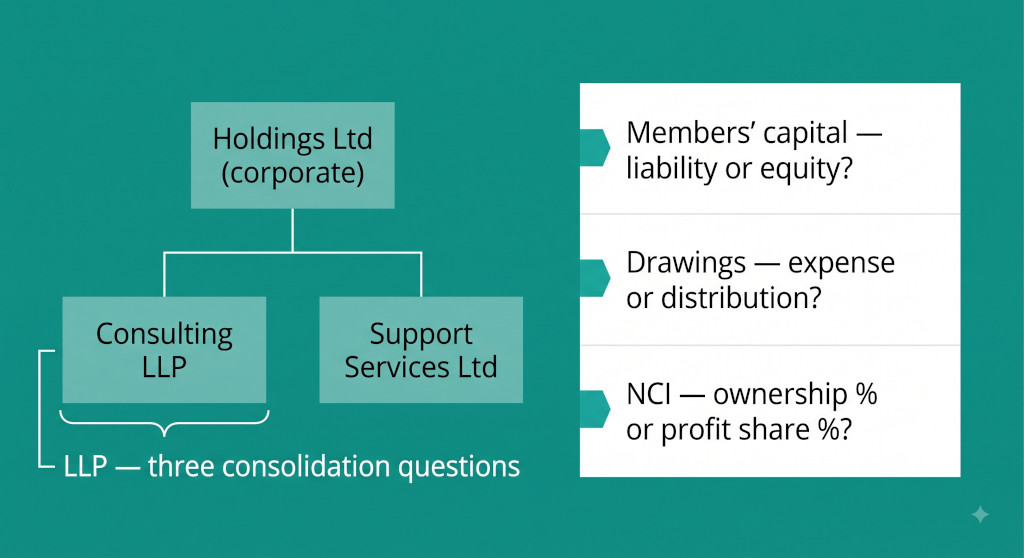
When the group financial controller of a professional services holding company set up the consolidation for the first time after the practice restructured from a pure partnership into a corporate group, she used the standard consolidation template she had always used for the Ltd subsidiaries. It did not take long for things to look wrong. The LLP’s balance sheet had a large “members’ capital” line in equity — but she was not sure whether that should sit in equity or liabilities in the group accounts. The LLP’s P&L showed profit for the year, but most of it had already been distributed to members as drawings during the year. And the group’s NCI calculation was producing a number that bore no relation to any ownership percentage she could identify.
All three problems had the same root cause: the LLP structure does not map cleanly onto the corporate group consolidation framework. The standard machinery of IFRS 10 consolidation — aggregate equity, calculate NCI as a percentage of net assets, treat distributions as movements in equity — was designed around companies. An LLP has members rather than shareholders, capital accounts rather than share capital, drawings rather than dividends, and profit-sharing ratios rather than ownership percentages. At entity level the LLP’s accounts are internally consistent. At consolidation level, the group accountant must resolve three questions that simply do not arise with corporate subsidiaries.
Why LLPs Are Common in Professional Services Groups
The limited liability partnership structure is the preferred vehicle for professional services firms in the UK for a combination of regulatory, tax, and cultural reasons. Law firms, accountancy practices, architecture studios, management consulting partnerships, and surveying firms routinely operate as LLPs. When these businesses grow, attract external capital, or are acquired, they often sit beneath a corporate holding company — creating exactly the mixed-structure group that produces the consolidation questions described here.
Stop building consolidations in spreadsheets.
BrizoConsol automates multi-entity consolidation — setup in minutes, reports the same day.
In a typical professional services group structure, Holdings Ltd (a company) controls Consulting LLP (the operating practice) and perhaps one or two other subsidiary companies (for support functions, property, or international operations). The LLP generates most of the group’s revenue and profit. The corporate subsidiaries are simpler to consolidate. The LLP is not.
IFRS 10 applies to LLPs in the same way as to companies — if the corporate parent controls the LLP (has power over it, exposure to variable returns, and the ability to use that power to affect those returns), it must consolidate it. Control of an LLP is typically established through the members’ agreement, which grants Holdings Ltd the right to appoint the designated members or to direct the LLP’s relevant activities. The consolidation obligation is clear; what is less clear is how to execute it correctly.
Question One: Are Members’ Capital Accounts Equity or Liability?
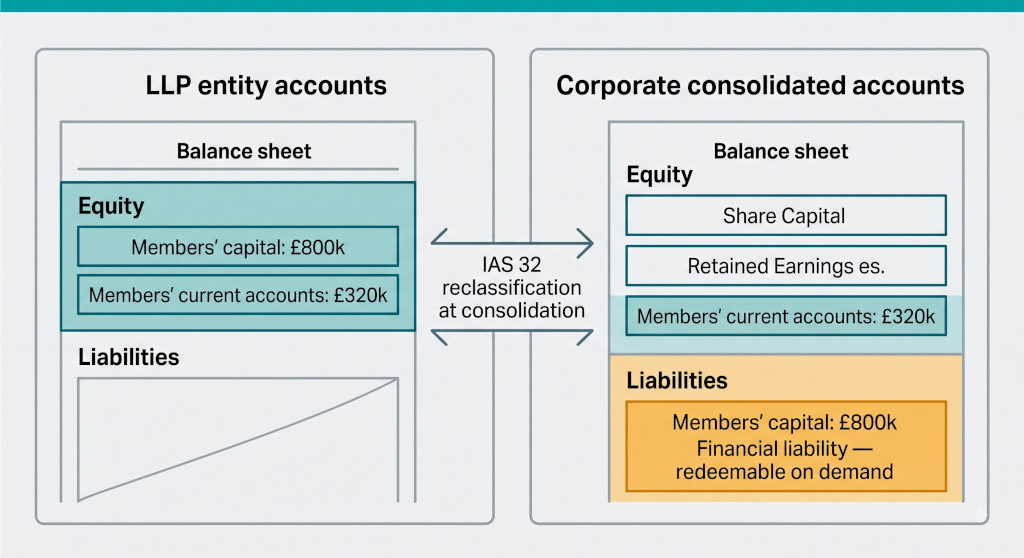
In the LLP’s own accounts, members’ capital is presented in the equity section — because in the LLP’s own framework, members are the owners and their capital represents their economic interest in the entity. At group level, however, the classification of members’ capital must be reassessed under IAS 32, which governs whether financial instruments are classified as equity or as financial liabilities in a set of IFRS financial statements.
Under IAS 32, an instrument is a financial liability if the issuer has a contractual obligation to deliver cash or another financial asset to the holder. The critical question for LLP members’ capital is: can a member demand repayment of their capital? In most LLP members’ agreements, a member can give notice of resignation and is entitled to receive back their capital account balance on departure. This creates a contractual obligation on the LLP to deliver cash — which means the capital balance is a financial liability under IAS 32, not equity.
The consolidation consequence is significant. Members’ capital that qualifies as a financial liability must be reclassified out of equity and into liabilities in the consolidated balance sheet. This reduces consolidated equity and increases consolidated liabilities — often materially, since professional services LLPs typically carry substantial members’ capital relative to their asset base.
| Balance sheet item | LLP entity accounts | Corporate group — after IAS 32 assessment |
|---|---|---|
| Members’ capital (redeemable on resignation) | Equity — £800,000 | Financial liability — £800,000 |
| Members’ current accounts (profit allocation, not yet drawn) | Equity — £320,000 | Depends — see below |
| Unallocated retained profit | Equity — £0 (fully allocated) | Equity (group retained earnings) — £0 |
The reclassification journal at consolidation moves members’ capital from equity to liabilities:
| Account | Dr | Cr |
|---|---|---|
| Members’ capital — equity (LLP) | £800,000 | |
| Members’ capital — financial liability (consolidated balance sheet) | £800,000 |
Reclassification journal — moves members’ capital from the equity section to liabilities in the consolidated balance sheet, reflecting the IAS 32 assessment that the capital is redeemable on demand and therefore a financial liability. This journal exists only in the group workings; the LLP’s entity accounts are unchanged.
When members’ capital is equity
Not all LLP capital is automatically a financial liability. If the members’ agreement gives the LLP discretion over whether and when to repay capital — for example, if redemption requires unanimous member consent and there is no individual member right to demand repayment — the instrument may qualify as equity under IAS 32. The assessment is fact-specific and depends on the exact terms of the members’ agreement. Groups that are uncertain should take accounting advice on their specific LLP structure before the first consolidation, because the outcome materially changes the group’s debt and equity presentation.
Question Two: How Are Members’ Current Accounts Classified?
LLP members’ current accounts (also called profit share accounts or drawings accounts) accumulate the member’s share of profit for the year, less drawings taken during the year. At any point in time, a positive current account balance represents profit earned but not yet drawn — money the member is owed but has not yet taken in cash.
In the LLP’s entity accounts, these current accounts sit in equity. At group level, the classification again depends on whether the member has a contractual right to demand immediate payment. If a member can draw down their current account balance at will, the balance is a financial liability — the LLP has an obligation to pay it on demand. If drawings require approval by the designated members or are subject to liquidity constraints under the members’ agreement, the position is more nuanced and requires judgement.
In many professional services LLPs, members’ current accounts are effectively withdrawable on demand — the firm distributes profit regularly and members expect to receive it. In that case, both the capital accounts and the current accounts reclassify to liabilities at consolidation, and consolidated equity may be very small even if the LLP is a profitable, well-capitalised business.
The practical implication of reclassifying members’ capital as a liability is that profit allocated to members in the period is treated as an interest charge, not a distribution. In a corporate group, a subsidiary’s profit flows into consolidated retained earnings and any dividend paid to shareholders is shown as a movement in equity. In a consolidated LLP where members’ capital is a liability, the allocation of profit to members’ accounts is interest expense (payment on a financial liability) — it reduces consolidated profit, not consolidated equity. This can significantly reduce reported group profit relative to what the combined entity accounts suggest.
Question Three: How Is the NCI Calculated?
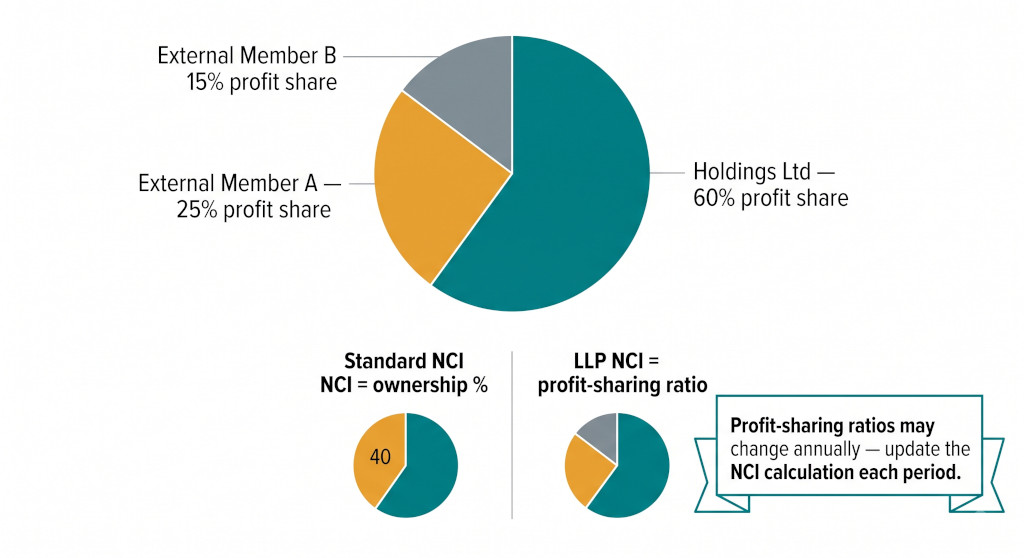
In a standard corporate subsidiary, the NCI is calculated as the minority shareholders’ percentage ownership of the subsidiary’s net assets and profit. If Holdings Ltd owns 70% of a subsidiary, the NCI is 30% of net assets and 30% of profit — straightforward.
In an LLP, there are no shares. There is no fixed ownership percentage. Instead, the members’ agreement specifies a profit-sharing ratio — the proportion of each year’s profit allocated to each member. Holdings Ltd, as a corporate member, will have a profit-sharing entitlement. The external individual members will share the remainder in proportions set out in the agreement.
The NCI equivalent in a consolidated LLP is not derived from ownership but from profit-sharing entitlement. If the members’ agreement allocates 60% of profit to Holdings Ltd, 25% to Partner A, and 15% to Partner B, then the external members’ aggregate entitlement is 40% — that is the NCI share for consolidation purposes. The NCI’s share of the LLP’s net assets and profit for the period uses that 40% figure, not any ownership percentage.
| Consulting LLP profit for the year | £1,200,000 |
| Holdings Ltd profit share (60%) | £720,000 |
| External members’ profit share (40% — NCI equivalent) | £480,000 |
| NCI share of profit included in consolidated P&L | £480,000 |
This NCI calculation must use the profit-sharing ratio in effect for the period — which may change annually. Many professional services LLPs revise their profit-sharing arrangements each year as partners join, retire, or are promoted. Each change in the profit-sharing ratio is a change in the effective NCI percentage, and the consolidated NCI calculation must be updated accordingly.
| Account | Dr | Cr |
|---|---|---|
| Consolidated profit attributable to parent | £720,000 | |
| NCI share of profit | £480,000 | |
| Consolidated profit for the year | £1,200,000 |
Allocation of consolidated LLP profit between Holdings Ltd and the NCI (external members). The NCI percentage is the external members’ aggregate profit-sharing entitlement (40%), not an ownership percentage. The NCI’s share is credited to the NCI reserve in consolidated equity (assuming members’ current accounts are classified as equity — see qualification above regarding liability classification).
Consolidating a mixed corporate and LLP group?
BrizoConsol handles multi-entity groups with different legal structures — post your policy alignment and reclassification journals alongside standard eliminations, and produce a consolidated set of accounts that correctly presents your LLP subsidiary.See It In Action
How Drawings Flow Through the Consolidated Accounts
In a corporate group, when a subsidiary pays a dividend to its parent, the dividend is eliminated on consolidation — it is a movement within the group, not a third-party transaction. When a subsidiary pays a dividend to a minority shareholder, it reduces the NCI balance in the consolidated equity.
In an LLP, members take drawings — cash withdrawals against their profit entitlement — rather than dividends. How drawings appear in the consolidated accounts depends entirely on the IAS 32 classification of the members’ accounts.
If members’ current accounts are classified as equity: drawings reduce the NCI balance in consolidated equity (for external member drawings) or reduce the parent’s investment (for Holdings Ltd’s drawings from the LLP). The mechanics are broadly similar to dividends from a minority-owned subsidiary.
If members’ current accounts are classified as financial liabilities: drawings are cash repayments of a liability. They do not affect consolidated profit or equity at all — they reduce the financial liability on the balance sheet and reduce cash. The allocation of profit to members’ accounts, which creates the liability in the first place, is the income statement event (treated as interest expense or as a charge against profit depending on the specific classification).
This distinction matters significantly for how the group’s cash flow statement presents payments to members. Under the liability classification, distributions to members appear as financing outflows (repayment of a financial liability). Under the equity classification, they appear as distributions to NCI — equity movements, not cash flow items.
The Invested Capital of Holdings Ltd in the LLP
Holdings Ltd, as a corporate member of the LLP, will have its own capital account in the LLP — its share of the LLP’s members’ capital. In the group consolidation, Holdings Ltd’s investment in the LLP (recorded at cost or equity method in Holdings Ltd’s own accounts) is eliminated against the LLP’s net assets in the standard consolidation elimination. Any difference between the cost of investment and the group’s share of the LLP’s net assets at the date Holdings Ltd acquired its membership interest is recognised as goodwill.
For LLPs that have always been part of the group from formation, this elimination is straightforward — the investment cost equals the capital contributed, and there is no goodwill. For LLPs that were acquired from external members, the acquisition accounting follows IFRS 3 in the same way as for a corporate acquisition, with the added complexity that the “shares” acquired are membership interests rather than ordinary shares, and the fair value of the LLP’s net assets at acquisition must take into account the IAS 32 classification of members’ capital.
Practical Illustration: The Full Consolidated Balance Sheet Position
To make the three questions concrete, consider how Consulting LLP’s balance sheet transforms at consolidation. The LLP’s entity accounts show:
| Consulting LLP — entity balance sheet | Amount |
|---|---|
| Net assets (trade debtors, WIP, less creditors) | £1,120,000 |
| Members’ capital accounts | £800,000 |
| Members’ current accounts (profit share less drawings) | £320,000 |
| Total members’ equity | £1,120,000 |
After the consolidation adjustments (assuming both capital and current accounts reclassify to liabilities under IAS 32):
| Consolidated balance sheet — Consulting LLP contribution | Amount |
|---|---|
| Net assets (unchanged) | £1,120,000 |
| Members’ capital — financial liability | £(800,000) |
| Members’ current accounts — financial liability | £(320,000) |
| Net contribution to consolidated equity | £0 |
The LLP contributes £0 to consolidated equity — not because it is unprofitable, but because all of its net assets are funded by members’ capital that is a financial liability rather than equity. This is a common and often surprising outcome for groups consolidating a professional services LLP for the first time. The LLP may be highly profitable and cash-generative, but its equity as defined by IAS 32 is structurally zero or close to zero.
Practical Checklist for Consolidating an LLP Subsidiary
- Review the members’ agreement in detail before the first consolidation. Specifically, identify whether any member has the right to demand repayment of their capital account and current account balances — this drives the IAS 32 classification.
- Classify members’ capital accounts as financial liabilities or equity based on the IAS 32 assessment. Document the basis of classification clearly — the conclusion will be tested by auditors and must be supported by reference to the specific agreement terms.
- Classify members’ current accounts separately. Even where capital accounts are equity, current accounts may be liabilities if they are withdrawable on demand.
- Post the reclassification journal at each period end — moving the relevant balances from the LLP’s equity section to the consolidated liabilities. This is a consolidation-only journal; the LLP’s entity accounts are unchanged.
- Determine the NCI equivalent using the profit-sharing ratio in the members’ agreement for the period, not an ownership percentage. Obtain the current-year profit-sharing schedule from the LLP before each consolidation run.
- Update the NCI calculation when the profit-sharing ratio changes — which may be annually. A change in ratio mid-period requires a blended calculation for the affected period.
- Determine how drawings are presented in the consolidated cash flow statement — financing outflows (if members’ accounts are liabilities) or distributions to NCI (if equity). Apply consistently.
- Perform the standard investment elimination — eliminate Holdings Ltd’s investment in the LLP against the group’s share of the LLP’s net assets (after the IAS 32 reclassification). Recognise any difference as goodwill.
- Review the profit allocation treatment — if members’ accounts are financial liabilities, profit allocated to those accounts in the period may reduce consolidated profit (as a finance charge) rather than flowing through as a distribution in equity. Confirm the P&L presentation with the group’s auditors.
- Disclose the LLP structure clearly in the consolidated financial statements — the nature of the members’ interests, the basis of consolidation, and the IAS 32 classification conclusions should be transparent to readers of the accounts.
Consolidating an LLP into a corporate group is one of the more structurally unusual consolidation exercises a group accountant will encounter — not because the underlying business is complex, but because the legal entity form creates classification questions that the standard consolidation toolkit is not designed to answer automatically. Getting the IAS 32 assessment right, establishing the correct NCI basis, and understanding how drawings flow through the consolidated accounts are decisions that should be made at the first consolidation and documented in a way that carries through to every subsequent period.
For the broader context of how professional services group consolidations are structured — including intercompany eliminations, WIP consolidation, and multi-entity reporting — the practical guide in Financial Consolidation for Professional Services Groups sets out the overall framework.
Professional services group consolidation shouldn’t be a one-person puzzle
BrizoConsol brings your LLP and corporate entity accounts together in one place, lets you post classification and alignment journals alongside standard eliminations, and produces a consolidated set of accounts your auditors can follow — every period. Start Free Trial