Best Multi-Entity Consolidation Software in 2026: BrizoConsol, Oracle Cloud EPM, Joiin, Reach Reporting, and Konsolidator Compared
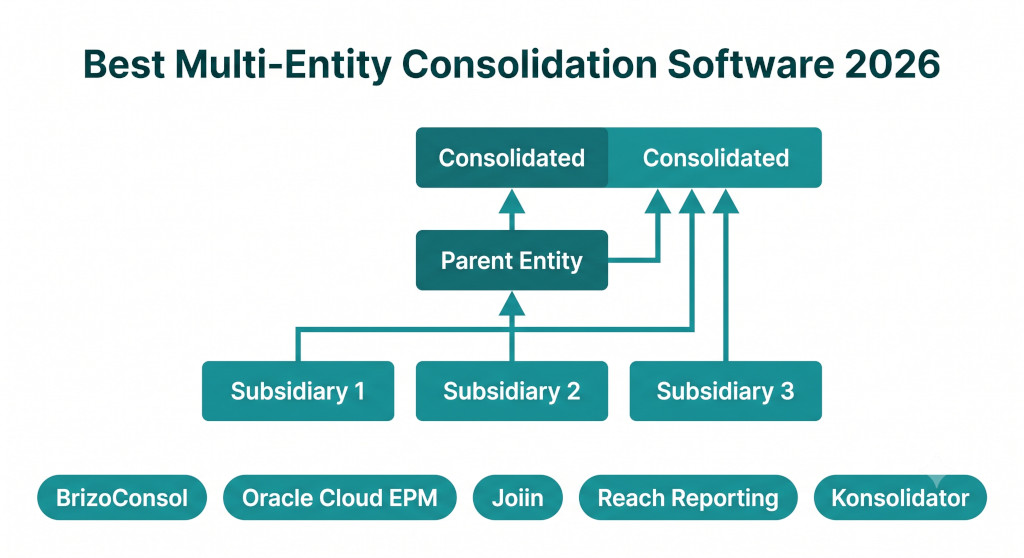
Multi-entity consolidation software solves a problem that grows in complexity with every entity added to a group: getting financial data from multiple accounting systems, currencies, and accounting frameworks into a single reliable view. The tools in this comparison take meaningfully different approaches to that problem — from enterprise platforms that integrate natively with Oracle’s ERP ecosystem, to cloud-native tools that connect directly to Xero and QuickBooks within hours of sign-up, to import-based platforms that accept trial balance data from any source.
This comparison covers BrizoConsol, Oracle Cloud EPM, Joiin, Reach Reporting, and Konsolidator across the two challenges that define multi-entity consolidation: how each tool handles data collection across entities, and how deeply it handles the consolidation accounting mechanics once the data is collected.
⚡ Quick Reference — Top Picks by Use Case
Selections reflect BrizoConsol’s editorial assessment as of August 2026, based on the criteria in the How We Evaluated section below. They are not paid placements and may not reflect assessments by independent third parties.
Stop building consolidations in spreadsheets.
BrizoConsol automates multi-entity consolidation — setup in minutes, reports the same day.
- Best for enterprise multi-entity consolidation: Oracle Cloud EPM
- Best for SME groups on cloud accounting platforms: BrizoConsol
- Best for budget statutory multi-entity consolidation: Konsolidator
- Best for management reporting across entities: Joiin
- Best for client-facing multi-entity report packs: Reach Reporting
The Two Challenges of Multi-Entity Consolidation
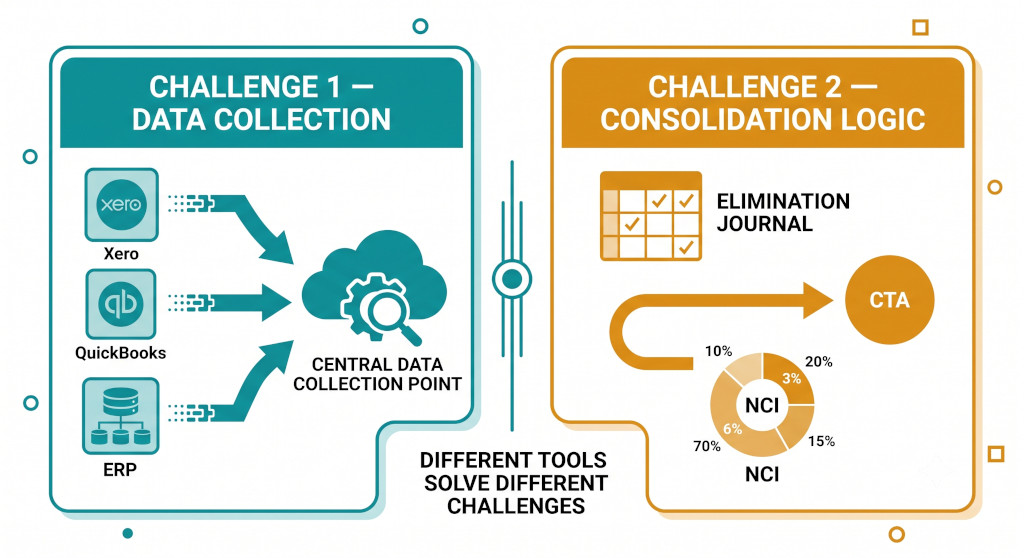
Groups with multiple entities face two distinct challenges when consolidating, and the tools in this comparison address them to different degrees.
Challenge 1 — Data collection. Each entity runs its own accounting system — often a different platform, often in a different currency, often with a chart of accounts built by a different accountant. Getting trial balance data from each entity into the consolidation system is often where the most time is spent. Tools vary significantly on this: some connect directly via API to cloud accounting platforms; others require manual trial balance exports and imports; enterprise platforms connect via ERP integration middleware. This challenge also includes account mapping — aligning the different chart of accounts structures across entities so they can be meaningfully aggregated.
Challenge 2 — Consolidation accounting logic. Once the data is collected, the consolidation mechanics need to be applied: intercompany elimination journal entries, currency translation adjustment (CTA) for foreign entities, non-controlling interest (NCI) calculations for partially owned subsidiaries, and GAAP-specific treatment across different standards. Tools vary significantly here too — some apply full statutory consolidation logic with an audit trail; others aggregate and net figures for a cleaner management view without the formal accounting layer underneath.
Many groups find they have a bigger problem with Challenge 1 than Challenge 2 — getting clean, timely data from entities is often more difficult than the consolidation mechanics themselves once the data is in place. A tool that connects live to all entity accounting systems and automates account mapping may save more time than one that has deeper consolidation logic but requires manual data exports every month.
Scope of This Comparison
These five tools were selected to cover the full range of multi-entity consolidation approaches accessible to accounting firms and groups from SME through to enterprise scale. Tools not covered here include SAP S/4HANA Group Reporting, CCH Tagetik, OneStream, BlackLine, Lucanet, and Workiva — platforms typically targeting larger enterprise structures with dedicated EPM teams and implementation budgets in the six-figure range. Readers evaluating for enterprise-scale requirements significantly above 50 entities, or organisations already running Oracle, SAP, or Microsoft Dynamics as their core ERP, should evaluate those platforms alongside the tools below. A separate comparison covering the intercompany elimination angle is available at How Financial Consolidation Software Cuts Your Month-End Close.
How We Evaluated These Tools
We evaluated each tool against seven criteria relevant to multi-entity groups and accounting firms. Assessment draws on publicly available vendor documentation, official pricing pages, G2 and Gartner Peer Insights aggregate user ratings, product demonstrations where available, and consolidation-specific functionality relevant to group finance teams:
| Criterion | What we looked at |
|---|---|
| Data collection | How each entity’s trial balance data gets into the consolidation system — native API integration, file import, or ERP middleware — and how account mapping across different charts of accounts is handled |
| Entity hierarchy management | Whether the tool supports complex group structures with sub-groups, partial ownership (equity method, proportional consolidation), and frequent structure changes |
| Multi-currency handling | Whether the tool translates each entity’s functional currency correctly and calculates the CTA for the group’s presentation currency |
| Consolidation depth | Whether the tool produces GAAP-specific elimination journal entries, NCI calculations, and an auditable consolidation record — or aggregates and nets for management reporting |
| GAAP and accounting standard support | Which accounting standards are supported (IFRS, US GAAP, UK GAAP, SFRS) and whether per-entity standard configuration is available for mixed-standard groups |
| Scalability | The typical entity count and group complexity the tool is designed for; implementation timeline and the technical resource required to set up and maintain the platform |
| Pricing | Whether pricing is published and predictable; how it scales with entity count, user count, or transaction volume |
Pricing figures are based on publicly available pricing information at the time of publication.
Comparison at a Glance
| Tool | Data collection | Multi-currency / CTA | Consolidation depth | GAAP standards | Best entity scale | Pricing |
|---|---|---|---|---|---|---|
| BrizoConsol | Native API: Xero, QuickBooks, MYOB, Zoho Books; AI account mapping (BrizoMapster) | ✅ Full CTA + NCI (Pro plan) | Statutory consolidation layer — elimination journals, audit trail | IFRS, US GAAP, UK GAAP, SFRS — per entity | 3–20 entities; SME and accounting firms | From $15/entity/month (Standard); $35 (Pro) [1] |
| Oracle Cloud EPM | Oracle ERP ecosystem (Fusion, EBS, PeopleSoft, JDE, NetSuite); non-Oracle via adapters | ✅ Enterprise-grade multi-currency and CTA | Enterprise statutory consolidation — full ownership structures, equity method, proportional consolidation | Multi-GAAP enterprise configuration | Enterprise — large multi-entity, global groups | Custom enterprise pricing; no public list price [2] |
| Joiin | Native API: Xero, QuickBooks, Sage, spreadsheets; AI-powered account mapping | ⚠️ Multi-currency; CTA mechanics at reporting layer | Reporting-layer consolidation — management accounts; elimination journals available | Framework-agnostic | SME to mid-market; management reporting focus | From $23/month; volume pricing for 100+ companies |
| Reach Reporting | Native API: QuickBooks, Xero, Sage, others | ⚠️ Multi-currency; reporting-layer conversion | Reporting-layer consolidation — client report packs; eliminations available | Framework-agnostic | SME; accounting firms; client reporting | From USD 149/month [3] |
| Konsolidator | Xero, Sage, QuickBooks (native 1-click sync via Xero App Store); file import from any other ERP or accounting system | ✅ Full currency translation; CTA and NCI | Statutory consolidation layer — automated elimination, minority interests, audit trail | GAAP and IFRS statutory focus | SME to mid-market; ERP-agnostic | From €200/month; unlimited users [4] |
Scoring Summary
Scores 1–5 reflect the editorial team’s assessment of suitability for typical SME and mid-market buyers, and are not derived from vendor-supplied ratings. A lower score reflects design scope, not product quality — Oracle’s 1/5 for ease of setup reflects its enterprise implementation model, not a defect. Assess tools against your specific entity count, accounting platforms, and output requirement.
| Criterion | BrizoConsol | Oracle Cloud EPM | Joiin | Reach Reporting | Konsolidator |
|---|---|---|---|---|---|
| Ease of setup | 5/5 | 1/5 | 5/5 | 5/5 | 3/5 |
| Consolidation depth | 4/5 | 5/5 | 2/5 | 2/5 | 4/5 |
| Multi-currency / CTA | 4/5 | 5/5 | 3/5 | 3/5 | 4/5 |
| Integrations | 4/5 | 3/5 | 4/5 | 4/5 | 2/5 |
| Value for money | 4/5 | 2/5 | 5/5 | 4/5 | 4/5 |
BrizoConsol
Best for: SME groups and accounting firms managing 3–20 entities on cloud accounting platforms, needing statutory consolidation without an enterprise implementation
A consolidation-native platform that solves both the data collection problem (native API integration with cloud accounting systems) and the consolidation logic problem (statutory-layer elimination, CTA, NCI, and GAAP-specific treatment).
Strengths
- Native integrations with Xero, QuickBooks, MYOB, and Zoho Books — trial balance data is pulled directly from each entity’s accounting system, removing the manual export-import step that adds time to every monthly close
- BrizoMapster AI account mapping automatically aligns different charts of accounts across entities, flagging exceptions for review rather than requiring full manual mapping
- Per-entity accounting standard selection: IFRS, US GAAP, UK GAAP (FRS 102), and SFRS — enabling groups where subsidiaries report under different frameworks
- Full CTA and NCI calculations on the Pro plan — foreign entity translation and minority interest accounting are part of the core consolidation run, not add-ons
- Automated intercompany eliminations (BrizoElim) with a full audit trail per adjustment; manual override available for complex transactions
- Designed for accounting firms managing multiple separate client group structures alongside in-house finance teams with groups of this scale [5]
- Self-service implementation; BrizoConsol’s product page describes same-day consolidated output from initial entity connection [1]
Limitations
- Standard plan covers single-currency consolidation with basic eliminations; multi-currency, CTA, NCI, and GAAP-specific treatment require the Pro plan [1]
- Integration list is focused on cloud accounting platforms — direct ERP connectors (SAP, Oracle, NetSuite) are not available; groups on those systems should use Konsolidator’s import model or Oracle’s native consolidation
- Designed for groups up to approximately 20 entities; larger enterprise structures with complex ownership hierarchies (equity method, proportional consolidation) may require Oracle FCCS or a comparable enterprise platform
- FP&A, budgeting, and forecasting are limited (basic budgeting on Pro) — groups needing full planning and consolidation in one platform should evaluate Oracle Cloud EPM
Pricing: from $15/entity/month — Standard; $35/entity/month — Pro [1]
BrizoConsol’s approach to the data collection challenge is to connect directly to the accounting platforms entities already use, removing the trial balance export-import step from the monthly workflow. The consolidation accounting layer then applies on top of that live data — so the eliminated, translated, and GAAP-adjusted consolidated output reflects the current period’s data from each entity rather than a manually assembled snapshot.
BrizoConsol is not the right fit for every group. Consider alternatives if: entities run on SAP, Oracle, NetSuite, or other ERPs outside BrizoConsol’s integration list (Konsolidator’s import model or Oracle FCCS may be better suited); the group has more than approximately 20 entities or complex ownership structures including equity method or proportional consolidation (Oracle Cloud EPM addresses this at enterprise scale); or the group’s primary deliverable is management report design rather than statutory consolidated accounts (Joiin or Reach Reporting are optimised for that output).
Oracle Cloud EPM
Best for: large enterprises running Oracle ERP systems that need deep statutory consolidation, complex ownership structures, and a unified EPM platform
Oracle’s Financial Consolidation and Close (FCCS) — enterprise-grade multi-entity consolidation with full ownership management, multi-GAAP support, and native Oracle ecosystem integration.
Strengths
- Handles complex ownership structures: full consolidation, equity method, and proportional consolidation — suited to enterprise groups with partial ownership across many entities
- Multi-GAAP support with enterprise configuration — organisations can run different reporting standards across their entity structure
- Pre-built consolidation artifacts (dimensions, forms, and calculations) reduce initial design effort relative to building from a general planning platform [6]
- Native connectivity to Oracle Fusion Cloud, EBS, PeopleSoft, JDE, and NetSuite — data flows directly from Oracle ERP without middleware for Oracle-centric organisations
- Smart View Excel add-in provides a familiar interface for finance teams already working in Excel
- Named in the 2026 Gartner Magic Quadrant for Financial Close and Consolidation Solutions (March 2026) [7]
- 638 reviews on Gartner Peer Insights for Oracle Fusion Cloud EPM [8]
Limitations
- Custom enterprise pricing; no public list price — implementation and licensing costs typically place FCCS in the enterprise budget range; contact Oracle directly for a quote
- Implementation timelines of 6–18 months are typical for full deployment; professional services engagement is standard [9]
- Non-Oracle source systems require additional integration work via adapters — organisations not using Oracle’s ERP ecosystem incur more integration overhead
- Ownership module requires careful configuration; user reviews note it can be challenging to maintain when group structures change frequently [10]
- Consolidation run times can be slow for very large entity structures; users note imbalance issues during consolidation can be difficult to trace to the originating entity [10]
- Most appropriate when the broader Oracle EPM suite (planning, reconciliation, narrative reporting) is also in scope — using FCCS in isolation may not justify the implementation investment
Pricing: custom enterprise contract; no public list price — contact Oracle for a quote
Oracle Cloud EPM’s consolidation capabilities are designed for the complexity that large enterprise groups face: variable ownership percentages, equity method accounting, sub-group consolidations, and multi-GAAP reporting across geographies. For organisations already running Oracle’s ERP stack, FCCS integrates directly into an existing data flow. For organisations evaluating FCCS outside the Oracle ecosystem, or whose primary need is consolidation rather than the full EPM suite, the implementation investment and integration overhead may be disproportionate to the requirement.
Oracle Cloud EPM is not the right fit for every group. Consider alternatives if: the group has fewer than approximately 20 entities without equity method or proportional consolidation complexity — the 6–18 month implementation is likely disproportionate; entities do not run on Oracle’s ERP family (Fusion, EBS, PeopleSoft, JDE, NetSuite), as non-Oracle integration requires significant additional work; the requirement is consolidation-only without the broader Oracle EPM suite (planning, account reconciliation, narrative reporting); the implementation timeline needs to be weeks rather than months; or the buyer is an accounting firm managing multiple separate client group structures under one subscription.
Joiin
Best for: accounting firms and SME groups consolidating multiple Xero, QuickBooks, or Sage entities into management accounts and dashboards
A multi-entity consolidation and reporting platform optimised for speed — connects multiple cloud accounting systems within hours and produces consolidated management reports the same day.
Strengths
- Connects to Xero, QuickBooks, Sage, and spreadsheets via native API — multiple entities are linked and consolidated within a day of setup
- AI-powered account mapping aligns different entity charts of accounts automatically, reducing the manual mapping effort
- Unlimited entity consolidation — scales from two entities to large group structures within the same subscription
- AI analytics and anomaly detection surface performance trends and variances across entities in the consolidated view
- Supports financial, operational, and KPI data in a single consolidated dashboard — useful for management teams needing more than a consolidated P&L
- Winner of the Xero Global App Awards 2025 — Small Business App of the Year (Canada) [11]; Intuit Platinum App Partner [12]; G2 4.7/5 from 79 reviews [13]
- 14-day free trial with full feature access
Limitations
- Operates primarily as a reporting-layer consolidation tool — the output is a consolidated management view rather than a formal set of statutory consolidated accounts with GAAP-specific elimination entries
- CTA and NCI mechanics are at reporting-layer depth; groups with formal statutory obligations requiring GAAP-specific foreign currency translation and minority interest accounting should evaluate fit carefully for those requirements
- Groups with formal statutory consolidated account requirements — particularly where the auditor will review elimination workings — should verify whether Joiin’s consolidation depth meets their obligations directly with Joiin
Pricing: from $23/month; volume pricing for 100+ companies; 14-day free trial
Joiin’s strength is on the data collection side of the two-challenge framework: it connects multiple cloud accounting systems quickly, maps accounts automatically, and delivers a consolidated view with minimal setup friction. For the multi-entity group whose primary need is a live, clean, management-reporting view across entities — board dashboards, consolidated P&L, KPI tracking — Joiin addresses the data problem efficiently. The consolidation accounting depth is appropriate for management reporting rather than statutory audit requirements.
Joiin is not the right fit for every group. Consider alternatives if: the group has formal statutory consolidated account requirements where an auditor will review intercompany elimination workings and expect a GAAP-specific consolidation journal trail; entities run on accounting systems outside Joiin’s integration list (SAP, Oracle, legacy ERPs); significant NCI and statutory CTA mechanics are required at audit level; or the group’s primary deliverable is a set of statutory accounts rather than management-reporting dashboards.
Reach Reporting
Best for: accounting firms producing consolidated management report packs for clients across multiple entities, with a priority on visual quality and client portal delivery
A financial reporting platform with multi-company consolidation — connects to cloud accounting systems and produces professionally formatted, branded consolidated report packs.
Strengths
- Multi-company consolidation with currency conversion and intercompany elimination settings — consolidated reports include eliminated figures across all linked entities
- Drag-and-drop report builder with pre-built templates and white-label option — consolidated reports match the accounting firm’s brand, not the platform’s
- Client portal with scheduled delivery — consolidated reports are distributed automatically each period without manual sending
- 3-way budgeting and forecasting (P&L, balance sheet, cash flow) available within the same platform
- AI-enhanced analysis adds variance commentary to the consolidated report output automatically
- G2 4.9/5 from 27 reviews; from USD 149/month with all features included [3] [14]
Limitations
- Primary positioning is report presentation and client delivery — the consolidation is a feature of the reporting workflow rather than the core product
- Groups with formal statutory consolidated account requirements should verify whether the consolidation depth and elimination workings meet their auditor’s expectations before relying on Reach Reporting as their primary consolidation system
- Multi-dimensional reporting not available in the financial form spreadsheet module, as noted in user reviews [15]
Pricing: from USD 149/month; pricing decreases per company at volume [3]
Reach Reporting solves the multi-entity problem from the report delivery end: once entities are connected and consolidation settings are configured, the tool produces a polished, branded, consolidated report pack ready for client distribution. The consolidation mechanics are functional and appropriate for management accounts; groups requiring statutory-grade elimination journal entries with an audit trail should verify the tool’s capabilities directly with Reach Reporting for their specific requirements.
Reach Reporting is not the right fit for every group. Consider alternatives if: the group produces statutory consolidated accounts for external audit and needs an auditable consolidation journal trail rather than a consolidated management report; multi-dimensional reporting in the financial form spreadsheet module is a requirement; entities run on accounting systems outside Reach Reporting’s integration list; or the group needs GAAP-specific elimination treatment rather than framework-agnostic reporting consolidation.
Konsolidator
Best for: SME to mid-market groups needing statutory multi-entity consolidation with broad source system compatibility — including Xero, Sage, QuickBooks, and file-import support for any ERP
A statutory consolidation platform with native integrations for Xero, Sage, and QuickBooks, plus file import compatibility for any ERP or legacy accounting system.
Strengths
- Import-based data model — trial balance data can be loaded from any accounting system, ERP, or spreadsheet; no native accounting system integration required
- Automated consolidation of actuals, budget, and forecast across groups and sub-groups — elimination rules are defined once and applied every period [4]
- Full currency translation, CTA, and NCI included as standard — the consolidation mechanics cover the main requirements of a statutory consolidated account
- Designed around GAAP and IFRS statutory consolidation requirements; elimination entries form part of the consolidation output rather than a reporting overlay
- SaaS model with unlimited users — no per-seat cost; easy to include auditors or client contacts
- Starts at approximately €200–€300/month based on third-party listings — verify current pricing at konsolidator.com; a flat rate that can become more cost-effective as entity count increases [4]
Limitations
- Native integration with Xero, Sage, and QuickBooks (1-click sync via Xero App Store); for entities on MYOB, Zoho Books, SAP, Oracle, or legacy ERPs, trial balance data is loaded via file import rather than live sync
- Reporting and dashboard layer is functional but not designed for polished client-presentation output; groups needing management dashboards typically connect Konsolidator to a separate BI tool via its API
- Intercompany transaction handling at high volumes has been noted as an area for improvement in user reviews [16]
- Does not integrate directly with cloud accounting platforms like Xero, QuickBooks, or MYOB
Pricing: from €200/month; unlimited users; free trial available [4]
Konsolidator’s source system compatibility is its primary differentiator: it integrates natively with Xero, Sage, and QuickBooks (via Xero App Store 1-click sync), and additionally accepts trial balance file imports from SAP, Oracle, Dynamics, and any other ERP or legacy system. This makes it the most broadly compatible tool in this comparison for groups with mixed accounting system environments.
Konsolidator is not the right fit for every group. Consider alternatives if: entities run on MYOB or Zoho Books and a live direct connection is preferred — Konsolidator does not currently list these among its native integrations (unlike BrizoConsol); polished management dashboards are a primary output alongside statutory accounts — Konsolidator’s reporting layer is functional rather than designed for client presentation; the group has very high intercompany transaction volumes where elimination depth at scale is a factor; or the buyer is an accounting firm managing multiple separate client group structures under one subscription, as Konsolidator is better suited to a single group structure.
Where Competitors Have an Edge Over BrizoConsol
Where Oracle Cloud EPM is stronger. Oracle FCCS handles consolidation complexity that goes beyond BrizoConsol’s design scope: equity method accounting, proportional consolidation, entity hierarchies with sub-group consolidations, and multi-GAAP reporting across complex enterprise group structures. For organisations running Oracle’s ERP stack, FCCS integrates into an existing data flow without requiring a separate integration layer. BrizoConsol is not designed for that level of structural complexity — groups with those requirements should shortlist Oracle FCCS or an equivalent enterprise platform.
Where Konsolidator is stronger. Konsolidator’s flat monthly pricing can become more cost-effective than BrizoConsol’s Pro plan as entity count increases. Its source system compatibility is also broader: Konsolidator integrates natively with Xero, Sage, and QuickBooks, and additionally accepts trial balance file imports from SAP, Oracle, Dynamics, and any legacy ERP — covering entity structures that BrizoConsol’s integration list does not currently reach (MYOB and Zoho Books are BrizoConsol-specific; SAP and Oracle ERP imports are Konsolidator-specific). Groups already using a BI tool for dashboards who need only the statutory consolidation output may find Konsolidator’s focused scope a better fit.
Which Tool Is Right for Your Group?
| Buyer profile | Recommended tool | Why |
|---|---|---|
| Large enterprise running Oracle ERP with complex ownership structures and multi-GAAP requirements | Oracle Cloud EPM | Native Oracle ERP integration; equity method, proportional consolidation, and complex ownership structures supported; enterprise-grade for large, complex multi-entity groups |
| SME group or accounting firm with 3–20 entities on Xero, QuickBooks, MYOB, or Zoho Books needing statutory consolidation | BrizoConsol | Native API integration removes manual data collection; GAAP-specific treatment per entity; CTA and NCI on Pro plan; statutory-layer output with audit trail |
| Mid-market group with entities on mixed or legacy systems needing GAAP/IFRS-compliant statutory consolidation | Konsolidator | Native Xero, Sage, QuickBooks integration plus file-import support for any ERP; statutory consolidation; flat monthly rate with unlimited users |
| Accounting firm producing management accounts and dashboards across multiple client entities | Joiin | Same-day setup from cloud accounting platforms; AI account mapping; management reporting and dashboard focus; G2 4.7/5 |
| Accounting firm producing branded consolidated report packs for clients | Reach Reporting | Multi-company consolidation with professional report design, white-label option, and client portal delivery; G2 4.9/5 |
How to Choose Multi-Entity Consolidation Software
✅ Buyer Evaluation Checklist
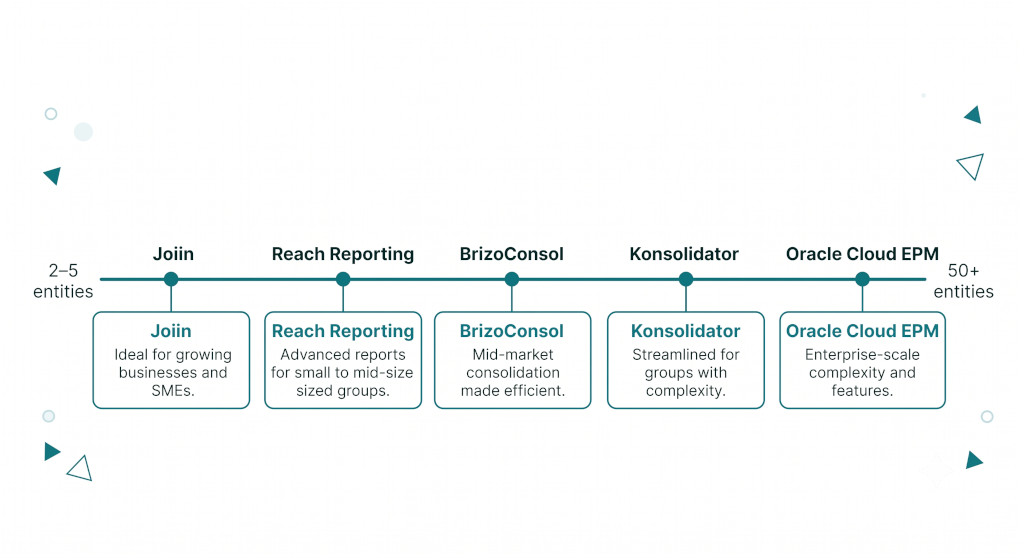
- Count your entities and identify their accounting systems. The accounting platforms each entity uses determine which tools can collect data natively. BrizoConsol, Joiin, and Reach Reporting connect to Xero, QuickBooks, and Sage directly. Konsolidator integrates natively with Xero, Sage, and QuickBooks, and accepts file imports from any other system — including SAP and Oracle. Oracle FCCS connects to Oracle ERPs natively. If entities run on systems outside those lists, an import-based model (Konsolidator) or Oracle’s integration middleware may be the only realistic path.
- Determine your statutory vs management reporting requirement. If the consolidation needs to satisfy an external audit or comply with a specific accounting standard, the consolidation accounting layer matters — elimination journal entries, CTA, and NCI need to be produced through a compliant process. If the primary output is management accounts and dashboards, reporting-layer tools (Joiin, Reach Reporting) address the requirement faster and at lower cost.
- Assess your ownership structure complexity. Groups with straightforward 100%-owned subsidiaries are well-served by any of the tools in this comparison. Groups with partial ownership (minority interests), equity method investments, or proportional consolidation entities need a platform with dedicated ownership management — Oracle FCCS, or at minimum BrizoConsol or Konsolidator’s NCI support.
- Set an implementation timeline expectation. Joiin and Reach Reporting: hours to a day. BrizoConsol: same day to a week for initial setup. Konsolidator: days to weeks. Oracle Cloud EPM: 6–18 months with professional services. The timeline is often the deciding factor when a group has an approaching close deadline.
- Match pricing model to entity count. BrizoConsol charges per entity — more cost-effective for smaller groups. Konsolidator charges a flat monthly rate — more cost-effective for larger groups. Joiin and Reach Reporting charge per data connection with volume discounts. Oracle Cloud EPM requires a direct quote; contact Oracle for current pricing.
Frequently Asked Questions
What is multi-entity consolidation software?
Multi-entity consolidation software combines the financial statements of multiple legal entities — subsidiaries, divisions, or joint ventures — into a single set of group accounts. It addresses two core challenges: collecting trial balance data from each entity’s accounting system, and applying the consolidation accounting logic (intercompany eliminations, currency translation, minority interest calculations) once the data is in place. Tools in this category range from reporting-layer aggregators that produce consolidated management views, to statutory consolidation platforms that produce GAAP-specific elimination journal entries with an audit trail, to enterprise EPM suites that handle complex multi-entity ownership structures at scale.
What is the difference between BrizoConsol and Oracle Cloud EPM for multi-entity consolidation?
BrizoConsol is designed for SME to mid-market groups on cloud accounting platforms (Xero, QuickBooks, MYOB, Zoho Books), with self-service implementation and GAAP-specific consolidation at the statutory layer. Oracle FCCS is an enterprise platform designed for large organisations running Oracle ERP systems, with complex ownership management (equity method, proportional consolidation) and 6–18 month implementation timelines. The two tools serve different scale and infrastructure profiles; they are not direct substitutes. For mid-market groups outside the Oracle ecosystem, BrizoConsol or Konsolidator are likely better matches on both cost and implementation timeline. For large enterprises on Oracle infrastructure with complex group structures, FCCS is the more appropriate tool.
Which multi-entity consolidation software integrates with Xero or QuickBooks?
BrizoConsol integrates natively with Xero, QuickBooks, MYOB, and Zoho Books, pulling data directly from each entity’s accounting system. Joiin and Reach Reporting both integrate natively with Xero and QuickBooks, as well as Sage. Konsolidator integrates natively with Xero, Sage, and QuickBooks via 1-click sync (Xero App Store), and additionally accepts trial balance file imports from any other accounting system or ERP — including SAP, Oracle, and Dynamics. Oracle Cloud EPM connects to Oracle’s ERP family (Fusion, EBS, PeopleSoft, JDE, NetSuite) and to non-Oracle systems via integration adapters rather than direct cloud accounting platform connections.
How much does multi-entity consolidation software cost?
Joiin starts at $23/month with volume pricing for larger company counts. Reach Reporting starts at USD 149/month with all features included. BrizoConsol is priced per entity — from $15/entity/month on the Standard plan (single-currency, basic eliminations) and $35/entity/month on the Pro plan (multi-currency, CTA, NCI, GAAP-specific treatment). Konsolidator starts at €200/month with unlimited users — a flat rate that becomes proportionally more cost-effective as entity count grows. Oracle Cloud EPM has no public list price; pricing is module-based and requires a direct quote from Oracle.
What consolidation software is best for accounting firms managing multiple client groups?
The answer depends on the firm’s primary deliverable. Firms producing statutory consolidated accounts for clients with formal GAAP reporting obligations are best served by a consolidation-layer tool; BrizoConsol is designed for this use case, supporting multiple separate client group structures under one account, with per-entity accounting standard configuration and native integration with the cloud accounting platforms most firm clients use. Firms producing management report packs and dashboards for business-owner clients may find Joiin or Reach Reporting more appropriate — faster to set up, optimised for the management reporting deliverable, and more cost-effective for that specific output.
Conclusion
The five tools in this comparison approach multi-entity consolidation from meaningfully different starting points. Oracle Cloud EPM is built for enterprise-scale group structures within the Oracle ecosystem — complex ownership, global multi-GAAP requirements, and organisations where a 12-month implementation is proportionate to the scope. Joiin and Reach Reporting solve the data collection challenge efficiently for cloud accounting users, producing consolidated management views quickly and with minimal setup friction. Konsolidator and BrizoConsol sit at the statutory consolidation layer — producing GAAP-specific elimination entries and an auditable consolidation trail — at price points and implementation timelines accessible to mid-market groups and accounting firms.
The most useful decision filter is the one that combines two questions: what accounting systems do your entities actually run, and what level of consolidation depth does your primary output require? Those two answers map cleanly to the tools above — and typically narrow a five-tool shortlist to two or three meaningful options before any demo is booked.
Sources
- BrizoConsol Pricing Page — brizoconsol.com/pricing/ (Standard: $15/entity/month — single-currency, basic eliminations; Pro: $35/entity/month — multi-currency, CTA, all GAAP standards, NCI, budgeting)
- Oracle Financial Consolidation and Close product page — oracle.com/performance-management/financial-consolidation-close/ (no public list price; module-based subscription; contact Oracle for a quote)
- Reach Reporting, “Limelight vs. Reach Reporting” — reachreporting.com/blog/limelight (pricing from USD 149/month, all features included; pricing decreases per company at volume)
- G2, Konsolidator product page — g2.com/products/konsolidator/reviews (SaaS subscription with unlimited users; consolidated P&L, balance sheet, cash flow, intercompany eliminations, minority interests, currency translation; automated actual, budget, and forecast consolidation included as standard). Pricing note: third-party listings in 2026 show starting prices in the €200–€300/month range; verify current pricing and integration availability directly at konsolidator.com — some listings also indicate direct integrations with Xero, Sage, and QuickBooks which should be confirmed with Konsolidator before publishing the “import-only” positioning.
- BrizoConsol FAQ — brizoconsol.com/faq/ (designed for groups of 3–20 entities; accounting firms can manage multiple client group structures)
- FitGap, “Oracle Financial Consolidation and Close reviews 2026” — us.fitgap.com (pre-built consolidation artifacts; multi-currency translation; ownership management; intercompany eliminations; journal adjustments)
- Oracle Financial Consolidation and Close product page — oracle.com (references Gartner Magic Quadrant for Financial Close and Consolidation Solutions, March 9, 2026)
- Gartner Peer Insights, Oracle Fusion Cloud EPM — gartner.com/reviews/product/oracle-fusion-cloud-enterprise-performance-management-epm (638 reviews; stable and scalable for enterprise-level financial consolidation and close process)
- CFO Shortlist, “Oracle FCCS Guide 2026” — cfoshortlist.com/vendors/oracle-fccs (implementation timelines 6–18 months; professional services engagement standard)
- BARC review, “Oracle Cloud EPM Financial Consolidation and Close” — barc.com (ownership module challenging with frequent structure changes; consolidation run times; imbalance issues difficult to trace to originating entity)
- EINPresswire, “Joiin Wins FinTech of the Year at the Tech South West Awards 2025”, 26 November 2025 — einpresswire.com (Winner, Xero Global App Awards 2025 — Small Business App of the Year, Canada)
- EINPresswire via CBInsights, “Joiin Recognised as Platinum Partner in Intuit’s App Program”, 24 February 2026 — cbinsights.com/company/joiin
- G2, Joiin product page — g2.com (4.7/5, 79 verified reviews)
- G2, Reach Reporting product page — g2.com (4.9/5, 27 verified reviews)
- SoftwareAdvice user reviews for Reach Reporting — softwareadvice.com (multi-dimensional reporting limitation in financial form spreadsheet module)
- SoftwareAdvice user reviews for Konsolidator — softwareadvice.com (intercompany section improvement noted by users with high transaction volumes)
Managing consolidation across multiple entities on Xero, QuickBooks, MYOB, or Zoho Books?
BrizoConsol connects directly to each entity’s accounting system, maps accounts automatically with AI, and produces GAAP-specific consolidated accounts — P&L, balance sheet, and cash flow — with intercompany eliminations, CTA, and NCI calculated in the same run. See It in Action