A Practical Cross-GAAP Consolidation Method: Identify Differences, Post Conversion Journals, and Document Review
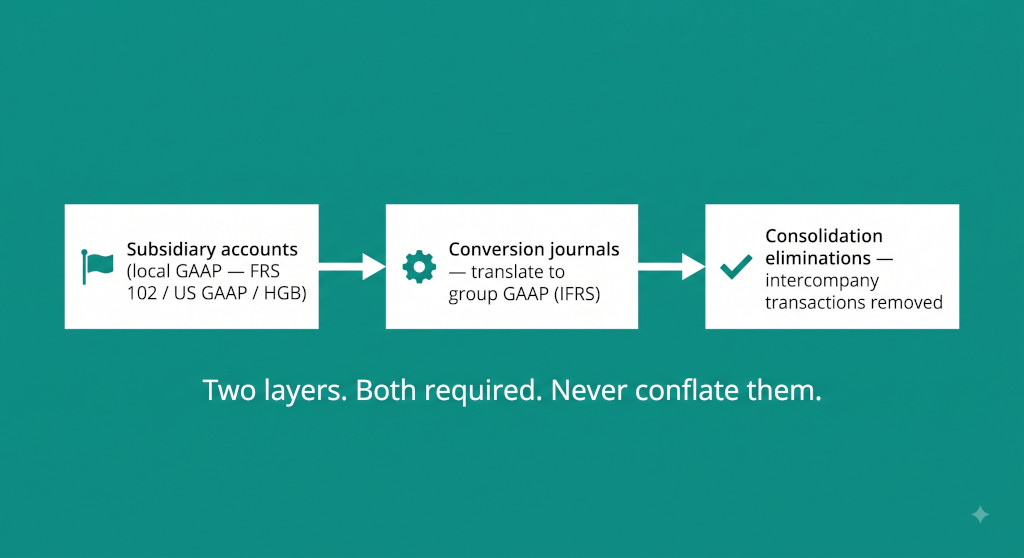
When every subsidiary in a group uses the same accounting framework as the parent, the consolidation workbook has one layer of complexity: intercompany eliminations. When subsidiaries report under different frameworks — one on FRS 102, another on US GAAP, a third on local German HGB — there are two layers: first, convert each subsidiary’s accounts to the group’s reporting GAAP; then apply the intercompany eliminations. Both layers are required. The order matters. And they must be documented separately so that a reviewer can follow the chain from entity accounts to consolidated output without ambiguity.
This post sets out the practical method for cross-GAAP consolidations, with worked journals for the two most common scenarios UK groups encounter: a subsidiary reporting under FRS 102 converting into an IFRS parent, and a subsidiary reporting under US GAAP converting into the same IFRS parent.
The Three-Step Method
Step 1: Identify the Differences
For each subsidiary, map its local GAAP to the group’s reporting GAAP and identify every policy difference that applies to that entity’s actual circumstances. A subsidiary with no leases has no IFRS 16 conversion issue; a subsidiary with no goodwill has no goodwill amortisation adjustment. The mapping is entity-specific, not a generic GAAP comparison. Document which differences apply, which do not, and why.
Stop building consolidations in spreadsheets.
BrizoConsol automates multi-entity consolidation — setup in minutes, reports the same day.
Step 2: Post Conversion Journals
For each identified difference, prepare a conversion journal that translates the subsidiary’s trial balance from local GAAP to the group’s reporting GAAP. These journals sit in the consolidation workbook between the entity trial balance and the intercompany elimination journals. They must be applied before eliminations — eliminations are designed for GAAP-consistent figures, not local GAAP figures. Conversion journals typically adjust both the balance sheet and the P&L; carry-forward entries for prior period balances go to opening retained earnings.
Step 3: Document and Review
Each conversion journal needs a numbered reference, the policy basis for the adjustment (citing the relevant IFRS standard and the subsidiary’s local GAAP treatment), the calculation workings, and a sign-off by the preparer and reviewer. The documentation should be sufficient for an external auditor to independently verify every conversion without asking the preparer for an explanation.
The Clearfield Group: The Worked Example
Clearfield Group Ltd is the IFRS reporting parent. It has three subsidiaries relevant to this post:
| Subsidiary | Location | Local GAAP | Key conversion issues |
|---|---|---|---|
| Clearfield UK Ltd | United Kingdom | FRS 102 | IFRS 16 lease recognition; goodwill amortisation reversal |
| Clearfield US Inc | United States | US GAAP | LIFO to FIFO/AVCO inventory conversion; development cost capitalisation |
| Clearfield Germany GmbH | Germany | HGB | Provisions (HGB more conservative); financial instruments; deferred tax |
The post works through Clearfield UK and Clearfield US in detail. Clearfield Germany illustrates the principle that every national GAAP requires its own mapping — the specific adjustments for German HGB, French Plan Comptable, or Dutch GAAP follow the same three-step method even if the differences are different.
Scenario A: FRS 102 Subsidiary Converting to IFRS
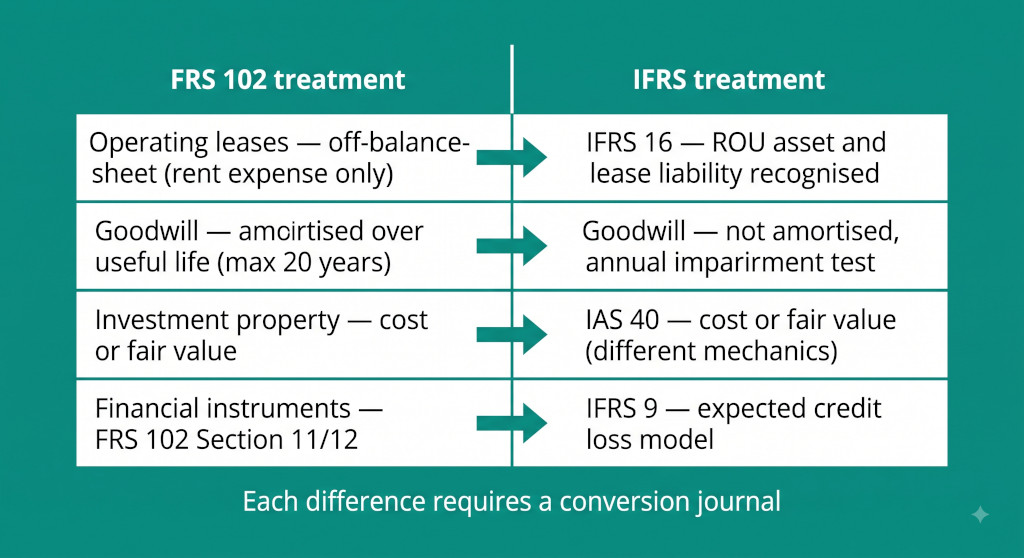
Clearfield UK Ltd prepares its statutory accounts under FRS 102. The group reports under IFRS. Two differences apply to Clearfield UK’s actual circumstances:
A1: IFRS 16 — Operating Leases Under FRS 102 Are Off-Balance-Sheet
Under FRS 102 Section 20, operating leases are not recognised on the balance sheet. Clearfield UK charges its operating lease payments (offices and equipment) directly to the income statement as rent expense. Under IFRS 16, all leases above the short-term and low-value exemptions require recognition of a right-of-use asset and lease liability.
At the current year end, Clearfield UK has two material operating leases: an office lease with three years remaining (annual payments £96,000) and a warehouse lease with four years remaining (annual payments £60,000). Both would have been recognised under IFRS 16 from their commencement dates. The group applies a 4.5% incremental borrowing rate.
The conversion journal must recognise both leases as they would appear at the current balance sheet date under IFRS 16 — including the ROU assets net of accumulated depreciation, the lease liabilities, and a retained earnings adjustment for the prior-period difference between rent expense (as charged under FRS 102) and the IFRS 16 depreciation plus interest that would have been charged:
Conversion Journal A1 — IFRS 16 recognition (Clearfield UK Ltd)
| Account | Dr | Cr |
|---|---|---|
| Right-of-use asset — office lease (net of accumulated depreciation) | £258,000 | |
| Right-of-use asset — warehouse lease (net of accumulated depreciation) | £174,000 | |
| Opening retained earnings (cumulative prior-period difference) | £14,000 | |
| Lease liability — office lease (closing balance) | £276,000 | |
| Lease liability — warehouse lease (closing balance) | £228,000 | |
| Deferred tax liability (on temporary differences above, at 25%) | £(32,000) |
The £14,000 debit to opening retained earnings reflects the cumulative difference between IFRS 16 costs (depreciation + interest) and FRS 102 rent expense in prior periods. In early lease years, IFRS 16 front-loads costs relative to straight-line rent, so prior periods under IFRS 16 would have shown higher costs — hence the debit to retained earnings. The deferred tax liability recognises the temporary difference created by the ROU asset/lease liability mismatch. The P&L conversion for the current year separately reverses the rent expense and recognises depreciation and interest — see the companion P&L journal below.
Conversion Journal A1 (P&L) — IFRS 16 current year P&L (Clearfield UK Ltd)
| Account | Dr | Cr |
|---|---|---|
| Depreciation — ROU assets (office £86k + warehouse £58k) | £144,000 | |
| Finance costs — lease interest (office £12.4k + warehouse £10.3k) | £22,700 | |
| Operating expenses — rent (FRS 102 charge reversed: office £96k + warehouse £60k) | £156,000 | |
| Tax expense (deferred tax on above, net, at 25%) | £10,700 |
The net P&L effect in the current year: £144,000 depreciation + £22,700 interest − £156,000 rent reversal = £10,700 additional pre-tax cost, offset by the deferred tax credit. The IFRS 16 treatment is more expensive than FRS 102 in the early years of a lease because interest front-loads the cost; in later years, the total IFRS 16 cost falls below the straight-line rent. Over the full lease term, cumulative P&L charges are identical.
A2: Goodwill Amortisation Reversal
Clearfield UK recognised goodwill of £480,000 three years ago following a bolt-on acquisition. Under FRS 102, goodwill is amortised over its useful economic life — Clearfield UK’s accounting policy amortises it over eight years at £60,000 per year. At the current year end, the FRS 102 carrying value is £480,000 − (3 × £60,000) = £300,000.
Under IFRS, goodwill acquired in a business combination is not amortised — it is tested for impairment annually (IAS 36). For the group’s consolidated accounts, the full £180,000 of amortisation charged over the three years must be reversed, and goodwill reinstated to its original £480,000 (assuming no impairment has been identified under the IFRS impairment testing framework):
Conversion Journal A2 — Goodwill amortisation reversal (Clearfield UK Ltd)
| Account | Dr | Cr |
|---|---|---|
| Goodwill (reinstate FRS 102 amortisation — 3 years × £60,000) | £180,000 | |
| Opening retained earnings (prior 2 years: 2 × £60,000) | £120,000 | |
| Amortisation expense (current year — reversed) | £60,000 |
The goodwill in the group’s IFRS consolidated accounts (£480,000) now differs permanently from the goodwill in Clearfield UK’s FRS 102 entity accounts (£300,000, continuing to amortise). This divergence grows by £60,000 per year until the FRS 102 goodwill reaches zero at year eight. The conversion journal must be updated each year to reflect the cumulative amortisation charged under FRS 102. Note: this conversion journal relates only to any goodwill recorded in Clearfield UK’s own FRS 102 accounts. Any goodwill from the group’s IFRS 3 acquisition accounting (which lives only in the consolidation workbook, never in an entity’s own books) is unaffected.
The goodwill amortisation reversal is one of the largest and most persistent conversion adjustments for groups with FRS 102 subsidiaries that themselves hold goodwill (for example, subsidiaries that have made bolt-on acquisitions under their own balance sheets). The conversion journal grows in size each year as the FRS 102 amortisation accumulates. Maintain a dedicated schedule tracking goodwill per FRS 102, per IFRS, and the annual conversion movement.
Scenario B: US GAAP Subsidiary Converting to IFRS
Clearfield US Inc prepares its accounts under US GAAP. Two differences apply to its circumstances:
B1: LIFO Inventory to FIFO/Weighted Average
US GAAP permits the last-in-first-out (LIFO) inventory method; IFRS (IAS 2) prohibits it. Clearfield US uses LIFO. In a period of rising input costs — common in manufacturing and distribution — LIFO produces a lower inventory balance and higher cost of goods sold compared to FIFO or weighted average, because the most recently purchased (higher-cost) items are assumed sold first.
Clearfield US’s LIFO reserve at the current year end — the cumulative difference between LIFO inventory and FIFO inventory — is $310,000 (£248,000 translated at the closing exchange rate of £1 = $1.25). The current year movement in the LIFO reserve is $40,000 (£32,000), representing the additional cost of goods assumed sold under LIFO relative to FIFO in the current year:
Conversion Journal B1 — LIFO to FIFO inventory conversion (Clearfield US Inc)
| Account | Dr | Cr |
|---|---|---|
| Inventory (increase from LIFO to FIFO basis) | £248,000 | |
| Opening retained earnings (prior period LIFO reserve: £248k − £32k) | £216,000 | |
| Cost of goods sold (current year LIFO reserve movement reversed) | £32,000 |
The LIFO reserve at each year end represents the full cumulative adjustment needed to bring inventory to a FIFO basis. The split between opening retained earnings (all prior periods) and current year COGS (only the current year movement in the reserve) ensures the P&L conversion is limited to the current period and prior periods are handled through the opening retained earnings adjustment. Note that the LIFO reserve and its movement must be translated to sterling at consistent exchange rates — balance sheet items at closing rate, P&L movements at average rate — to avoid spurious FX differences in the adjustment.
B2: Development Costs — Expensed Under US GAAP, Potentially Capitalisable Under IFRS
Under US GAAP (ASC 730), research and development costs are generally expensed as incurred. Under IFRS (IAS 38), research costs are expensed but development costs that meet six specific criteria — technical feasibility, intention to complete, ability to use or sell, probable future economic benefits, available resources, and ability to reliably measure expenditure — must be capitalised and amortised over the useful life of the developed product or process.
Clearfield US has been developing a proprietary logistics software platform. The project met all six IAS 38 criteria from the start of the current year. Under US GAAP, £420,000 of qualifying development costs were expensed in the year. Under IFRS, these would be capitalised as an intangible asset and amortised over the platform’s four-year useful economic life (£105,000 per year). Since the development only began in the current year, there are no prior period adjustments:
Conversion Journal B2 — Development cost capitalisation (Clearfield US Inc)
| Account | Dr | Cr |
|---|---|---|
| Internally developed intangible asset (development costs capitalised) | £420,000 | |
| R&D expense (reversed — costs no longer expensed) | £420,000 |
Capitalising the full year’s development spend improves current year profit by £420,000 less one year’s amortisation of £105,000 = £315,000 net benefit to P&L. The amortisation journal is a separate entry — see below. In subsequent years, the conversion will reverse the continuing US GAAP expensing and charge only the IFRS amortisation through the P&L.
Conversion Journal B2 (amortisation) — Development cost amortisation (Clearfield US Inc)
| Account | Dr | Cr |
|---|---|---|
| Amortisation expense (£420,000 ÷ 4 years, year 1) | £105,000 | |
| Accumulated amortisation — development intangible | £105,000 |
Keeping the capitalisation and amortisation as separate journal entries (rather than netting them) maintains clarity in the audit trail: a reviewer can see the full capitalised amount and the amortisation rate without having to work backwards from a net figure. The intangible at year end: £420,000 less £105,000 accumulated amortisation = £315,000 net carrying value.
IAS 38 capitalisation is not optional: where development costs meet all six criteria, IFRS requires capitalisation — it is not a choice. US subsidiaries that expense all R&D under ASC 730 may be systematically understating the group’s intangible assets where IFRS criteria are met. Review the development pipeline annually, not just at first recognition. If a project’s status changes from research phase to development phase, capitalisation starts from the point at which the criteria are met — not retrospectively from the beginning of the project.
The Conversion Workbook Layer Structure
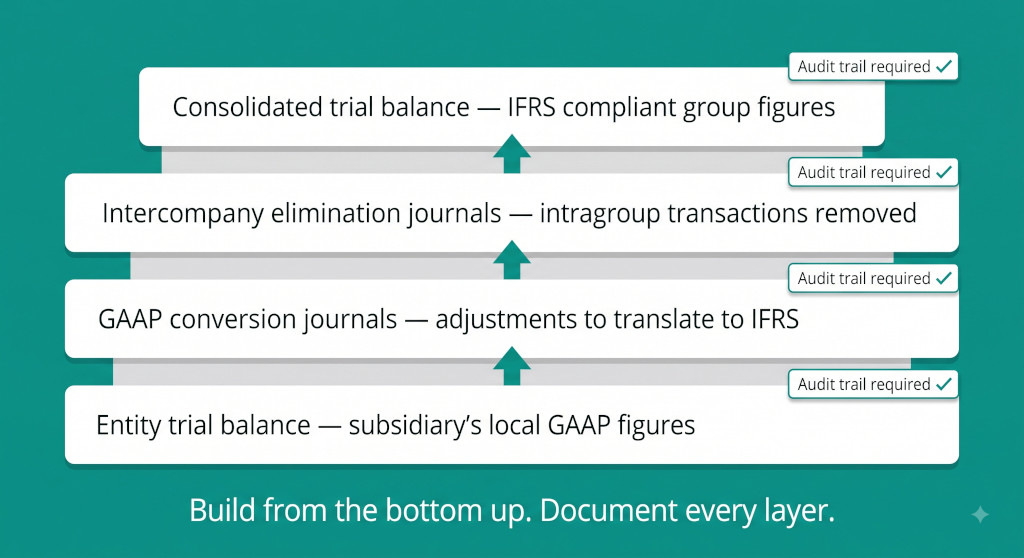
The consolidation workbook for a cross-GAAP group should be structured as four distinct layers for each subsidiary, progressing from entity accounts to consolidated output:
| Layer | Content | Who prepares | Reference |
|---|---|---|---|
| 1 — Entity trial balance | The subsidiary’s own figures in local GAAP, translated to the group’s reporting currency at appropriate rates (closing rate for balance sheet, average rate for P&L) | Subsidiary finance team | Source: entity accounts / statutory TB |
| 2 — GAAP conversion journals | Adjustments for each identified GAAP difference, converting local GAAP figures to IFRS. Each journal numbered and cross-referenced to the policy basis | Group consolidation team | Conversion journal schedule (separate tab) |
| 3 — Intercompany eliminations | Standard intragroup eliminations (loans, dividends, trading balances, unrealised profit) applied to the IFRS-adjusted figures | Group consolidation team | Elimination journal schedule (separate tab) |
| 4 — Consolidated trial balance | The sum of all entity TBs (IFRS-converted) after all eliminations — the source for the consolidated financial statements | Group consolidation team | Signed off consolidated TB |
The separation of layers 2 and 3 is essential. Intercompany eliminations use intercompany balances — those balances are the same whether the subsidiary is on FRS 102 or IFRS, in most cases. But GAAP differences affect the amounts in the trial balance itself: a subsidiary’s inventory value under LIFO is different from under FIFO; its ROU assets do not exist at all under FRS 102. Applying eliminations to unconverted local GAAP figures will produce incorrect consolidated numbers for any line affected by a conversion difference.
Documentation Standard for Each Conversion Journal
Every conversion journal should be accompanied by a documentation record. The format below is a practical template that satisfies audit requirements without being onerous:
| Field | Example — Journal A2 (Goodwill Amortisation Reversal) |
|---|---|
| Journal reference | CUK-A2 |
| Subsidiary | Clearfield UK Ltd |
| GAAP difference | Goodwill amortisation: FRS 102 requires amortisation; IAS 38 / IFRS 3 prohibits amortisation of acquired goodwill |
| FRS 102 reference | FRS 102 Section 19.23 — goodwill amortised over useful economic life, maximum 20 years where life cannot be reliably estimated |
| IFRS reference | IFRS 3.B67 and IAS 36.90 — goodwill not amortised; tested annually for impairment |
| Calculation | Original goodwill £480,000. FRS 102 amortisation £60,000/yr (8-year life). Year 3 of 8. Cumulative reversal: 3 × £60,000 = £180,000. Prior periods (2 years): £120,000 to retained earnings. Current year: £60,000 to P&L. |
| Impairment assessment | Group performed impairment test at year end. Recoverable amount £620,000 (value-in-use). No impairment required. |
| Prepared by / date | Group Finance Controller / [date] |
| Reviewed by / date | CFO / [date] |
The documentation for a conversion journal serves three purposes: it provides an audit trail; it ensures the preparer has considered both the local GAAP basis and the IFRS basis before posting; and it creates an institutional record that survives staff turnover — the next controller who picks up the workbook can understand what each journal does and why without having to reconstruct the analysis.
The Annual Review Cycle
Cross-GAAP conversion journals are not set-and-forget. Several events require the journal schedule to be reviewed and updated:
- New leases or lease modifications in FRS 102 subsidiaries: each new lease, renewal, or modification requires a new or updated IFRS 16 conversion entry. The opening lease liability and ROU asset must be calculated at commencement and the workbook updated.
- Changes in local GAAP: FRS 102 itself is updated periodically — the Financial Reporting Council’s triennial review has made changes to Section 20 (leases) and other areas. Confirm at each year end whether new local GAAP pronouncements affect the conversion requirement.
- Changes in the LIFO reserve for US subsidiaries: the LIFO reserve movements with price changes and inventory volume changes. The conversion journal amount and the balance sheet/P&L split change every year.
- Completion of development projects: when a capitalised development project is complete and the asset enters use, amortisation begins. When a project is abandoned, the capitalised amount is written off. Both events affect the development cost conversion journal.
- Acquisitions of new subsidiaries: each new subsidiary requires a GAAP mapping exercise before the first consolidation. Identify the differences, prepare the conversion journals, and add them to the schedule before applying any intercompany eliminations for that entity.
A Practical Checklist for Cross-GAAP Consolidations
- Complete the GAAP mapping exercise for every subsidiary at onboarding. For each subsidiary, compare its local GAAP to the group’s reporting GAAP and identify every difference that is relevant to that entity’s actual transactions and balances. Document which differences apply and which do not, with a brief rationale for each.
- Keep the conversion layer separate from the elimination layer in the workbook. Conversion journals are applied to the entity trial balance; elimination journals are applied to the IFRS-converted trial balance. Mixing them creates a single layer of adjustments that auditors cannot cleanly follow and that controllers cannot review without re-deriving the amounts.
- Split conversion journals between balance sheet and P&L components, and between current year and prior year (retained earnings) components. The current year P&L effect of a conversion adjustment belongs in the income statement; the prior period cumulative effect belongs in opening retained earnings. Never run a multi-period catch-up through the current year income statement.
- Maintain a running schedule of each conversion journal, its prior year balance, and the current year movement. Many conversion adjustments are cumulative — the LIFO reserve, goodwill amortisation reversal, and IFRS 16 ROU/liability balances all compound over time. The prior year closing balance becomes the current year opening balance.
- Apply the group’s consistent accounting policies to all conversions. The point of the conversion layer is to make the subsidiary’s figures consistent with the group’s IFRS policies — not just generically IFRS compliant. If the group uses FIFO for inventory, convert LIFO subsidiaries to FIFO, not weighted average. If the group’s IFRS 16 policy applies a specific IBR methodology, apply the same methodology to FRS 102 subsidiaries’ conversion leases.
- Document each conversion journal to the standard required for audit review. Include: the local GAAP policy applied, the IFRS policy required, the relevant standard references for both, the calculation, and the preparer/reviewer sign-off. This documentation should be retained as part of the permanent consolidation file, not just the current year working papers.
- Review the conversion schedule at the start of each reporting period for changes. Check whether new leases, GAAP amendments, changes in development project status, or inventory method changes require additions or modifications to the existing conversion journals before preparing the current period consolidation.
Consolidating a group with subsidiaries on different accounting frameworks?
BrizoConsol supports multi-GAAP consolidations — maintaining separate conversion and elimination layers, with full audit trails for every adjustment from entity accounts to consolidated output. See It In Action