The Disposal Gain That Doesn’t Exist: Eliminating Intragroup Development Profits When Your DevCo Sells to Your PropCo
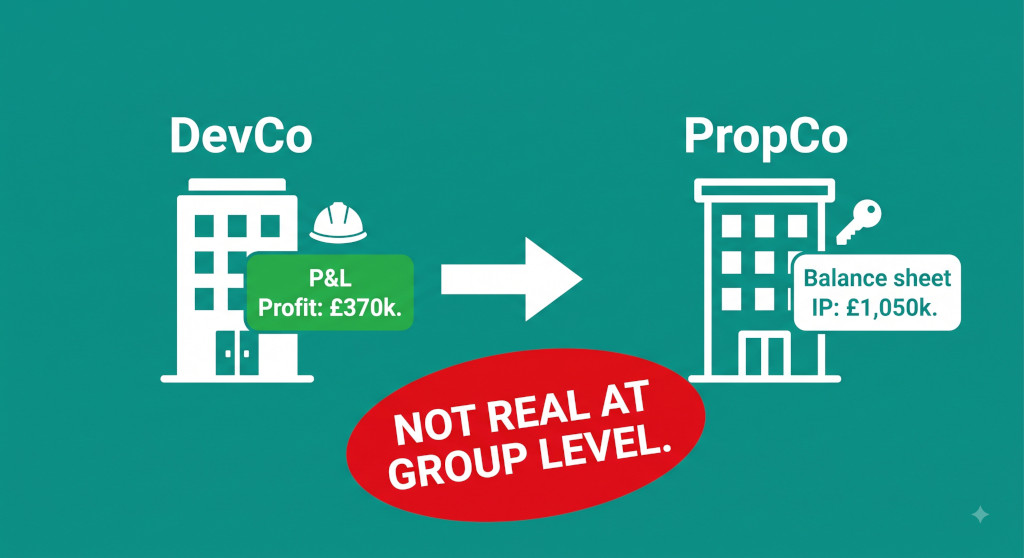
James is the group controller for Oakfield Property Group. When he closes the March year-end, Oakfield Developments Ltd — the group’s development entity — shows a disposal profit of £370,000 on a commercial unit it transferred to Merlin Yield SPV Ltd, the group’s long-term holding vehicle. The profit is real in the DevCo’s standalone accounts. The unit was independently valued at £1,050,000, and the DevCo built it for £680,000. The books are correct.
But when James prepares the group consolidation, that £370,000 vanishes. No external buyer has paid the group £1,050,000. No third party has agreed to that price. The property is still owned by the group — it just sits in a different entity. At group level, the only thing that has happened is that a property costing £680,000 to build has moved from a current asset in the DevCo to a non-current asset in the PropCo. The group is not richer by £370,000. And yet, without a correct elimination, that profit will appear in the consolidated P&L as if it were.
This is one of the most common and most persistently mishandled problems in property group consolidation. It is invisible at entity level — both the DevCo and the PropCo have prepared their accounts correctly. The problem only exists when you look across both entities and ask: has this group actually transacted with an external party? The answer is no, and the consolidation must reflect that.
Stop building consolidations in spreadsheets.
BrizoConsol automates multi-entity consolidation — setup in minutes, reports the same day.
Why Property Groups Structure This Way
The DevCo / PropCo split is standard practice in property groups for straightforward commercial reasons. Development activity — land acquisition, planning, construction, letting-up — sits in a separate entity that carries the development risk and can be wound down, refinanced, or ring-fenced without disturbing the long-term holding portfolio. Once a unit is complete and income-producing, it transfers to a PropCo SPV that will hold it for yield. That PropCo can then be financed against the stabilised asset on different terms.
Both entities serve legitimate purposes. But the moment the DevCo sells a completed unit to the PropCo, the group consolidation has a problem: the DevCo has recognised a profit that, from the group’s perspective, does not yet exist. The property has not been sold to anyone outside the group. The £370,000 is not cash the group has received from a willing external buyer — it is a number that emerged from a valuation and an internal agreement.
The consolidation test: would this profit exist if the group operated as a single entity? If the DevCo and PropCo were one company, the completed development would simply be reclassified from current assets (property stock) to non-current assets (investment property) at cost. No sale, no revenue, no profit. The profit is an artefact of the multi-entity structure.
The Entity-Level Position Before Any Elimination
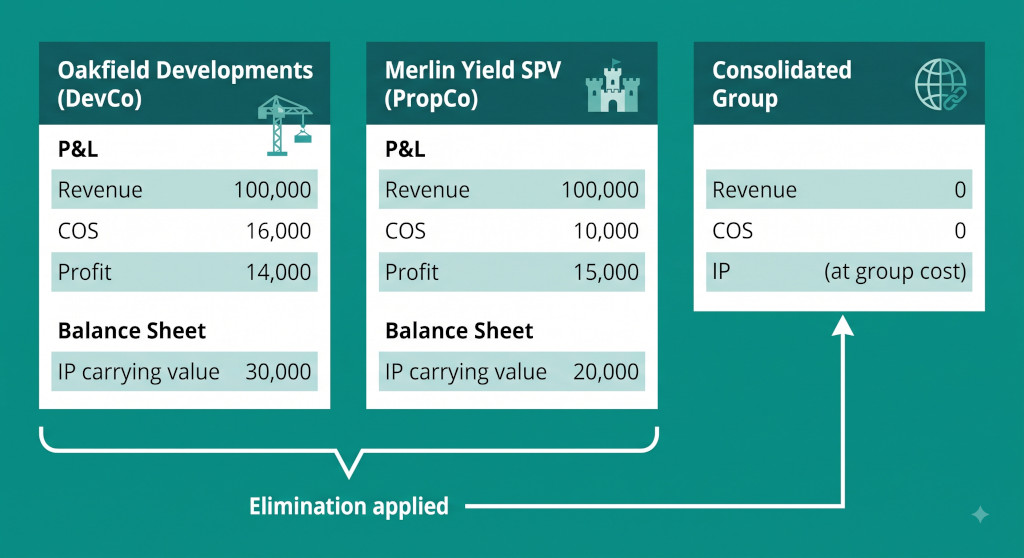
To understand what needs to be eliminated, it helps to lay out exactly what each entity has recognised and what the combined (pre-elimination) position looks like.
Oakfield Developments Ltd completes the unit in January. Build cost carried in property stock: £680,000. Agreed intercompany transfer price, based on an independent RICS valuation: £1,050,000. The DevCo records:
| Oakfield Developments — P&L extract | £ |
|---|---|
| Revenue (intragroup sale) | 1,050,000 |
| Cost of sales (build cost) | (680,000) |
| Gross profit on development | 370,000 |
Merlin Yield SPV Ltd receives the property and records it as investment property at the acquisition cost of £1,050,000. Both entities also carry an intercompany receivable (DevCo) and payable (PropCo) of £1,050,000 representing the unpaid consideration.
Before elimination, the combined group position shows revenue of £1,050,000, a gross profit of £370,000, investment property of £1,050,000 on the balance sheet, and an intercompany receivable netting against an intercompany payable of £1,050,000. None of these are correct for the consolidated accounts.
The Three Things That Must Be Eliminated
Three separate adjustments are required in the consolidation workings:
First, the intercompany receivable and payable must be eliminated against each other. This is a standard elimination — the DevCo’s trade receivable and the PropCo’s trade payable both relate to the same intragroup transaction and both disappear when you consolidate.
Second, the DevCo’s revenue and cost of sales must be eliminated from the consolidated P&L. The group did not sell anything to an external party, so no revenue should be recognised, and the corresponding cost should not flow through cost of sales.
Third — and this is the one that is most often missed or handled incorrectly — the investment property in the PropCo must be written down from the transfer price (£1,050,000) to the group’s original cost of the asset (£680,000). The group did not pay £1,050,000 to acquire this property. It paid £680,000 to build it. The consolidated balance sheet must reflect the group’s true economic investment.
The Elimination Journals
Journal 1 — Eliminate intercompany receivable and payable:
| Account | Dr | Cr |
|---|---|---|
| Intercompany payable (PropCo) | £1,050,000 | |
| Intercompany receivable (DevCo) | £1,050,000 |
Standard intercompany balance elimination. Confirm the balances agree between the two entities before proceeding — if they do not agree, investigate the discrepancy before eliminating. A mismatch here may indicate a timing difference on the payment that requires a separate in-transit adjustment.
Journal 2 — Eliminate intragroup revenue, cost of sales, and unrealised profit in investment property:
| Account | Dr | Cr |
|---|---|---|
| Revenue — development sales (DevCo) | £1,050,000 | |
| Cost of sales — development (DevCo) | £680,000 | |
| Investment property (PropCo) | £370,000 |
This single journal does three things simultaneously: removes the intragroup revenue, removes the corresponding cost of sales, and reduces the PropCo’s investment property carrying value from £1,050,000 to £680,000 — the group’s actual cost. The net effect on the consolidated P&L is zero (no profit or loss recognised). The net effect on the consolidated balance sheet is to reduce investment property by £370,000.
After both journals, the consolidated position looks like this:
| Line item | Pre-elimination | Eliminated | Consolidated |
|---|---|---|---|
| Revenue | £1,050,000 | (£1,050,000) | — |
| Cost of sales | (£680,000) | £680,000 | — |
| Gross profit | £370,000 | (£370,000) | — |
| Investment property | £1,050,000 | (£370,000) | £680,000 |
| IC receivable (DevCo) | £1,050,000 | (£1,050,000) | — |
| IC payable (PropCo) | (£1,050,000) | £1,050,000 | — |
Stop tracking intragroup eliminations in a spreadsheet
BrizoConsol maintains your elimination journals across periods — so the DevCo-to-PropCo adjustment carries forward automatically until the property is sold externally.See It In Action
Carrying the Elimination Forward: The Multi-Period Problem
The elimination does not disappear after the first year. As long as Merlin Yield SPV continues to hold the property, the unrealised profit of £370,000 remains embedded in the PropCo’s investment property carrying value at entity level. Every subsequent period, the consolidation must repeat the write-down — reducing the PropCo’s carrying value by £370,000 in the consolidation workings to keep the group’s balance sheet at group cost.
This means the elimination becomes a standing adjustment in your consolidation pack, not a one-off. It needs to be recorded in your consolidation adjustment schedule with the following details carried forward each period: the date of the original intragroup transfer, the entities involved, the DevCo’s build cost, the transfer price, and the unrealised profit to be eliminated. If you do not maintain this record, the adjustment will be missed the following year and the consolidated balance sheet will silently overstate investment property.
Watch out for staff turnover. The most common reason this elimination gets lost is that the person who prepared it in year one has left by year three. If the elimination is not documented in the consolidation workings with a clear narrative — not just a number with no explanation — the next preparer will not know it exists.
What Happens When PropCo Sells the Property Externally
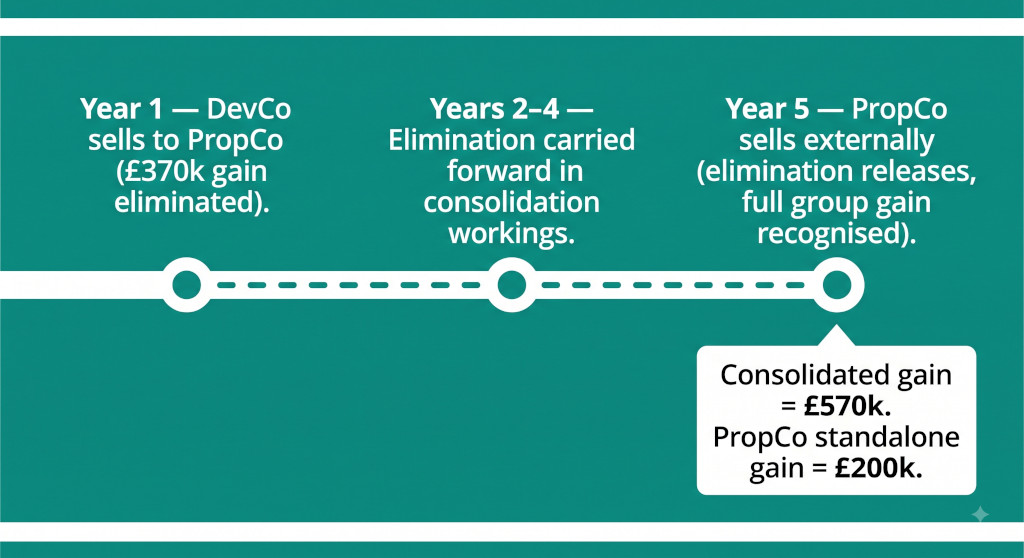
This is the point that catches many finance directors off guard. When Merlin Yield SPV eventually sells the property to a third-party buyer, the consolidated gain will be substantially larger than what the PropCo reports in its standalone accounts — and that difference is not an error. It is the correct accounting.
Say the property is sold in year five for £1,250,000. In the PropCo’s standalone accounts:
| Sale proceeds | £1,250,000 |
| Less: IP carrying value in PropCo | (£1,050,000) |
| Gain on disposal (PropCo standalone) | £200,000 |
In the consolidated accounts, the property’s carrying value is £680,000 (group cost, after elimination). The group has now realised a gain measured from its original investment:
| Sale proceeds | £1,250,000 |
| Less: IP carrying value in consolidated accounts | (£680,000) |
| Gain on disposal (consolidated) | £570,000 |
The consolidated gain of £570,000 is made up of two components: the £200,000 gain that the PropCo recognises in its own accounts (from the intragroup transfer price to the sale price), plus the £370,000 previously eliminated profit that is now realised because an external buyer has paid above the group’s original cost. In the consolidation workings, the elimination is reversed in the period of disposal:
| Account | Dr | Cr |
|---|---|---|
| Investment property — elimination reversal | £370,000 | |
| Gain on disposal of investment property | £370,000 |
This reversal is posted in the period of external disposal only. It adds the previously eliminated £370,000 back to the consolidated gain — so the total consolidated disposal gain becomes £200,000 (PropCo standalone) + £370,000 (reversal) = £570,000. The group now recognises the full gain from its original economic investment of £680,000 to the external sale price of £1,250,000.
The implication for cash flow forecasting is important: when the property team reports a projected disposal gain to the board, they will typically use the PropCo’s own carrying value as the base. The finance director needs to adjust for the group accounting base, which will give a higher consolidated gain number. These are both correct — they just answer different questions. The PropCo base gives the entity-level profit; the group base gives the true economic return on the group’s original investment.
What If PropCo Measures at Fair Value?
The worked example above uses the cost model — Merlin Yield SPV holds investment property at the transfer cost of £1,050,000 with no subsequent revaluation. This is the case where the unrealised profit sits frozen in the balance sheet until external disposal.
If the PropCo instead measures investment property at fair value through profit or loss (which is permitted under both IFRS and FRS 102 for investment property), the position is different. The fair value measurement provides an independent, external reference point for the property’s value. Over time, as the PropCo obtains annual valuations and reflects fair value movements through P&L, the original intercompany transfer price becomes less relevant — the property’s value is being marked to market each period.
In this case, the elimination of the gross revenue and cost of sales from the DevCo is still required (the group cannot show an intragroup sale as revenue). But the net profit may or may not need to be eliminated depending on whether the current fair value at consolidation date already supports the PropCo’s carrying amount independently of the intragroup price. If the external valuation confirms a fair value at or above the transfer price, the argument can be made that the gain is market-evidenced and the net elimination is not required — only the gross presentation (revenue vs. fair value gain reclassification) changes. This is a complex area and you should take advice specific to your reporting framework before concluding.
For most SME property groups operating under FRS 102 with investment property at cost, the straightforward rule applies: eliminate the profit, write down the IP to group cost, and track the elimination until external disposal.
Deferred Tax on the Eliminated Profit
The elimination of the £370,000 unrealised profit creates a timing difference between the group’s accounting carrying value (£680,000) and the PropCo’s tax base (£1,050,000 — what the PropCo paid and will use as the base for calculating taxable gain on future disposal). Because the PropCo’s tax base is higher than the consolidated carrying value, the group will eventually pay less tax on disposal than its accounting profit would suggest — which is a deferred tax asset at group level.
The quantum of this asset depends on the applicable tax rate. At 25% (current UK corporation tax rate), the deferred tax asset on the £370,000 elimination is approximately £92,500. This is recognised as part of the consolidation adjustment and reverses in the period of disposal, when the timing difference unwinds.
Whether to recognise this deferred tax asset depends on whether there is sufficient evidence that the group will realise a benefit — i.e., that the PropCo will eventually sell the property and generate a taxable gain. For most yield-generating investment properties, this condition is met, and the asset should be recognised. If the PropCo is a long-term hold with no foreseeable disposal, recognising the deferred tax asset requires more judgement about timing.
If your group files a tax-consolidated return where the DevCo and PropCo are within the same tax group, the intragroup transfer may be ignored for tax entirely — no gain is recognised, no tax base is stepped up. In that case, the deferred tax calculation at group level is different and you should model it on the basis of the PropCo’s actual tax position in the consolidated tax return.
The LTV Divergence Problem
There is a practical consequence of this elimination that affects how the group discusses its finances with lenders. When the PropCo obtains debt financing against the investment property, the lender will assess loan-to-value based on the SPV’s standalone accounts — where the property is at £1,050,000. The PropCo’s standalone balance sheet shows an LTV calculated on that higher figure.
But the consolidated balance sheet shows the property at £680,000. If covenants or management reporting use the consolidated carrying value, the group’s apparent LTV looks worse than the PropCo’s standalone LTV — even though the actual physical asset is worth the same amount and is secured to the same lender.
Finance directors need to manage this divergence carefully. The narrative for the board and for lenders should distinguish between the consolidated accounting position (reflecting group cost) and the asset’s current market value (which is independent of both the group cost and the intercompany transfer price). Presenting the group’s investment property on a market-value basis in a note to the consolidated accounts, alongside the accounting carrying value, is good practice and avoids the confusion that arises when board members compare the consolidated balance sheet to the SPV’s financing papers.
A Practical Checklist for Property Groups With DevCo-to-PropCo Transfers
- Identify all intragroup property transfers in the period. Pull the DevCo’s disposal schedule and confirm which transfers were to entities within the consolidation perimeter. Any intragroup transfer requires an elimination, regardless of whether the transfer price was independently supported.
- Agree the group’s original cost for each transferred property. This is the DevCo’s carrying value (typically build cost plus attributable development overheads) immediately before the transfer, not the transfer price. Obtain this from the DevCo’s asset records.
- Calculate the unrealised profit. Transfer price minus group cost = the amount to be eliminated. Document this in your consolidation adjustment schedule with the entity names, transfer date, and asset description.
- Post Journal 1: eliminate the intercompany receivable and payable. Confirm the balances agree before eliminating. Investigate any discrepancy.
- Post Journal 2: eliminate DevCo revenue, COS, and write down PropCo IP. Confirm the investment property in the PropCo’s consolidation pack reduces by the correct amount after this journal.
- Record the elimination as a standing adjustment in your consolidation workings. It must carry forward every period until external disposal. Include a clear narrative — not just a debit and credit — so the next preparer understands what it represents.
- Assess deferred tax on the elimination. Calculate the timing difference between the group’s consolidated carrying value and the PropCo’s tax base. Recognise a deferred tax asset if there is sufficient evidence of future disposal.
- On external disposal of the property: reverse the elimination. The prior elimination is released to the consolidated gain on disposal in the period of the external sale. Confirm the total consolidated gain equals (sale proceeds minus original group cost), and that this reconciles to (PropCo standalone gain plus reversal of accumulated elimination).
- Reconcile the LTV narrative. Where lender or board reporting references investment property values, ensure a clear distinction is maintained between the accounting carrying value (cost model), the group-cost base (for elimination tracking), and the current market value.
Consolidating a property group with DevCo and PropCo entities?
BrizoConsol tracks your intercompany eliminations period to period — including the DevCo-to-PropCo adjustments that need to carry forward until external disposal. Start Free Trial