BrizoConsol vs Joiin: Which Group Reporting Tool Is Right for Your Multi-Entity Group?
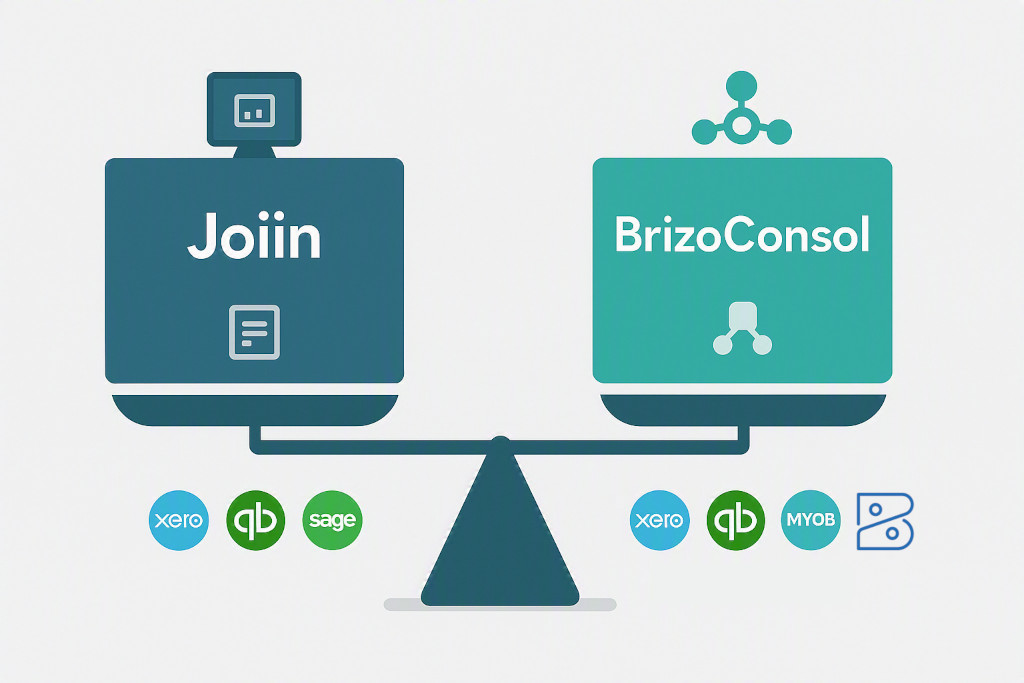
When a multi-entity group outgrows spreadsheet consolidation and starts evaluating purpose-built tools, two names frequently appear on the shortlist: Joiin and BrizoConsol. Both connect to popular cloud accounting systems, both produce consolidated financial statements across multiple entities, and both are designed for finance teams who need group accounts without enterprise-level complexity or cost.
The two tools approach the problem from different angles, however, and the right choice depends on the specific needs of your group. This comparison covers the key differences — accounting system connections, intercompany eliminations, multi-currency handling, technical consolidation depth, and accounting firm workflow — to help finance directors and practice managers make an informed decision.
At a Glance
| Joiin | BrizoConsol | |
|---|---|---|
| Primary audience | Finance teams and accountants needing fast management reporting for straightforward groups | Finance teams and accounting firms needing technically correct statutory consolidation |
| Accounting systems | Xero, QuickBooks Online, Sage | Xero, QuickBooks, MYOB, Zoho Books |
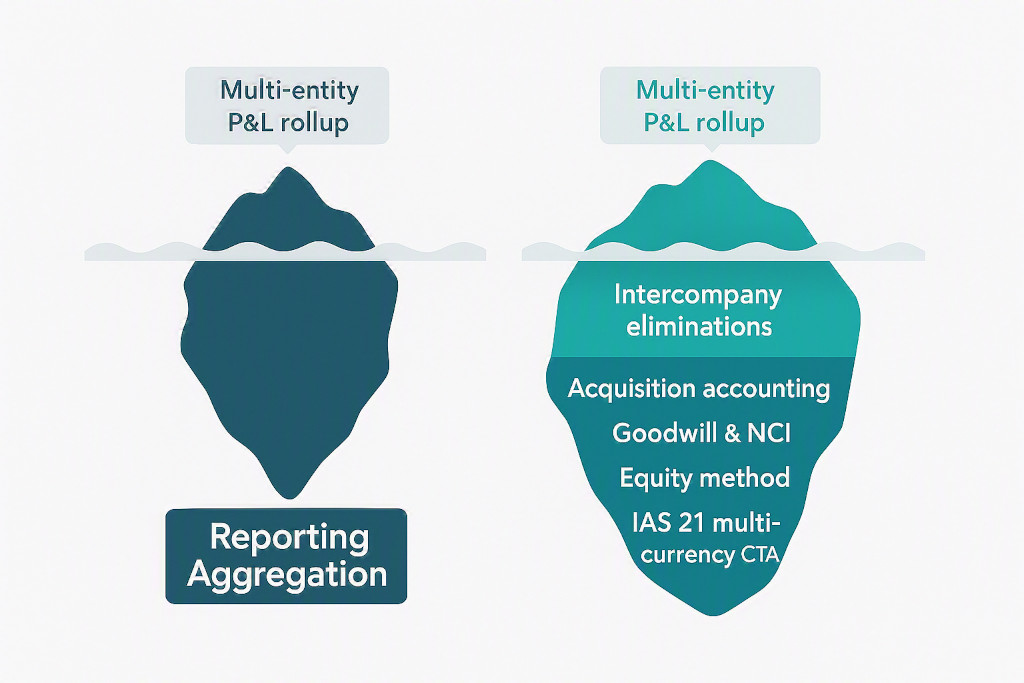
| Consolidation depth | Reporting aggregation — intercompany mapping, multi-currency conversion | Full consolidation engine — IAS 21 CTA, NCI, goodwill, acquisition accounting, equity method |
| Multi-currency | Currency conversion supported; CTA not automatically calculated | IAS 21 closing/average rate translation; CTA calculated and posted to equity automatically |
| Unrealised profit elimination | Not natively supported | Supported; configurable by entity and margin rate |
| Best for | Simple structures on Xero/QuickBooks/Sage; management reporting focus | Mixed platforms; acquisition history; statutory accounts under IFRS, FRS 102, or US GAAP |
| Free trial | Available | Available |
The sections below cover each area in detail.
Stop building consolidations in spreadsheets.
BrizoConsol automates multi-entity consolidation — setup in minutes, reports the same day.
What Joiin Does
Joiin is a cloud-based group reporting tool designed to aggregate financial data from multiple entities and produce consolidated P&Ls, balance sheets, and dashboards. It connects to Xero, QuickBooks Online, and Sage, and is particularly well regarded for the speed and simplicity with which a consolidated view can be set up for a group already using those platforms. Joiin’s primary strength is reporting: it is designed to deliver a clear, presentable multi-entity financial picture quickly, with minimal configuration.
It is a popular choice for accountants and bookkeepers managing groups where the consolidation requirements are relatively straightforward — same currency, no complex intercompany structures, and a need primarily for management reporting rather than statutory consolidated accounts.
What BrizoConsol Does
BrizoConsol is a financial consolidation platform built specifically for the technical requirements of group consolidation under IFRS, FRS 102, and US GAAP. It connects to Xero, QuickBooks, MYOB, and Zoho Books, and is designed to handle the full consolidation workflow: intercompany eliminations, multi-currency translation with IAS 21 CTA, acquisition accounting, goodwill, non-controlling interests, and the equity method for associates and joint ventures.
BrizoConsol serves both the finance teams of mid-market groups and the accounting firms that prepare group accounts for their clients. Its depth is oriented towards groups where the consolidation itself — not just the reporting — needs to be technically correct.
Accounting System Connections
The first question for any multi-entity group is whether the tool connects to all of the accounting systems in use across the group. Mixed-platform groups — where entities use different software — are common and often overlooked in product comparisons.
| Accounting System | Joiin | BrizoConsol |
|---|---|---|
| Xero | Direct API connection | Direct API connection |
| QuickBooks Online | Direct API connection | Direct API connection |
| Sage | Direct API connection | Not currently supported |
| MYOB | Not supported | MYOB AccountRight & MYOB Business via direct API |
| Zoho Books | Not supported | Direct API connection |
| Excel import | Via Excel Add-in | Supported |
| CSV / manual import | Supported | Supported |
For groups where all entities run on Xero or QuickBooks, both tools connect equally well. The difference becomes material for any group that includes MYOB or Zoho Books entities — Australian and New Zealand groups with MYOB users, or international groups with entities on Zoho. For those groups, BrizoConsol is the only option of the two that can connect directly; Joiin users would need to export and import manually, which reintroduces the very manual data handling that consolidation software is meant to eliminate.
Intercompany Eliminations
| Feature | Joiin | BrizoConsol |
|---|---|---|
| Intercompany balance elimination | Supported; configured by mapping intercompany accounts | Supported; automated matching and elimination with reconciliation reporting |
| Intercompany trading elimination (P&L) | Supported at the account level | Supported; includes unrealised profit on inventory elimination |
| Management fee elimination | Supported via account mapping | Configured as standing elimination; auto-applied each period |
| Intercompany loan elimination | Balance sheet matching available | Full balance and interest elimination; mismatch reporting |
| Unrealised profit on interco inventory | Not natively supported | Supported; configurable by entity and margin rate |
Both platforms allow intercompany eliminations to be configured, but the depth differs. For groups with straightforward intercompany structures — management fees and intercompany loans only — both tools will handle the work adequately. Where groups have intercompany inventory sales with unrealised profit in closing stock (common in manufacturing, distribution, and retail groups), BrizoConsol’s native support for this elimination avoids the manual adjustment that is otherwise required outside the system.
Multi-Currency and IAS 21 Translation
| Feature | Joiin | BrizoConsol |
|---|---|---|
| Multi-currency reporting | Supported; entities reported in group currency | Supported |
| Closing rate / average rate translation | Configurable exchange rates | IAS 21 closing rate (B/S) and average rate (P&L) applied separately |
| Currency translation adjustment (CTA) | Not automatically calculated and posted to equity | CTA automatically calculated and posted to foreign currency translation reserve in group equity |
This is one of the more significant technical differences between the two tools. Joiin converts foreign entity figures into the group currency, but the currency translation adjustment — the difference arising from translating balance sheet items at the closing rate and P&L items at the average rate, which must be taken to equity under IAS 21 — is not automatically calculated and posted. Groups producing statutory consolidated accounts under IFRS or FRS 102 need this figure to be correct, and computing it outside the system adds a manual step and a potential source of error.
Technical Consolidation Depth
| Feature | Joiin | BrizoConsol |
|---|---|---|
| Acquisition date journals | Not supported | Configured at acquisition; standing adjustments applied automatically |
| Goodwill recognition and tracking | Not supported | Full goodwill and partial goodwill methods; tracked separately on group balance sheet |
| Non-controlling interest (NCI) | Not supported | NCI in equity and NCI share of profit calculated and presented automatically |
| Equity method (associates / JVs) | Not supported | Non-consolidated entity treatment supported; investment carrying amount requires manual journal adjustment |
| Acquired intangible amortisation | Not supported | Amortisation of PPA intangibles posted as standing consolidation adjustment |
| Consolidated cash flow statement | Available | Indirect method consolidated cash flow with intercompany adjustments |
| Virtual Groups (segment reporting) | Company grouping for reporting subsets; not a consolidation-level virtual entity | Virtual groups by geography, brand, division, or any custom segment |
| Audit trail on consolidation adjustments | Limited | Full audit trail on all eliminations and consolidation journals |
Joiin is well suited to what it is designed to do: delivering a fast, clear multi-entity financial picture for groups where the consolidation adjustments are simple. BrizoConsol is built for groups where the consolidation itself needs to be technically correct — where auditors, lenders, or investors will scrutinise the group accounts against IFRS or FRS 102.
Accounting Firm Workflow
Both tools are used by accounting firms managing group reporting for clients. The right choice depends on the accounting systems your clients use and the technical complexity of the consolidations you are preparing.
| Joiin | BrizoConsol | |
|---|---|---|
| Client accounting systems | Xero, QuickBooks Online, Sage | Xero, QuickBooks, MYOB, Zoho Books |
| Best fit for | Straightforward groups on Xero or QuickBooks needing fast, presentable management reporting | Groups with MYOB or Zoho Books entities, or groups requiring statutory-quality consolidated accounts |
| Statutory accounts support | Management reporting focus; limited statutory consolidation depth | IFRS, FRS 102, and US GAAP; designed for statutory consolidated accounts |
| Multi-client management | Client separation supported | Client separation, role-based access control, and multi-client delivery from a single platform |
| Complex consolidation scenarios | Not designed for acquisition accounting, NCI, or equity method | Full support for acquisition accounting, goodwill, NCI, equity method, and unrealised profit elimination |
For firms whose clients are straightforward Xero or QuickBooks groups with no complex consolidation requirements, Joiin provides a fast and professional reporting output. For firms whose clients include MYOB or Zoho Books users, groups that have grown through acquisition, or groups that need statutory-quality consolidated accounts, BrizoConsol provides the technical depth and multi-platform connectivity that makes it the appropriate choice.
Which Tool Should You Choose?
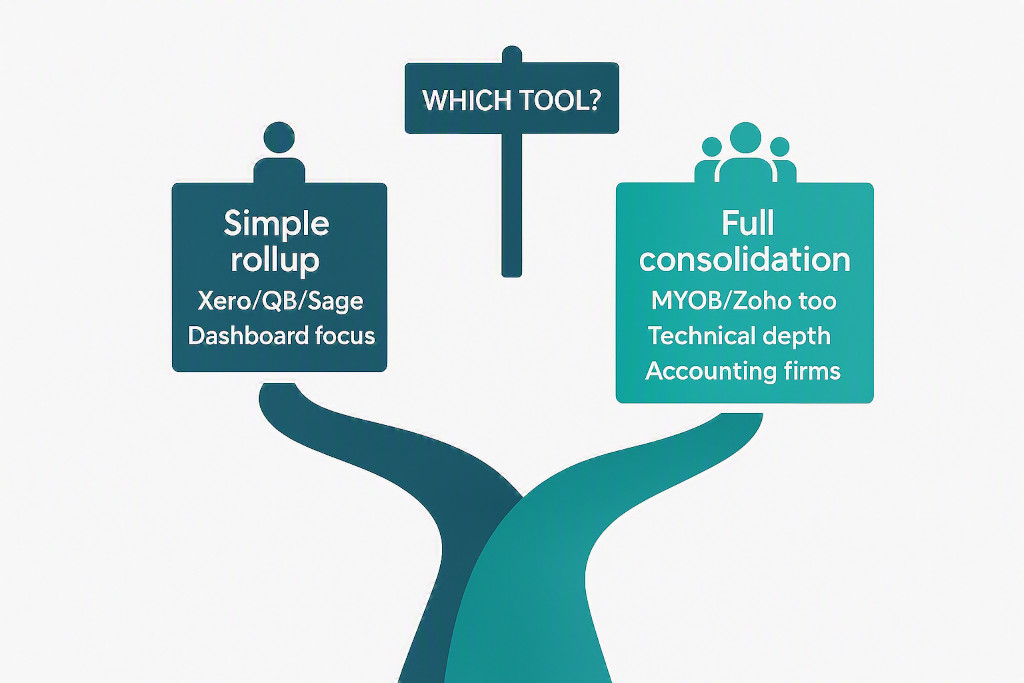
Joiin may be the right fit if…
- All your entities run on Xero, QuickBooks Online, or Sage — no MYOB or Zoho Books.
- Your consolidation requirements are straightforward: no acquisition accounting, no goodwill, no NCI, no equity method associates.
- You are primarily producing management reports rather than statutory consolidated accounts.
- Speed of setup and ease of use are the primary criteria.
- Your group operates in a single currency, or multi-currency translation without a formally calculated CTA is sufficient for your purposes.
BrizoConsol is likely the better fit if…
- One or more entities use MYOB (AccountRight or Business) or Zoho Books.
- Your group has grown through acquisition and carries goodwill, acquired intangibles, or non-controlling interests that need to be reflected correctly in the group accounts.
- You hold interests in associates or joint ventures that require equity method accounting.
- You produce statutory consolidated accounts under IFRS, FRS 102, or US GAAP and need the consolidation to be technically correct — including IAS 21 currency translation with automatic CTA.
- You have intercompany inventory sales with unrealised profit that needs to be eliminated.
- You are an accounting firm managing group consolidations for multiple clients, including clients on MYOB or mixed platforms.
- You need segment or virtual group reporting by geography, brand, or division in addition to legal entity consolidation.
Summary
Joiin and BrizoConsol are both credible tools in the group reporting space, but they serve different points on the complexity spectrum. Joiin is a well-designed reporting aggregation tool for groups where the consolidation is simple and the accounting platforms are Xero, QuickBooks, or Sage. BrizoConsol is a full consolidation platform for groups that need technical depth — acquisition accounting, MYOB and Zoho Books connectivity, IAS 21 multi-currency translation, equity method associates, and an audit trail that supports statutory accounts.
For groups starting their consolidation journey with simple structures, Joiin is a reasonable starting point. For groups that have outgrown simple aggregation — or that never fitted it in the first place — BrizoConsol provides the consolidation engine that the accounts actually require. The post on what financial consolidation software does and why your group needs it covers the full range of capabilities to look for when evaluating tools in this space.
See BrizoConsol in Action
Connect your entities — Xero, QuickBooks, MYOB, or Zoho Books — and run your first consolidated group P&L in minutes. No spreadsheets, no manual eliminations. Start Free Trial