Financial Consolidation for E-commerce Groups: How Multi-Entity Online Retail Businesses Get Clean Group Accounts
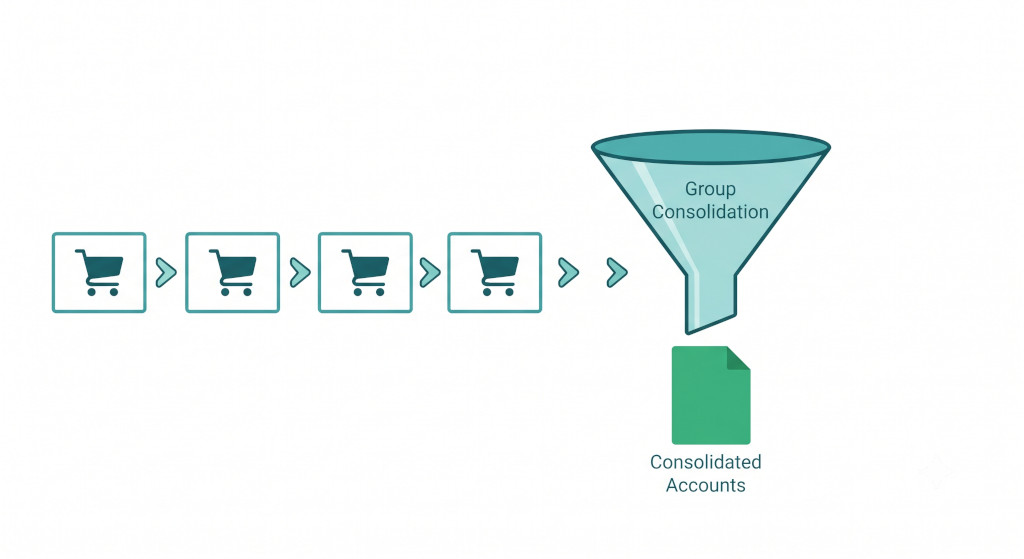
A fast-growing online retailer typically starts life as a single entity. Then it expands into a second market, sets up a separate legal entity to manage local tax and regulatory obligations, and brings in a third entity to hold the fulfilment infrastructure. Before long there is a UK trading company, an Australian holding company, a US marketplace entity, and a logistics subsidiary — each on its own accounting system, each closing its books on a slightly different timeline, each using a chart of accounts that made perfect sense when it was first set up.
Getting clean, consolidated group accounts out of that structure is one of the more underappreciated challenges in e-commerce finance. The numbers are high-volume, the intercompany flows are frequent, the currencies are multiple, and the accounting systems are rarely the same across entities. This guide covers how multi-entity e-commerce groups approach financial consolidation, what makes the e-commerce structure genuinely different from other industries, and how purpose-built consolidation software changes the process.
The E-commerce Group Structure That Creates Consolidation Complexity
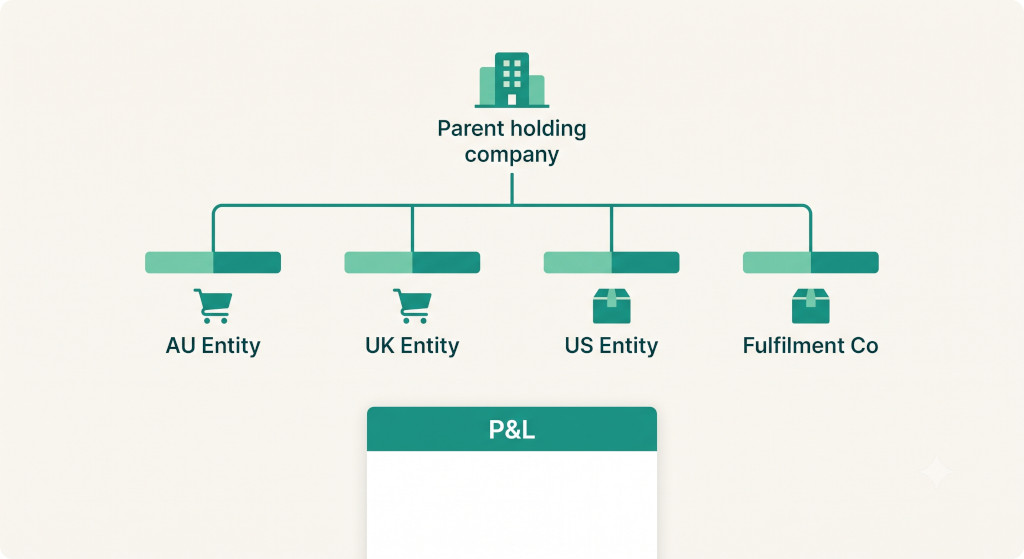
Most multi-entity e-commerce groups arrive at their structure organically rather than by design, which means the legal and operational structure rarely maps neatly onto a clean consolidation hierarchy. A typical mid-size group might look something like this.
Automate NCI calculations across all your entities.
BrizoConsol handles non-controlling interest automatically — no manual adjustments required.
A typical mid-size e-commerce group looks something like this:
| Entity | Role | Intercompany flows |
|---|---|---|
| Holding company | Owns all trading subsidiaries; charges management fees | Management fee income → subsidiaries |
| Country trading entities (one per market) | Revenue recognition, local tax compliance, local employment | Receives stock from fulfilment entity; pays management fees and royalties |
| Fulfilment / logistics entity | Holds inventory, operates warehouses | On-charges stock to trading entities at transfer price |
| IP holding entity | Holds brand and trademarks | Charges royalties to trading companies |
That structure generates several types of intercompany transaction every month: stock transfers, management fees, royalty charges, and intercompany loans between any combination of the above. Each must be identified and eliminated before the group accounts mean anything.
The defining challenge of e-commerce consolidation is not the number of entities — it is the volume of intercompany transactions. A group doing £20m in group revenue might process several hundred intercompany stock transfer and recharge lines per month, each of which needs to be matched and eliminated.
Intercompany Stock Transfers and Unrealised Profit
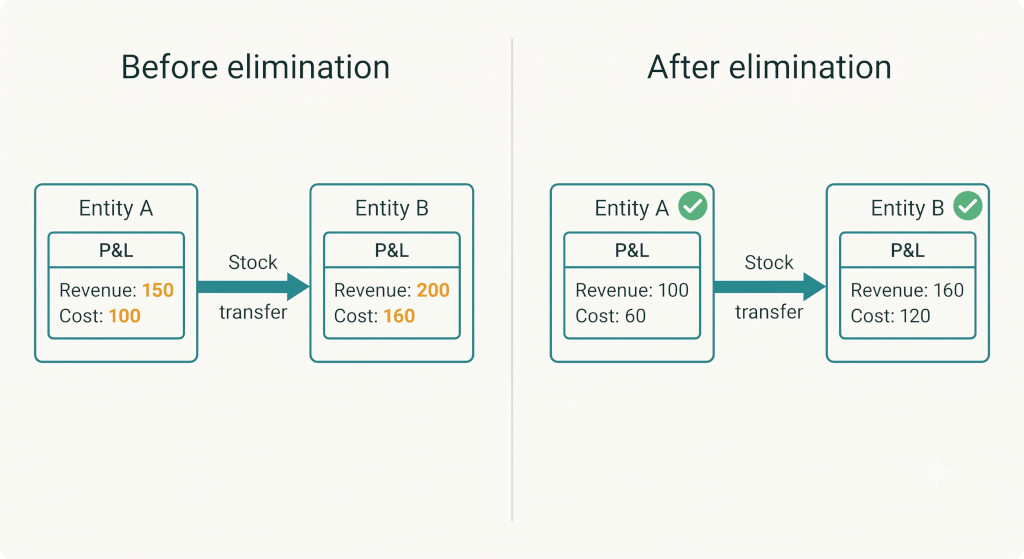
The most e-commerce-specific consolidation challenge is the treatment of intercompany stock transfers where the selling entity recognises a margin on the transaction.
Consider a fulfilment entity that purchases inventory at cost and transfers it to a trading subsidiary at a 15% mark-up. In the entity accounts, the fulfilment entity records revenue and a profit; the trading subsidiary records the stock at the transfer price. If that stock has not yet been sold to an external customer by the period end, the group accounts contain unrealised profit — profit that has been recognised internally but not yet earned from a third-party sale.
Under IFRS 10 and equivalent standards, that unrealised profit must be eliminated on consolidation. The elimination reduces the carrying value of the inventory on the consolidated balance sheet and removes the corresponding profit from the consolidated P&L. Getting this right requires knowing, at each period end, how much of the transferred stock remains unsold — information that must come from inventory management systems, not just the accounting ledgers.
A Worked Example: NorthCart Group
NorthCart Group operates three entities: NorthCart Fulfilment Ltd (the inventory holder), NorthCart UK Ltd (the UK trading entity), and NorthCart AU Pty Ltd (the Australian trading entity). During June, the fulfilment entity transferred £180,000 of stock to the UK entity at cost plus 15%, creating a £23,478 intercompany margin. At 30 June, £60,000 of the transferred stock (at transfer price) remains unsold in the UK entity’s warehouse.
| Item | Amount | Consolidation Treatment |
|---|---|---|
| Total stock transferred (at cost) | £156,522 | Eliminate intercompany revenue / cost of sales |
| Transfer price mark-up (15%) | £23,478 | Eliminate intercompany profit on transfer |
| Unsold stock at period end (at transfer price) | £60,000 | Write down to cost — unrealised profit elimination |
| Unrealised profit in closing stock | £7,826 | Reduce inventory; reduce group P&L profit |
| Net adjustment to consolidated profit | £7,826 | Recognised only when stock sold externally |
This calculation needs to be performed every month, for every intercompany stock transfer, across every entity pair in the group. In a group that ships products across multiple country entities simultaneously, the number of elimination entries compounds quickly.
Multi-Currency Consolidation in E-commerce Groups
E-commerce groups are almost always multi-currency by nature. The UK entity reports in GBP, the Australian entity in AUD, and the US entity in USD. The holding company may consolidate into a fourth functional currency. Each subsidiary’s financials must be translated into the group presentation currency before consolidation can take place.
The translation rules under IAS 21 are straightforward in principle — assets and liabilities at the closing rate, income and expenses at the average rate for the period, with the resulting difference posted to the currency translation adjustment (CTA) reserve in equity — but they are tedious and error-prone to apply manually when exchange rates are moving and the group has four or more currency exposures.
For e-commerce groups, exchange rate movements also affect the value of intercompany balances. An intercompany loan from the holding company to the Australian subsidiary, for example, will carry a different AUD/GBP rate at the balance sheet date than it did when the loan was advanced. The resulting translation difference must be accounted for consistently and eliminated correctly on consolidation.
Chart of Accounts Fragmentation
Few e-commerce groups have a standardised chart of accounts across all entities. The UK entity may have been set up in Xero by the founders using a basic default chart; the Australian entity was configured by a local bookkeeper with a different preference for account granularity; the US entity uses QuickBooks with a chart that reflects US GAAP conventions.
Before any consolidation can happen, every entity’s accounts must be mapped to a common group chart of accounts. Revenue needs to roll up to the same group revenue line regardless of whether the underlying account is called “Online Sales”, “Shopify Revenue”, or “E-commerce Income”. Cost of goods needs to be separated from fulfilment costs, which need to be separated from platform fees — or combined, depending on what the group P&L is designed to show.
This mapping exercise is typically done once and then maintained as entities add or rename accounts. The burden is not the initial mapping — it is keeping it current across four or more entities whose charts of accounts evolve independently.
BrizoConsol’s AI Auto-Map feature handles the initial account mapping automatically, matching each entity’s local account names to the group chart of accounts and flagging exceptions for review. Confirmed mappings are stored and reapplied on every subsequent import, so the mapping burden is front-loaded rather than repeated each month.
The Consolidation Process for a Typical E-commerce Group
A structured monthly consolidation for a four-entity e-commerce group typically runs in five stages.
1. Entity-level close
Each entity completes its own month-end — bank reconciliations, accruals, prepayments, and any entity-specific journals. The responsible bookkeeper or accountant signs off the entity trial balance before it is pulled into the consolidation. This stage should be complete within the first three to five working days of the new month.
2. Data ingestion and account mapping
The consolidated platform pulls trial balance data from each entity’s accounting system — Xero, QuickBooks, MYOB, or Zoho Books — and applies the stored account mappings to translate each entity’s chart of accounts into the group chart. Any new or unmapped accounts are surfaced for review before the consolidation proceeds.
3. Currency translation
Each non-functional-currency entity is translated into the group presentation currency using the period’s closing and average rates. The currency translation adjustment is calculated automatically and posted to the CTA reserve in group equity.
4. Intercompany eliminations
All intercompany balances — loans, receivables, payables, revenue, cost of sales, management fees, royalties, and dividends — are matched and eliminated. Unrealised profit on intercompany stock transfers is calculated and the inventory balance adjusted. The consolidation platform flags any intercompany mismatches (where one entity has recorded a different figure to the counterparty) for resolution before the accounts are finalised.
5. Consolidation adjustments and reporting
Any group-level journals — goodwill amortisation if applicable under the group’s accounting framework, acquisition adjustments, or prior-period corrections — are posted. The consolidated P&L, balance sheet, and cash flow statement are generated, and the board or management pack is assembled for distribution.
Where Manual Consolidation Breaks Down for E-commerce Groups
The five-stage process above is manageable for a two-entity group with light intercompany activity. It becomes genuinely painful once the group reaches three or more entities with regular intercompany stock transfers and multiple currencies. The most common failure modes are:
Intercompany mismatches caught too late
Matching is done manually in a spreadsheet with no shared visibility. Discrepancies surface at the end of the close rather than at the start, forcing late-stage corrections under time pressure.
Unrealised profit calculated on the wrong closing stock figure
Inventory data is not available at period end, or the formula in the spreadsheet references the wrong cell. The unrealised profit elimination is either missed or applied to an incorrect amount.
Purpose-built financial consolidation software addresses each of the above failure modes directly. Intercompany matching is automated — every intercompany balance is compared to its counterparty in real time, and mismatches surface immediately rather than at the end of the close. Account mapping is stored and maintained centrally, so new accounts are flagged the first time they appear rather than silently missing from the group roll-up. Currency translation is applied automatically using rates entered once per period, with the CTA calculated and posted without manual intervention.
For e-commerce groups specifically, the gains are most visible in two areas. First, the intercompany elimination workload — which in a four-entity group with active stock transfers can run to forty or fifty individual elimination entries per month — is reduced to a review and approval task rather than a preparation task. Second, the account mapping maintenance burden is managed centrally rather than scattered across multiple spreadsheets owned by different members of the finance team.
The result is a consolidated close that completes in days rather than weeks, with a clear audit trail for every elimination and every currency translation movement — something that becomes important when the group is preparing for external audit, a fundraising round, or a sale process.
Conclusion: E-commerce Finance Teams Deserve a Faster Close
Multi-entity e-commerce groups have some of the most demanding consolidation requirements of any sector — high transaction volumes, frequent intercompany stock transfers, multiple currencies, and accounting systems that were never designed to talk to each other. The manual response to that complexity is a month-end close that consumes most of the finance team’s capacity and produces results that are difficult to audit and even harder to explain under scrutiny.
The alternative is a consolidation process built around the specific structure of an e-commerce group: automated intercompany matching, centrally managed account mappings, currency translation applied at the correct rates, and unrealised profit eliminations calculated from live inventory data. That process closes in days, not weeks, and produces consolidated accounts the CFO can stand behind.
For e-commerce finance teams that have outgrown the spreadsheet model, BrizoConsol provides that consolidation layer — connecting directly to Xero, QuickBooks, MYOB, and Zoho Books, and automating the elimination and translation work that currently consumes the close.
Consolidate Your E-commerce Group in Days, Not Weeks
BrizoConsol connects to Xero, QuickBooks, MYOB, and Zoho Books to automate intercompany eliminations, currency translation, and group reporting for multi-entity online retail groups. Start Free Trial