Fiscal Year Alignment in Group Consolidation: Rules, Options, and the Three-Month Rule Explained
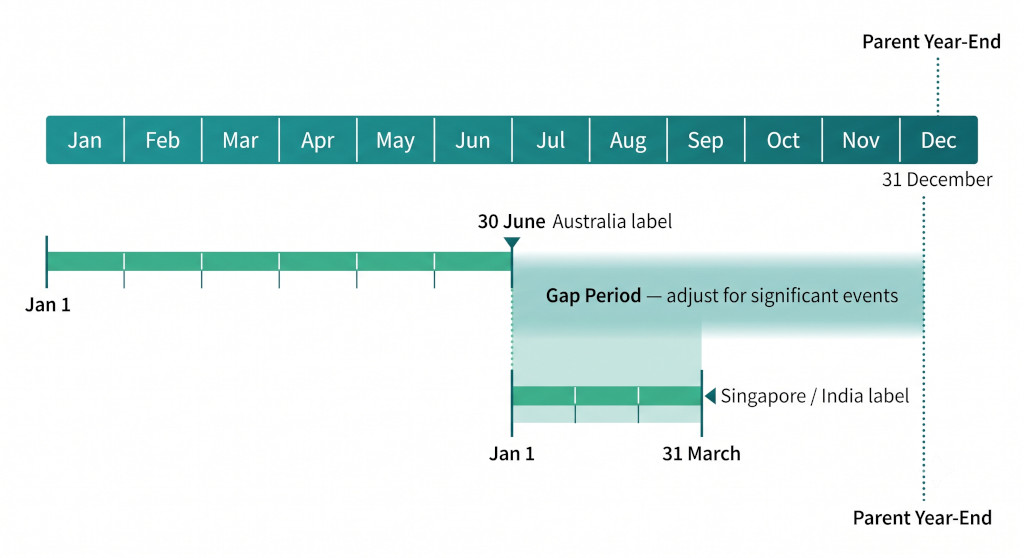
One of the less-discussed but practically significant challenges in group consolidation is the fiscal year mismatch. A parent company reporting on a 31 December year-end acquires a subsidiary in Australia, where the statutory year-end is 30 June. Or it expands into Singapore, where many companies use a 31 March year-end. Or into India, where 31 March is mandatory for most entities. Each of these creates a gap between when the subsidiary’s accounts close and when the parent needs to consolidate them.
How that gap is handled is governed by each major accounting framework — and the rules are stricter than many finance teams assume. Every standard that addresses this question limits the permissible gap to three months. Beyond that, the subsidiary must prepare a special set of accounts aligned to the parent’s reporting date. This post covers the rules under IFRS, US GAAP, and FRS 102; the three practical options available when year-ends are misaligned; what events in the gap period require adjustment; and how currency translation works when the subsidiary’s period-end differs from the parent’s.
Why Year-End Alignment Matters
Consolidated financial statements are supposed to represent the financial position and performance of the group as a single economic entity at a single point in time. When different entities within the group are measured at different dates, that premise breaks down. A subsidiary that reports its balance sheet position as at 30 June — six months before the parent’s 31 December year-end — will include assets and liabilities that may have changed materially in the interim. Revenue earned and expenses incurred between 1 July and 31 December will be missing from the consolidated income statement entirely if no adjustment is made.
Stop building consolidations in spreadsheets.
BrizoConsol automates multi-entity consolidation — setup in minutes, reports the same day.
Misaligned year-ends also create practical risks beyond accounting accuracy: intercompany balances may not offset, intercompany transactions may be recognised in different periods, and auditors must assess whether gap-period events have been properly considered. The longer the gap, the greater these risks.
The Three-Month Rule: Standard by Standard
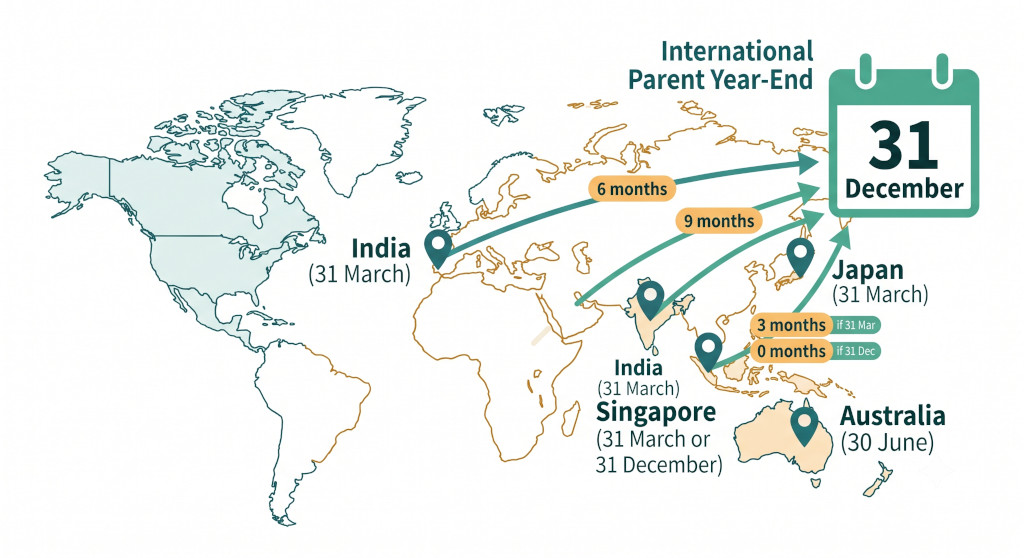
Every major consolidation standard converges on the same maximum gap: three months. The wording differs but the principle is consistent.
IFRS 10 (and SFRS(I) 10) — Paragraphs B92 and B93
“The financial statements of the parent and its subsidiaries used in the preparation of consolidated financial statements shall be prepared as of the same reporting date. When the end of the reporting period of a parent is different from that of a subsidiary, the subsidiary prepares, for consolidation purposes, additional financial information as of the same date as the financial statements of the parent… If it is impracticable to do so, the parent shall consolidate the financial information of the subsidiary using the most recent financial statements of the subsidiary adjusted for the effects of significant transactions or events that occur between the date of those financial statements and the date of the consolidated financial statements. In any case, the difference between the date of the subsidiary’s financial statements and that of the consolidated financial statements shall be no more than three months.”
US GAAP — ASC 810-10-45-12
“When the fiscal year of a consolidated entity differs from that of the parent, it ordinarily is practicable to prepare, for consolidation purposes, statements for a period that corresponds to or closely approaches the fiscal year of the parent. If the difference in fiscal year-ends does not exceed about three months, it usually is acceptable to use, for consolidation purposes, the entity’s statements prepared as of its own fiscal year-end.”
UK GAAP — FRS 102 Paragraph 9.16
“The financial statements of all entities in a group shall normally be prepared to the same reporting date. If it is impracticable to do so, financial statements prepared to a different date may be used, provided that the difference is not more than three months and adjustments are made for the effects of any significant transactions or events that occur between the different date and the group reporting date.”
Three months is therefore the hard limit across all frameworks. A subsidiary with a year-end that falls more than three months before or after the parent’s must either be aligned or must prepare special-purpose accounts as of the parent’s date. The “impracticable” exception in IFRS 10 and FRS 102 is narrow — it is meant for situations where preparing aligned accounts is genuinely not possible (recently acquired subsidiaries mid-period, complex regulatory constraints), not a general opt-out from the preparation burden.
Consistency requirement (IFRS 10 B93): Once a gap is established, the length of the reporting period and the size of the gap must be the same from period to period. A group that consolidates its Australian subsidiary using a 30 June year-end (six-month gap) cannot switch to using stub-period accounts in a subsequent year without disclosure and a valid reason. Consistency matters both for the auditors and for the comparability of the consolidated accounts.
Common Misalignment Scenarios by Country
| Subsidiary jurisdiction | Common statutory year-end | Gap vs 31 Dec parent | Gap vs 30 Jun parent | Within three months? |
|---|---|---|---|---|
| Australia | 30 June | 6 months | 0 | No (vs 31 Dec) / Yes (vs 30 Jun) |
| India | 31 March (mandatory) | 9 months | 3 months | No (vs 31 Dec) / Borderline (vs 30 Jun) |
| Japan | 31 March (most listed) | 9 months | 3 months | No (vs 31 Dec) / Borderline (vs 30 Jun) |
| Singapore | 31 March or 31 December | 0 or 9 months | 3 or 6 months | Depends on chosen year-end |
| UK | 31 December or 31 March | 0 or 9 months | 6 or 3 months | Depends on chosen year-end |
| Any | 31 December | 0 | 6 months | Yes (vs 31 Dec) / No (vs 30 Jun) |
The most common problem for 31 December parent groups is the Australian subsidiary (six-month gap) and the Indian or Japanese subsidiary (nine-month gap). Both exceed the three-month limit and require one of the three approaches described below.
Three Practical Options When Year-Ends Differ
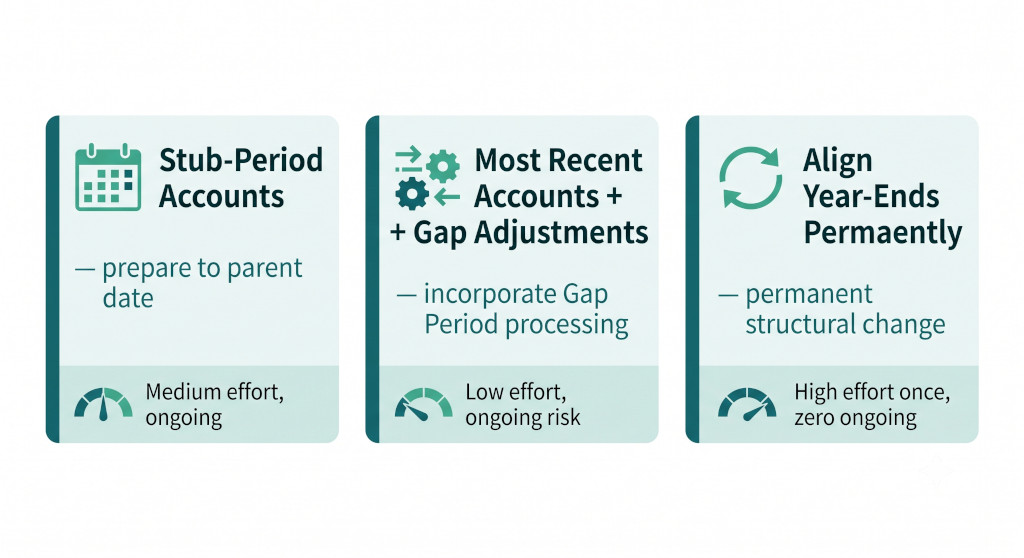
Option 1
Prepare Stub-Period Accounts to the Parent’s Reporting Date
The subsidiary prepares a special set of management accounts (or full statutory accounts where required) as at the parent’s year-end date. For an Australian subsidiary with a 30 June year-end and a 31 December parent, this means preparing a second set of accounts for the period 1 July to 31 December — a six-month stub period. These stub-period accounts are what feeds into the group consolidation. The subsidiary’s own statutory accounts (to 30 June) continue to be filed with ASIC as normal.
AdvantagesFully aligned with parent date. No gap-period estimate risk. Cleanest audit position. Required by IFRS 10 as the primary approach unless impracticable.
DisadvantagesOngoing resource cost — finance team must close two sets of books each year. Can delay group close if subsidiaries are slow. Audit cost may increase.
Option 2
Use Most Recent Accounts with Gap-Period Adjustments
Where preparing stub-period accounts is genuinely impracticable — immediately post-acquisition, or for smaller subsidiaries without sufficient finance resource — the subsidiary’s most recent statutory accounts are used for consolidation, adjusted for significant transactions and events that occurred between the subsidiary’s year-end and the parent’s reporting date. This option is only permissible if the gap does not exceed three months. For an Australian subsidiary (six-month gap) or an Indian subsidiary (nine-month gap), this option is simply not available without first aligning the year-ends.
AdvantagesLower ongoing cost. Relies on existing statutory accounts. Suitable for small or newly acquired subsidiaries within the three-month window.
DisadvantagesOnly available for gaps of three months or less. Requires a robust process for identifying significant gap-period events. Increases audit scrutiny. Risk of incomplete adjustment if significant events are missed.
Option 3
Align Year-Ends Permanently
The cleanest long-term solution is to change the subsidiary’s statutory year-end to match the parent’s. This involves a regulatory filing in the subsidiary’s jurisdiction and, in most cases, a stub accounting period in the year of change (for example, a nine-month period from 1 April to 31 December when changing from a 31 March to 31 December year-end). Most jurisdictions allow year-end changes, though some impose restrictions — UK companies can typically shorten their year-end freely but can only extend once every five years, while Singapore’s ACRA process requires a straightforward notification filing. Tax authorities must also be notified separately, and the stub period may have its own tax implications.
AdvantagesEliminates the problem permanently. Reduces ongoing finance team workload. Simplifies audit. Removes gap-period event risk every year.
DisadvantagesOne-time effort and cost. Stub-period tax return required. May disrupt local reporting cycles and relationships with local auditors. Regulatory filing required in each jurisdiction.
For groups with more than two or three subsidiaries outside the three-month window, Option 3 — aligning year-ends — almost always produces the best long-term outcome on a cost-benefit basis. The one-time effort of alignment is typically recovered within two or three reporting cycles through reduced ongoing stub-period and adjustment work.
What Counts as a “Significant” Gap-Period Event?
Under Option 2, the consolidation team must assess which events occurring between the subsidiary’s year-end and the parent’s reporting date require adjustment. The standards use the word “significant” without prescribing a quantitative threshold — it is a judgement call, but the following categories consistently require adjustment:
Events that typically require adjustment
- Acquisition or disposal of a business or major asset
- Impairment of goodwill, PP&E, or financial assets
- Significant legal judgments or settlements
- Major restructuring charges
- Significant debt issuance or repayment
- Material write-offs of inventory or receivables
- Natural disasters or other one-off events affecting asset values
- Share issuances or significant distributions to owners
Events that typically do not require adjustment
- Routine trading revenue and operating costs
- Normal capital expenditure within budget
- Minor fluctuations in working capital
- Regular payroll and tax payments
- Routine lease payments
- Normal FX movements on monetary items
- Minor changes in headcount
The practical approach is to request a summary of significant events from the subsidiary’s finance director or controller at the parent’s reporting date. This summary should be documented and retained as audit evidence. Auditors will ask for it — producing it proactively shortens the audit process.
Disclosure required: IFRS 10 paragraph B93 requires that the difference between the subsidiary’s year-end and the parent’s year-end is disclosed in the consolidated accounts, along with the reason for using a different date. FRS 102 paragraph 9.16 has the same requirement. Do not assume that a gap below three months removes the disclosure obligation — the gap must be disclosed regardless of its size once the subsidiary’s date differs from the parent’s.
Currency Translation When Year-Ends Differ
Fiscal year misalignment adds a layer of complexity to currency translation that is often overlooked. The choice of exchange rates depends on which accounts are being translated.
Option 1 — Stub-period accounts: The stub-period accounts are prepared as at the parent’s reporting date. Currency translation uses the parent’s year-end closing rate for the balance sheet and the average rate for the stub period (not the subsidiary’s full year) for the income statement. This is straightforward and consistent with the normal IAS 21 / ASC 830 methodology.
Option 2 — Most recent accounts with adjustments: This is more complex. The subsidiary’s balance sheet is as at its own year-end (say, 30 September), not the parent’s (31 December). Two approaches are used in practice:
- Translate at parent’s closing rate: The subsidiary’s most recent balance sheet is translated using the parent’s year-end closing rate — not the rate at the subsidiary’s own year-end. This means the translated balance sheet reflects the exchange rate at the parent’s date, which is the more faithful representation of the group position. Any gap-period adjustments are also translated at the parent’s closing rate. This is the approach most consistent with IAS 21’s objective.
- Translate at subsidiary’s closing rate, retranslate at parent’s rate: Some groups translate the subsidiary’s accounts at its own year-end rate and then retranslate the full balance at the parent’s closing rate, with the difference going to the translation reserve. This is operationally simpler but produces a translation reserve that includes a component relating to the gap period — which should be disclosed.
Whichever approach is adopted, it should be documented in the group accounting policy, applied consistently from period to period, and reviewed with the group auditor on first adoption.
Changing a Subsidiary’s Accounting Period: Jurisdiction by Jurisdiction
For groups pursuing Option 3, the regulatory process for changing a year-end varies by jurisdiction. The key requirements for the most common subsidiary jurisdictions are:
| Jurisdiction | Regulatory body | Process | Key constraint |
|---|---|---|---|
| Singapore | ACRA | Online notification via BizFile+; no approval required | The first accounting period after incorporation cannot be changed. Otherwise, no restriction on frequency. |
| UK | Companies House | File AA01 form online or by post | Can shorten year freely. Can only extend once in five years (maximum extension to 18 months). Exceptions apply for group alignment. |
| Australia | ASIC | Lodge Form 491 or apply for substituted accounting period (SAP) | ASIC approval required for a substituted accounting period. Tax year change requires separate ATO approval. |
| India | MCA / Registrar of Companies | Application to National Company Law Tribunal (NCLT) | 31 March year-end is mandatory for all companies incorporated in India. NCLT can grant an exception for subsidiaries of foreign companies. |
| Japan | Local Legal Affairs Bureau | Amendment of articles of incorporation; shareholder approval required | No statutory restriction on frequency; requires shareholder resolution and articles amendment. |
| Germany | Local commercial register (Handelsregister) | Registration of changed year-end; shareholder resolution required | No frequency restriction; stub year has its own audit and filing obligations. |
India — mandatory 31 March year-end: India is the most constrained jurisdiction for year-end alignment. The Companies Act 2013 mandates a 31 March year-end for all companies incorporated in India. The only exception is for companies that are subsidiaries of foreign corporates — these may apply to the National Company Law Tribunal (NCLT) for a different year-end if the holding company’s year-end differs. The NCLT process takes time and is not guaranteed; most groups consolidating Indian subsidiaries use Option 1 (stub-period accounts to 31 December) or accept a nine-month gap with Option 2 restricted to a three-month window if they close the parent in March.
Building the Process into Your Group Close
Fiscal year misalignment is most manageable when it is built into the group close timetable from the start of the year, rather than addressed reactively in the final weeks before consolidation. A well-designed timetable accounts for:
- The deadline for each subsidiary to deliver stub-period accounts or gap-period adjustment summaries to the group finance team
- Time for the group team to review gap-period events, raise queries, and obtain sign-off from subsidiary controllers
- The exchange rates to be used for each subsidiary — documented and locked before translation begins
- Disclosure drafting for the notes to the consolidated accounts
Tracking subsidiary status across different reporting dates is also where a consolidation platform adds meaningful value. When each entity’s period-end and data submission status is visible in one place, the group controller can see at a glance which subsidiaries are aligned, which have submitted stub-period accounts, and which are still outstanding — rather than managing this through a spreadsheet of email confirmations.
✅ Fiscal Year Alignment Checklist — Per Consolidation Cycle
- Map all subsidiaries to their statutory year-end dates and calculate the gap vs the parent’s reporting date
- Identify which subsidiaries fall within three months (Option 2 available), which exceed three months (Option 1 or 3 required), and which are fully aligned
- Confirm whether stub-period accounts are being prepared for misaligned subsidiaries, or whether gap-period adjustment summaries are being used (and verify the gap is within three months)
- Issue a timetable to subsidiary finance directors specifying submission deadlines for stub accounts or gap-period summaries
- Request a signed gap-period event summary from each subsidiary controller covering the period between their year-end and the parent’s reporting date
- Review gap-period summaries for significant events: acquisitions, disposals, impairments, restructurings, major financings, legal settlements
- Prepare or review adjusting entries for each identified significant event
- Confirm exchange rates to be used for translation of each subsidiary’s accounts — parent closing rate for balance sheet, appropriate average rate for income statement
- Confirm the currency translation approach for any gap-period adjustments (translate at parent’s closing rate)
- Draft or update the notes disclosure on different year-end dates, the size of the gap, and why a different date was used
- Ensure consistency with the prior period — same gap length, same approach, same disclosure
- Document the process and retain gap-period summaries as audit evidence
Managing a group with multiple year-ends?
BrizoConsol’s Month End Status panel tracks each entity’s submission status and period-end date in one view — so your group close stays on track regardless of how many different fiscal years your subsidiaries run. Start Free Trial