Intragroup Leases in Consolidation: How to Eliminate Ghost IFRS 16 Assets When Landlord and Tenant Are Both in the Group
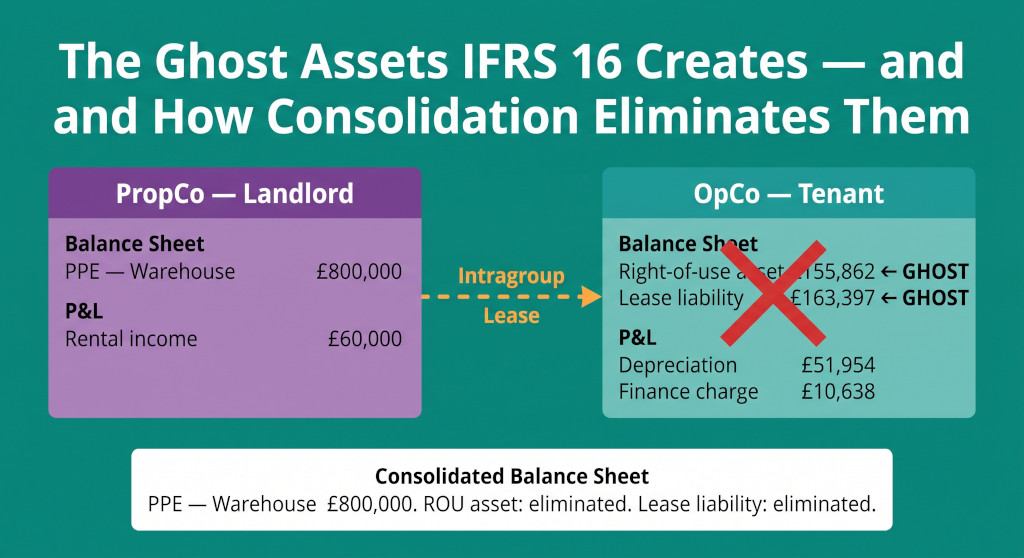
When one group entity owns a building and leases it to another group entity, something awkward happens at consolidation. The tenant is required by IFRS 16 to recognise a right-of-use asset and a corresponding lease liability on its balance sheet. The landlord continues to hold the building as property, plant and equipment. At consolidated level, the group owns the building once. There is no external lease. But the consolidation workpaper now has two representations of the same economic reality: the underlying PPE in the landlord entity’s accounts and the ghost ROU asset in the tenant entity’s accounts.
Eliminating these ghost entries is one of the more technically demanding intragroup adjustments, because IFRS 16 changed the mechanics significantly from the old IAS 17 world. Under IAS 17, the tenant showed a rental expense that matched the landlord’s rental income; the elimination was a straightforward Dr income / Cr expense. Under IFRS 16, the tenant shows depreciation on the ROU asset plus interest on the lease liability — a combination that front-loads P&L charges and never matches the landlord’s income in any individual period. The imbalance flows through retained earnings each year and must be explicitly calculated and adjusted.
This guide covers the full elimination mechanics for any group with an intragroup operating lease: what each entity shows, the four separate components to eliminate, the complete consolidation journal, and where the retained earnings timing adjustment comes from.
Stop building consolidations in spreadsheets.
BrizoConsol automates multi-entity consolidation — setup in minutes, reports the same day.
What Each Entity Shows — Before Consolidation
- Property, plant and equipment (the building) — at cost less accumulated depreciation
- No lease receivable (operating lease — PPE stays on balance sheet)
- Accrued rent receivable (if rent not yet collected at period-end)
- Rental income — typically straight-line over the lease term
- Depreciation on the underlying building (already in PropCo’s P&L — this stays at consolidation; not an IC item)
- Right-of-use asset — the discounted present value of future lease payments, depreciated straight-line over the lease term
- Lease liability — the outstanding PV of remaining payments, unwinding at the discount rate (current and non-current portions)
- Accrued rent payable (if payment not yet made at period-end)
- Depreciation: right-of-use asset (straight-line over lease term)
- Finance charge: lease liability (effective interest — highest in early years, declining)
- No rental expense — replaced entirely by the above two lines
The building appears once as PPE (PropCo) and once again — differently — as an ROU asset (OpCo). The group does not have two buildings. At consolidation, OpCo’s ROU asset and lease liability must be eliminated, along with all the P&L entries driven by the intragroup lease, and the opening retained earnings adjusted for the cumulative timing difference from prior periods.
The Four Components to Eliminate
1Right-of-use asset
Remove the ROU asset gross cost and accumulated depreciation from OpCo’s balance sheet. At consolidated level, the group owns the building as PPE — no synthetic lease right-of-use exists.
2Lease liability
Remove the outstanding lease liability from OpCo’s balance sheet. The obligation to pay rent is an intragroup cash flow — there is no external creditor. Current and non-current portions both eliminate.
3Intercompany rental income and IFRS 16 P&L charges
Eliminate PropCo’s rental income against OpCo’s IFRS 16 charges (depreciation on ROU asset + finance charge on lease liability). These items together represent the intragroup income/cost that must not appear at consolidated level.
4Accrued rent receivable / payable
If PropCo holds accrued rent receivable at period-end and OpCo holds a matching payable, eliminate both: Dr Accrued rent payable (OpCo) / Cr Accrued rent receivable (PropCo). These are standard IC balance eliminations.
Worked Example: Year 2 Consolidated Accounts
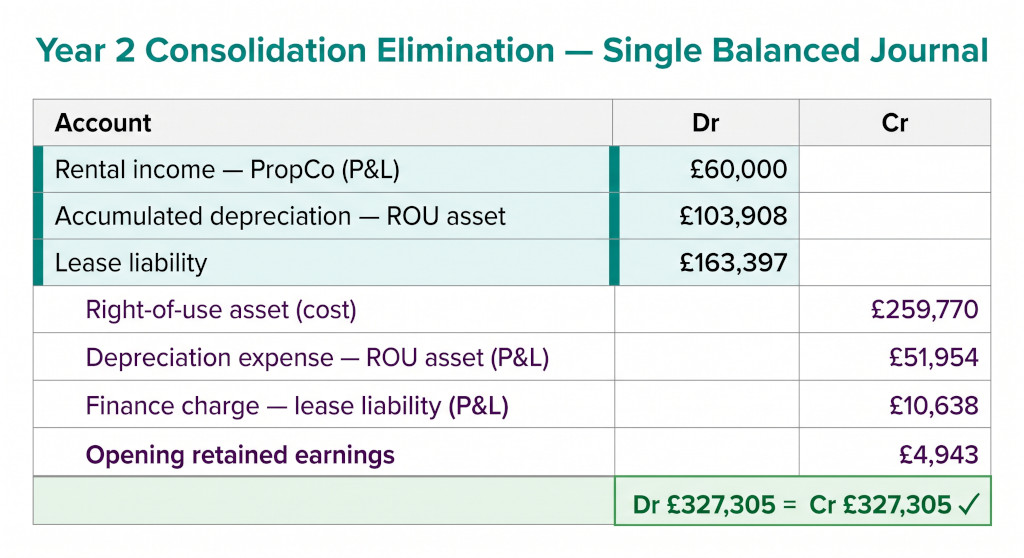
Lease terms: PropCo leases a warehouse to OpCo for 5 years at £60,000 per year, paid in arrears. Discount rate: 5%. Commencement: 1 January Year 1. Both entities report under IFRS. The lease qualifies as an operating lease in PropCo’s books (PropCo retains the building as PPE and recognises straight-line rental income). OpCo applies IFRS 16 in full (the lease is not short-term and does not involve a low-value asset).
IFRS 16 at-inception calculation (OpCo)
| Annual lease payment | £60,000 |
| Lease term | 5 years |
| Discount rate | 5% |
| Annuity factor (5 years @ 5%) | 4.3295 |
| ROU asset / Lease liability at inception | £259,770 |
Liability amortisation schedule — Years 1 and 2:
| Year | Opening liability (£) | Interest @ 5% (£) | Payment (£) | Closing liability (£) |
|---|---|---|---|---|
| Year 1 | 259,770 | 12,989 | (60,000) | 212,759 |
| Year 2 | 212,759 | 10,638 | (60,000) | 163,397 |
ROU asset at Year 2 year-end:
ROU asset movement
| Cost at inception | £259,770 |
| Annual depreciation (£259,770 ÷ 5 years) | (£51,954) |
| Accumulated depreciation after Year 1 | (£51,954) |
| Accumulated depreciation after Year 2 | (£103,908) |
| Net book value at end of Year 2 | £155,862 |
Year 2 P&L entries in each entity (before consolidation):
| Item | Entity | Year 2 amount (£) |
|---|---|---|
| Rental income (straight-line) | PropCo (P&L credit) | 60,000 |
| Depreciation: ROU asset | OpCo (P&L debit) | (51,954) |
| Finance charge: lease liability | OpCo (P&L debit) | (10,638) |
| Net combined P&L from IC lease (Year 2) | (2,592) |
The combined group P&L shows a net cost of £2,592 from the intragroup lease in Year 2 — the tenant’s total IFRS 16 charges (£62,592) exceed the landlord’s income (£60,000). At consolidated level this should be zero. The difference goes to retained earnings (current year element in P&L, prior year element in opening RE).
The Full Consolidation Elimination Journal — Year 2
Year 2 consolidation workpaper — intragroup lease elimination
| Account | Dr (£) | Cr (£) |
|---|---|---|
| Rental income — PropCo (P&L) | 60,000 | |
| Accumulated depreciation: ROU asset — OpCo (balance sheet) | 103,908 | |
| Lease liability — OpCo (balance sheet) | 163,397 | |
| Right-of-use asset (cost) — OpCo (balance sheet) | 259,770 | |
| Depreciation expense: ROU asset — OpCo (P&L) | 51,954 | |
| Finance charge: lease liability — OpCo (P&L) | 10,638 | |
| Opening retained earnings (prior year timing adjustment) | 4,943 | |
| Total debits | 327,305 | |
| Total credits | 327,305 ✓ | |
Line-by-line logic:
Dr Rental income: removes PropCo’s intragroup income from the consolidated P&L.
Dr Accumulated depreciation: clears the contra account on the ROU asset (both Year 1 and Year 2 accumulated amounts).
Dr Lease liability: removes the intragroup obligation from the consolidated balance sheet.
Cr ROU asset (cost): removes the ghost asset from the consolidated balance sheet.
Cr Depreciation expense: reverses OpCo’s current-year IFRS 16 depreciation charge from the consolidated P&L.
Cr Finance charge: reverses OpCo’s current-year interest charge from the consolidated P&L.
Cr Opening retained earnings: corrects for the Year 1 excess tenant charge (£12,989 interest + £51,954 dep = £64,943) over landlord income (£60,000), net of the Year 1 income reversal = net RE credit of £4,943.
The Retained Earnings Timing Adjustment Explained
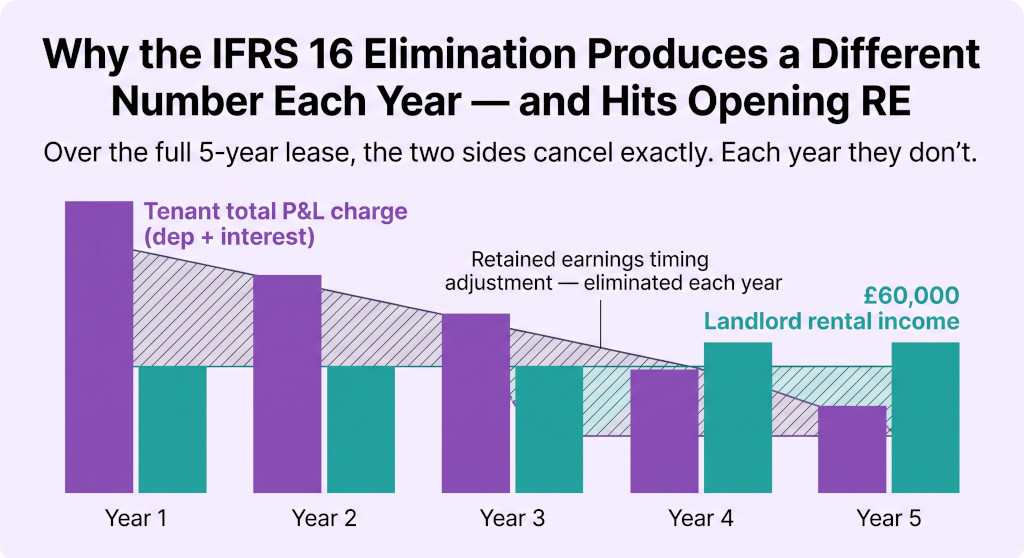
The retained earnings credit of £4,943 is the most counterintuitive line in the journal. Here is where it comes from.
Consolidation journals are not posted to the entities’ books — they exist only in the workpaper. At each year-end, you re-perform all eliminations from scratch against the entities’ unadjusted trial balances. The entities’ opening retained earnings therefore include the IC lease entries from all prior years, unreversed. In the combined opening RE, PropCo’s RE includes +£60,000 from Year 1 rental income and OpCo’s RE includes -£64,943 (Year 1 depreciation £51,954 + Year 1 interest £12,989). Net: -£4,943.
The correctly-stated consolidated opening RE should show zero net impact from the IC lease (the elimination in Year 1’s workpaper reversed both sides, producing a net P&L improvement of £4,943 in that year). The £4,943 Cr to opening RE in the Year 2 journal corrects the combined unadjusted opening RE from -£4,943 to £0 — restoring the correct consolidated position.
Retained earnings timing: 5-year cumulative effect
| Year | Landlord income (£) | Tenant dep (£) | Tenant interest (£) | Tenant total (£) | RE adjustment (£) |
|---|---|---|---|---|---|
| 1 | 60,000 | (51,954) | (12,989) | (64,943) | Cr 4,943 |
| 2 | 60,000 | (51,954) | (10,638) | (62,592) | Cr 2,592 |
| 3 | 60,000 | (51,954) | (8,169) | (60,123) | Cr 123 |
| 4 | 60,000 | (51,954) | (5,577) | (57,531) | Dr 2,469 |
| 5 | 60,000 | (51,954) | (2,857) | (54,811) | Dr 5,189 |
| Total | 300,000 | (259,770) | (40,230) | (300,000) | 0 |
In early years the tenant charges more than the landlord earns (IFRS 16 front-loading) — RE adjustment is a credit (improves consolidated position). In later years the reverse is true — the adjustment becomes a debit. Over the full lease term, the cumulative RE adjustment is exactly zero: total tenant charges match total landlord income.
The check: after the Year 2 elimination, verify that Lease liability (£163,397) minus ROU asset NBV (£155,862) equals the cumulative RE timing adjustment (£7,535 = £4,943 Year 1 + £2,592 Year 2). If the difference between the two balance sheet items matches cumulative retained earnings adjustments, the elimination is complete and balanced.
Accrued Rent: The Simpler Companion Elimination
In the worked example above, the £60,000 annual rent is assumed to have been paid and settled — no accruals at year-end. In practice, groups often have unpaid rent at the balance sheet date. If PropCo has recognised an accrued rent receivable of £X and OpCo has a matching accrued rent payable of £X, the intercompany balance must be eliminated separately:
Journal — Eliminate accrued intercompany rent at period-end
| Account | Dr (£) | Cr (£) |
|---|---|---|
| Accrued rent payable — OpCo (balance sheet) | X | |
| Accrued rent receivable — PropCo (balance sheet) | X |
This is a pure balance sheet elimination of an intercompany debtor/creditor pair. It is entirely separate from the IFRS 16 ROU/liability elimination and follows the same logic as any other intragroup payable/receivable. If the two balances do not agree (timing difference, different accrual methods), investigate and agree the amounts before eliminating.
When IFRS 16 Doesn’t Apply: Short-Term and Low-Value Lease Exemptions
IFRS 16 provides two exemptions under which a lessee may elect not to recognise an ROU asset and lease liability:
- Short-term leases: where the lease term at commencement is 12 months or less (including renewal options the lessee is not reasonably certain to exercise).
- Low-value asset leases: where the underlying asset, when new, has a value below the IFRS 16 threshold (commonly applied at approximately USD 5,000 / GBP 4,000 per asset).
If an intragroup lease falls within either exemption and the tenant elects to apply it, the tenant simply charges a straight-line rental expense to P&L — the pre-IFRS 16 treatment. In this case, the consolidation elimination is straightforward: Dr Rental income (PropCo) / Cr Rental expense (OpCo). The amounts match exactly with no timing adjustment, no ROU asset elimination, and no lease liability elimination. The elimination is a single line, identical in structure to an intercompany management fee.
Group-wide exemption decisions. IFRS 16 exemptions are elected by lease class and applied consistently. A group accounting policy decision to apply the short-term exemption for all leases under 12 months must be applied across all entities, not selectively. Document the policy in the group accounting policy manual and ensure the entity completing the tenant’s accounts has elected consistently. Inconsistent application creates a mismatch between entities that makes the consolidation elimination more complex, not simpler.
When the Landlord Applies Finance Lease Accounting
The worked example above assumes the intragroup lease is an operating lease in PropCo’s books — the landlord retains the building as PPE and recognises rental income. This is the most common scenario for intragroup PropCo/OpCo arrangements, where the building genuinely transfers operating risk to the tenant but PropCo retains residual value risk.
In rare cases — typically where the lease term covers the majority of the building’s useful life or the present value of lease payments represents substantially all the fair value of the asset — PropCo may classify the intragroup lease as a finance lease in its own books. In this case, PropCo derecognises the building as PPE and recognises a finance lease receivable. The consolidation becomes considerably more complex: the building must be reinstated as PPE at consolidated level, the lease receivable eliminated, and the tenant’s ROU asset and lease liability eliminated, with a full recalculation of the consolidated depreciation based on the underlying asset’s useful life rather than the lease term.
Finance lease treatment at the landlord level in an intragroup PropCo/OpCo arrangement is uncommon in practice — most intragroup lease structures are specifically designed to retain the finance lease risk at PropCo level. If you encounter it, the consolidation adjustments should be worked through with the group’s auditors.
Cross-Framework: FRS 102 Landlord, IFRS 16 Tenant
Some groups operate in a mixed framework where the parent entity — and the consolidated accounts — are prepared under FRS 102, but a subsidiary that has previously reported under IFRS (or a subsidiary that retains an IFRS framework for its own accounts) applies IFRS 16. The consolidation must convert the subsidiary’s IFRS 16 entries to the FRS 102 equivalent before eliminating.
Under FRS 102 Section 20, the lessee test for a finance lease is similar to IAS 17 but not identical. FRS 102 uses the same risk/reward transfer test, and short-term/low-value exemptions are available. A lease classified as operating under FRS 102 is charged straight-line to the P&L — no ROU asset or lease liability in the entity’s own accounts. A lease classified as finance under FRS 102 produces a finance lease asset (not an ROU asset) and a finance lease liability.
When the consolidated accounts are prepared under FRS 102 and a tenant subsidiary applies IFRS 16 in its own accounts, the subsidiary’s accounts must be restated to FRS 102 as part of the accounting policy alignment step before the standard intercompany lease elimination is applied. For a broader treatment of what changes when an FRS 102 parent consolidates a subsidiary that reports under a different framework, see how to consolidate an FRS 102 subsidiary into an IFRS parent: lease recognition, goodwill reversal, and GBP translation.
What This Looks Like in Practice
For groups with a PropCo/OpCo structure — a common arrangement in retail, hospitality, property, and healthcare — intragroup lease elimination is typically one of the highest-volume consolidation adjustments at year-end. A group with 12 operating sites, each leased by PropCo to an OpCo trading entity, has 12 separate ROU assets to eliminate, 12 lease liabilities to eliminate, 12 sets of depreciation and finance charges to reverse, and 12 retained earnings adjustments to compute. The probability of an error — a missed elimination, a prior-year RE adjustment carried forward at the wrong amount, or an ROU asset that has been partially impaired and then eliminated — increases with volume.
For the retail sector version of this elimination — including practical complications like mid-lease amendments, tenant break clauses, and variable lease payments — see PropCo/OpCo intragroup leases in a retail group: eliminating the ghost IFRS 16 assets. For property groups with multiple SPV landlords and complex lease portfolios, see the same building, counted twice: eliminating ghost assets from intragroup leases in property groups. For hotel groups where the lease includes a variable rent component linked to revenue — which does not appear on the consolidated balance sheet at all even though the fixed component does — see PropCo/OpCo hotel leases: the variable rent that doesn’t appear on the balance sheet.
For a broader overview of intercompany elimination mechanics — including loans, management fees, inventory margins, and intragroup PPE — see intercompany eliminations: a complete guide for group consolidation. For why intragroup journal volume multiplies quickly as groups add entities, see why intercompany journal volume explodes as your group grows. The comparable ghost asset problem that arises when one group entity constructs PPE for another is covered in intragroup PPE construction: why your consolidated balance sheet is overstating fixed assets.
Intragroup lease eliminations calculated and posted automatically
BrizoConsol tracks every intragroup lease relationship, computes the ROU asset NBV and lease liability at each period-end, and posts the full elimination journal — including the retained earnings timing adjustment — without manual recalculation. See It in Action Start Free