Hotel Group Consolidation: How to Eliminate Management Fees, Brand Royalties, and Intercompany Rent Across Multiple Properties
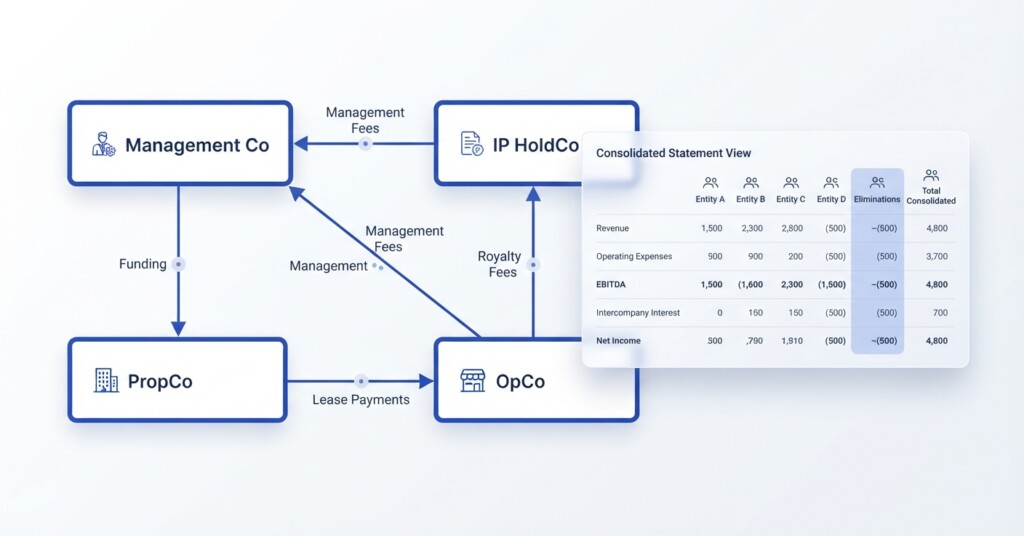
For hotel groups operating across multiple properties — whether branded franchises, management contract hotels, or wholly owned subsidiaries — the month-end consolidation process is rarely straightforward. Between management fees flowing from operating entities to a parent or management company, brand royalty charges passed down from a central IP holding entity, and intercompany rent arrangements between a property-owning company and its operating tenant, the volume of intercompany transactions can be substantial. If these are not eliminated correctly before producing group financial statements, the consolidated P&L and balance sheet will overstate both revenue and expenses, and any group-level KPIs built on top of them will be unreliable.
This article walks through the practical mechanics of intercompany elimination for hotel groups, covering the most common transaction types, the journal entries involved, and where the process tends to break down at scale.
Why Hotel Groups Face Unusually High Intercompany Volumes
A mid-sized hotel group with eight to fifteen properties will typically have at least three layers of intercompany activity running every month. First, there is the management fee — the operating hotel entity pays a percentage of revenue (often 2–4% of total revenue plus an incentive component) to the management company that holds the brand licence, employs central staff, and provides shared services. Second, if the group operates under a franchise or proprietary brand, a separate IP holding entity or head office may charge a royalty — often 1–3% of rooms revenue — to each property for use of the brand name, reservation systems, and loyalty programme. Third, where a property-owning entity (a PropCo) leases the physical hotel to an operating entity (an OpCo), there is an intercompany rent charge that flows between two subsidiaries within the same group.
Intercompany eliminations without the manual work.
BrizoConsol identifies and eliminates intercompany balances automatically at consolidation.
Each of these creates a matching pair: income in one entity and an expense in another. At the consolidated level, these transactions cancel out — the group has not earned revenue from itself, and it has not incurred a real external cost. The problem arises when the matching pairs do not agree, when month-end timing differs between entities, or when different currencies are involved across jurisdictions.
The Three Core Intercompany Flows and How to Eliminate Them
Before elimination journals can be prepared, the finance team needs a clear map of which entity books the income side and which books the expense side for each intercompany flow. In a typical hotel group structure, this looks as follows:
| Intercompany Flow | Income Entity | Expense Entity | Typical P&L Lines Affected |
|---|---|---|---|
| Management fee | Management Co / HoldCo | Operating hotel (OpCo) | Fee income vs. Management expense |
| Brand royalty | IP HoldCo / Franchisor entity | Operating hotel (OpCo) | Royalty income vs. Franchise / royalty charge |
| Intercompany rent | Property owner (PropCo) | Operating hotel (OpCo) | Rental income vs. Rent expense |
| Shared services recharge | Head office / shared services | Operating hotel (OpCo) | Recharge income vs. Admin / overhead expense |
| Intercompany loan interest | Lending entity (often HoldCo) | Borrowing entity (OpCo) | Interest income vs. Finance cost |
For each of these, the consolidation process requires two steps: eliminating the income and expense on the P&L, and eliminating the corresponding intercompany receivable and payable on the balance sheet. If one entity has not yet recorded its side of the transaction, you will have a mismatch — income without a corresponding expense, or a receivable with no matching payable.
Practical Journal Entries for Each Elimination
Below are the consolidation elimination journals for the three most common hotel group intercompany flows. These journals are prepared at the group consolidation level and do not appear in the individual entity ledgers. They exist only in the consolidated working papers or consolidation system.
| Account | Dr | Cr |
|---|---|---|
| Management fee income (Management Co) | 50000 | |
| Management expense (OpCo) | 50000 |
Elimination of intercompany management fee: £50,000 charged by Management Co to OpCo for the month. Debit management fee income to remove it from consolidated revenue; credit management expense to remove it from consolidated costs.
| Account | Dr | Cr |
|---|---|---|
| Brand royalty income (IP HoldCo) | 18000 | |
| Franchise / royalty charge (OpCo) | 18000 |
Elimination of brand royalty: £18,000 charged by IP HoldCo to OpCo based on 2% of rooms revenue of £900,000 for the month.
| Account | Dr | Cr |
|---|---|---|
| Rental income (PropCo) | 75000 | |
| Rent expense (OpCo) | 75000 |
Elimination of intercompany rent: £75,000 monthly lease charge from PropCo to OpCo under an intragroup lease agreement. Both the income in PropCo and the expense in OpCo are removed from the consolidated P&L.
Once the P&L lines are eliminated, the balance sheet balances must also be cleared. If the management fee was invoiced but not yet paid at month end, Management Co will carry an intercompany receivable and OpCo will carry an intercompany payable. These must be eliminated against each other in the consolidation.
Intercompany balance sheet mismatches are one of the most common causes of consolidation errors in hotel groups. If OpCo has accrued the management fee but Management Co has not yet raised the invoice, or has raised it in a different period, the receivable and payable will not agree. Establish a cut-off policy that requires all intercompany invoices to be raised and acknowledged by a fixed date each month — typically two to three working days before month-end close.
Handling FX Translation in Multi-Currency Hotel Groups
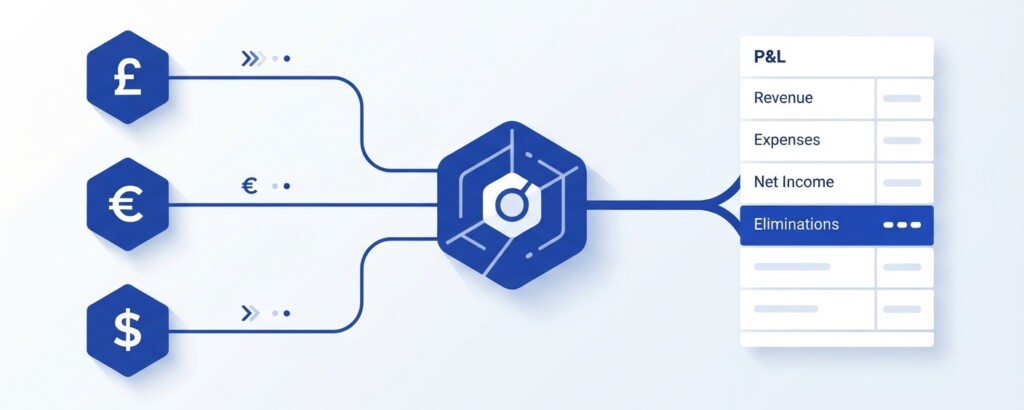
Hotel groups with properties in multiple countries face an additional layer of complexity: each entity may report in a different functional currency, and intercompany charges are often denominated in the management company’s home currency. A management fee charged in GBP by a UK head office to a German OpCo reporting in EUR will be recorded at the spot rate on the transaction date in each entity. By the time consolidation occurs, the closing rate for balance sheet translation and the average rate for P&L translation may differ from both the transaction rate and from each other.
| Management fee charged (GBP, at transaction date rate of 1.15 EUR/GBP) | £50,000 / €57,500 |
| EUR equivalent at consolidation closing rate (1.18 EUR/GBP) | €59,000 |
| FX translation difference on intercompany balance | €1,500 |
| Elimination: remove intercompany income and expense | €57,500 (at average rate used for P&L) |
| Residual FX difference recognised in consolidated profit or loss | €1,500 |
The residual FX difference on intercompany trading balances after elimination is not an error — it is a genuine currency fluctuation effect. Under IAS 21 and US GAAP (ASC 830), foreign exchange gains or losses arising on routine intercompany monetary balances (such as trade receivables and payables for management fees) must be recognised in consolidated profit or loss, not in other comprehensive income. Intragroup monetary items can only be taken to other comprehensive income and held in the foreign currency translation reserve within equity if they qualify as part of the net investment in a foreign operation (where settlement is neither planned nor likely in the foreseeable future), which does not apply to short-term operational charges like management fees.

Non-Controlling Interests in Hotel Group Structures
Not every hotel in a group will be wholly owned. A common structure in the hospitality sector involves a parent company owning 70–80% of a property entity, with the remainder held by a local joint venture partner, a property fund, or a passive investor. Where such non-controlling interests (NCI) exist, the consolidation must attribute the correct share of the subsidiary’s profits, losses, and net assets to the NCI, separate from the equity attributable to the parent.
Intercompany eliminations still apply in full — regardless of the NCI percentage, the management fee between a wholly owned management company and a 75%-owned OpCo is eliminated in its entirety at the group level. Crucially, however, the attribution of consolidated profit to non-controlling interests depends on the direction of the transaction. Because a management fee charged by a parent or wholly owned management company to a subsidiary is a downstream transaction (and reflects services consumed during the period rather than unrealised profit in an asset), the elimination does not increase the profit attributable to the NCI. OpCo’s standalone profit reflects its genuine operating performance and costs, and allocating a share of the eliminated fee to NCI would improperly transfer parent-level income to outside minority owners.
Do not inflate the NCI profit share by adding back downstream intercompany expenses like management fees. If a hotel OpCo reports £200,000 profit in its own accounts after deducting a £50,000 management fee paid to the wholly owned management company, the NCI’s 25% share is calculated on OpCo’s standalone profit of £200,000 (£50,000), not on the post-elimination figure of £250,000. Under IFRS 10 and US GAAP (ASC 810), downstream eliminations are attributed entirely to the parent entity. Adjusting NCI for eliminations is only appropriate for upstream transactions where the subsidiary itself has recorded unrealised profit on transactions with the parent.
Group Reporting: What the Consolidated P&L Should Actually Show
After all eliminations have been applied, the consolidated P&L for a hotel group should reflect only revenue earned from external guests and customers, and only costs incurred with external suppliers. Management fees, royalties, and intercompany rent simply disappear. What remains is the economic performance of the group as a whole — which is often very different from the sum of the individual entity P&Ls, particularly in structures where management fees are sized to shift profit between entities for tax or structural reasons.
Hotel group CFOs and finance managers often find that the consolidated result is more useful for operational decision-making than any individual entity report, because it strips out the artificial charges that exist only to allocate profit within the structure. RevPAR (revenue per available room), GOP margins, and EBITDA at the group level are the figures that lenders, investors, and boards actually care about — and these need to be based on consolidated, elimination-adjusted numbers.
Where the Process Breaks Down in Practice
For hotel groups running consolidations in Excel, the process of gathering trial balances from each entity, applying eliminations, translating foreign currency balances, and producing a consolidated pack is typically a two to four day exercise at month end. The risk of error is high, for several reasons.
- Intercompany invoices are raised at different times by different entities, creating mismatches in the receivable/payable positions that must be manually tracked and resolved.
- FX translation is often applied inconsistently — some teams translate at average rate, others at spot, and the difference is treated as an unexplained variance rather than a translation reserve movement.
- NCI calculations are sometimes done on spreadsheet tabs that are not linked to the elimination workings, meaning they do not update automatically when elimination figures change.
- New intercompany arrangements — for example, a new shared services recharge introduced mid-year — are sometimes not captured in the elimination schedule until they have been running for several months, causing the consolidated P&L to overstate costs in the interim.
- Management fee structures often include an incentive component based on GOP or EBITDA, which means the fee itself is not fixed — it changes as the underlying results change, requiring the elimination to be recalculated each month rather than simply carried forward.
Consolidation software that maintains a live intercompany elimination matrix — where each entity’s intercompany postings are matched against their counterpart in real time — eliminates much of this manual reconciliation work. When an entity posts a management fee expense, the corresponding income in the management company is flagged automatically, and any mismatch is surfaced before the consolidation pack is produced rather than during the review process.
Building a Reliable Intercompany Elimination Process
Whether a hotel group is consolidating manually or moving towards a dedicated consolidation tool, the foundation is the same: a clear intercompany transaction register, agreed cut-off rules, and a documented elimination schedule that is reviewed each time a new intercompany arrangement is introduced.
Finance teams that get this right find that the consolidation itself becomes a faster, lower-risk exercise — and the group reporting pack that comes out of it is one that the board, lenders, and auditors can rely on. The marginal cost of getting intercompany eliminations wrong — restated accounts, audit adjustments, mis-stated covenant calculations — is almost always higher than the investment required to put a clean process in place.
See Automated Hotel Group Consolidation in Practice
BrizoConsol is built for multi-entity finance teams managing complex intercompany flows, FX translation, and group reporting. See how the platform handles management fee eliminations, intercompany matching, and consolidated reporting across hotel group structures.