SaaS Group Consolidation: How to Handle Deferred Revenue, ARR, and Intercompany Licensing Across Multiple Entities
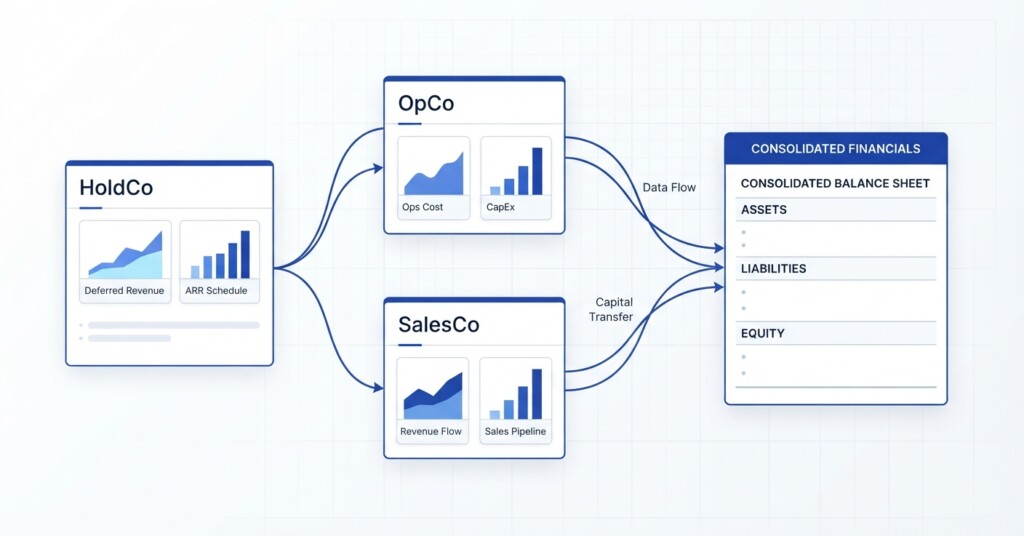
For SaaS businesses operating across multiple legal entities — whether that means a UK holding company licensing software to a US operating subsidiary, a European sales entity passing revenue upstream, or a group with distinct product lines sitting in separate companies — consolidation is rarely straightforward. Deferred revenue behaves differently from most balance sheet items. ARR is a non-GAAP metric that cuts across entity boundaries. Intercompany licensing creates a web of royalties, cost allocations, and elimination entries that can consume days of month-end effort. This article walks through the core accounting and reporting challenges, with worked examples and practical guidance on building a consolidation process that actually holds together under audit.
Why SaaS Groups Are Harder to Consolidate Than Traditional Businesses
A manufacturing group consolidating inventory and intercompany sales faces well-understood eliminations. A SaaS group faces all of those challenges plus several that are unique to subscription businesses. Deferred revenue is recognised over the contract period, not at invoice. A contract billed annually upfront creates a deferred revenue liability that must be correctly carried at the entity level and then reconstituted at the group level after eliminations. ARR — typically defined as annualised recurring subscription revenue — is reported to investors and boards but sits nowhere in the statutory accounts. And when one group entity licenses the core platform to another entity that sells to end customers, you have an intercompany royalty stream that must be eliminated in consolidation while preserving a coherent picture of group profitability.
SaaS consolidation often breaks down not because of complex accounting standards, but because the underlying data — contract start dates, billing schedules, deferred balances, and ARR schedules — lives in different systems across different entities and nobody has a clean process for bringing it together at month-end.
Intercompany eliminations without the manual work.
BrizoConsol identifies and eliminates intercompany balances automatically at consolidation.
Deferred Revenue in a Multi-Entity SaaS Group: The Core Problem
Consider a group where the parent entity (HoldCo) contracts directly with enterprise customers and invoices annually upfront. Revenue is recognised ratably over 12 months. A sister entity (SalesCo) in another jurisdiction does the same thing with its own customer base. At the group level, you need to aggregate the deferred revenue balances, translate any foreign currency amounts, and ensure the movement in deferred revenue reconciles to recognised revenue for the period. That last step — the movement reconciliation — is where most finance teams hit trouble.
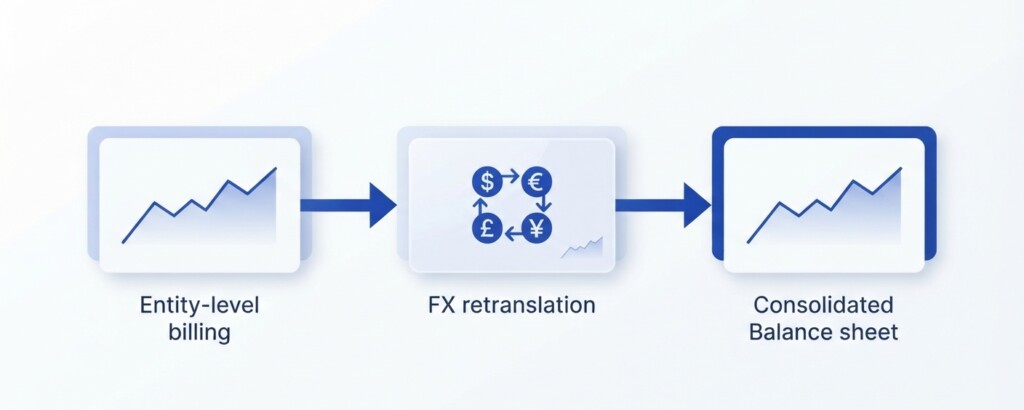
The deferred revenue balance at group level should equal the sum of entity-level deferred revenue balances after FX translation. But when contracts are added mid-period, renewed early, or modified under IFRS 15 or ASC 606, the movements become difficult to track. When a foreign subsidiary’s functional-currency balance sheet is translated into the group reporting currency (GBP), its deferred revenue balance is translated at the closing rate each period, generating a translation difference that must be routed through the foreign currency translation reserve in OCI — not through recognised revenue.
FX Translation of Deferred Revenue: Which Rate Applies?
Under IFRS (IAS 21 / IFRIC 22) and US GAAP (ASC 830), deferred revenue is classified as a non-monetary liability at the entity level because it represents an obligation to deliver software or services rather than cash; consequently, foreign-currency contracts on a standalone ledger are held at historical rates and are not revalued to profit or loss. However, during financial consolidation of a foreign subsidiary under the current rate method, all balance sheet assets and liabilities — including deferred revenue — are translated into the group presentation currency at the closing rate at each reporting date. The resulting translation difference goes to OCI (other comprehensive income) and accumulates in the foreign currency translation reserve, not in the income statement. This creates a reporting presentation issue: consolidated deferred revenue moves period to period not just because of new sales and revenue recognition, but because of exchange rate movements.
For management reporting purposes — particularly when presenting ARR or contracted revenue metrics — finance teams need to separate the ‘real’ movement in deferred revenue (new bookings, renewals, churn, revenue recognition) from the currency-driven movement. Failure to do this leads to ARR analysis that appears to show customer churn or growth when in fact the entity has simply been affected by currency movements.
| Opening deferred revenue (USD subsidiary, translated at opening rate of 1.25) | £800,000 |
| New bookings in period (translated at average rate of 1.28) | £156,250 |
| Revenue recognised in period (translated at average rate of 1.28) | (£234,375) |
| Closing deferred revenue before FX (sum of above) | £721,875 |
| FX retranslation adjustment (closing rate 1.22 vs blended rate) | £15,830 |
| Closing deferred revenue (retranslated at closing rate of 1.22) | £737,705 |
The FX retranslation adjustment of £15,830 in the example above reflects the difference between the closing rate (£737,705) and the pre-retranslation sum of opening and net movements (£721,875), and goes to the translation reserve in OCI, not to revenue. In Excel-based consolidations, this adjustment is routinely misclassified — either omitted entirely or posted against revenue, which distorts both the income statement and the deferred revenue movement analysis.
Intercompany Licensing: What Gets Eliminated and What Stays
A common structure in SaaS groups is for an IP-holding entity (often in a low-tax jurisdiction) to license the core platform to one or more operating entities. Those operating entities then sell to end customers and pay a royalty back to the IP entity. At the entity level, this creates royalty income in the IP entity and royalty expense in the operating entity. At the group level, both must be eliminated — the income and the expense cancel out, and no group-level asset or liability should remain from the intercompany arrangement.
The elimination entry is straightforward when amounts are in the same currency and both entities close on the same date. It becomes more complex when the royalty is denominated in one currency, the IP entity reports in another, and the operating entity reports in a third. Each leg of the intercompany transaction will be translated into group reporting currency (ordinarily using transaction or period-average rates for income statement items), and exchange rate differences can leave a residual balance after elimination — a consolidation difference that must be identified, explained, and either corrected or disclosed.
| Account | Dr | Cr |
|---|---|---|
| Intercompany royalty income (IP entity — eliminate) | £120,000 | |
| Intercompany royalty expense (OpCo — eliminate) | £120,000 |
Elimination of matched intercompany royalty — same currency, same period. Both legs confirm at £120,000 with no residual difference.
| Account | Dr | Cr |
|---|---|---|
| Intercompany royalty income (IP entity — USD translated at period rate) | £118,500 | |
| FX consolidation difference (P&L / FX gain or loss) | £1,500 | |
| Intercompany royalty expense (OpCo — EUR translated at period rate) | £120,000 |
Elimination where a currency mismatch between entities creates a £1,500 residual consolidation difference. Under IAS 21 and ASC 830, exchange differences arising from intra-group transactions are recognized in profit or loss, or investigated if they suggest an accounting mismatch.
Intercompany balances that do not eliminate cleanly are one of the most common causes of audit queries in SaaS group accounts. Before closing the consolidation, every intercompany payable must be agreed against its corresponding receivable, and every intercompany revenue stream must be matched to the corresponding expense. Unexplained differences — even small ones — should be investigated rather than posted to a suspense account.
ARR as a Group Metric: Building It From Entity-Level Data
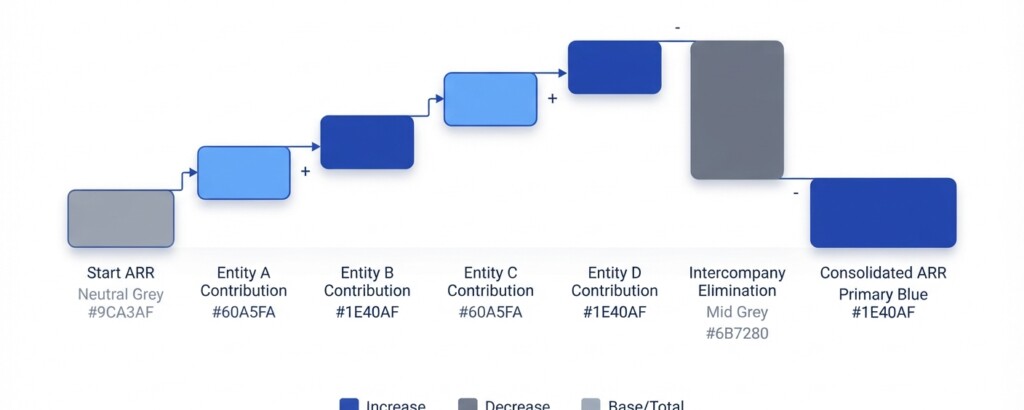
ARR is not defined by any accounting standard, and its calculation varies between companies. Most SaaS groups define it as the annualised value of active recurring subscription contracts at a point in time, excluding one-off fees and professional services revenue. The challenge in a multi-entity group is assembling this figure from entity-level contract data, eliminating intercompany subscriptions (for example, where one group entity subscribes to the platform from another), and presenting it in a single reporting currency.
| Entity | Local Currency ARR | Exchange Rate | GBP Equivalent ARR | Intercompany to Eliminate | Group ARR Contribution |
|---|---|---|---|---|---|
| HoldCo (GBP) | £1,200,000 | 1.00 | £1,200,000 | £0 | £1,200,000 |
| US OpCo (USD) | $960,000 | 1.28 | £750,000 | £60,000 (IC licence) | £690,000 |
| DE SalesCo (EUR) | €480,000 | 1.15 | £417,391 | £0 | £417,391 |
| AU Branch (AUD) | A$300,000 | 1.92 | £156,250 | £0 | £156,250 |
| Group Total | — | — | £2,523,641 | £60,000 | £2,463,641 |
The intercompany elimination in the table above reflects a scenario where US OpCo has a subscription to a module built by HoldCo, paid at arm’s length rates. At the group level, this is an internal arrangement and must be excluded from reported ARR. Failure to strip out intercompany subscriptions is a common error in ARR reporting and will overstate the group’s external revenue run-rate.
The Financial Close Process for SaaS Groups
A practical month-end close for a SaaS group with three or more entities typically needs to run through a defined sequence. Entity-level closes must complete first — each subsidiary reconciles its deferred revenue ledger, confirms intercompany balances with group finance, and submits a trial balance. Only then can consolidation begin. The order matters because deferred revenue balances, intercompany confirmations, and FX rates must all be locked before elimination journals are posted.
- Each entity completes its local close and reconciles deferred revenue to the contract schedule
- Intercompany balances are confirmed bilaterally — every receivable is agreed against a payable
- Closing FX rates are locked for balance sheet translation and appropriate period rates for P&L accounts
- Trial balances are submitted to group finance in the consolidation reporting currency
- Elimination journals are posted — intercompany revenue/expense, intercompany balances, and unrealised profit if applicable
- FX translation differences are calculated and posted to OCI and the translation reserve
- Non-controlling interest (NCI) share of profit and net assets is calculated for any partly-owned subsidiaries
- Group trial balance is reviewed, analytical review performed, and management pack prepared
In practice, SaaS groups often struggle with step one — reconciling deferred revenue to the contract schedule. If the billing system (Stripe, Chargebee, or a bespoke CRM) does not sync cleanly with the accounting system, finance teams are manually exporting data, building reconciliation spreadsheets, and chasing discrepancies. This is where significant time is lost at month-end, and where errors are most likely to creep into the consolidation.
NCI in a SaaS Group: Partial Subsidiaries and Deferred Revenue
If the group owns less than 100% of one of its subsidiaries — say, 75% of a regional entity — a non-controlling interest must be calculated and presented in the consolidated accounts. The NCI represents the 25% of net assets and profit that belong to minority shareholders. For a SaaS entity, the NCI share of net income is driven by recognised revenue rather than upfront cash collections or deferred revenue additions. A subsidiary with high new bookings and upfront deferred revenue, but low current revenue recognition, will show lower net profit — and therefore a smaller NCI profit allocation — even while its commercial bookings are growing.
This is worth flagging to boards and investors when presenting group results. A quarter with high new bookings and low revenue recognition will suppress reported NCI profit, and the reverse is true in a quarter with high renewals and strong revenue recognition from prior period deferred balances. Understanding this dynamic is essential for interpreting group results correctly.
Reducing Manual Work: Where Automation Helps Most
The consolidation tasks that consume the most time in SaaS groups are typically: aggregating trial balances from multiple entities and currencies, running intercompany elimination logic (including identifying mismatches), retranslating foreign currency balances and routing differences correctly, and assembling ARR and deferred revenue movement schedules that reconcile to the statutory numbers. These are all mechanical tasks once the rules are defined — but in Excel, they require careful construction of formulas, manual rate inputs, and a high degree of discipline to avoid version-control errors.
Dedicated consolidation software — whether purpose-built tools or ERP consolidation modules — handles the translation, elimination, and aggregation steps systematically, with audit trails that show exactly what was eliminated, at what rate, and why. For groups with four or more entities, the time saving compared to Excel consolidation is substantial, and the risk of misclassifying an FX difference or missing an intercompany elimination is meaningfully reduced.
Practical Takeaways for SaaS Finance Teams
Getting SaaS group consolidation right requires discipline at both the entity and group level. The deferred revenue schedule must be the single source of truth for revenue recognition — it must reconcile to the billing system, to the income statement, and to the balance sheet every period. Intercompany arrangements must be documented with transfer pricing policies, and balances must be confirmed before the consolidation is run. FX translation adjustments must be clearly separated from revenue and booking movements in all management reporting. And ARR must be built from contract-level data with explicit intercompany eliminations, not simply summed from entity P&Ls.
The most resilient SaaS consolidations are built on a clearly defined intercompany policy, a locked-rate process for FX, and a deferred revenue reconciliation that runs from contract data through to the balance sheet — every period, without exception. If any of those three things breaks down, the consolidation becomes unreliable.
See How Group Consolidation Works in Practice
BrizoConsol is built for multi-entity finance teams managing consolidation, intercompany eliminations, FX translation, and group reporting. If your team is spending too much time on manual reconciliation at month-end, explore how a connected consolidation process can help.