How to Build Recurring Consolidation Journals That Post Automatically Every Period: A Step-by-Step Guide for Multi-Entity Groups

For finance teams managing multiple entities, one of the most time-consuming parts of the monthly close is rebuilding the same consolidation journals from scratch — intercompany eliminations, investment eliminations, non-controlling interest adjustments, and FX translation entries. These journals follow predictable patterns, yet most groups still recreate them manually in spreadsheets every single period. That creates risk: missed entries, inconsistent treatments, version-control nightmares, and a financial close that drags on longer than it should. Building recurring consolidation journals that post automatically each period is one of the highest-leverage improvements a multi-entity finance team can make. This guide walks through exactly how to do it, from identifying which journals can be standardised to the logic behind each journal type.
Why Recurring Consolidation Journals Matter for Multi-Entity Groups
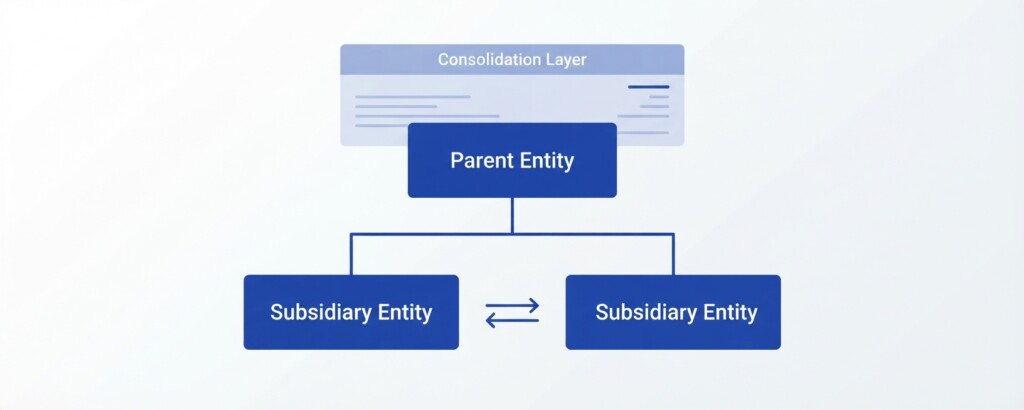
In a single-entity business, the month-end journal list is relatively stable. In a group structure — even a modest one with three or four subsidiaries — the consolidation layer adds a second tier of journals that must be prepared, reviewed, and posted before consolidated financials can be produced. These consolidation journals do not live in any single subsidiary’s ledger. They exist only at the group level, adjusting the aggregated trial balances to produce financials that reflect the group as a single economic entity. The problem is that many of these journals are structurally identical every period. The intercompany loan elimination between two entities changes in balance, but the accounts involved and the logic do not. The investment elimination is usually fixed unless the group structure changes. The NCI allocation uses the same percentage. Recreating these manually each month is not just inefficient — it is an avoidable source of error.
The goal of recurring consolidation journals is not to remove human judgement from the close process — it is to eliminate the repetitive manual work so that finance teams can focus on the entries that actually require judgement each period.
Stop building consolidations in spreadsheets.
BrizoConsol automates multi-entity consolidation — setup in minutes, reports the same day.
Step 1: Categorise Your Consolidation Journals by Recurrence Type
Before building any automation, map out every consolidation journal your group currently prepares. Then categorise each one by how it changes period to period. This categorisation determines the level of automation that is appropriate and safe for each journal type.
| Journal Type | Changes Each Period? | Automation Suitability |
|---|---|---|
| Investment elimination (goodwill & equity) | Rarely — only if structure changes | High — template with fixed accounts |
| Intercompany loan elimination | Yes — balance changes monthly | Medium — auto-post with live balance feed |
| Intercompany trading elimination (sales/COGS) | Yes — volume changes monthly | Medium — requires matched IC balances |
| Dividend elimination | Only when dividend is declared | High — event-triggered template |
| NCI allocation of profit | Yes — based on subsidiary profit | Medium — formula-driven calculation |
| FX translation adjustment (OCI) | Yes — rates change monthly | Medium — requires rate feed |
| Deferred tax on consolidation adjustments | Sometimes | Low — requires periodic review |
Once you have this map, you can distinguish between journals that can be fully automated, those that need a formula-driven template with manual confirmation, and those that still require individual review each period. Do not try to automate everything at once — start with the highest-recurrence, lowest-variability journals first.
Step 2: Build the Investment Elimination Journal as a Fixed Template
The investment elimination is typically the most stable consolidation journal in any group. When a parent acquires a subsidiary, the parent records an investment on its balance sheet. At consolidation, that investment is eliminated against the subsidiary’s equity at acquisition date, with any excess recognised as goodwill. Unless the group structure changes, goodwill is impaired, or goodwill is amortised (under UK GAAP / FRS 102), this initial elimination journal posts with identical amounts every period. This makes it the ideal starting point for a recurring template.
Consider a parent company that acquired 80% of a subsidiary for £500,000 when the subsidiary had net assets of £400,000. The goodwill at acquisition was £180,000 (£500,000 minus 80% of £400,000). The NCI at acquisition was £80,000 (20% of £400,000). This elimination journal looks the same every period at the consolidation level.
| Account | Dr | Cr |
|---|---|---|
| Share Capital (Subsidiary) | 100,000 | |
| Retained Earnings at Acquisition (Subsidiary) | 300,000 | |
| Goodwill | 180,000 | |
| Investment in Subsidiary (Parent) | 500,000 | |
| Non-Controlling Interest (Equity) | 80,000 |
Investment elimination at acquisition date — fixed recurring consolidation template. Posts identically each period unless group structure changes. Total debits £580,000 equal total credits £580,000.
This journal is locked once established. Tag it in your consolidation system or workbook as ‘fixed template — do not modify without group structure review.’ It should post automatically every period with no manual input required.
Step 3: Build Formula-Driven Templates for Intercompany Eliminations
Intercompany eliminations are more dynamic than investment eliminations because the underlying balances change every period. However, the structure of the journal — which accounts are debited and credited — stays consistent. The automation here is not about hard-coding amounts but about feeding current-period intercompany balances into a standard journal template. The critical prerequisite is that your intercompany balances must be matched and confirmed before the journal can post. If Entity A records an intercompany receivable of £150,000 and Entity B records an intercompany payable of £148,000, you have a £2,000 mismatch that must be resolved first. Posting the elimination on unreconciled balances simply shifts the error into the consolidated accounts.
Never automate intercompany elimination journals without a confirmed reconciliation step. An automated journal posting against unreconciled intercompany balances will embed discrepancies directly into your consolidated trial balance, making them harder to find after the fact.
Once intercompany balances are confirmed as matched, the elimination journal posts automatically. Here is an example for an intercompany loan where Entity A has lent £200,000 to Entity B at period end.
| Account | Dr | Cr |
|---|---|---|
| Intercompany Loan Payable — Entity B | 200,000 | |
| Intercompany Loan Receivable — Entity A | 200,000 |
Intercompany loan elimination — formula-driven template. Amount is sourced from the confirmed intercompany reconciliation for the current period. Interest on the loan is eliminated separately.
Step 4: Automate NCI Profit Allocation Each Period
Non-controlling interest requires an allocation of the subsidiary’s post-tax profit to the NCI equity holders each period. This is not discretionary — it is a required consolidation adjustment under both IFRS and UK GAAP. The NCI percentage is fixed (unless there has been a change in ownership), so the only variable is the subsidiary’s profit for the period. This makes NCI allocation well-suited to a formula-driven recurring journal.
| Subsidiary post-tax profit for the period | £85,000 |
| NCI percentage | 20% |
| NCI share of profit (journal amount) | £17,000 |
| Account | Dr | Cr |
|---|---|---|
| Profit Attributable to Non-Controlling Interests (P&L) | 17,000 | |
| Non-Controlling Interest (Equity — Balance Sheet) | 17,000 |
NCI profit allocation for the period. Amount is calculated as 20% of subsidiary post-tax profit of £85,000. This journal ensures the consolidated P&L correctly splits profit between parent shareholders and minority interest holders.
Step 5: Handle FX Translation Adjustments as Recurring Entries
When a group includes subsidiaries that report in a currency different from the group presentation currency, FX translation produces an adjustment that is recognised in Other Comprehensive Income (OCI) rather than in the P&L. Under standards such as IAS 21 and FRS 102, this translation difference arises because assets and liabilities are translated at the closing rate, income and expenses are translated at average rates, and opening equity items are translated at historical rates. The translation difference is not an operational item and does not affect retained earnings or profit, but it must be captured in the consolidated balance sheet and equity reconciliation every period. Groups with foreign subsidiaries should build a recurring FX translation template that pulls the closing rate and average rate for the period and calculates the translation adjustment automatically. The accounts involved are always the same — only the amounts change.
| Account | Dr | Cr |
|---|---|---|
| Other Comprehensive Income — Foreign Currency Translation Loss (OCI) | 12,400 | |
| Foreign Currency Translation Reserve (Equity — Balance Sheet) | 12,400 |
FX translation adjustment for EUR-functional subsidiary translated to GBP presentation currency. Closing rate 1.18, average rate 1.15. Translating opening net assets at the closing rate versus the opening rate and current-period profit at closing versus average rates produces a £12,400 translation movement recognised in OCI and accumulated in the Foreign Currency Translation Reserve. The direction adjusts based on whether GBP has strengthened or weakened against EUR in the period.
Step 6: Set Up Controls and Review Gates Before Auto-Posting
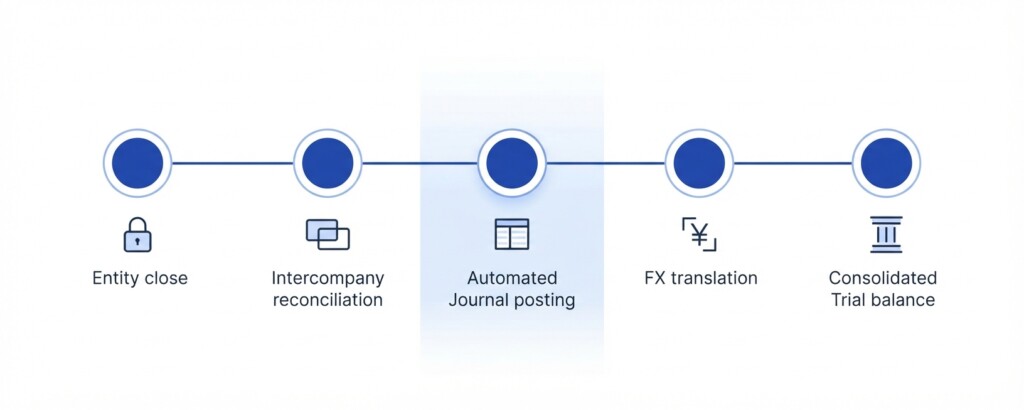
Recurring journals that post without human intervention are only safe when the underlying data is reliable. Every recurring consolidation journal template should have defined pre-conditions that must be satisfied before posting is triggered. These are not optional checkpoints — they are the controls that prevent automated journals from embedding errors into your consolidated accounts.
- All subsidiary trial balances must be submitted and locked before consolidation journals post.
- Intercompany balances must be reconciled and the difference confirmed as zero (or within an agreed materiality threshold with documented explanation).
- FX rates must be confirmed from an approved rate source — do not allow journals to post using stale rates from the prior period.
- NCI percentage must be verified against the current group structure — flag any period where ownership has changed.
- A senior reviewer (controller or CFO) must approve the journal batch before it is marked as posted in the consolidation ledger.
- Variance analysis should run automatically after posting to flag any consolidated line item that has moved by more than an agreed threshold, for review before finalisation.
Reducing Manual Excel Work: Where the Real Time Savings Come From
Most multi-entity finance teams that have not yet automated their consolidation journals are running a process that looks something like this: each entity emails its trial balance in a slightly different format, someone aggregates them into a master Excel workbook, another sheet holds the intercompany reconciliation, and the consolidation journals are hard-coded in a separate tab that gets updated — carefully, nervously — each month. The time cost of this process is not just the hours of data entry. It is the review time, the error-checking, the back-and-forth when a subsidiary trial balance needs to be corrected, and the delay to the whole group close when any single entity is late. Recurring automated journals eliminate the journal preparation step almost entirely for the high-recurrence entries. What remains is review and sign-off, which is exactly where senior finance time should be spent. Groups that move to automated consolidation journals typically find that the most significant time saving is not in the journals themselves but in the downstream reconciliation — because automated journals are consistent and traceable, the consolidated trial balance closes cleaner with fewer unexplained variances.
Common Mistakes to Avoid When Automating Consolidation Journals
- Automating before the chart of accounts is standardised across entities — mismatched account codes mean intercompany eliminations target the wrong accounts.
- Using automation to skip the intercompany reconciliation step rather than to accelerate it.
- Failing to version-control journal templates — when a template is updated, prior periods should reflect the correction, not silently change.
- Not accounting for mid-year changes in group structure — if an entity is acquired or disposed of during the year, fixed-template journals must be reviewed.
- Assuming that FX translation automation works without a rate governance process — rates fed from unreliable sources can produce material errors in the OCI and equity sections.
Bringing It Together: A Consolidated Financial Close That Actually Closes
Building recurring consolidation journals is not a one-time project — it is an ongoing discipline. Start with the journals that are most stable and highest frequency. Document each template with its source logic, the accounts it touches, and the conditions under which it must be manually reviewed. Build the pre-posting controls before you build the automation. And treat each journal template as a living document that must be reviewed whenever the group structure, ownership percentages, intercompany arrangements, or applicable accounting standards change. Done well, this approach transforms the group financial close from a period of high-stress manual effort into a structured, reviewable process where most of the mechanical work happens automatically and the finance team’s attention is directed toward analysis, exceptions, and decision-support — which is where it should be.
See How Automated Consolidation Journals Work in Practice
BrizoConsol is built for multi-entity groups that need automated consolidation journals, intercompany eliminations, FX translation, and group reporting — without rebuilding spreadsheets every month.