How to Consolidate an IFRS Subsidiary into a US GAAP Parent: Journals, Fiscal Alignment, and Currency Translation
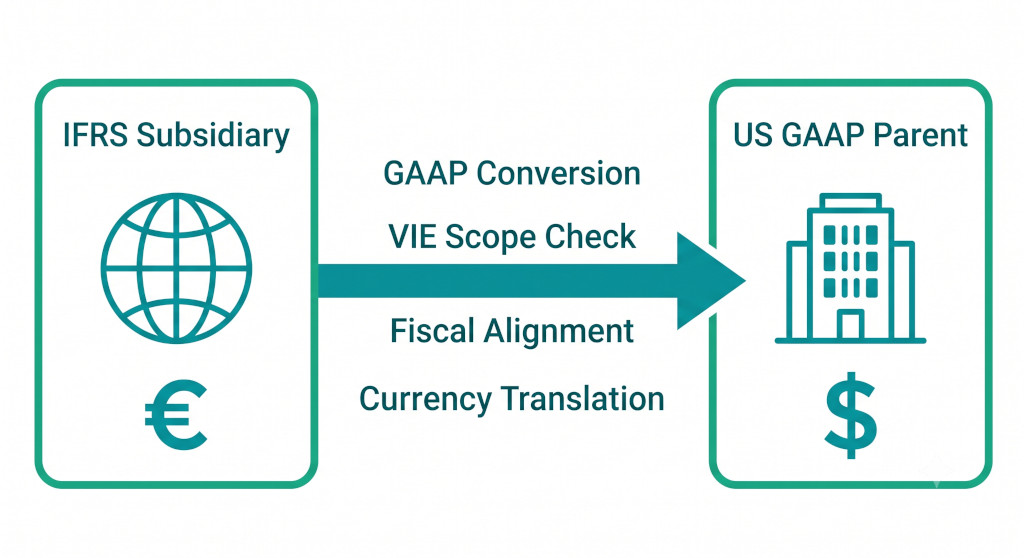
US-listed companies with overseas subsidiaries face a recurring challenge at every reporting period: those subsidiaries prepare their statutory financial statements under IFRS — the dominant accounting framework outside the United States — but the consolidated group report must comply with US GAAP. The two frameworks share many principles, but the differences between them are real, and in some areas material.
Producing a US GAAP consolidated report that incorporates IFRS subsidiaries accurately requires three distinct layers of work. First, the IFRS subsidiary’s accounts must be restated to US GAAP through a set of GAAP conversion adjustment journals. Second, any difference in fiscal year-end between the subsidiary and the parent must be addressed. Third, the subsidiary’s local currency financials must be translated into US dollars using the rates prescribed by ASC 830.
This guide walks through each layer with worked journal entries and a practical translation example. For background on the conceptual differences between the two frameworks, see our US GAAP vs IFRS guide.
Foreign currency consolidation, handled automatically.
BrizoConsol applies the correct CTA/FCTR treatment across all entities — no spreadsheets needed.
The Group Structure Used in This Guide
Throughout this post we use the following example:
- BrizoCorp Inc — US-listed parent, reports under US GAAP in USD, fiscal year 1 January to 31 December
- BrizoEU Ltd — UK-based subsidiary, 100% owned, reports under IFRS in GBP, fiscal year 1 January to 31 December
- Exchange rates (illustrative): closing rate GBP/USD 1.27; average rate for the year GBP/USD 1.25; historical rate (date of investment) GBP/USD 1.30
BrizoEU has capitalised development costs, holds an investment property at fair value, has revalued a freehold building, and previously recognised and subsequently reversed an impairment loss on a piece of equipment.
Step 1 — GAAP Conversion Adjustment Journals
Step 1
All GAAP conversion journals are prepared in GBP — the subsidiary’s functional currency. They are not translated until Step 3. The objective is to produce a US GAAP trial balance for BrizoEU in GBP, which is then carried into the currency translation step.
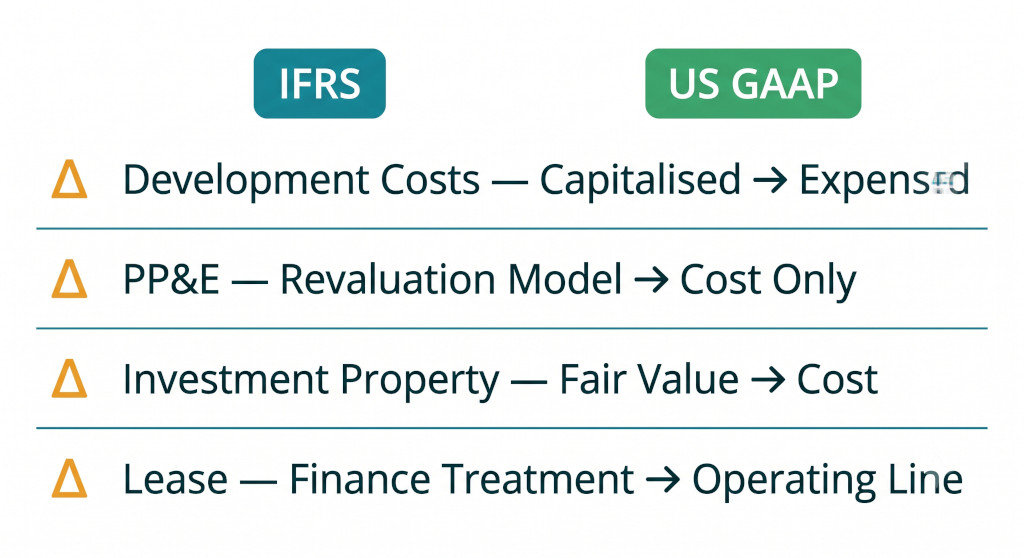
Adjustment 1: Development Costs — Expense Under US GAAP
BrizoEU has capitalised GBP 800,000 of development costs under IAS 38, amortised by GBP 160,000 to date (net book value GBP 640,000). Current-year development expenditure capitalised: GBP 250,000; current-year amortisation charge: GBP 160,000. Under US GAAP ASC 730, all research and development is expensed as incurred.
Journal 1A — Reverse opening net book value of capitalised development costs
DR Retained Earnings GBP 640,000
CR Intangible Assets (Dev Costs) GBP 800,000
CR Accumulated Amortisation GBP (160,000)
Reduces retained earnings by the cumulative net book value. All prior-period development spend is treated as if it had been expensed at the time.
Journal 1B — Reverse current-year amortisation and expense current-year development spend
DR R&D Expense GBP 250,000
DR Intangible Assets (Dev Costs) GBP 160,000
CR Intangible Assets (Dev Costs) GBP 250,000
CR Amortisation Expense GBP 160,000
Current-year capitalisation is reversed and charged to R&D expense. The current-year amortisation charge is also reversed, as there is no longer an asset to amortise.
Adjustment 2: PP&E Revaluation — Revert to Cost Model
BrizoEU revalued its freehold building upwards by GBP 400,000 under the IAS 16 revaluation model. Additional depreciation of GBP 20,000 has been charged on the revalued increment (over a 20-year remaining useful life). The revaluation surplus net of the excess depreciation stands at GBP 380,000 in equity.
Journal 2 — Reverse PP&E revaluation to cost model
DR Revaluation Surplus (OCI/Equity) GBP 380,000
DR Accumulated Depreciation GBP 20,000
CR Property, Plant & Equipment GBP 400,000
Reduces PP&E to historical cost. Revaluation surplus eliminated from equity. The excess depreciation previously charged on the revalued increment is also reversed, as the asset is now carried at cost-based depreciation only.
Adjustment 3: Investment Property — Fair Value to Cost Model
BrizoEU holds a commercial property classified as investment property under IAS 40 and measured at fair value. The property was acquired for GBP 1,200,000 and is now carried at fair value of GBP 1,500,000, with a GBP 300,000 fair value gain recognised in profit or loss in the current year. Under US GAAP, investment property is carried at cost less accumulated depreciation. Assume the property has a 40-year useful life, so annual depreciation on cost is GBP 30,000 (GBP 1,200,000 ÷ 40 years). Accumulated depreciation since acquisition (5 years): GBP 150,000.
Journal 3A — Reverse fair value gain recognised in current year
DR Fair Value Gain (P&L) GBP 300,000
CR Investment Property GBP 300,000
Removes the current-year fair value uplift from both the asset and the income statement.
Journal 3B — Reinstate cost model: introduce accumulated depreciation
DR Retained Earnings (prior years) GBP 120,000
DR Depreciation Expense (current yr) GBP 30,000
CR Accumulated Depreciation GBP 150,000
Recognises depreciation that would have been charged under the cost model from the date of acquisition. Prior-year depreciation goes to retained earnings; current-year charge hits the income statement.
Adjustment 4: Impairment Reversal — Not Permitted Under US GAAP
In a prior year, BrizoEU recognised a GBP 90,000 impairment loss on a manufacturing asset. In the current year, circumstances improved and BrizoEU reversed GBP 60,000 of that impairment under IAS 36. Under US GAAP (ASC 360), impairment of long-lived assets is not reversible.
Journal 4 — Reverse impairment reversal
DR Impairment Reversal Gain (P&L) GBP 60,000
CR Property, Plant & Equipment GBP 60,000
Removes the impairment reversal from the income statement and reduces the asset back to the US GAAP carrying value (original impaired amount, net of subsequent depreciation on the impaired balance).
Adjustment 5: Lease Income Statement Reclassification
BrizoEU has an office lease treated under IFRS 16 that produces depreciation of the right-of-use asset (GBP 95,000) and interest on the lease liability (GBP 14,000). Under US GAAP ASC 842, this would be classified as an operating lease with a straight-line lease expense of GBP 105,000. The balance sheet treatment is broadly similar for lessee accounting; the difference is in income statement presentation.
Journal 5 — Reclassify lease expense from IFRS 16 to ASC 842 operating presentation
DR Operating Lease Expense GBP 105,000
CR Depreciation — ROU Asset GBP 95,000
CR Interest Expense — Lease Liability GBP 14,000
DR Lease Liability (timing difference) GBP 4,000
Net income impact varies by lease age — IFRS 16 front-loads cost (higher interest in early years), while ASC 842 operating lease expense is straight-line across the lease term.
Not all IFRS subsidiaries will require every one of these adjustments. Start by reviewing which IFRS accounting policies the subsidiary actually applies — revaluation, fair value for investment property, and impairment reversals only arise where the entity has elected those policies or where specific circumstances apply. Many subsidiaries will need only one or two material conversion journals.
Step 2 — Consolidation Scope: Does the VIE Model Change Anything?
Step 2
Before translating or eliminating anything, the US parent’s finance team should confirm that the consolidation scope under US GAAP matches the scope under IFRS. In most straightforward subsidiary relationships — where the parent holds a majority equity interest and exercises ordinary control — the IFRS 10 control assessment and the US GAAP ASC 810 assessment will reach the same conclusion.
The risk of a scope difference arises when BrizoEU or any other entity in the group has structured arrangements that might qualify as Variable Interest Entities (VIEs) under ASC 810. IFRS 10 uses a single control model based on power, variable returns, and the ability to use power to affect those returns. US GAAP adds a separate VIE framework that requires consolidation of entities where the group is the primary beneficiary — even if it holds little or no equity.
Common situations where the VIE assessment might differ from the IFRS 10 assessment include joint ventures with complex profit-sharing arrangements, special purpose entities used for lease financing or securitisation, and entities where the equity at risk is insufficient to finance their activities without subordinated financial support. If any such structures exist in the group, a specific VIE analysis should be completed before the consolidation is finalised.
Step 3 — Fiscal Year Differences
Step 3
In this example, BrizoEU and BrizoCorp Inc share a 31 December year-end, so no adjustment is needed. Where fiscal years differ, ASC 810-10-45-12 permits a subsidiary’s year-end to differ from the parent’s by up to three months. Beyond three months, the subsidiary must prepare a set of financial statements as of the parent’s reporting date.
Where the difference is within three months, any significant transactions occurring in the gap between the subsidiary’s year-end and the parent’s year-end must be identified. Material acquisitions or disposals, large financing events, and significant one-off items should either be included as adjustments in the consolidation or disclosed as subsequent events in the consolidated financial statements.
Step 4 — Currency Translation: GBP to USD
Step 4
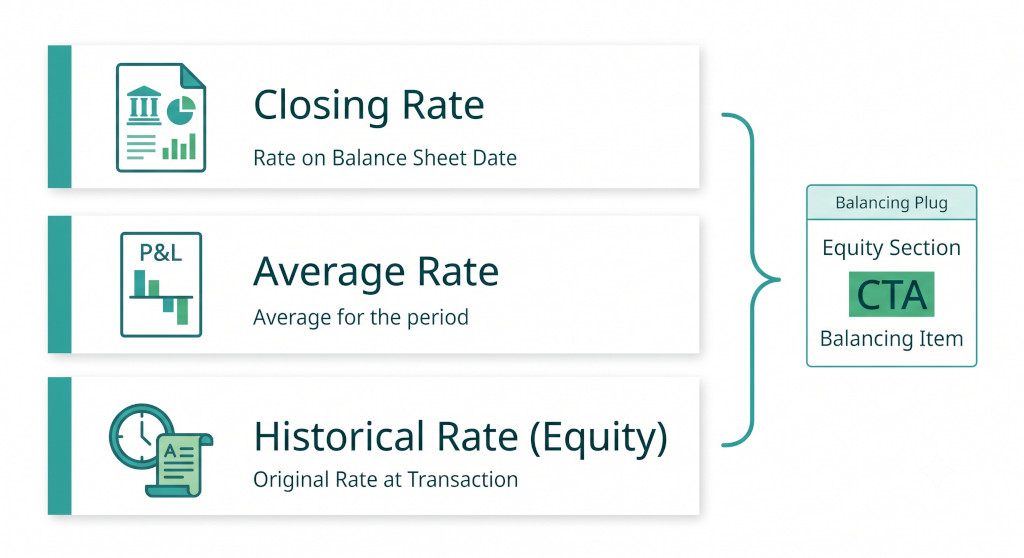
With the US GAAP trial balance prepared in GBP (original IFRS figures plus conversion adjustments), the next step is translation into USD under ASC 830. The approach mirrors IAS 21 closely — different rates apply to different parts of the financial statements, and the resulting difference accumulates as a Cumulative Translation Adjustment (CTA) in other comprehensive income.
| Item | Translation Rate | Rationale |
|---|---|---|
| Balance sheet assets and liabilities | Closing rate (GBP/USD 1.27 at year-end) | Reflects the USD equivalent of the subsidiary’s net position at the reporting date |
| Income statement revenues and expenses | Average rate for the period (GBP/USD 1.25) | Approximates the rates in effect at the time each transaction was recorded |
| Share capital and share premium | Historical rate (GBP/USD 1.30 at date of acquisition) | Equity contributed is a fixed historical transaction; does not retranslate |
| Opening retained earnings | Carried forward from prior year translation | Consistent with cumulative translation applied in prior periods |
| Current year net profit | Average rate (GBP/USD 1.25) | Translated consistently with the income statement |
| Cumulative Translation Adjustment (CTA) | Balancing figure | Absorbs all differences from applying different rates to different items; recorded in OCI within equity |
Worked Translation Example
Using BrizoEU’s US GAAP-restated figures in GBP (after conversion journals above) and the exchange rates from our example:
| Item | GBP (US GAAP restated) | Rate | USD |
|---|---|---|---|
| Income Statement | |||
| Revenue | 12,000,000 | Avg 1.25 | 15,000,000 |
| Total Expenses (incl. conversion adjustments) | (9,500,000) | Avg 1.25 | (11,875,000) |
| Net Profit | 2,500,000 | 3,125,000 | |
| Balance Sheet | |||
| Total Assets | 18,000,000 | Close 1.27 | 22,860,000 |
| Total Liabilities | (9,200,000) | Close 1.27 | (11,684,000) |
| Net Assets | 8,800,000 | 11,176,000 | |
| Equity Reconciliation | |||
| Share Capital (historical rate 1.30) | 3,000,000 | Hist 1.30 | 3,900,000 |
| Opening Retained Earnings (carried forward) | 3,300,000 | Prior year | 4,092,000 |
| Current Year Net Profit | 2,500,000 | Avg 1.25 | 3,125,000 |
| CTA (balancing figure) | — | Plug | 59,000 |
| Total Equity | 8,800,000 | 11,176,000 | |
The CTA of USD 59,000 is recognised in other comprehensive income in BrizoCorp Inc’s consolidated statements and accumulates in equity. It will be recycled to the income statement only on disposal of BrizoEU. A strengthening GBP against the USD generates a positive CTA; a weakening GBP generates a negative CTA — for UK subsidiaries of US parents, sterling movements can be a significant driver of reported group equity.
Step 5 — Intercompany Eliminations
Step 5
With BrizoEU’s US GAAP-restated, USD-translated figures loaded into the group consolidation, standard intercompany eliminations apply. Any balances between BrizoEU and other BrizoCorp Inc entities — intercompany receivables and payables, intercompany loans, management fees charged, intercompany sales and purchases — must be eliminated in full.
One practical complication arises with intercompany balances between GBP-functional and USD-functional entities. The GBP balance will have been translated at the closing GBP/USD rate on BrizoEU’s side; the USD entity will have recorded the same balance at the rate prevailing on the transaction date. The translation difference between those two rates creates a foreign currency difference at the point of elimination. This is treated as an FX difference at group level — typically recognised in the consolidated income statement for monetary items, or within the CTA for qualifying intercompany loans that form part of the net investment in the foreign operation.
Intercompany loans that are, in substance, part of the net investment in a foreign subsidiary — where settlement is neither planned nor likely in the foreseeable future — qualify for special treatment under both ASC 830 and IAS 21. Exchange differences on these balances go to the CTA in OCI rather than the income statement, avoiding P&L volatility on what are effectively quasi-equity instruments.
Practical Checklist: IFRS to US GAAP Consolidation
✅ Period-End Consolidation Checklist
- Obtain BrizoEU’s trial balance in GBP under IFRS
- Review which IFRS policies create US GAAP differences: development costs, revaluation, investment property, impairment reversals, lease income statement presentation
- Prepare GAAP conversion journals in GBP; document each adjustment with a justification note
- Confirm consolidation scope — run a VIE assessment for any structured entities in the group
- Confirm BrizoEU’s fiscal year-end aligns with BrizoCorp Inc’s; if not, identify and adjust for significant gap-period events
- Apply closing rate to all balance sheet items (GBP/USD)
- Apply average rate to all income statement items
- Apply historical rate to share capital and share premium
- Carry forward opening retained earnings at prior year translated amount
- Calculate CTA as the equity balancing figure; record in OCI
- Load translated US GAAP figures into group consolidation model
- Eliminate all intercompany balances and transactions
- Identify and treat FX differences on intercompany monetary eliminations
- Classify intercompany loans forming part of the net investment — route exchange differences to CTA, not P&L
- Review CTA movement for reasonableness against GBP/USD rate change in the period
Note: The journal entries and translation mechanics in this guide are illustrative and use simplified figures. The GAAP conversion adjustments required for your subsidiary will depend on its specific accounting policies, the materiality of individual differences, and guidance agreed with your external auditors. Engage your auditors when establishing the GAAP conversion framework for the first time or when new IFRS/US GAAP standards create additional differences.
Managing a multi-currency, multi-GAAP group consolidation?
BrizoConsol automates intercompany eliminations, currency translation, and consolidated reporting — connecting directly to Xero, QuickBooks, MYOB, and Zoho Books across all your entities. Start Free Trial