NCI in the Consolidated Statement of Changes in Equity: How to Build the NCI Column Correctly
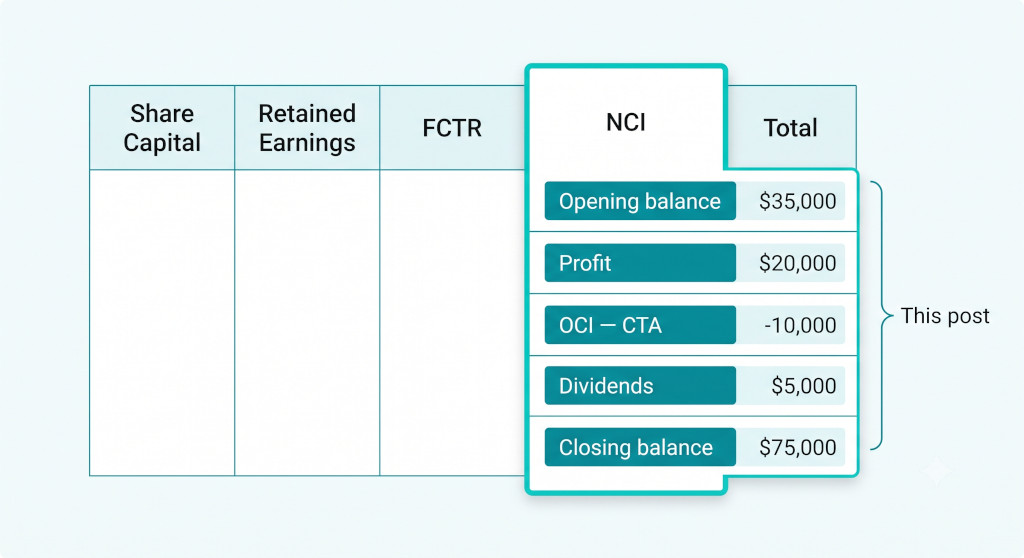
The audit partner had reviewed the consolidated financial statements twice. The income statement looked right. The balance sheet reconciled. But the statement of changes in equity had a problem: the NCI column showed a closing balance that couldn’t be traced back to the opening balance through the movements disclosed. Profit was there. Dividends were there. But the OCI line was blank — not nil, blank. There was no currency translation adjustment allocated to NCI anywhere in the statement, despite the group holding a 70%-owned Australian subsidiary for the entire year through a period of significant AUD/GBP movement.
This is an extremely common presentation gap in group accounts. Finance teams that correctly calculate the CTA allocation to NCI sometimes fail to carry it through to the statement of changes in equity. And teams that haven’t calculated the split at all produce an NCI column that shows only profit and dividends — a column that can never reconcile total comprehensive income correctly.
This article explains what belongs in the NCI column of the consolidated statement of changes in equity, how each component is calculated, and how to build a column that reconciles cleanly from opening to closing balance — with a worked example that brings together all the moving parts.
Automate NCI calculations across all your entities.
BrizoConsol handles non-controlling interest automatically — no manual adjustments required.
Why the Statement of Changes in Equity Matters for NCI
Under IAS 1.106, all entities preparing financial statements in accordance with IFRS are required to present a statement of changes in equity showing, for each component of equity, the opening balance, each movement during the period, and the closing balance. For consolidated financial statements, NCI is a component of equity — presented within equity but separately from the equity attributable to the owners of the parent.
The NCI column is, in effect, a mini-equity statement for the minority shareholders of the group’s partly-owned subsidiaries. It must show everything that moved the NCI balance during the year — not just what flowed through the income statement. For groups with foreign subsidiaries and partly-owned entities, the NCI column will typically contain movements that originate from three different financial statements: the income statement (profit attributable to NCI), the statement of comprehensive income (OCI — CTA attributable to NCI), and the balance sheet (changes arising from transactions with NCI shareholders).
Getting this column right matters for two reasons. First, it is a required disclosure under IFRS and auditors will check that the opening balance, movements, and closing balance reconcile arithmetically. Second, it is the most transparent record of what NCI shareholders have earned and received during the year — an important governance document for groups where NCI shareholders have information rights or distribution entitlements tied to the accounts.
Components of the NCI Column
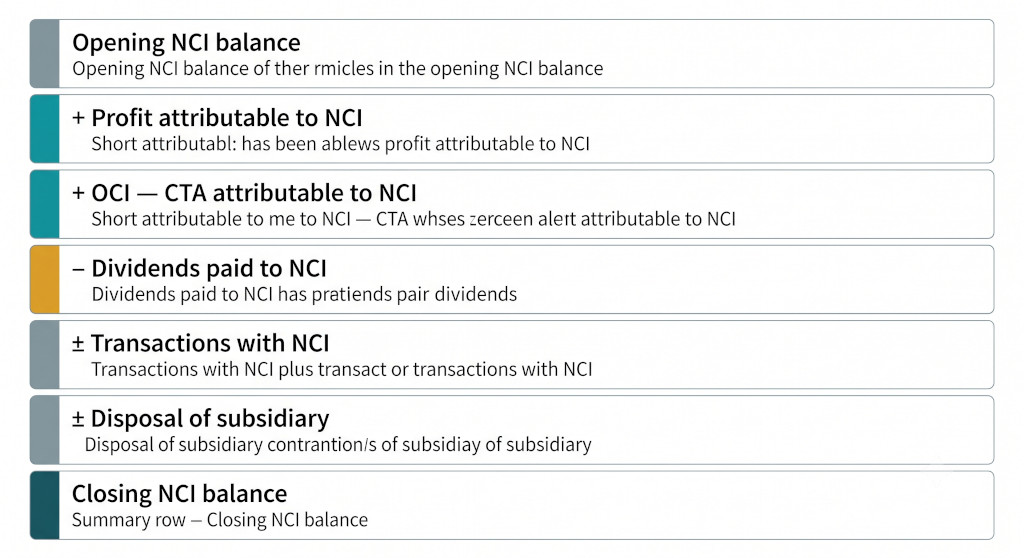
The NCI column should include every movement in the NCI balance during the period. The full set of components for a typical group with foreign subsidiaries is as follows.
Opening NCI balance
The closing NCI balance from the prior period. This should agree to the NCI line on the comparative balance sheet. For a group’s first year of consolidation, this is the NCI at the acquisition date — measured at either the proportionate share of identifiable net assets or at fair value, depending on the measurement method elected under IFRS 3.
Profit attributable to NCI
The NCI’s share of the subsidiary’s profit (or loss) for the period, translated at the average exchange rate. This is the figure presented in the consolidated income statement as “profit attributable to non-controlling interests” — the two statements must agree. This is the component most finance teams include correctly.
OCI attributable to NCI — currency translation adjustment
The NCI’s share of the CTA arising on translation of the foreign subsidiary’s financial statements. This is calculated as the NCI ownership percentage multiplied by the CTA movement for the period, as described in detail in the post on splitting the CTA in partly-owned foreign subsidiaries. This component is the one most commonly omitted.
If there are other OCI items attributable to NCI — for example, a share of a revaluation surplus in a subsidiary that has adopted the revaluation model for property — those would also appear here, each as a separate OCI line.
Divid ends paid to NCI
Cash or non-cash distributions made during the year by partly-owned subsidiaries to their NCI shareholders. These reduce the NCI balance but do not affect profit or OCI — they are distributions of equity, not expenses. They must be translated at the exchange rate at the date of payment, not the average rate.
Transactions with NCI (no loss of control)
When the parent acquires additional shares in a subsidiary from NCI shareholders, or sells part of its interest to new NCI shareholders, without losing control, IFRS 10 requires the transaction to be accounted for as an equity transaction. The difference between the consideration paid or received and the carrying amount of NCI acquired or disposed of is recognised directly in equity — specifically, it is allocated between the parent’s retained earnings and does not affect the income statement. The NCI column reflects the change in the NCI balance that results from the transaction.
If the parent buys out 10% of a subsidiary from NCI (reducing NCI from 30% to 20%), the NCI balance decreases by the carrying amount of that 10% interest. Any difference between what the parent paid and that carrying amount adjusts the parent’s equity, not the NCI column.
Disposal of a subsidiary (loss of control)
When a subsidiary is fully disposed of and control is lost, the NCI is derecognised in full — both the profit/retained earnings component and the NCI’s share of the FCTR are removed from the NCI column as part of the disposal. The derecognition of NCI is not presented as a separate line in the SOCIE for the income statement period in the same way as other movements; it is included within a “disposal of subsidiary” or similar line that zeroes out the NCI balance for that entity. This connects directly to the disposal accounting covered in the preceding post in this cluster.
Closing NCI balance
The sum of all the above. This must agree to the NCI line on the consolidated balance sheet at the period end. If it doesn’t, something has been omitted or miscalculated — the most common culprit is a missing CTA allocation.
The NCI column in the SOCIE is the only place in the financial statements where profit, OCI, dividends, and equity transactions attributable to minority shareholders are brought together in a single reconciliation. If the column doesn’t close, the error is almost always in the OCI line — specifically, a missing or incorrectly calculated CTA allocation.
Worked Example: Building the Full NCI Column
The scenario: ParentCo (GBP presentation currency) owns 75% of SubCo (AUD functional currency). NCI holds 25%, measured under the proportionate method. The following events occurred during the year:
- SubCo earned a profit of AUD 800,000 (= GBP 421,053 at the average rate of 1.90)
- The CTA for the year was GBP 245,614 (AUD strengthened; see the CTA/NCI allocation post for the full workings)
- SubCo paid a dividend of AUD 200,000 to all shareholders (rate at payment date: 1.85; GBP 108,108). NCI received 25% = GBP 27,027
- No transactions with NCI during the year
- Opening NCI balance: GBP 500,000
NCI column for the year:
| Movement | GBP | Source |
|---|---|---|
| Opening NCI balance | 500,000 | Prior year closing balance |
| Profit attributable to NCI (25%) | 105,263 | Income statement — GBP 421,053 × 25% |
| OCI: CTA attributable to NCI (25%) | 61,403 | OCI — GBP 245,614 × 25% |
| Total comprehensive income attributable to NCI | 166,667 | Agrees to SOCI |
| Dividends paid to NCI | (27,027) | AUD 200,000 × 25% ÷ 1.85 |
| Closing NCI balance | 639,640 | Must agree to balance sheet NCI line |
The NCI balance has moved from GBP 500,000 to GBP 639,640 — a net increase of GBP 139,640, representing comprehensive income of GBP 166,667 less dividends of GBP 27,027.
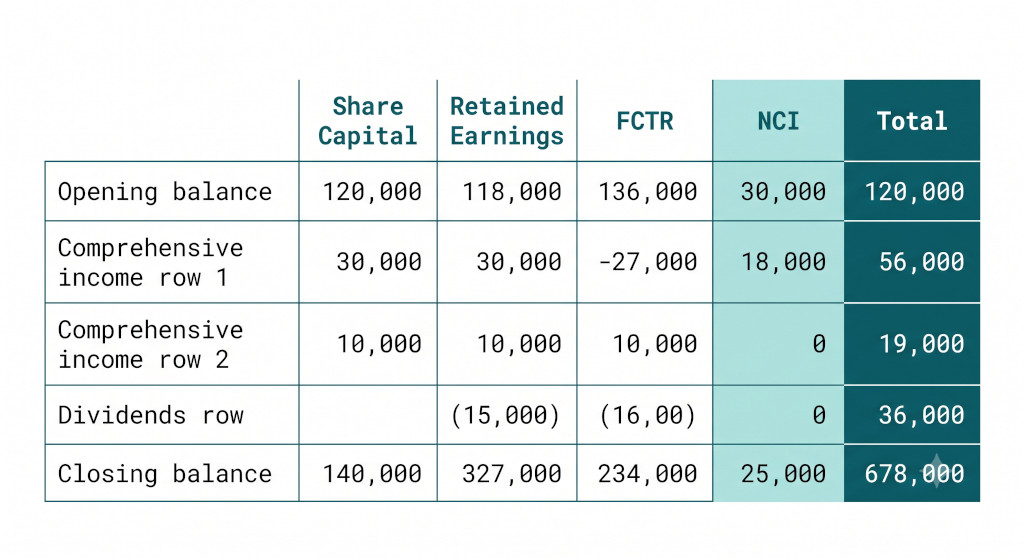
Now here is the same figure presented as part of the full consolidated statement of changes in equity, showing all equity columns side by side:
| Movement | Share capital | Retained earnings | FCTR | NCI | Total equity |
|---|---|---|---|---|---|
| Opening balance | 1,000,000 | 2,340,000 | 180,000 | 500,000 | 4,020,000 |
| Profit for the year | — | 315,789 | — | 105,263 | 421,053 |
| OCI: CTA for the year | — | — | 184,211 | 61,403 | 245,614 |
| Total comprehensive income | — | 315,789 | 184,211 | 166,667 | 666,667 |
| Dividends paid to parent shareholders | — | (81,081) | — | — | (81,081) |
| Dividends paid to NCI | — | — | — | (27,027) | (27,027) |
| Closing balance | 1,000,000 | 2,574,708 | 364,211 | 639,640 | 4,578,559 |
Every column closes. The FCTR has increased by GBP 184,211 (the parent’s 75% share of the CTA). The NCI has increased by GBP 139,640 (total comprehensive income of GBP 166,667 less dividends of GBP 27,027). Total equity has increased by GBP 558,559, which is total comprehensive income of GBP 666,667 less total dividends of GBP 108,108.
The Tell: When the NCI Column Doesn’t Close
The most reliable diagnostic for NCI errors is a SOCIE that doesn’t reconcile. If the opening balance plus all disclosed movements doesn’t produce the closing balance shown on the balance sheet, something is wrong. The most common causes:
OCI line missing entirely
The CTA allocation to NCI was never calculated, so the OCI row in the NCI column is blank. The closing NCI balance on the balance sheet may appear correct if it was carried forward from a prior year calculation, but it won’t reconcile from the opening balance through the disclosed movements. The gap equals the cumulative unallocated CTA.
Dividends translated at the wrong rate
Dividends paid by a foreign subsidiary to NCI shareholders are translated at the spot rate at the date of payment. Teams sometimes translate them at the average rate or the closing rate, creating a small difference that accumulates over time and prevents the column from closing. The difference is not material in most cases but will prevent a clean reconciliation.
Transactions with NCI not isolated correctly
Where the parent has acquired additional shares from NCI during the year, the transaction affects the NCI balance but does not go through profit or OCI. If the transaction is not separately presented in the SOCIE — or if it is incorrectly included in retained earnings without a corresponding adjustment to NCI — the column will not reconcile. IFRS 10 requires these transactions to be presented in the SOCIE as equity transactions, with a clear line showing the movement in NCI and the offsetting movement in the parent’s equity.
Watch out: If the NCI closing balance on the SOCIE agrees to the balance sheet but the SOCIE movements don’t add up — for example, if the closing balance was input directly rather than derived from the opening balance plus movements — the error is being masked rather than fixed. A SOCIE that is built bottom-up (from movements) rather than top-down (from desired closing balance) will always surface genuine errors rather than hide them.
Multiple Subsidiaries with Different NCI Percentages
Groups with more than one partly-owned subsidiary present the aggregate NCI as a single column in the SOCIE. The movements — profit, OCI, dividends, transactions — are the sum of the equivalent movements across all partly-owned subsidiaries, each calculated at its own ownership percentage.
For example, if the group has two partly-owned subsidiaries:
- SubCo A (25% NCI, AUD functional currency) — NCI profit GBP 105,263, NCI CTA GBP 61,403, dividends GBP 27,027
- SubCo B (40% NCI, EUR functional currency) — NCI profit GBP 88,000, NCI CTA GBP (12,400) (EUR weakened), dividends nil
The aggregate NCI column shows:
| Movement | SubCo A | SubCo B | Total NCI |
|---|---|---|---|
| Profit | 105,263 | 88,000 | 193,263 |
| OCI — CTA | 61,403 | (12,400) | 49,003 |
| Total comprehensive income | 166,667 | 75,600 | 242,267 |
| Dividends | (27,027) | — | (27,027) |
IFRS 12 requires groups to disclose, in the notes, summarised financial information for each subsidiary with material NCI — including the NCI’s share of profit, OCI, and closing equity for each entity individually. The aggregate SOCIE column is the summary; the note disclosure provides the entity-level breakdown that supports it.
Disclosures Required Under IFRS 12
The statement of changes in equity presents the aggregate NCI column. But IFRS 12 requires additional note disclosures for each subsidiary with material NCI, including:
- The subsidiary’s name and principal place of business
- The proportion of ownership interest and voting rights held by NCI
- Profit or loss allocated to NCI during the period
- Accumulated NCI at the end of the period
- Summarised financial information for the subsidiary (revenue, profit, assets, liabilities, cash flows)
The NCI column in the SOCIE provides the top-level reconciliation; the IFRS 12 note provides the entity-level detail that allows readers to understand where the NCI balance comes from and what the NCI shareholders are economically entitled to.
Build Your NCI Column Without Manual Workpapers
BrizoConsol tracks NCI profit, CTA, dividends, and equity transactions for each partly-owned subsidiary throughout the year. The movements are available at any time — ready to feed directly into your SOCIE without reconstruction. Start Free Trial
How BrizoConsol Supports the NCI Column
The NCI column in the SOCIE is only as good as the underlying calculations that feed it. BrizoConsol maintains the following for each partly-owned subsidiary throughout the year:
- Profit attributable to NCI — calculated from the translated income statement at the configured ownership percentage
- CTA attributable to NCI — calculated as the NCI’s share of the period’s CTA, derived from the IAS 21 translation of the subsidiary’s balance sheet
- Dividend payments to NCI — recorded at the payment date rate
- NCI balance — the opening balance plus all movements, maintained period by period so the SOCIE column is always derivable from the platform data
For groups with multiple partly-owned foreign subsidiaries, each entity’s NCI movements are calculated independently at its own ownership percentage and CTA, then aggregated for the SOCIE. The result is a SOCIE NCI column that closes correctly from day one — not one that requires a reconciliation exercise at year-end to explain why the closing balance doesn’t match the balance sheet.
You can read more about how BrizoConsol handles non-controlling interest and currency translation across the consolidation workflow.
Summary
The NCI column in the consolidated statement of changes in equity must reconcile from the opening balance to the closing balance through every movement that affected the NCI during the year. For groups with partly-owned foreign subsidiaries, those movements include:
- Opening NCI balance — from the prior period closing balance sheet
- Profit attributable to NCI — the NCI’s share of the subsidiary’s translated profit, presented in the income statement
- OCI — CTA attributable to NCI — the NCI’s share of the period’s currency translation adjustment; the component most frequently omitted
- Any other OCI items attributable to NCI — revaluation surpluses, actuarial gains, etc., where the subsidiary has such items
- Dividends paid to NCI — at the spot rate at the payment date
- Transactions with NCI — acquisitions or disposals of NCI interests that don’t result in loss of control; treated as equity transactions
- Disposal of subsidiary — full derecognition of NCI on loss of control, including NCI’s share of FCTR
- Closing NCI balance — must agree to the balance sheet
A SOCIE NCI column built from these components, with each derived from consistent underlying calculations rather than estimated or forced to balance, is both audit-ready and genuinely informative for anyone seeking to understand what the minority shareholders of the group hold and have received.
Accurate NCI. Clean SOCIE. Every Period.
BrizoConsol calculates NCI profit, CTA, and dividend movements for each partly-owned subsidiary automatically. No manual workpapers. No reconciliation surprises at year-end. Start Free Trial