How to Eliminate Intercompany SaaS Platform Fees When the IP Entity and the Operating Subsidiaries Are in Different Currencies
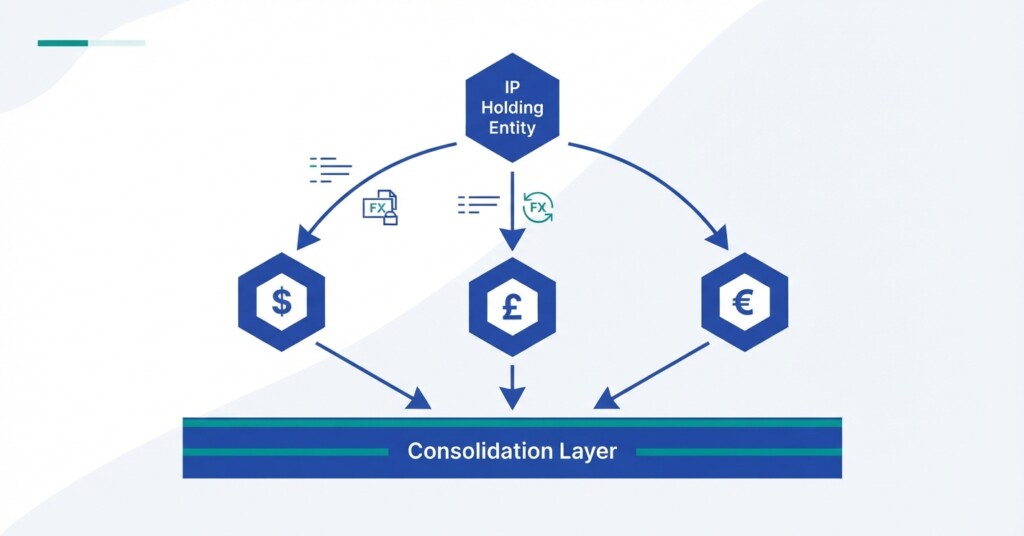
For many SME groups, the intellectual property or technology platform sits in one legal entity — often chosen for tax or regulatory reasons — while the operating subsidiaries that actually use the software sit in different countries with different functional currencies. When the IP entity charges a monthly SaaS or platform fee to each operating subsidiary, you have a classic intercompany transaction. But because the fee is denominated in one currency and the subsidiaries report in another, eliminating it at consolidation is more involved than a simple journal reversal. Exchange rate differences, timing mismatches, and inconsistent translation bases all create reconciling items that can stall your financial close.
This article walks through the mechanics step by step: how to structure the intercompany SaaS charge, how FX translation interacts with the elimination, where NCI adds another layer, and what your consolidation journals need to look like to arrive at clean group financials.
Why Intercompany SaaS Fees Create More Complexity Than a Simple Loan or Trade Payable
A straightforward intercompany trade payable can be eliminated by matching the receivable in the IP entity to the payable in the subsidiary. When both entities share the same functional currency, the numbers cancel exactly. SaaS platform fees in a cross-currency group are harder for three reasons.
Automate NCI calculations across all your entities.
BrizoConsol handles non-controlling interest automatically — no manual adjustments required.
- The fee is typically invoiced in the IP entity’s functional currency (say, USD), but it lands in the subsidiary’s books in the subsidiary’s functional currency (say, GBP or EUR) at the exchange rate on the invoice date.
- By the time month-end arrives, the exchange rate has moved. The subsidiary must revalue its foreign currency monetary payable at the closing rate, generating an exchange difference in its P&L that persists in consolidated profit or loss under IAS 21.45 rather than canceling out.
- If the subsidiary is not wholly owned, the platform fee expense and any related foreign exchange movement in the subsidiary’s P&L flow through to the NCI allocation and require careful verification.
Setting Up the Transaction: What Good Record-Keeping Looks Like
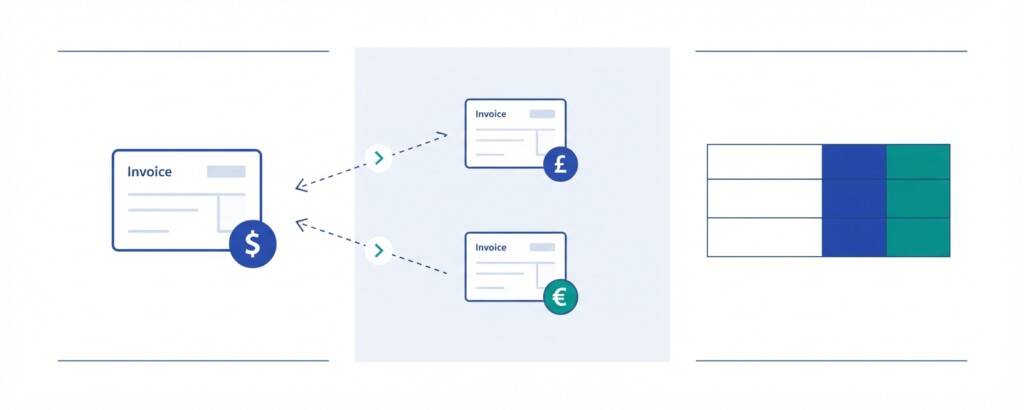
Before you can eliminate the fee, both sides of the transaction need to be recorded consistently. The IP entity — let us call it TechHoldCo, with USD as its functional currency — raises a monthly invoice of USD 50,000 to each of two subsidiaries: OpSub UK (functional currency GBP) and OpSub DE (functional currency EUR). The group’s presentation currency is USD.
| Entity | Functional Currency | Monthly Fee (USD) | FX Rate at Invoice Date | Fee in Local Currency |
|---|---|---|---|---|
| TechHoldCo (IP entity) | USD | USD 50,000 | n/a | USD 50,000 |
| OpSub UK | GBP | USD 50,000 | 1.25 USD/GBP | GBP 40,000 |
| OpSub DE | EUR | USD 50,000 | 1.10 USD/EUR | EUR 45,455 |
TechHoldCo recognises revenue and a receivable of USD 50,000 per subsidiary. Each subsidiary recognises an expense and a payable in its own functional currency. So far so straightforward. The complexity arrives at month-end, when you translate everything into the presentation currency for consolidation.
Under IAS 21 (and its equivalents), foreign currency monetary items — including intercompany payables and receivables — must be retranslated at the closing rate at each balance sheet date, with exchange differences recognised in profit or loss in the entity’s own financial statements. Because the monetary payable is revalued to the closing rate in the subsidiary’s accounts and then translated at that same closing rate for consolidation, the presentation currency amounts on the balance sheet match exactly. However, under IAS 21.45, that exchange difference is not eliminated and remains in consolidated profit or loss.
The Translation Mismatch: Where the Numbers Stop Agreeing
Assume the invoice was raised on the 1st of the month and the month-end closing rate moves. Here is what happens to the UK subsidiary’s payable and where confusion often arises.
| USD invoice recorded in GBP at invoice date (USD 50,000 / 1.25) | GBP 40,000 |
| Month-end closing rate (USD/GBP) | 1.28 |
| OpSub UK payable revalued at closing rate (USD 50,000 / 1.28) | GBP 39,062.50 |
| FX gain recognised in OpSub UK P&L (GBP 937.50 × 1.28) | USD 1,200 |
| OpSub UK payable translated into USD at closing rate | USD 50,000 |
| TechHoldCo receivable in USD (matches OpSub UK payable exactly) | USD 50,000 |
If a finance team omits the IAS 21 month-end revaluation in the subsidiary ledger and simply retranslates the historical GBP 40,000 at the closing rate of 1.28, they calculate an erroneous payable of USD 51,200, creating an apparent USD 1,200 mismatch against the USD 50,000 receivable. In reality, once OpSub UK revalues its USD monetary liability to GBP 39,062.50, translating it at the closing rate yields exactly USD 50,000. The balances match perfectly on the balance sheet, but OpSub UK has recognised a genuine USD 1,200 exchange gain in its P&L that must be accounted for correctly at group level.
The Consolidation Journals: Elimination Step by Step
The elimination process has two stages. First, eliminate the reciprocal intercompany revenue and expense. Second, eliminate the reciprocal intercompany balance sheet positions while properly preserving the foreign exchange difference in consolidated results.
For simplicity, we will work through OpSub UK only. The same logic applies to OpSub DE with EUR amounts.
| Account | Dr | Cr |
|---|---|---|
| Intercompany Revenue (TechHoldCo) | 50,000 | |
| Intercompany Platform Fee Expense (OpSub UK — translated at transaction rate) | 50,000 |
Step 1 — Eliminate the matched intercompany fee. Both amounts are translated into USD presentation currency using the transaction rate (or an average rate as a proxy). This eliminates the gross-up from both group revenue and group operating expenses, leaving no net impact on group operating profit from the intragroup charge.
| Account | Dr | Cr |
|---|---|---|
| Intercompany Payable (OpSub UK — USD equivalent at closing rate) | 50,000 | |
| Intercompany Receivable (TechHoldCo — USD 50,000) | 50,000 |
Step 2 — Eliminate the balance sheet intercompany positions. To eliminate the accounts, debit the payable and credit the receivable. Because both balances translate to USD 50,000 at the closing rate, they eliminate in full. Crucially, under IAS 21.45, the USD 1,200 exchange difference that OpSub UK recognised in its own P&L is not eliminated on consolidation; it remains in group P&L because it reflects an ongoing currency exposure until cash settlement.
A common mistake is to eliminate the intercompany revenue and expense at the closing rate rather than the transaction or average rate. Income statement items should be translated at the transaction date rate (or an average rate as a proxy, per IAS 21.39(b) and IAS 21.40). If you use the closing rate for P&L elimination, you will introduce a spurious currency variance into your group results. Always confirm which rate your consolidation tool — or your manual process — is applying to each line.
What Happens When OpSub UK Is Not Wholly Owned
Suppose TechHoldCo owns only 75% of OpSub UK, with a 25% non-controlling interest. The intercompany elimination still removes 100% of the intragroup transaction — you do not eliminate only 75% because you own 75%. The full revenue in TechHoldCo and the full expense in OpSub UK are eliminated.
The NCI impact arises differently: the platform fee expense and the IAS 21 foreign exchange movement run through OpSub UK’s P&L before consolidation. OpSub UK’s post-tax profit, from which the NCI’s 25% share is calculated, reflects both the platform fee charge and any FX gain or loss on the open USD payable. The fee has effectively reduced the profit available to the NCI, which is the intended commercial outcome when an IP entity charges an arm’s length rate for software services. No additional NCI-specific elimination journal is needed for the fee itself, but you should verify that the arm’s length nature of the charge is documented, particularly if your auditors or tax authorities might scrutinise transfer pricing.
Handling Unpaid Balances and Timing Differences
In practice, subsidiaries do not always pay the platform fee on the same day the invoice is raised. If a January invoice is still outstanding at 31 January, the receivable and payable both sit on the balance sheet and need retranslation at the closing rate as described above. If OpSub UK has partially paid — say, USD 25,000 (GBP 20,000 at the original rate) — then that portion has been cash-settled and only the remaining USD 25,000 remains as a monetary item subject to retranslation. Your elimination needs to reflect the actual open balance, not the original invoice total.
This is precisely the kind of granular reconciliation that becomes unmanageable in a shared Excel workbook once a group has more than two or three subsidiaries charging each other. Each pair of entities generates its own FX-adjusted balance, and the elimination journal amounts need to be recalculated each month as rates change.
Practical Steps to Get This Right Every Month
- Agree a single source of truth for FX rates across all entities before month-end. Everyone should use the same closing rate and the same average rate. Inconsistency here is the single biggest cause of unexplained consolidation differences.
- Confirm intercompany balances before you start eliminations. The IP entity and each subsidiary should confirm their open intercompany positions — invoice by invoice if needed — so you know exactly what to eliminate.
- Separate the FX difference from the trading difference. The exchange movement on the foreign currency monetary payable is normal and expected. Remember that under IAS 21.45, this exchange difference remains in consolidated profit or loss rather than being forced out in the balance sheet elimination.
- Document the transfer pricing basis for the platform fee. If the fee is denominated in USD and charged to GBP and EUR entities, that is a transfer pricing decision with tax implications. The arm’s length price and currency denomination should be reviewed at least annually.
- Reconcile the intercompany P&L as well as the balance sheet. Teams often focus on eliminating the balance sheet balances but miss unmatched revenue and expense lines that create artificial gross profit in the group accounts.
- Use a consistent P&L translation rate. Apply transaction or average rates to income statement items, not closing rates, and do so consistently across all entities in the group.
Why This Process is Difficult to Scale in Spreadsheets
If your group has a single IP entity invoicing four or five subsidiaries in different currencies, you are managing at least four separate elimination calculations, each with their own rate history, open balance confirmations, and journal entries. Add a mid-year acquisition, a change in ownership percentage affecting NCI, or a new currency in the mix, and the Excel-based consolidation workbook quickly becomes the highest-risk document in the finance team’s toolkit.
Automated consolidation tools handle the translation and elimination mechanics systematically — they apply consistent rates, generate the elimination journals automatically once intercompany relationships are mapped, and flag residual differences for investigation rather than burying them. The finance team’s job shifts from rebuilding the workbook each month to reviewing and explaining a much smaller set of genuine variances. That is a meaningfully different use of a controller’s or CFO’s time.
The elimination of intercompany SaaS fees in a multi-currency group is not a one-off exercise. Rates move every month, balances change, and new subsidiaries get added. Building a repeatable, documented process — whether in a consolidation platform or a rigorously structured spreadsheet — saves significant time over the course of a financial year and reduces audit risk.
A Note on Disclosure and Group Reporting
Once the eliminations are complete, your group accounts should show no intercompany revenue, no intercompany expense, and no intercompany balance in respect of the platform fee. What does appear is the group’s net result from the IP entity’s activities as they relate to external customers, the operating subsidiaries’ results net of the intragroup charge, and any consolidated FX difference arising on unsettled monetary balances under IAS 21.45. Management reporting packs often also show a segmental view where the IP entity’s contribution is visible separately — but that is a management accounting choice, not a statutory one, and the intercompany fees should still be clearly flagged as eliminated in any segmental reconciliation presented alongside statutory results.
Getting this process right — methodically, every month, with consistent rates and documented journals — is one of the foundational disciplines of multi-entity finance. It is not glamorous, but it is the difference between group accounts that close cleanly and group accounts that carry unexplained variances into the next quarter.
Automate Your Intercompany Eliminations and FX Translation
BrizoConsol is built for SME finance teams managing multi-entity consolidation, intercompany eliminations, and group reporting across different currencies. Connect your entities, map intercompany relationships, and let the platform handle the elimination journals and FX translation automatically — so your team spends less time rebuilding workbooks and more time on analysis.