Contingent Consideration in Group Consolidation: Why Earn-Outs and Deferred Payments Look Different in Your Consolidated Accounts
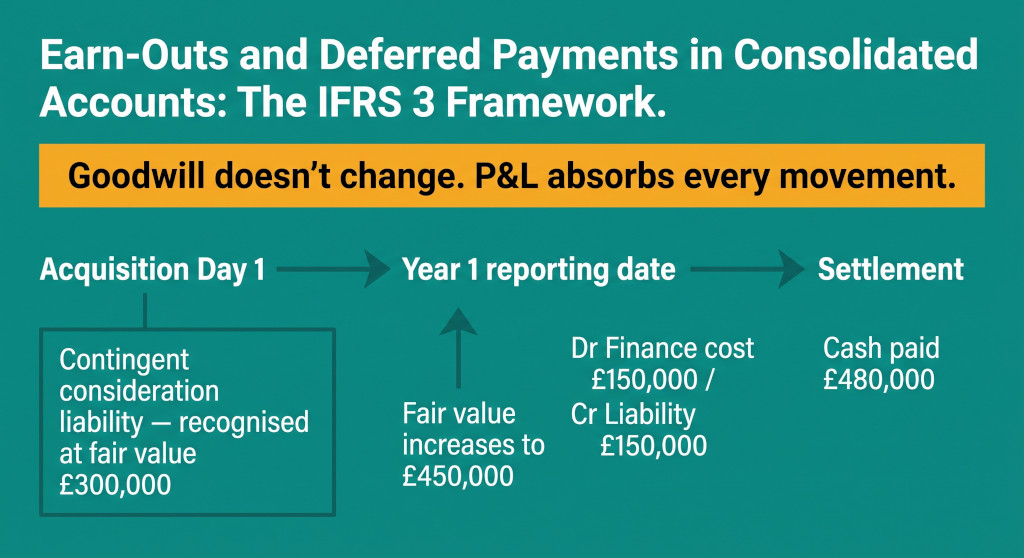
When a group acquires a business, the consideration paid is rarely a single clean cash figure. Most acquisitions include some form of contingent or deferred payment — an earn-out tied to revenue or profit targets, milestone payments linked to contract wins or product launches, or structured deferred payments with future settlement dates. From a commercial perspective, these arrangements protect the acquirer against overpaying for a business whose future performance is uncertain. From an accounting perspective, they introduce complexity that shows up almost entirely in the consolidated accounts, and almost never in any entity’s standalone books.
Under IFRS 3 Business Combinations, contingent consideration is recognised at fair value on the acquisition date — even though no cash has changed hands and the payment may never occur. After acquisition, the liability is remeasured to fair value at every reporting date, with changes going through the consolidated P&L. If the acquired business performs better than expected and the earn-out liability increases, the group records a loss. If the business disappoints and the earn-out falls away, the group records a gain. These movements can materially distort the consolidated P&L in ways that have nothing to do with underlying trading performance, and they exist nowhere in the standalone accounts of any entity in the group.
What Counts as Contingent Consideration
Revenue earn-out
Additional payment if the acquired business achieves a defined revenue figure in a specified period post-acquisition. Common in service businesses where forward revenue is uncertain.
Stop building consolidations in spreadsheets.
BrizoConsol automates multi-entity consolidation — setup in minutes, reports the same day.
Profit earn-out (EBITDA / PBT)
Additional payment linked to profit margin or a profit threshold. More complex to measure than revenue earn-outs; susceptible to disputes if the group allocates overhead to the acquired entity post-acquisition.
Milestone payment
Lump sum payable on the occurrence of a specific event — regulatory approval, a key contract win, a product launch, or a defined trading volume. Binary: either the event occurs or it doesn’t.
Equity earn-out
Additional shares issued to the seller if conditions are met. Classified as equity (not a financial liability) if the number of shares is fixed on the acquisition date. Classified as a liability if the number of shares depends on future fair value calculations.
Deferred consideration is not the same as contingent consideration. A fixed amount payable at a future date — for example, £400,000 payable 18 months after completion — is deferred consideration, not contingent consideration. It is recognised as a financial liability at discounted present value on Day 1, with the unwinding of the discount treated as a finance charge over the deferral period. The amount does not change based on future performance; only the timing differs from a cash payment at completion.
The IFRS 3 Framework: Three Stages
IFRS 3 paragraph 39 requires the acquirer to recognise the acquisition-date fair value of any contingent consideration as part of the consideration transferred for the acquired business. The framework then governs how the liability evolves in each subsequent reporting period.
Stage 1 — Recognition at fair value on the acquisition date. The fair value of the contingent consideration is estimated using probability-weighted scenarios. If an earn-out has a maximum payable of £500,000 and the acquirer estimates a 60% probability of full payment and a 40% probability of zero, the acquisition-date fair value is £300,000 (ignoring discounting for simplicity). This £300,000 is recognised as a liability on Day 1 and is included in the consideration transferred — which means it flows into the goodwill calculation.
Stage 2 — Subsequent remeasurement. If the contingent consideration is classified as a financial liability, it is remeasured to fair value at every reporting date. Changes are recognised in the consolidated P&L — not as an adjustment to goodwill. This is the critical rule change introduced by the 2008 revision of IFRS 3. Under the pre-2008 standard, earn-out changes adjusted goodwill. Under current IFRS 3, goodwill is fixed at the acquisition date and never changes because of post-acquisition earn-out developments.
Stage 3 — Settlement. When the earn-out period ends and the actual payment is determined, any remaining difference between the carrying value of the liability and the amount paid is recognised in P&L at settlement. The liability is derecognised and cash (or shares) are transferred to the seller.
Worked Example: Acquisition With a Revenue Earn-Out
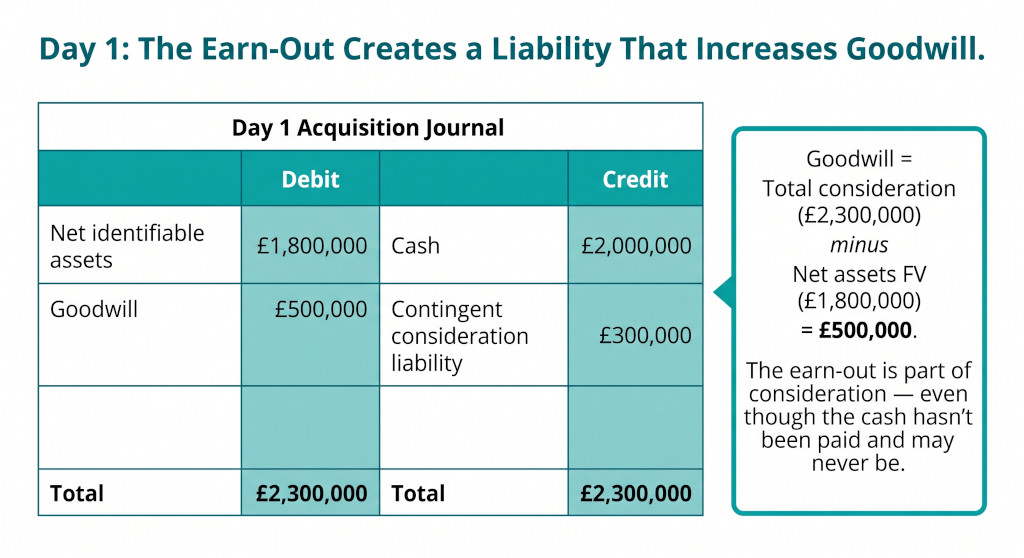
Terms: AcquireCo acquires TargetCo on 1 January Year 1. Cash consideration at completion: £2,000,000. Earn-out: 25% of TargetCo’s Year 1 revenue, capped at £500,000, payable in cash in January Year 2. At the acquisition date, the earn-out is estimated to have a fair value of £300,000 (probability-weighted: 60% chance of £500,000, 40% chance of £0). Net identifiable assets of TargetCo at fair value: £1,800,000.
Goodwill calculation — 1 January Year 1
| Cash consideration paid | £2,000,000 |
| Fair value of contingent consideration | £300,000 |
| Total consideration transferred | £2,300,000 |
| Less: Net identifiable assets at fair value | (£1,800,000) |
| Goodwill recognised at acquisition | £500,000 |
Journal 1 — Acquisition date (1 January Year 1)
| Account | Dr (£) | Cr (£) |
|---|---|---|
| Net identifiable assets — TargetCo (various, at fair value) | 1,800,000 | |
| Goodwill | 500,000 | |
| Cash — consideration paid at completion | 2,000,000 | |
| Contingent consideration liability (earn-out at FV) | 300,000 |
The £300,000 contingent consideration liability is recognised immediately, even though no payment has been made and whether any payment will be made depends on Year 1 trading. It is a financial liability measured at fair value through profit or loss (FVTPL) from this point forward. Goodwill is fixed at £500,000 — it will not change when the earn-out develops in Year 1.
(reporting date)
(earn-out determined)
Journal 2 — Year 1 reporting date (31 December Year 1): earn-out FV increases
| Account | Dr (£) | Cr (£) |
|---|---|---|
| Finance cost — earn-out remeasurement (P&L) | 150,000 | |
| Contingent consideration liability | 150,000 |
The liability increases from £300,000 to £450,000. The £150,000 is recognised as a finance cost (or equivalent P&L line) in the consolidated income statement. It is not an adjustment to goodwill. No entry of this kind appears in TargetCo’s own accounts — TargetCo has no visibility of the earn-out liability or its remeasurement.
Journal 3 — January Year 2: settle the earn-out at £480,000
| Account | Dr (£) | Cr (£) |
|---|---|---|
| Finance cost — earn-out remeasurement (residual) (P&L) | 30,000 | |
| — recognise final £30,000 movement | ||
| Contingent consideration liability | 480,000 | |
| Cash | 480,000 | |
| Finance cost (P&L) | 30,000 |
Total earn-out paid: £480,000. Total finance cost recognised across Years 1 and 2 from earn-out remeasurement: £180,000 (£150,000 + £30,000). Goodwill remains at £500,000 — entirely unchanged. The £180,000 incremental cost is absorbed entirely in consolidated P&L.
Why These Entries Exist Only in Consolidated Accounts
When AcquireCo’s finance team prepares the consolidation, the contingent consideration movements appear as consolidation-level adjustments — not as entries in any entity’s trial balance. TargetCo has no entry for the earn-out at all: it simply runs its business and records trading transactions. AcquireCo (the parent entity) records the investment in TargetCo at cost in its own accounts and may recognise the earn-out liability as a creditor, but the parent’s own accounts do not necessarily show the IFRS 3 remeasurement through P&L in the same way — particularly if the parent entity applies a different framework (FRS 102, for example) or recognises the investment at cost rather than consolidating.
The consolidated group accounts are where IFRS 3 applies in full. It is the consolidated income statement that shows the finance cost from earn-out remeasurement. It is the consolidated balance sheet that carries the contingent consideration liability. And it is the consolidated equity — specifically retained earnings — that is reduced by the cumulative remeasurement losses over the earn-out period. None of this appears as a line in any subsidiary’s accounts, and the parent entity’s own accounts may show a different picture depending on its accounting policy for investments in subsidiaries.
For a full walkthrough of the acquisition journal and goodwill calculation mechanics under IFRS 3 — including the purchase price allocation that determines the net identifiable assets figure used in the goodwill calculation — see acquisition accounting in group consolidation: a step-by-step guide to IFRS 3.
Contingent Consideration vs Post-Acquisition Compensation: The Critical Distinction
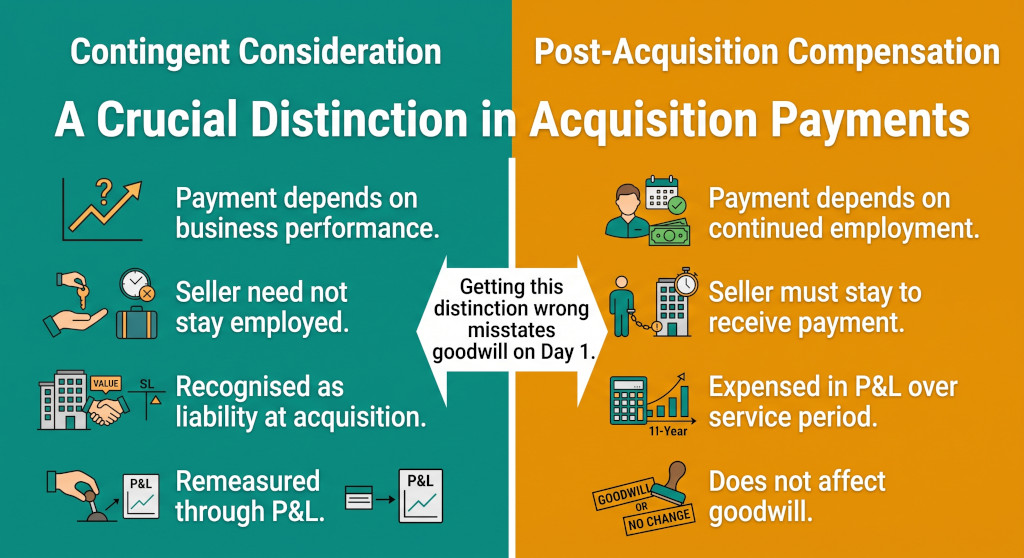
The most consequential classification decision in earn-out accounting is whether a payment represents contingent consideration (part of the acquisition price, included in goodwill) or post-acquisition compensation (an employment cost, recognised as an expense over the service period). IFRS 3 paragraph B55 sets out indicators to help make this determination.
- The seller receives the payment whether or not they remain employed by the acquired business
- Payment is solely contingent on business performance metrics (revenue, profit, milestones), not on continued service
- The payment would not forfeit if the seller leaves or is terminated
- The amount is commercially comparable to what would be paid to a third-party seller with no employment relationship
- Recognised as a liability at acquisition-date fair value; remeasured through consolidated P&L
- The seller forfeits the payment if they leave or are terminated before the earn-out period ends
- The payment is specifically contingent on continued employment during the earn-out period
- The number of employees sharing the payment is disproportionate to their equity ownership
- The earn-out amount is comparable to market-rate remuneration for the role
- Recognised as compensation expense over the service period — not as consideration or goodwill
Misclassification materially misstates goodwill. If a payment that should be post-acquisition compensation is incorrectly classified as contingent consideration, goodwill is overstated by the fair value of that payment on Day 1. If a genuine contingent consideration payment is incorrectly expensed as compensation, goodwill is understated. Both errors are material and will be challenged by auditors. In practice, many private company acquisitions involve founder-sellers who are also key managers; the employment condition test is the single most important factor in the classification.
Cross-Standard Comparison: IFRS 3, FRS 102, and ASC 805
| Area | IFRS 3 | FRS 102 | ASC 805 (US GAAP) |
|---|---|---|---|
| Recognition at acquisition date | Fair value — required (IFRS 3 para 39) | Best estimate of likely payment — not necessarily FV modelled (FRS 102 para 19.11) | Fair value — required (ASC 805-30-25) |
| Subsequent changes to contingent consideration | Liability: remeasure through P&L. Equity: no remeasurement | Historically: adjust goodwill. Current FRS 102 revision may change this — check ASC guidance | Liability: remeasure through P&L. Equity: no remeasurement. Same as IFRS 3 |
| Does goodwill adjust after acquisition date? | No — goodwill fixed at Day 1 | Yes (under pre-revision FRS 102) — changes adjust goodwill during measurement period | No — goodwill fixed at Day 1 (after measurement period) |
| P&L volatility from remeasurement | Yes — liability changes hit P&L each period | Minimal under old treatment (adjusts goodwill, not P&L) | Yes — same as IFRS 3 |
| Measurement period adjustments | Up to 12 months post-acquisition — retrospective adjustment to goodwill for new information about facts existing at acquisition date | Similar measurement period concept | Up to 12 months post-acquisition — same concept as IFRS 3 |
| Post-acquisition compensation test | Yes — IFRS 3 para B55 indicators apply | Similar principle in FRS 102 | Yes — ASC 805-10-55 indicators apply; generally consistent with IFRS 3 |
The P&L Volatility Problem — and How to Present It
For acquisitive groups that complete multiple earn-out transactions in a year, the remeasurement of contingent consideration liabilities can become a significant driver of consolidated P&L movement that has no connection to underlying trading performance. A group that has acquired three businesses — each with a two-year earn-out — may be carrying three earn-out liabilities simultaneously, each remeasured at every reporting date based on the latest probability-weighted forecast for each acquired business.
In practice, groups typically exclude earn-out remeasurement from their adjusted EBITDA and adjusted profit metrics. The earn-out movements are presented separately — either as a finance item or as a non-underlying charge — to allow readers to distinguish between trading performance and the accounting effects of acquisition structures. This presentation choice should be applied consistently and disclosed in the accounting policies and in the notes to the consolidated financial statements.
IFRS 3 requires disclosure of: the range of possible outcomes (minimum and maximum undiscounted contingent consideration), the basis for estimating fair value, and the changes in fair value recognised in the period. For groups with multiple earn-outs, the disclosure burden is proportionally higher.
For the specific application of earn-out accounting in a professional services context — where the seller-managers are typically critical to the business’s continued performance and the employment condition test is most acute — see earn-outs in professional services acquisitions: why the contingent consideration accounting only exists in your group accounts. For the purchase price allocation mechanics that produce the net identifiable assets figure that anchors the goodwill calculation, see goodwill in group consolidation: how to calculate and account for it and goodwill in group consolidation: calculation, impairment, and common errors. For the negative goodwill treatment when the acquisition is a bargain purchase, see negative goodwill: why the bargain purchase gain must hit your consolidated P&L.
Earn-out liabilities tracked and remeasured automatically at each close
BrizoConsol maintains contingent consideration schedules for each acquisition — recording the acquisition-date fair value, tracking period-end remeasurements, posting the P&L entries, and reconciling closing liability balances across the group consolidation workpaper. See It in Action Start Free