IFRS 10 Consolidated Financial Statements: A Practical Guide for Multi-Entity Groups
When a business owns shares in another company, the first question an accountant must answer is not how to record the investment — it is whether to consolidate it at all. The answer determines everything that follows: whether the subsidiary’s assets and liabilities appear in the group balance sheet, whether its revenue runs through the group P&L, whether its intercompany transactions need to be eliminated, and whether a non-controlling interest must be recognised.
IFRS 10 Consolidated Financial Statements is the standard that answers that question. Issued by the IASB and effective for annual periods beginning on or after 1 January 2013, it replaced the consolidation provisions of IAS 27 and the entire SIC-12 interpretation on special purpose entities. Its core contribution was to establish a single, principle-based definition of control that applies to every type of investee — subsidiaries, structured entities, funds, and everything in between.
This guide explains how IFRS 10 works in practice: the three-element control test, how to apply it in situations that are not straightforward, the investment entities exception, and what the standard actually requires once you have determined that consolidation is necessary.
Automate NCI calculations across all your entities.
BrizoConsol handles non-controlling interest automatically — no manual adjustments required.
The Three-Element Control Model
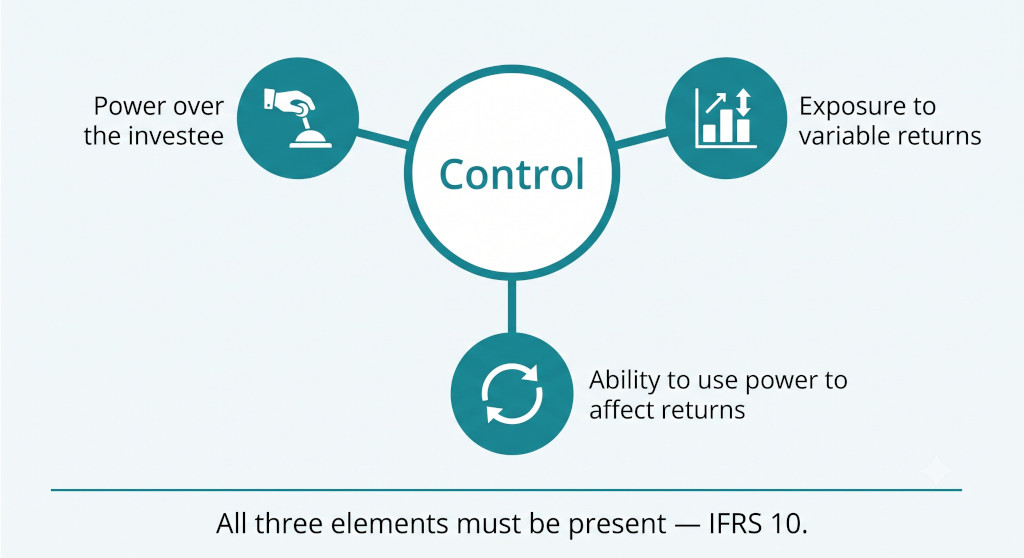
Under IFRS 10, an investor controls an investee — and must therefore consolidate it — when all three of the following elements are present simultaneously:
- Power over the investee — the investor has existing rights that give it the current ability to direct the relevant activities of the investee.
- Exposure, or rights, to variable returns — the investor is exposed to, or has rights to, returns from its involvement that can vary as a result of the investee’s performance.
- The ability to use power to affect the amount of those returns — the investor can use its power over the investee to influence the returns it receives.
All three must be present. An investor that has power but no meaningful exposure to returns is not a parent — it is an agent acting on behalf of others. An investor with exposure to returns but no power over relevant activities is not a parent either — it is a passive investor.
Element 1: Power
Power arises from rights. The most straightforward source of power is a voting majority: holding more than 50% of the ordinary shares typically gives the investor the current ability to appoint and remove the board of directors, which in turn controls the relevant activities of the business.
But IFRS 10 goes considerably further. Power can also arise from:
- Contractual arrangements — a management contract that gives one party the right to direct the operating and financing activities of an entity, even without equity ownership.
- Potential voting rights — options, warrants, or convertible instruments that, if exercised, would give the investor a voting majority. These count if they are currently exercisable and substantive (i.e., not deeply out of the money).
- De facto control — holding less than 50% of the votes but still having power because the remaining votes are so widely dispersed that the investor consistently controls decisions in practice. This is one of the most judgement-intensive aspects of IFRS 10.
Relevant activities under IFRS 10 are those that most significantly affect the investee’s returns. For most operating businesses, this means decisions about products, markets, capital expenditure, and management. For a structured entity, it might be decisions about asset management or credit exposure.
Element 2: Exposure to Variable Returns
Variable returns are returns that are not fixed — they can be positive, negative, or both. They include dividends, management fees that depend on performance, residual interests in the net assets on liquidation, tax benefits, and exposure to losses.
This element is almost always present in any investment that has substance. Even a lender who holds a senior secured loan has some exposure to variable returns (credit loss risk). The key judgement is whether the variability is sufficient to be meaningful — a fixed-fee service contract generally does not create variable-return exposure.
Element 3: Link Between Power and Returns
The third element distinguishes a principal from an agent. If an investor has power and variable returns but cannot actually use its power to affect its returns, control is not established. In practice, this element is usually satisfied automatically once elements one and two are present — an investor with voting control and equity returns almost always has the ability to influence those returns through the decisions it makes. The element becomes more relevant in complex fund or trust structures where decision-making rights are constrained by agreement.
Applying the Control Test in Practice
For most straightforward equity investments, the IFRS 10 assessment is clear. The complexity arises in edge cases — and those edge cases come up regularly in multi-entity group structures.
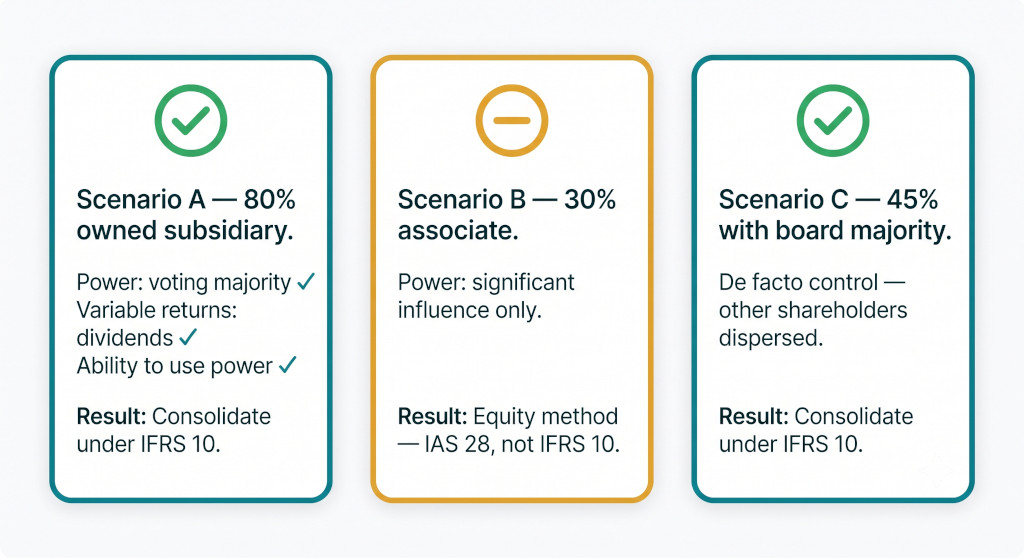
Scenario A: Clear Subsidiary (80% Ownership)
Arkwright Holdings owns 80% of the ordinary shares in Arkwright Manufacturing Ltd. The remaining 20% is held by a passive outside investor with no additional rights. Arkwright Holdings appoints the board, directs strategy, and receives 80% of dividends. All three elements are met. Arkwright Manufacturing is consolidated under IFRS 10, with the 20% outside interest recognised as a non-controlling interest in the consolidated balance sheet and P&L.
Scenario B: Associate (30% Ownership)
Arkwright Holdings also owns 30% of Meridian Logistics Ltd. No single shareholder holds more than 35%. Arkwright has two seats on a seven-member board. It has significant influence over Meridian but cannot direct its relevant activities unilaterally. Element 1 — power — is not met. Meridian Logistics is not consolidated. Instead, it is accounted for using the equity method under IAS 28: a single line in the balance sheet representing Arkwright’s share of Meridian’s net assets, and a single line in the P&L representing Arkwright’s share of Meridian’s profit or loss.
Scenario C: De Facto Control (45% Ownership)
Arkwright Holdings owns 45% of Pacific Distribution Pty Ltd. The remaining 55% is spread across 200 shareholders, none of whom holds more than 1%. At every general meeting over the past four years, Arkwright has been the only shareholder to exercise its votes. Arkwright appoints all board members in practice. Under IFRS 10’s de facto control provisions, Arkwright controls Pacific Distribution despite holding less than 50%. All three elements are met. Pacific Distribution must be consolidated.
De facto control requires active assessment, not a one-time judgement. If the shareholder register changes — if a 15% activist investor acquires shares and begins attending meetings — the de facto control conclusion may need to be revisited. IFRS 10 requires reassessment whenever facts and circumstances indicate that one of the elements of control has changed.
Potential Voting Rights
Suppose Arkwright holds 40% of Coastal Retail Ltd but also holds call options over a further 15%, exercisable at any time at market price. Even though Arkwright has not exercised the options, those options are substantive and currently exercisable. IFRS 10 requires Arkwright to include the effect of the options in its control assessment. With the options included, Arkwright’s effective interest would be 55% — giving it a voting majority. If the options are substantive (not deeply out of the money, not subject to blocking conditions), Arkwright controls Coastal Retail and must consolidate it.
See How BrizoConsol Handles Group Consolidation
Once you have determined which entities to consolidate under IFRS 10, BrizoConsol automates the rest — pulling live data from Xero, MYOB, QuickBooks, and Zoho Books, eliminating intercompany transactions, translating foreign currencies, and producing consolidated P&L, balance sheet, and cash flow statements. See It In Action
Structured Entities
Before IFRS 10, special purpose entities (SPEs) were governed by SIC-12, which used a risks-and-rewards model to determine consolidation. IFRS 10 replaced this with the same three-element control model used for all other investees — but it requires additional judgement for structured entities because these entities are designed so that voting rights are not the primary determinant of control.
A structured entity is one that has been designed so that voting or similar rights are not the dominant factor in deciding who controls it. Examples include securitisation vehicles, asset-backed finance structures, some property SPVs, and certain research joint ventures. For these entities, IFRS 10 directs the assessor to focus on which party has power through contractual arrangements — who manages the assets, who holds the relevant decision-making rights over the structure’s activities, and who absorbs the majority of the variable returns.
In practice, a group that holds subordinated notes in a securitisation vehicle and manages its assets under a servicing agreement will almost always consolidate that vehicle, even though it may hold no equity. The power comes from the servicing rights; the variable returns come from the subordinated position.
The Investment Entities Exception
IFRS 10 contains one significant exception to the general consolidation requirement: investment entities. An entity that meets the definition of an investment entity — broadly, a private equity fund, venture capital fund, or similar structure whose business model is investing in entities with the purpose of generating capital appreciation or investment income — is required to measure its subsidiaries at fair value through profit or loss rather than consolidating them line by line.
To qualify as an investment entity under IFRS 10, all three of the following criteria must be met:
- The entity obtains funds from investors for the purpose of providing investment management services.
- The entity commits to its investors that its business purpose is to invest funds solely for returns from capital appreciation, investment income, or both.
- The entity measures and evaluates the performance of substantially all of its investments on a fair value basis.
The exception exists because line-by-line consolidation would obscure the investment entity’s true economic performance — which is better measured by the fair value movement of its portfolio than by the aggregated revenues and costs of each investee.
However, an investment entity parent must still consolidate its subsidiaries that provide investment-related services (such as fund management or administration companies). Those entities are not themselves investments — they are operational vehicles that support the investment business.
What IFRS 10 Requires Once Control Is Established
Determining that control exists is only the first step. Once IFRS 10 determines that an entity must be consolidated, the standard sets out a number of requirements for how the consolidation is to be carried out.
Uniform Accounting Policies
All entities in the group must apply the same accounting policies for like transactions. If one subsidiary measures inventory using the weighted average cost method and another uses FIFO, an adjustment must be made to bring both onto a consistent basis before consolidation. In practice, most groups address this by issuing a Group Accounting Policy Manual that all entities adopt when they join the group.
Consistent Reporting Dates
IFRS 10 requires that the financial statements of a subsidiary used in the consolidation are prepared for the same reporting date as the parent’s financial statements. Where that is not practicable, the subsidiary’s most recent financial statements may be used provided the difference is no more than three months — but adjustments must be made for significant transactions or events between the subsidiary’s reporting date and the parent’s.
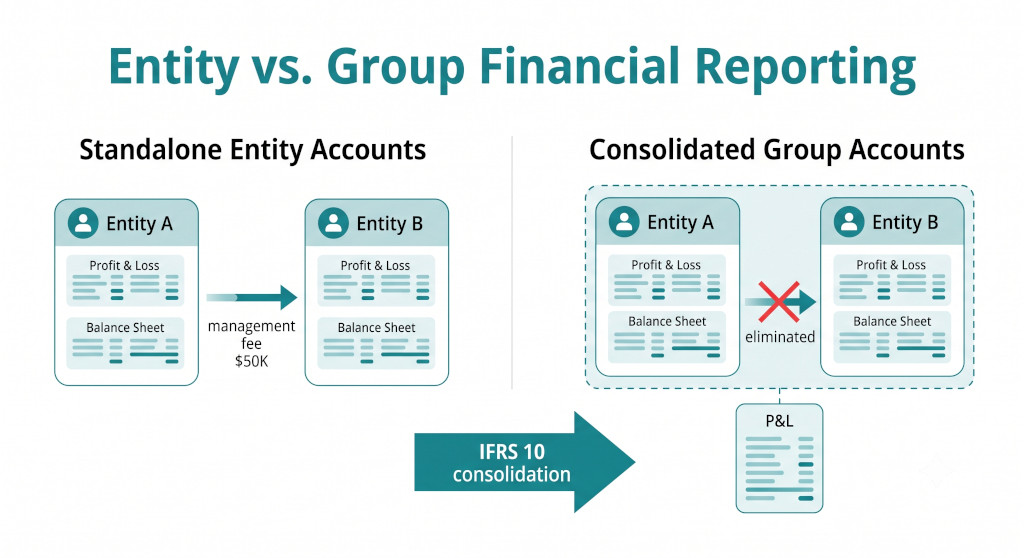
Intercompany Eliminations
IFRS 10 requires the full elimination of intragroup balances, transactions, income, and expenses. This includes:
- Intercompany sales and purchases — the revenue in the selling entity and the cost in the buying entity both disappear from the consolidated P&L.
- Unrealised profit in inventory — where goods have been sold from one group entity to another and remain in inventory at period end, the profit made by the selling entity on that transaction has not yet been realised from the group’s perspective and must be eliminated.
- Intercompany loans and receivables — the loan receivable in one entity and the loan payable in another are the same instrument viewed from both sides; they cancel to zero in the group balance sheet.
- Intercompany dividends — dividends paid by a subsidiary to its parent reduce the parent’s investment income and increase the subsidiary’s equity movements; both must be eliminated.
Non-Controlling Interests
Where a parent owns less than 100% of a subsidiary, the portion of the subsidiary’s net assets and profit or loss attributable to the other shareholders must be recognised as a non-controlling interest (NCI). IFRS 10 requires NCI to be presented within equity in the consolidated balance sheet, separately from the equity attributable to owners of the parent. In the consolidated P&L, profit or loss is allocated between the parent’s owners and the NCI.
IFRS 3 (Business Combinations) gives entities the choice, on an acquisition-by-acquisition basis, of measuring NCI either at fair value (the full goodwill method) or at the NCI’s proportionate share of the acquiree’s identifiable net assets (the partial goodwill method). This choice affects the goodwill figure recognised at acquisition but does not change how NCI is presented in ongoing consolidations.
IFRS 10 vs IAS 27: What Changed
Before IFRS 10, the consolidation requirements were split across IAS 27 (Consolidated and Separate Financial Statements) and SIC-12 (Consolidation — Special Purpose Entities). This created an inconsistency: the control model in IAS 27 was primarily based on voting rights, while SIC-12 used a different risks-and-rewards model for SPEs. Groups could sometimes structure transactions to achieve off-balance-sheet treatment by exploiting the gap between the two standards.
IFRS 10 closed that gap by applying a single principle-based control model to all investees. IAS 27 was revised at the same time to cover only separate (entity-level) financial statements — the question of when to prepare separate financial statements and how to measure investments in subsidiaries, associates, and joint ventures within them.
| Standard | Scope | Key Question |
|---|---|---|
| IFRS 10 | Consolidated financial statements | Which entities must be included in the group consolidation? |
| IAS 27 (revised) | Separate financial statements | How does a parent account for its investments in its own standalone accounts? |
| IAS 28 | Associates and joint ventures | How to account for entities where the investor has significant influence but not control? |
| IFRS 11 | Joint arrangements | Is this a joint operation or a joint venture, and how is each accounted for? |
Practical Implications for Multi-Entity Group Finance Teams
The most immediate practical consequence of IFRS 10 for a group finance team is the need to maintain and periodically revisit a consolidation scope assessment for every entity in which the group holds an interest. That assessment should document, for each investee:
- The nature and extent of the group’s rights over the investee
- The group’s exposure to variable returns
- The conclusion reached (subsidiary, associate, joint venture, or other investment)
- The method applied (full consolidation, equity method, or cost/FVTPL)
- The date of last review and the trigger that would require reassessment
This documentation serves a dual purpose: it supports the group’s financial statement disclosures (IFRS 12 requires extensive disclosure of interests in other entities) and it provides the audit trail that auditors and regulators expect.
The consolidation procedures themselves — the elimination journals, currency translations, and NCI calculations — are where automation makes the biggest difference. Once the scope is determined and the accounting policies are aligned, the mechanical work of consolidation is a repeatable process that does not benefit from being done in a spreadsheet.
Automate the Consolidation Process IFRS 10 Requires
BrizoConsol handles the consolidation procedures that follow from your IFRS 10 scope assessment — intercompany eliminations, NCI calculations, currency translation, and consolidated report production — directly from your Xero, MYOB, QuickBooks, or Zoho Books data. Start Free Trial — No Credit Card Required
Summary
IFRS 10 establishes a single, principle-based model for determining which entities a parent must consolidate. Control exists when three elements are simultaneously present: power over the investee, exposure to variable returns from involvement with it, and the ability to use that power to affect the amount of those returns. The standard applies to all types of investee — majority-owned subsidiaries, entities controlled through contractual arrangements, and structured entities — with one key exception for qualifying investment entities.
Once consolidation scope is determined, IFRS 10 requires uniform accounting policies, consistent reporting dates, full elimination of all intragroup balances and transactions, and recognition of non-controlling interests where the subsidiary is not wholly owned. The standard works alongside IAS 28 (associates), IFRS 11 (joint arrangements), IAS 27 (separate financial statements), and IFRS 12 (disclosures) to form the complete framework for group financial reporting under IFRS.