Why Doesn’t My Consolidated Balance Sheet Balance?
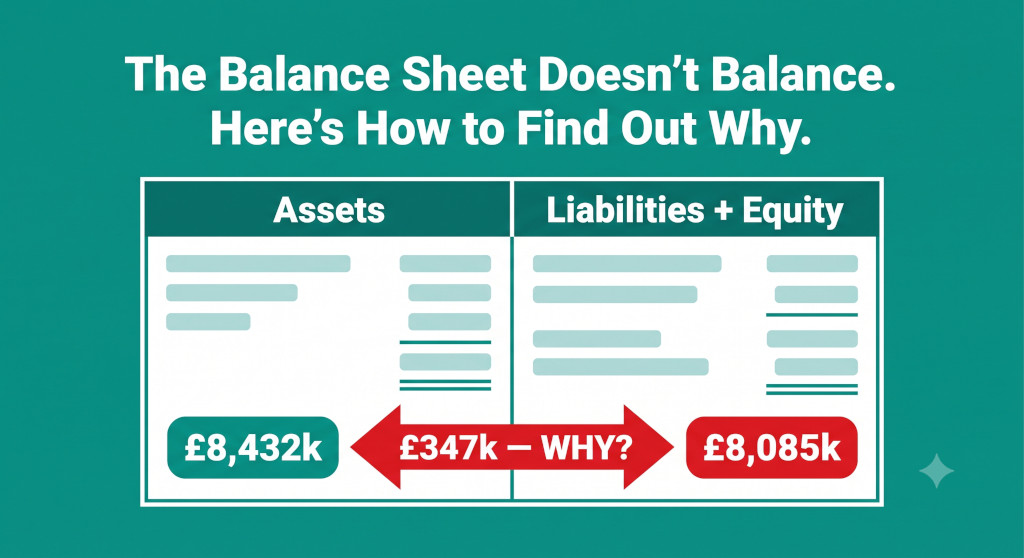
Nadia had been staring at the same number for forty minutes. Total assets: £8,432,000. Total liabilities plus equity: £8,085,000. The difference: £347,000, exactly, and it wasn’t moving. She had checked the balance sheet twice, rebuilt the equity section from scratch, and confirmed that the income statement flowed correctly into retained earnings. The balance sheet still didn’t balance, by exactly the same amount.
The board pack was due in two hours.
A consolidated balance sheet that fails to balance is one of the most disorienting problems in group reporting. The single-entity balance sheet is a closed system: if it doesn’t balance, the error is somewhere in the trial balance, and you work backwards until you find it. The consolidated balance sheet is different. It starts from multiple trial balances, applies a layer of consolidation adjustments — eliminations, NCI calculations, CTA entries, investment eliminations — and the imbalance could be in any one of those layers. It could also be in the interaction between them, or in the structure of the consolidation model itself.
Stop building consolidations in spreadsheets.
BrizoConsol automates multi-entity consolidation — setup in minutes, reports the same day.
This post is a diagnostic guide. It will tell you how to identify the cause of a consolidated balance sheet imbalance systematically, using the nature of the difference itself as the first clue, and then working through eight root causes in order of frequency until you find it.
Step One: Quantify and Characterise the Difference
Before starting the diagnostic, record the exact imbalance: the amount, whether assets exceed liabilities-plus-equity or vice versa, and whether the difference is new this period or has been carried forward from a prior period. These three facts immediately narrow the search.
If the imbalance is the same amount as last period — meaning the balance sheet was already out of balance before you did this period’s close — the error is in the prior-period consolidation or in the opening balance entries. Any error introduced this period would have changed the amount. Isolating a persistent prior-period imbalance from a new this-period imbalance is the first and most important diagnostic branch.
If the imbalance is new this period, it was introduced by something that changed this period: a new elimination, a new subsidiary, a new NCI calculation, or a new CTA entry. The search is bounded by the changes made in the current close cycle.
Step Two: Use the Difference Itself as a Clue
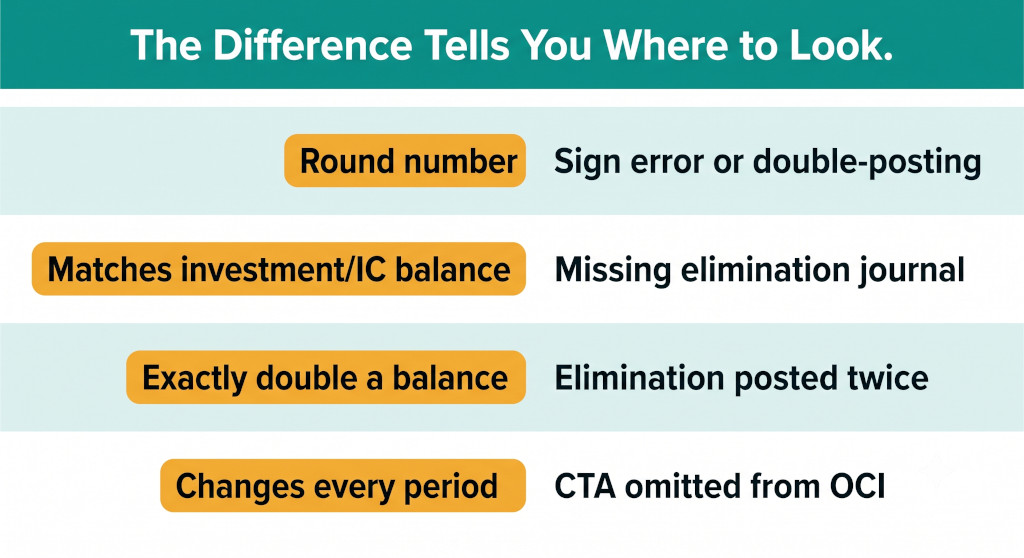
The amount of the imbalance is not arbitrary. It is the direct arithmetical consequence of whatever went wrong. In most cases, the difference amount will match a known figure in the consolidation workings — which tells you exactly where to look.
CLUE TYPE 1
The difference matches the carrying amount of the investment in a subsidiary
The investment elimination journal was not posted, or only part of it was posted. The investment in subsidiary on the parent’s balance sheet has not been cancelled against the subsidiary’s net assets. Check the investment elimination workings for each entity.
CLUE TYPE 2
The difference matches an intercompany loan, receivable, or payable balance
An intercompany balance elimination is missing or was only posted on one side. One entity’s intercompany receivable was eliminated but the other entity’s intercompany payable was not, or vice versa. Check the intercompany elimination schedule for any one-sided entries.
CLUE TYPE 3
The difference matches exactly twice an intercompany balance
An elimination was posted twice — once correctly, once in error. The double elimination has cancelled an asset or liability that should still be there, removing £X from assets or liabilities while the other side was only removed once. Find the duplicated journal entry and reverse one instance.
CLUE TYPE 4
The difference matches the CTA for a foreign subsidiary
The currency translation adjustment was calculated but not posted to OCI, or was posted to the income statement (P&L) rather than equity. Since the balance sheet translates assets and liabilities at the closing rate while the income statement uses the average rate, the difference between them must sit somewhere in equity as OCI — if it doesn’t, the balance sheet imbalance will equal the missing CTA. Check that the CTA for each foreign subsidiary is in the OCI section of equity, not in retained earnings or any P&L line.
CLUE TYPE 5
The difference is a round number (e.g. exactly £100,000 or £500,000)
Round numbers suggest either a sign error (a positive figure was entered as negative, or vice versa, which creates a difference equal to twice the amount) or a manual journal where the amount was typed incorrectly. Search the consolidation adjustments for the period for any manual entry where the amount approximates half the imbalance (if it’s a sign error) or the full imbalance (if it’s a transcription error).
CLUE TYPE 6
The difference matches the total net assets or goodwill of a subsidiary
A subsidiary has been omitted from the consolidation entirely, or was included in a prior period and has been dropped this period. Check that every entity in the group structure is represented in the consolidation model for the current period.
Step Three: Work Through the Eight Root Causes
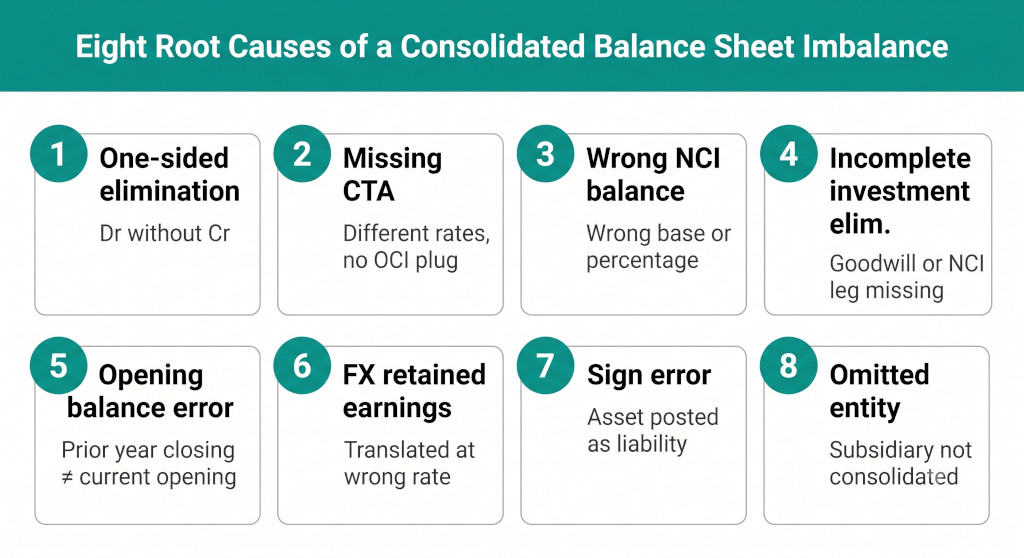
If the difference amount doesn’t immediately point to a known figure, work through the following eight root causes in order. They are ordered from most to least frequently encountered in practice. The first three account for the majority of consolidated balance sheet imbalances.
Root Cause 1: One-Sided Elimination Entry
The most common cause. Every consolidation elimination involves two sides: an asset or revenue that is removed, and a corresponding liability, cost, or equity item that is also removed. If only one side of an elimination has been posted — whether due to a formula error in the model, a manual entry that was only half-completed, or a missed row in the elimination schedule — the balance sheet will be out by the amount of the missing leg.
Check: Pull every elimination entry posted this period. For each entry, confirm that debits equal credits and that both the asset/revenue side and the liability/cost side are present. A useful model discipline is to include a formula check on each elimination entry that flags any row where debits and credits don’t net to zero.
Root Cause 2: Missing Currency Translation Adjustment
In a multi-currency group, the balance sheet translates all assets and liabilities at the closing rate while the income statement translates at the average rate. The retained earnings brought forward translates at the prior period’s closing rate. These three different rates applied to the same pool of net assets will never produce the same sterling figure — the difference is the CTA, and it must be posted to OCI within equity or the balance sheet will not balance.
If the CTA is omitted, the equity section of the consolidated balance sheet (calculated as the sum of translated equity items) will not equal total assets less total liabilities (calculated from the closing-rate-translated balance sheet). The imbalance will equal the sum of the CTAs for all foreign subsidiaries in the group.
Check: Confirm that every foreign subsidiary has a CTA calculated for the period, that the CTA is posted to the foreign currency translation reserve within equity (not to the income statement or retained earnings), and that the CTA roll-forward — prior year closing CTA plus current year movement — produces the correct closing CTA balance.
Root Cause 3: Incomplete Investment Elimination Journal
When a subsidiary is consolidated for the first time — or when the investment elimination is rebuilt after an acquisition — the journal eliminates the parent’s investment against the subsidiary’s net assets at acquisition, recognises goodwill, and establishes the NCI. If any leg of this journal is missing or incorrect, the balance sheet will not balance.
The standard investment elimination journal has at least four legs:
Dr Share capital (subsidiary) [FV of net assets — share capital] Dr Retained earnings (subsidiary) [FV of net assets — retained earnings] Dr Fair value adjustments [PPA uplifts, net of deferred tax] Dr Goodwill [Consideration minus group’s share of FV net assets] Cr Investment in subsidiary [Cost of investment on parent’s balance sheet] Cr Non-controlling interest [NCI share of FV net assets at acquisition] Note: All debits must equal all credits. A missing NCI credit or a wrong goodwill debit will unbalance the entire consolidated balance sheet.
A common variant of this error is a correct journal at acquisition that has since been modified — for example, the PPA was updated post-acquisition but the journal was not, leaving a deferred tax liability recognised in the PPA but not reflected in the goodwill calculation.
Root Cause 4: Non-Controlling Interest Balance Error
The NCI balance in the consolidated balance sheet must reconcile from the prior period: opening NCI plus the NCI’s share of profit for the period, plus the NCI’s share of the CTA (for a foreign subsidiary), less any dividends paid to the NCI. If the NCI balance has been manually overridden, calculated at the wrong percentage, or applied to the wrong profit figure (gross profit instead of profit after tax is a very common error), the equity section will not agree to net assets.
Check: Rebuild the NCI movement from the opening balance and verify that the closing NCI balance in the model matches the reconstructed figure. Verify that the NCI percentage applied is the actual ownership percentage of the minority (100% minus the group’s ownership stake), and that it is applied to consolidated profit after tax.
Root Cause 5: Opening Balance Mismatch
If the prior period’s closing balance sheet did not balance — or if the opening balances for the current period were imported incorrectly — the imbalance will carry forward into every subsequent period until it is corrected at source. This is why the character of a persistent imbalance (same amount, every period) points immediately to an opening balance problem rather than a current-period error.
Check: Compare the opening balances in the current period’s consolidation model, line by line, to the audited closing balance sheet from the prior period. Any discrepancy in the opening balances will be the source of the carried-forward imbalance. Common causes include an import formula that skipped a row, a sign convention that changed between periods, or a prior-period error that was corrected in the entity-level accounts but not in the group model.
Root Cause 6: Foreign Currency Retained Earnings Translation Error
A foreign subsidiary’s closing retained earnings in the group accounts is not the subsidiary’s local-currency retained earnings translated at the closing rate. It is the sum of all prior periods’ profit translated at each period’s average rate, accumulated forward. If the model has translated closing retained earnings at the closing rate — which looks intuitive but is wrong — the retained earnings figure in the group equity section will not agree to the sum of translated annual profits, and the balance sheet will not balance.
The correct treatment: the closing retained earnings in the group model for a foreign subsidiary equals the prior period’s group retained earnings for that entity plus the current period’s profit translated at the average rate. It is a derived figure, not a translated figure. Any model that has a formula of the form local retained earnings × closing rate for a foreign subsidiary has this error.
Root Cause 7: Sign Convention Error
Consolidation models aggregate trial balances from multiple source systems. Different accounting systems export trial balances with different sign conventions: some export liabilities and equity as positive numbers (balance sheet presentation), others as negative numbers (trial balance presentation where credits are negative). If a trial balance from one entity is imported with the wrong sign convention — or if the model’s aggregation formula doesn’t account for the source system’s sign convention — the aggregated totals will be wrong and the balance sheet will not balance.
This error is particularly common when a new subsidiary is added to the group and its trial balance is imported for the first time. The sign convention of the new entity’s source system may differ from the convention used by the other entities already in the model, and the import formula may not have been updated to handle it.
Check: For the entity whose trial balance was most recently imported or changed, print the raw trial balance and compare the signs of each line to how those lines appear in the consolidation model. Any line where the sign has been flipped will contribute twice its value to the imbalance (once as the wrong sign, once as the magnitude of the error).
Root Cause 8: Omitted Entity
A subsidiary that should be consolidated has been omitted — either because it was recently acquired and not yet added to the model, or because a formula in the aggregation step skips a row that represents one entity’s contribution. This produces an imbalance equal to the omitted entity’s net assets (if the entity’s balance sheet was omitted) or a more complex imbalance if the entity’s assets and liabilities were omitted separately.
Check: Compare the list of entities in the group structure (from the legal entity register or the investment schedule on the parent’s balance sheet) to the list of entities in the consolidation model. Every entity that should be fully consolidated and is not appearing in the aggregation is a candidate source of imbalance.
Worked Example: Diagnosing Nadia’s £347,000 Imbalance
Returning to Nadia. Her balance sheet shows assets exceeding liabilities-plus-equity by exactly £347,000. She runs through the clue types first.
£347,000 is not a round number. It doesn’t obviously match any investment balance or intercompany loan she can immediately recall. She pulls the intercompany elimination schedule and looks for the number there. It doesn’t appear as any single elimination. She checks whether it is twice any elimination — it isn’t. She checks the CTA schedule: the German subsidiary’s CTA for the period is £(89,000) and the French subsidiary’s is £(41,000), totalling £(130,000). Not £347,000.
She shifts to the systematic root cause approach and starts with Root Cause 1: one-sided eliminations. She runs a check on every elimination entry for the current period — a formula in her model sums debits and credits for each journal block and flags any block where the net is non-zero.
| Elimination Reference | Description | Debits £ | Credits £ | Net £ | Status |
|---|---|---|---|---|---|
| ELIM-001 | UK → Germany intercompany sales | 1,200,000 | (1,200,000) | — | ✓ |
| ELIM-002 | UK → Singapore intercompany sales | 480,000 | (480,000) | — | ✓ |
| ELIM-003 | Investment elimination — Germany | 3,420,000 | (3,420,000) | — | ✓ |
| ELIM-004 | Investment elimination — France OpCo | 2,041,000 | (1,694,000) | 347,000 | ✗ |
| ELIM-005 | Intercompany loan — UK / Germany | 800,000 | (800,000) | — | ✓ |
ELIM-004 is the source. The investment elimination journal for France OpCo — a subsidiary added to the group fourteen months ago — has a £347,000 net debit. Nadia opens the journal and finds the cause: the NCI credit leg was entered as £694,000 but the correct figure, calculated as 20% of France OpCo’s fair value net assets at acquisition of £1,735,000, should be £347,000. Someone had typed the wrong figure — the NCI credit understates the credit side of the journal by exactly £347,000, leaving the balance sheet with assets exceeding equity by that amount.
Cr Non-controlling interest £694,000 ← WRONG (typed £694k instead of £347k) Cr Non-controlling interest £347,000 ← CORRECT (20% × £1,735k FV net assets) Correction: Dr Non-controlling interest £347,000 / Cr [suspense / correction] £347,000 Then review whether NCI movements in subsequent periods were calculated on the correct opening NCI balance.
Nadia corrects the NCI credit, confirms the balance sheet now balances, and then checks whether the incorrect opening NCI balance has cascaded into the subsequent NCI movement calculations. Because NCI for the period is calculated as opening NCI plus share of profit, an overstated opening NCI by £347,000 means the closing NCI has also been overstated by the same amount throughout the fourteen months the error has been present. She updates the NCI opening balance in each of the prior affected periods and reissues the board pack for the current period with a prior-period correction note.
The Balance Sheet Balances — But Is It Right?
Important distinction: A balance sheet that balances is not necessarily a correct balance sheet. Every one of the errors described above — if corrected by adding the missing entry on the wrong side rather than on the right side — will make the balance sheet balance while leaving it materially misstated. The diagnostic process identifies what is causing the mathematical imbalance; the review process (checking that the correct amounts appear in the correct places) is a separate step. A balance sheet that balances after a correction should always be reviewed for reasonableness before being signed off.
The pre-board review process for identifying substantive errors in a balanced consolidated balance sheet — including incomplete eliminations that net to zero, NCI on the wrong profit base, and CTA posted to the wrong equity component — is covered in the post on How to Review Consolidated Financial Statements Before Board Reporting. The diagnostic process in this post finds the mathematical imbalance; the review process finds the errors that don’t create one.
A balance sheet that balances — automatically
BrizoConsol validates every consolidation entry before it posts, flags one-sided eliminations in real time, and calculates CTAs and NCI automatically — so the balance sheet balances because the consolidation is correct, not because you spent two hours finding the error.See It In Action
Diagnostic Checklist: Consolidated Balance Sheet Imbalance
- Record the exact imbalance. Amount, direction (assets high or equity high), and whether it is new this period or carried from prior periods. A carried-forward imbalance points to an opening balance error; a new imbalance points to a current-period entry.
- Compare the imbalance amount to known figures. Check whether the difference matches: any investment in subsidiary balance; any intercompany loan or trade balance; twice any intercompany balance (suggests double elimination); the CTA for any foreign subsidiary; the total net assets of any entity (suggests omitted consolidation).
- Run a debit/credit net check on every elimination entry. Every elimination journal must net to zero (total debits equal total credits). Any journal with a non-zero net is the source or a source of the imbalance.
- Check the CTA for every foreign subsidiary is in OCI, not P&L or retained earnings. Recalculate the CTA independently and verify it agrees to the figure in the model. Confirm the OCI total in the equity section includes the CTA.
- Verify the investment elimination journal for each subsidiary. Every leg should be present: share capital Dr, retained earnings Dr, fair value adjustments Dr, goodwill Dr, investment Cr, NCI Cr. Total debits must equal total credits. The NCI credit must equal the NCI percentage × fair value of net assets at acquisition date.
- Verify the NCI closing balance. Reconstruct: opening NCI + (NCI% × PAT) − (NCI% × dividends paid) ± (NCI% × CTA) = closing NCI. Confirm the closing NCI in the model matches this reconstructed figure.
- Check retained earnings for every foreign subsidiary. Closing retained earnings for a foreign subsidiary in the group model must be a derived figure (prior period group retained earnings + current period profit at average rate), not a translated figure (local retained earnings × closing rate). Any entity where retained earnings is calculated as local currency × closing rate has an error.
- Check sign conventions for every entity’s trial balance. Confirm that liabilities and equity balances are consistently signed across all entities in the model. Any entity recently added or whose trial balance export changed should be specifically checked.
- Confirm every entity in the group structure is in the consolidation model. Cross-reference the legal entity register against the consolidation model’s entity list. Missing entities are a less common but cleanly diagnosable cause of imbalance.
- Once corrected, review the balance sheet for reasonableness. A balanced balance sheet is the arithmetic minimum requirement; a correct one requires the additional review steps described in the pre-board review post. Confirm the correction is reasonable before signing off.
The consolidated balance sheet imbalance feels uniquely stressful because it is a definitive, binary failure — the number either balances or it doesn’t — in a context where precision matters. But it is also, in most cases, a solvable problem with a specific cause. The diagnostic framework above identifies that cause from the nature of the difference alone, and it does so faster than a line-by-line audit of every figure in the consolidation. Use the clue first. Then work through the eight causes. The answer is almost always in the first three.
Stop debugging. Start reporting.
BrizoConsol’s consolidation engine enforces balanced journals, validates intercompany eliminations, and posts CTAs automatically — so your close time goes to analysis, not arithmetic. Start free today. Start Free Trial