IFRS vs AASB: Key Differences That Affect Multi-Entity Group Consolidation in Australia
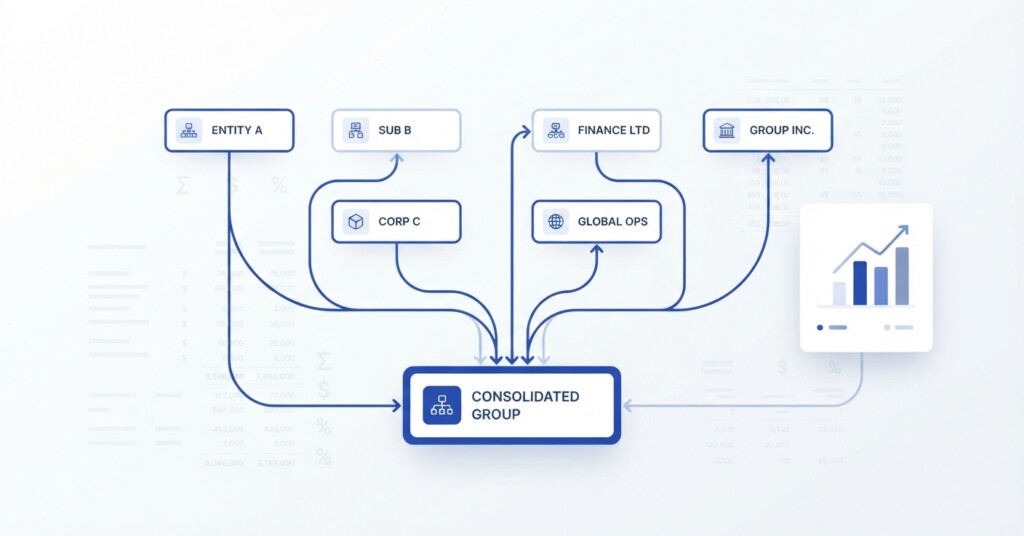
For Australian finance teams managing multiple entities, the question of which accounting standards apply — and how they differ — is far from academic. IFRS (International Financial Reporting Standards) and AASB (Australian Accounting Standards Board) standards sit closer together than many other national frameworks, but the differences that do exist carry real consequences for consolidated group reporting, intercompany eliminations, foreign currency translation, and non-controlling interest (NCI) measurement. Getting these details wrong compounds month-end workload and creates material errors in group financial statements.
This article unpacks the practical differences between IFRS as issued by the IASB and AASB standards as applied in Australia, focusing specifically on areas that affect multi-entity consolidation. Whether your group is privately held, listed, or part of a global structure reporting up to an offshore parent, understanding where the frameworks diverge helps your team make better decisions during the financial close process.
How AASB Standards Relate to IFRS
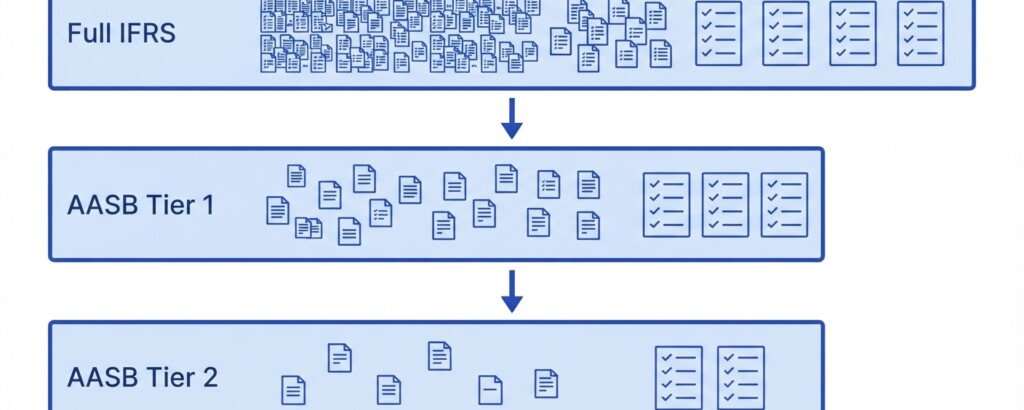
Australia adopted IFRS-equivalent standards from 1 January 2005. The AASB generally incorporates IFRS text directly into its own standards, with additional Australian-specific paragraphs tagged with ‘Aus’ prefixes. For most for-profit private and public sector entities, AASB standards are effectively IFRS-compliant. However, the AASB also produces standards for not-for-profit entities and Tier 2 Simplified Disclosures reporting, which create meaningful disclosure divergence from full IFRS.
Stop building consolidations in spreadsheets.
BrizoConsol automates multi-entity consolidation — setup in minutes, reports the same day.
AASB 10 (Consolidated Financial Statements), AASB 3 (Business Combinations), AASB 128 (Investments in Associates and Joint Ventures), and AASB 121 (The Effects of Changes in Foreign Exchange Rates) are the AASB equivalents of IFRS 10, IFRS 3, IAS 28, and IAS 21 respectively. For listed Australian groups, these are functionally equivalent. For unlisted entities applying Tier 2 Simplified Disclosures, the same recognition and measurement rules apply, but with reduced disclosure requirements under AASB 1060.
Where the Differences Actually Matter for Consolidation
The following areas represent the most operationally significant differences for finance teams running multi-entity consolidations.
| Area | Full IFRS (IASB) | AASB Full Tier 1 | AASB Tier 2 / SDS |
|---|---|---|---|
| Consolidation standard | IFRS 10 | AASB 10 (identical) | AASB 10 with AASB 1060 simplified disclosures |
| Business combinations | IFRS 3 — full fair value | AASB 3 — identical | AASB 3 with reduced disclosures |
| NCI measurement | Fair value or proportionate share | Same options | Same options, fewer disclosures |
| Investment entities | IFRS 10 exception applies | AASB 10 — same exception | Same |
| FX translation | IAS 21 | AASB 121 — identical | AASB 121 with reduced disclosures |
| Related party disclosures | IAS 24 | AASB 124 — some Aus additions | Reduced disclosure permitted |
| Segment reporting | IFRS 8 required for listed | AASB 8 — listed entities only | Not required for Tier 2 |
The headline message is that measurement rules are largely identical. The practical differences cluster around disclosure requirements, the availability of simplified reporting tiers, and a handful of not-for-profit-specific treatments that do not apply to most commercial groups.
NCI Measurement: Two Options, One Source of Group Reporting Errors
Both IFRS 3 and AASB 3 allow two methods for measuring non-controlling interests at the acquisition date: the full goodwill method (NCI measured at fair value) and the proportionate share method (NCI measured at the acquiree’s identifiable net assets). The choice affects the goodwill figure on the group balance sheet and ongoing NCI movements.
Consider a group that acquires 75% of an Australian subsidiary for AUD 3,000,000. The identifiable net assets of the subsidiary at acquisition are AUD 3,200,000. Under the proportionate method, NCI is simply 25% of AUD 3,200,000.
| Identifiable net assets of subsidiary at acquisition | AUD 3,200,000 |
| NCI share (25%) — proportionate method | AUD 800,000 |
| Consideration transferred (75%) | AUD 3,000,000 |
| Goodwill recognised (proportionate method) | AUD 600,000 |
Under the full goodwill method, if the fair value of the NCI at acquisition date were determined to be AUD 950,000, goodwill increases to AUD 750,000. This distinction compounds over reporting periods as you allocate goodwill impairment between the parent and NCI, and as the NCI balance moves with subsidiary profits, dividends, and other comprehensive income. Misapplying or inconsistently applying the chosen method across reporting periods is a common source of group equity reconciliation breaks.
| Account | Dr | Cr |
|---|---|---|
| Net assets of subsidiary (identifiable) | 3,200,000 | |
| Goodwill | 600,000 | |
| Investment in subsidiary (elimination) | 3,000,000 | |
| Non-controlling interests | 800,000 |
Acquisition elimination entry — proportionate NCI method, 75% acquisition. NCI recognised at 25% of identifiable net assets (AUD 800,000). This is a simplified illustration; actual entries depend on full fair value assessment.
FX Translation Under AASB 121: Functional vs Presentation Currency
For Australian groups with overseas subsidiaries — whether in New Zealand, Singapore, the US, or the UK — foreign currency translation is one of the most manual and error-prone parts of the consolidation process. AASB 121 (equivalent to IAS 21) requires each entity to determine its functional currency based on the primary economic environment in which it operates. The group then translates each subsidiary’s financial statements into the group’s presentation currency.
The translation rules are straightforward in principle: assets and liabilities translate at the closing rate, income and expenses at the average rate for the period (or transaction-date rates where material), and equity at historical rates. The resulting foreign currency translation reserve (FCTR) sits in other comprehensive income (OCI) and is only recycled to profit or loss on disposal of the foreign operation.
A frequent mistake in Excel-based consolidations is translating equity at closing rates rather than historical rates, or applying a single average rate to opening equity. This overstates or understates the FCTR and breaks the group equity reconciliation. The FCTR is not an optional balancing plug — it must be calculated explicitly and traced through each period.
One practical complication arises when a subsidiary has intercompany loans denominated in a currency other than that subsidiary’s functional currency. Under AASB 121, monetary intercompany balances are retranslated at closing rates, with exchange differences going to profit or loss — unless the loan forms part of the net investment in the foreign operation, in which case the exchange difference goes to OCI. Determining whether a loan qualifies as part of the net investment requires judgement and documentation. For multi-entity groups running several intercompany funding arrangements, this classification decision affects both the income statement and OCI each period.
Intercompany Eliminations and the Downstream vs Upstream Distinction
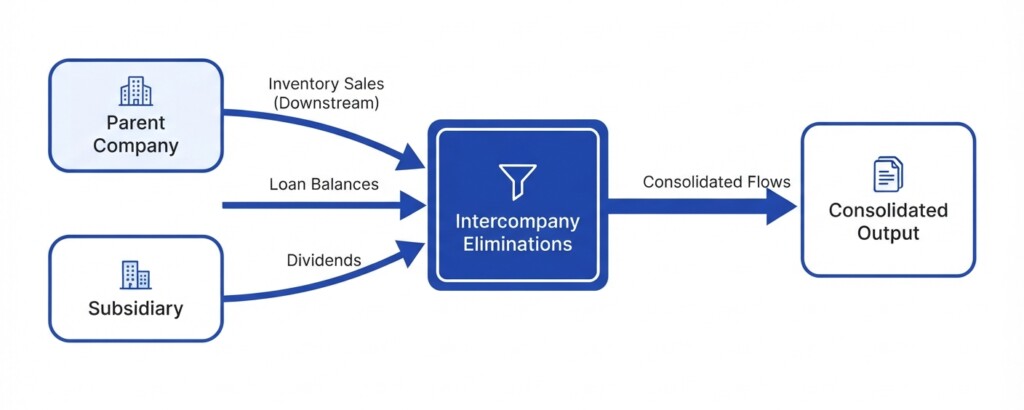
AASB 10 and IFRS 10 both require full elimination of intercompany transactions and balances in consolidated statements. The mechanics are identical, but the NCI interaction creates a nuance that trips up manual consolidations. When a parent sells inventory to a subsidiary (downstream) and the subsidiary still holds that inventory at period end, the unrealised profit is eliminated fully against the parent’s equity. When the subsidiary sells to the parent (upstream), the unrealised profit is eliminated and allocated between the parent’s equity and NCI in proportion to ownership.
- Identify all intercompany revenue and cost of sales for the period — both directions.
- Confirm which entity holds the goods at period end and calculate unrealised profit in closing inventory.
- For downstream sales: eliminate the full unrealised profit against retained earnings (parent’s share).
- For upstream sales: eliminate the full unrealised profit, allocating between parent equity and NCI.
- Confirm intercompany receivables and payables net to zero after elimination — any difference signals a timing or cut-off issue.
- Check intercompany dividend eliminations are complete so group retained earnings are not double-counted.
In practice, many SME groups skip the upstream/downstream distinction and eliminate all unrealised profits against group retained earnings only. This understates NCI balances and produces incorrect group equity. It is a small-number error in many cases, but auditors and sophisticated investors will pick it up.
Simplified Disclosure Standards: What Changes for Unlisted Australian Groups
From 1 July 2021, the AASB replaced the previous Reduced Disclosure Requirements (RDR) regime with the Simplified Disclosures Standard (AASB 1060). This applies to Tier 2 for-profit entities — typically unlisted companies that are not publicly accountable. While measurement bases under AASB 1060 remain consistent with Tier 1, significant disclosure relief is available.
For group reporting purposes, the most relevant simplifications under AASB 1060 include: reduced segment reporting disclosures (AASB 8 does not apply), reduced related party transaction disclosures (intercompany transactions between wholly owned group members can be exempted in some circumstances), and reduced goodwill impairment testing disclosures. This does not change how you perform the consolidation — eliminations, FX translation, NCI measurement, and acquisition accounting all work the same way. It only affects what you are required to disclose in the notes to the financial statements.
If your group reports to an overseas parent under full IFRS, your Australian entities may still be required to produce full IFRS-compliant reporting packages for group consolidation purposes — even if local statutory accounts use AASB Tier 2 simplified disclosures. Maintain clarity about which framework applies to which reporting output.
The Financial Close Problem: Manual Consolidation in Excel Does Not Scale
Most of the technical issues described above are manageable with discipline and well-structured spreadsheets — until they are not. The real cost of manual Excel consolidation is not the occasional error. It is the consistent, recurring effort: rebuilding translation workings each period, tracking NCI movements across multiple acquisition dates and ownership changes, chasing intercompany confirmation emails to reconcile mismatched balances, and manually rolling forward goodwill and intangible asset schedules.
For a group with five to fifteen entities, some with intercompany loans, some in foreign currencies, and a mix of wholly owned and partially owned subsidiaries, a disciplined Excel close process might require several full days of senior finance time each month. When a new entity is added, an FX rate changes materially mid-period, or the auditors request a restatement of an acquisition, the workload multiplies.
Connected accounting data — where entity-level trial balances feed directly into a consolidation platform — reduces the manual data transfer step, enables automated intercompany matching, and allows FX translation to be applied systematically rather than rebuilt each period. Audit trails become available by default rather than by construction. Month-end close becomes a review process rather than a data assembly process.
Practical Checklist for AASB-Compliant Group Consolidation
- Confirm the reporting framework for each output: Tier 1 (full AASB/IFRS), Tier 2 (AASB 1060 simplified disclosures), or an offshore parent’s IFRS reporting package.
- Document the functional currency of every entity in the group — review annually if business circumstances change.
- Apply consistent FX translation rates: closing rate for balance sheet assets and liabilities, average rate for income statement (or transaction-date rates where material).
- Calculate the FCTR explicitly each period; never use it as a balancing item.
- Choose and document the NCI measurement method at each acquisition — full goodwill or proportionate — and apply consistently.
- Track the NCI balance separately: opening balance, plus share of profit, plus share of OCI, less dividends paid to NCI.
- Prepare and confirm intercompany schedules before close — do not attempt to eliminate unconfirmed balances.
- Apply the upstream/downstream distinction for unrealised profit eliminations involving partially owned subsidiaries.
- Retain acquisition-date fair value workings as a permanent file — they are needed for every subsequent impairment test.
- Review intercompany loan classifications each period: profit or loss vs OCI treatment for FX differences.
Where to Focus Your Effort
The gap between IFRS and AASB is narrowest precisely where it matters most for consolidation mechanics. Australian finance teams do not need to worry about fundamentally different measurement models when producing group accounts. The real risks are in the detail: consistent NCI method application, correct FCTR calculation, disciplined intercompany elimination, and knowing which disclosure tier applies to which output.
For groups that are growing — adding entities, entering new jurisdictions, or taking on external investors — the structural question becomes whether manual processes can keep pace. The accounting judgements are the same whether you are working in a spreadsheet or a consolidation platform. The difference is how much time your team spends on data management versus financial analysis and review.
See How Automated Consolidation Works for Multi-Entity Groups
BrizoConsol is built for SME finance teams managing multi-entity consolidation, intercompany eliminations, FX translation, and group reporting. See how it handles the workflows described in this article.