Intercompany Dividends in Consolidation: Elimination Entries and Common Complications
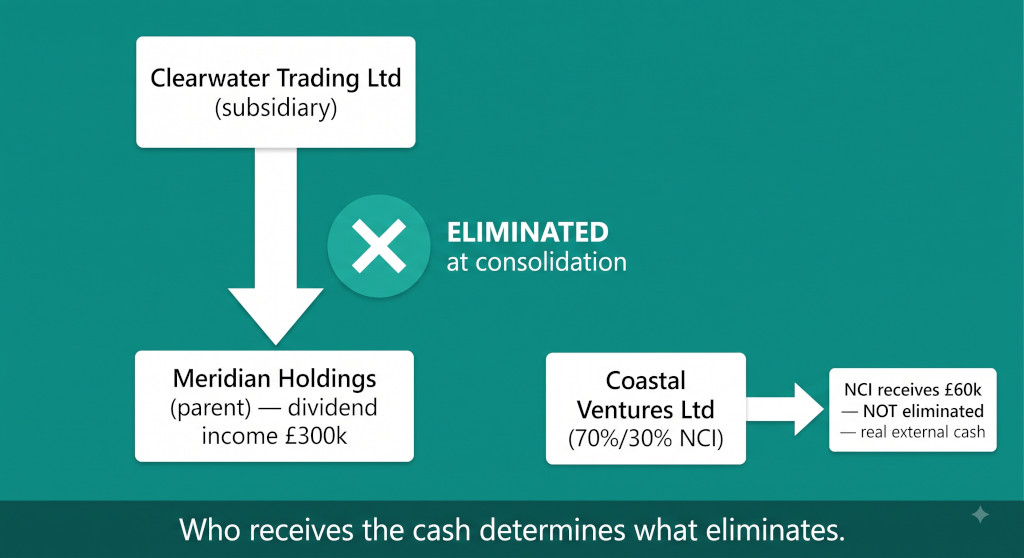
When a subsidiary pays a dividend to its parent, the parent records dividend income and the subsidiary’s retained earnings fall. Both entries are correct at entity level. At consolidation, both disappear: the group cannot earn income from itself. The elimination is simple in principle, and for a 100% owned subsidiary in a straightforward cash dividend scenario, it is simple in execution too.
The complications arise quickly. What happens when only 70% of the subsidiary is owned by the group — does the full dividend eliminate, or only part of it? What if the dividend was declared at year end but the cash moves after the balance sheet date? What if the dividend comes from profits earned before the acquisition? And what happens to the withholding tax the overseas subsidiary deducted before paying?
Each of these scenarios produces a different answer. This post works through all of them, using Meridian Holdings Group as the worked example, with full journal entries at each stage.
Intercompany eliminations without the manual work.
BrizoConsol identifies and eliminates intercompany balances automatically at consolidation.
The Meridian Holdings Group Structure
Meridian Holdings Group Ltd owns two subsidiaries that pay dividends during the year:
| Subsidiary | Ownership | Dividend paid (£) | Timing |
|---|---|---|---|
| Clearwater Trading Ltd | 100% owned | 300,000 | Paid in cash during the year |
| Coastal Ventures Ltd | 70% group / 30% NCI | 200,000 | Declared at year end, cash paid after year end |
Case 1: The 100% Owned Subsidiary — Full Elimination, Both Sides
Clearwater Trading Ltd declares and pays a £300,000 cash dividend to Meridian Holdings during the year. In Meridian’s entity accounts, the dividend is income — a credit to the income statement. In Clearwater’s accounts, the distribution reduces retained earnings.
At consolidation, both sides must be removed. The group has not earned income — it has moved cash from one pocket to another:
Elimination — Clearwater dividend (100% owned)
| Account | Dr | Cr |
|---|---|---|
| Dividend income (Meridian Holdings — parent entity P&L) | £300,000 | |
| Retained earnings / dividends paid (Clearwater Trading — subsidiary equity) | £300,000 |
The debit removes the dividend income from Meridian’s P&L, reducing consolidated profit by £300,000. The credit restores Clearwater’s retained earnings by £300,000 — reversing the reduction caused by paying out the dividend. Net effect on consolidated profit: zero. Net effect on consolidated retained earnings: zero. The cash movement (Clearwater paid cash to Meridian) is an intercompany cash flow and has no effect on consolidated cash — the group simply moved cash between entities.
After the elimination, the consolidated accounts look exactly as they would if the dividend had never been declared: Clearwater’s trading results flow through the consolidated P&L, and the cash that was distributed to Meridian is still within the group boundary. The dividend is invisible at group level.
A useful check: after eliminating an intercompany dividend, the consolidated retained earnings should be the same as if the subsidiary had retained all its profits and paid nothing. The dividend transfers value from subsidiary to parent within the group but creates no value at group level. If the consolidation shows a different retained earnings after the elimination, one side of the entry is missing.
Case 2: The Partly Owned Subsidiary — Partial Elimination and NCI
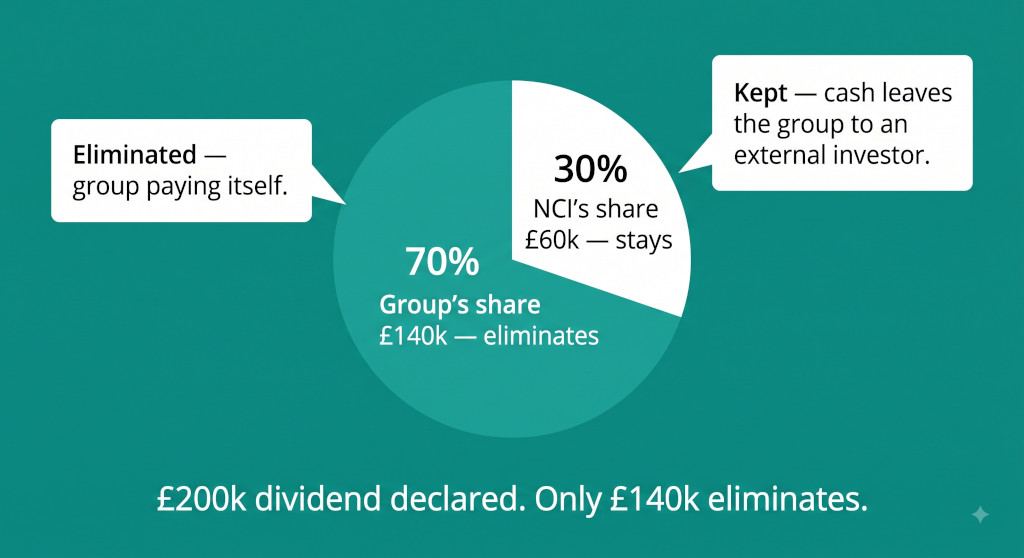
Coastal Ventures Ltd has declared a £200,000 total dividend at the year end. Meridian Holdings, as the 70% shareholder, receives £140,000. The remaining £60,000 goes to the external 30% minority investor — the non-controlling interest.
The elimination here is partial — and the logic follows directly from ownership. The group’s 70% share of the dividend is an intercompany payment that eliminates. The NCI’s 30% share is cash leaving the group entirely, paid to an external economic party. That £60,000 is not eliminated — it represents a real distribution of value to someone outside the group.
Elimination 1 — Group’s 70% share of Coastal Ventures dividend
| Account | Dr | Cr |
|---|---|---|
| Dividend income (Meridian Holdings — 70% × £200,000) | £140,000 | |
| Retained earnings — group share (Coastal Ventures equity, group portion) | £140,000 |
Only the group’s 70% share of the dividend eliminates. The £140,000 income in Meridian disappears; the corresponding reduction in Coastal Ventures’ retained earnings (group’s 70% portion) is reversed. The net effect on consolidated profit is zero for this portion.
Elimination 2 — NCI’s 30% share of Coastal Ventures dividend
| Account | Dr | Cr |
|---|---|---|
| NCI equity (Coastal Ventures — reduced by dividend to NCI) | £60,000 | |
| Retained earnings — NCI share (Coastal Ventures equity, NCI portion) | £60,000 |
The NCI’s £60,000 share of the dividend reduces the NCI equity balance on the consolidated balance sheet. This entry reflects the economic reality: the external minority investor has taken £60,000 out of Coastal Ventures in cash. The NCI equity falls accordingly. This is not an elimination in the traditional sense — it is recognition that value has genuinely left the group. In the consolidated cash flow statement, this £60,000 appears as “dividends paid to non-controlling interests” — a financing outflow from the group’s perspective.
The total Coastal Ventures dividend of £200,000 is therefore treated as follows at consolidation: £140,000 eliminates (group paying itself), £60,000 reduces NCI equity (real external outflow). The distinction is fundamental: ownership percentage determines what is internal and what is external.
Case 3: Dividend Declared but Not Paid at Year End
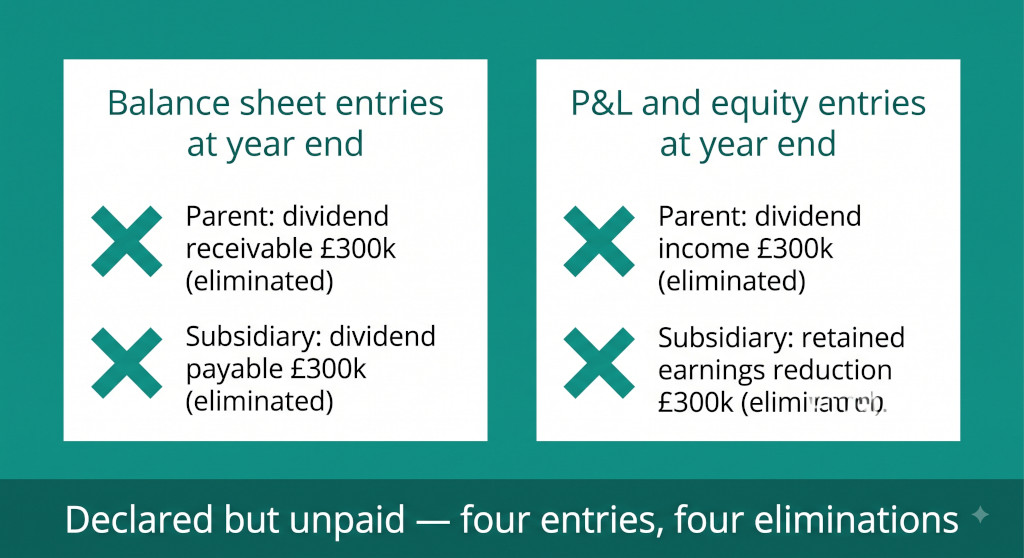
The Coastal Ventures dividend of £200,000 was declared at year end but the cash has not moved before the balance sheet date. Both entities have accrued the position:
| Entity | Balance sheet entry at year end | P&L / equity entry |
|---|---|---|
| Meridian Holdings (parent) | Dividend receivable: £140,000 | Dividend income: £140,000 |
| Coastal Ventures (subsidiary) | Dividend payable: £200,000 | Retained earnings reduced: £200,000 |
The consolidation now requires four entries rather than two: eliminations for both the balance sheet positions and the income/equity entries.
Balance sheet elimination — declared-but-unpaid dividend (group’s 70% share)
| Account | Dr | Cr |
|---|---|---|
| Dividend payable (Coastal Ventures — group’s 70% × £200,000) | £140,000 | |
| Dividend receivable (Meridian Holdings) | £140,000 |
The intercompany receivable in the parent and the matching payable in the subsidiary both disappear from the consolidated balance sheet. Only the NCI’s £60,000 share of the payable survives in consolidated liabilities — it is a genuine external obligation (owed to the minority investor).
P&L / equity elimination — declared-but-unpaid dividend (group’s 70% share)
| Account | Dr | Cr |
|---|---|---|
| Dividend income (Meridian Holdings — P&L) | £140,000 | |
| Retained earnings — group share (Coastal Ventures equity reduction reversed) | £140,000 |
This entry removes the income from the P&L and restores the equity reduction — the same as if the dividend had been paid in cash. The timing of the cash movement (before or after year end) does not change the P&L elimination; it only adds the balance sheet receivable/payable elimination when the cash hasn’t moved yet.
A common omission in manual workbooks: consolidations that correctly eliminate the P&L dividend income but forget to eliminate the balance sheet receivable and payable when the dividend was declared but not yet paid. The result is an inflated consolidated balance sheet — a financial asset (receivable) and a partially-external liability (payable) both appearing where only the NCI portion should remain. Always check whether declared dividends at year end have both P&L and balance sheet positions outstanding.
Dividends Paid From Pre-Acquisition Profits
A more complex situation arises when a subsidiary distributes a dividend from profits it earned before it joined the group — before the acquisition date. At group level, those pre-acquisition profits were already priced into the acquisition consideration: the parent paid for them as part of the net assets it acquired. A dividend from pre-acquisition profits is not an income distribution at group level — it is a return of capital.
In the parent entity’s own accounts, IFRS requires that dividends received from a subsidiary’s pre-acquisition profits be assessed: if the dividend represents a recovery of part of the cost of investment (i.e., the subsidiary is distributing profits that the parent paid for when it acquired the shares), an impairment indicator exists and the parent should assess whether the investment’s carrying value remains recoverable. In some cases, the dividend may need to be offset against the cost of the investment rather than recognised as income.
At consolidated level, the elimination is the same as any other intercompany dividend — the income and equity reduction cancel. But the consolidated balance sheet effect is meaningful: pre-acquisition profits distributed reduce the net assets that the group acquired, and where goodwill was recognised at acquisition, a pre-acquisition dividend distribution effectively reduces the underlying net assets that goodwill was intended to represent. This does not automatically require a goodwill impairment — goodwill represents more than just identifiable net assets — but it is an indicator that the impairment test should be reviewed carefully in the period of a material pre-acquisition distribution.
Withholding Tax on Intercompany Dividends
Where the paying subsidiary operates in a jurisdiction that imposes withholding tax on dividends paid to foreign shareholders, the withholding tax is a genuine external cash cost — it is paid to the local tax authority, not to the parent entity. It does not eliminate at consolidation.
Suppose Clearwater Trading is in a jurisdiction that withholds 10% on dividends paid abroad. On a £300,000 gross dividend, the parent receives only £270,000 in cash; £30,000 goes to the local tax authority. At consolidation:
| Item | Amount (£) | Consolidated treatment |
|---|---|---|
| Gross dividend declared by Clearwater | 300,000 | Eliminates (intercompany) |
| Cash received by Meridian (net of WHT) | 270,000 | Part of intercompany elimination |
| Withholding tax paid to foreign tax authority | 30,000 | Remains — real external tax cost |
In the consolidated accounts, the withholding tax of £30,000 appears either as a tax expense (if not creditable against the group’s domestic tax liability) or reduces the effective tax recovered through a foreign tax credit mechanism. The parent’s entity accounts may recognise the withholding tax as a prepayment against future domestic tax if treaty relief is available; at consolidated level, the treatment follows the substance of whether the tax is ultimately recoverable. Either way, it is not eliminated — the group paid it to an external authority.
This distinction catches groups off guard when the consolidation team eliminates the full gross dividend income without checking whether the cash received net of withholding tax matches the gross amount eliminated. The reconciliation of intercompany cash flows at year end should identify and separately track any withholding taxes that flowed to third-party tax authorities.
Dividends in Specie and Scrip Dividends
Not all distributions involve cash. A dividend in specie involves a subsidiary distributing a non-cash asset — for example, transferring property or investments to the parent entity as a dividend. At consolidated level, the asset has simply moved from one entity to another and the elimination removes both the dividend income (or deemed proceeds) in the parent and the gain or loss on disposal in the subsidiary. What matters at group level is the consolidated carrying value of the asset, which remains unchanged — the distribution is invisible at group level.
A scrip dividend — where shareholders receive additional shares rather than cash — requires a different approach. The parent entity receives shares in the subsidiary and would increase its investment in subsidiary account while also recognising dividend income. At consolidation, both the additional investment and the dividend income eliminate. The equity in the subsidiary increases by the same amount (share capital issued), which also eliminates against the consolidated investment. The scrip dividend is a particularly clean intercompany transaction from a consolidation perspective: it increases equity and investment in equal measure, both of which cancel, leaving no net effect on any consolidated figure.
The Consolidated Cash Flow Statement
Intercompany dividends affect the consolidated cash flow statement differently from the income statement. Intercompany cash flows — cash that moved between Clearwater and Meridian — are eliminated from the consolidated cash flow in the same way they are eliminated from the income statement. The group did not receive or pay external cash; it just moved money between entities.
The NCI dividend, however, does appear in the consolidated cash flow statement. The £60,000 paid to the external minority investor is a genuine cash outflow from the group boundary. It is presented in the financing activities section under “dividends paid to non-controlling interests.” This is one of the most common cash flow statement errors in manual consolidations: omitting the NCI dividend from the consolidated financing section, or incorrectly netting it against the eliminated group dividend.
The consolidated cash flow statement should show no dividend income in operating activities (all intercompany dividend income eliminates) and no intercompany dividend payments in financing activities. The only dividend cash flows that appear are those paid to external parties: dividends paid by the parent entity to its own external shareholders (financing outflow) and dividends paid by partly-owned subsidiaries to their minority investors (also financing outflow, under “dividends paid to NCI”).
Interaction With the Statement of Changes in Equity
Dividends paid by subsidiaries affect both the consolidated P&L (if the parent records dividend income — which eliminates) and the consolidated statement of changes in equity. In the consolidated SOCE, the NCI column shows the NCI’s share of profit for the year and then deducts the NCI dividend paid. This is the mechanism by which the NCI equity balance reduces when the minority receives their cash distribution. The group equity columns show no effect from the intercompany dividends — the parent’s dividend income and the subsidiary’s retained earnings reduction both eliminate, leaving group equity unchanged.
For partly-owned subsidiaries, the SOCE therefore shows: NCI profit allocation (credit to NCI column), NCI dividend (debit to NCI column). The net movement in NCI equity for the year reflects how much the minority’s economic interest grew (from their share of profits) versus how much they extracted (as dividends). The group’s equity columns are unaffected by the subsidiary dividend — as they should be.
A Practical Checklist for Intercompany Dividend Eliminations
- Compile all dividend declarations across the group for the period. Include both paid and declared-but-unpaid dividends at the year-end date. For each, record: the paying subsidiary, the receiving entity or entities, the total amount declared, the ownership percentage of each recipient, and the cash settlement date.
- For dividends from 100% owned subsidiaries: eliminate in full. Debit dividend income in the parent (or receiving entity) P&L; credit retained earnings / dividends paid in the subsidiary equity. If declared but not paid: also debit the subsidiary’s dividend payable and credit the parent’s dividend receivable on the balance sheet.
- For dividends from partly-owned subsidiaries: eliminate only the group’s proportionate share. Debit dividend income in the parent for the group’s ownership percentage × total dividend. Credit retained earnings in the subsidiary for the same amount. Separately debit NCI equity and credit the subsidiary’s retained earnings for the NCI’s share — this is not an elimination but a movement within equity reflecting the real distribution to external investors.
- Check for declared-but-unpaid dividends at year end. Where the subsidiary has declared a dividend before the year end but the cash moves after, both P&L and balance sheet eliminations are required. Confirm the intercompany receivable and payable balances agree and eliminate both.
- Identify any dividends from pre-acquisition profits. Review the source of dividends from recently acquired subsidiaries. Where distributions come from pre-acquisition retained earnings, flag for impairment review at parent entity level and consider the goodwill headroom in the consolidated impairment test.
- Confirm withholding tax treatment. For cross-border dividends, identify the withholding tax deducted before the net payment reached the parent. Confirm the gross dividend eliminates and the withholding tax is retained as an external cost. Do not eliminate the withholding tax.
- Confirm the NCI dividend appears in the consolidated cash flow statement. Cash paid to minority investors is a financing outflow that must appear in the consolidated SOCE and cash flow. It is not eliminated. If the cash flow statement shows no NCI dividend outflow in a period when a partly-owned subsidiary paid dividends to external shareholders, the cash flow is understated.
- Reconcile intercompany cash flows to confirm no net cash effect from eliminated dividends. The consolidated cash and cash equivalents movement should not be affected by intercompany dividends. Prepare a cash flow intercompany elimination schedule to confirm that cash received by the parent from 100% owned subsidiaries is fully offset by cash paid by those subsidiaries.
Managing dividend eliminations across multiple entities?
BrizoConsol tracks every intercompany dividend — paid and declared, 100% and NCI-split — and produces elimination entries, SOCE movements, and cash flow adjustments automatically. See It In Action