Intercompany Staff Secondments in a Professional Services Group: How the Margin Hides in WIP and What to Do About It
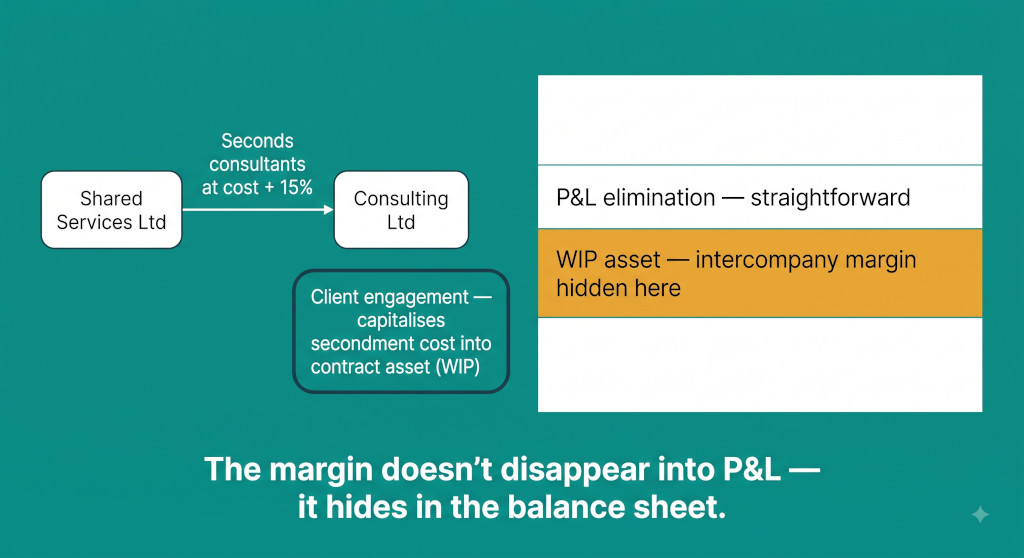
Professional services groups routinely second staff across entities. A shared services centre provides analysts to a client-facing consulting firm. A specialist technical team embedded in one subsidiary supports engagements run by a sibling entity. A holding company’s in-house legal team advises a subsidiary on a matter the subsidiary capitalises as part of a project cost. In each case, the seconding entity charges the receiving entity for the time — usually at cost plus a margin — and both entities record their side of the transaction without any problem in their own accounts.
The consolidation problem arises when the receiving entity does not expense the secondment cost immediately. In professional services, costs directly attributable to an active client engagement are often capitalised as contract assets under IFRS 15 — work in progress that will be recognised as revenue when, or as, the performance obligation is satisfied. When the intercompany secondment cost is capitalised into that WIP, the intercompany margin is no longer sitting in the P&L waiting to be eliminated. It is embedded in a balance sheet asset.
The standard P&L elimination — debit the seconding entity’s intercompany income, credit the receiving entity’s intercompany cost — clears the income statement correctly. But it does nothing about the margin that has already migrated into the contract asset. Without a second elimination entry reducing the WIP balance, the consolidated balance sheet overstates contract assets by the amount of the unrealised intercompany margin. The group is carrying an asset that includes a profit the group has not yet earned from an external client — and cannot earn, because the margin is internal.
Intercompany eliminations without the manual work.
BrizoConsol identifies and eliminates intercompany balances automatically at consolidation.
Why This Is the Same Problem as Manufacturing PURP
The mechanics are identical to the provision for unrealised profit (PURP) on intercompany inventory in a manufacturing group. A manufacturing subsidiary sells goods to a distribution subsidiary at a transfer price that includes a margin. If those goods are still in the distribution subsidiary’s closing stock at year end, the intercompany margin is embedded in an asset. The consolidation must eliminate that margin — reduce the stock balance and reduce consolidated profit — because the group has not yet sold the goods to an external customer.
In a professional services group, the “goods” are hours of consultant time. The “stock” is the contract asset (WIP). The intercompany transfer price is the secondment recharge rate. The unrealised profit is the margin between the recharge rate and the actual cost of the seconded staff. The elimination mechanics follow exactly the same logic: calculate the margin fraction, apply it to the balance sheet asset, eliminate it through the consolidated P&L.
The PURP elimination on manufacturing inventory is well understood and routinely included in consolidation checklists. The equivalent elimination on professional services WIP is frequently missed — because it requires the group accountant to track which contract assets in the receiving entity contain intercompany secondment costs, and at what margin those costs were recharged. This information does not appear in the receiving entity’s trial balance; it requires communication between the two entities’ finance teams before the consolidation workings can be completed.
The Scenario: Apex Shared Services Seconds Analysts to Apex Consulting
Apex Group operates two subsidiaries: Apex Shared Services Ltd (which employs a pool of analysts and consultants and recharges their time to other group entities) and Apex Consulting Ltd (which runs client engagements and generates external revenue).
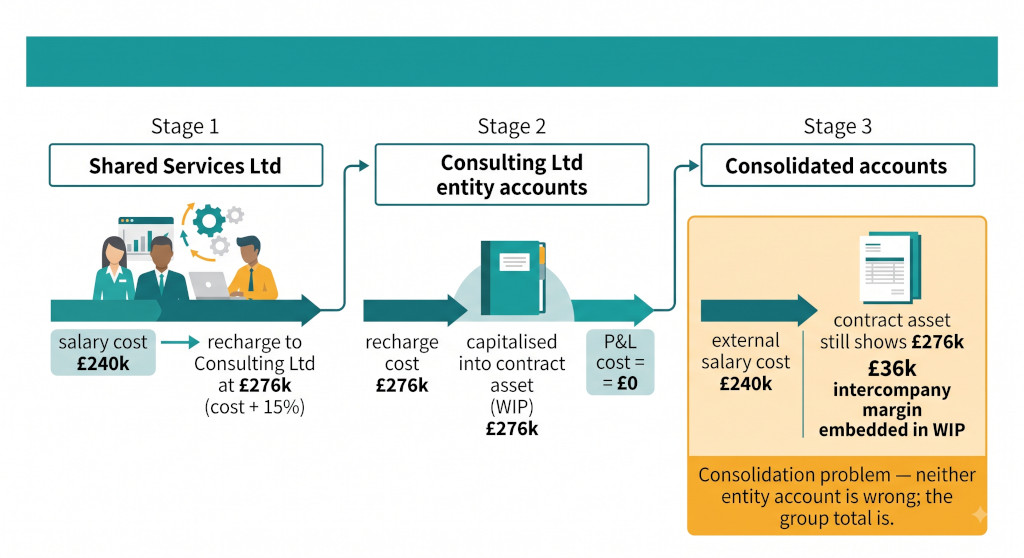
Apex Shared Services seconds a team of four analysts to Apex Consulting for a large client transformation project. During the year, Apex Shared Services recharges £276,000 to Apex Consulting for the analysts’ time. This recharge is calculated as the analysts’ salary cost (£240,000) plus a 15% intragroup margin (£36,000).
Apex Consulting capitalises the entire £276,000 as a contract asset under IFRS 15, because the transformation project is active and the costs are directly attributable to satisfying the performance obligation. At the year end, the project is not yet complete — the client has not been billed and the contract asset remains on Apex Consulting’s balance sheet.
In the entity accounts, both subsidiaries are correct:
| Entity account | Entry | Amount |
|---|---|---|
| Apex Shared Services Ltd — P&L | Intercompany recharge income | £276,000 |
| Apex Consulting Ltd — P&L | No cost recognised — capitalised to WIP | £nil |
| Apex Consulting Ltd — balance sheet | Contract asset (WIP) | £276,000 |
When the group consolidates, both of these trial balance entries are included. The resulting consolidated accounts — before any elimination — show:
- Intercompany income of £276,000 in the consolidated P&L (from Shared Services) — overstated
- Contract asset of £276,000 on the consolidated balance sheet (from Consulting) — overstated by the £36,000 margin
- No intercompany cost in the consolidated P&L (Consulting capitalised it rather than expensing it)
The Two-Step Elimination
The elimination requires two journals, not one.
Journal 1 — Eliminate the intercompany income and recover the capitalised cost:
| Account | Dr | Cr |
|---|---|---|
| Intercompany recharge income (Shared Services — P&L) | £276,000 | |
| Contract asset — WIP (Consulting — balance sheet) | £276,000 |
Journal 1 — eliminates the intercompany recharge income in Shared Services against the contract asset in Consulting. This clears the intercompany income from the consolidated P&L and reduces the WIP balance. After this journal, the contract asset balance is £nil and the P&L income is £nil. But the actual salary cost (£240,000) that Shared Services incurred to pay the analysts has now been eliminated without being replaced — the group has incurred a real external cost that must be reinstated.
Journal 2 — Reinstate the underlying external cost at actual salary cost:
| Account | Dr | Cr |
|---|---|---|
| Contract asset — WIP (consolidated — at group cost) | £240,000 | |
| Staff costs — analysts’ salaries (Shared Services — P&L) | £240,000 |
Journal 2 — reinstates the underlying external cost at the group’s actual salary cost (£240,000), not at the transfer price. The contract asset is now held at group cost. The analysts’ salary cost, which was already in Shared Services’ P&L, is now reclassified as a capitalised cost that flows into the contract asset rather than being expensed. After both journals, the consolidated position is: contract asset £240,000 (group cost, no intercompany margin), P&L cost = £nil (salary capitalised), P&L income = £nil (intercompany eliminated).
The two journals can be combined into a single net entry if preferred:
| Account | Dr | Cr |
|---|---|---|
| Intercompany recharge income (Shared Services — P&L) | £276,000 | |
| Contract asset — WIP (net — reduces to group cost) | £36,000 | |
| Staff costs — analysts’ salaries (reclassified to WIP) | £240,000 |
Combined elimination journal — net effect: intercompany income £276,000 eliminated; contract asset reduced by £36,000 (the intercompany margin); salary cost reclassified from P&L expense to capitalised WIP. Consolidated contract asset = £240,000 (group cost). Consolidated P&L: no intercompany income, salary cost capitalised (not expensed). The £36,000 margin is eliminated — it has never been earned from an external client and cannot be recognised as a consolidated asset.
Calculating the Margin Fraction
In a manufacturing PURP, the margin fraction is applied to the closing stock balance. The same approach applies here: the margin fraction is the intercompany profit as a proportion of the transfer price, applied to the WIP balance that contains intercompany costs.
| Intercompany recharge rate (transfer price) | £276,000 |
| Underlying salary cost (group cost) | £240,000 |
| Intercompany margin | £36,000 |
| Margin fraction (£36,000 ÷ £276,000) | 13.04% |
| Contract asset balance containing intercompany costs | £276,000 |
| Unrealised intercompany margin in WIP (13.04% × £276,000) | £36,000 |
Note that the margin fraction is calculated on the transfer price (13.04%), not on the cost (15%). The recharge is cost plus 15% — but the margin as a proportion of the transfer price is 36/276, not 15%. This distinction matters when the margin rate is high; using the wrong base understates the elimination.
What Happens When the Client Is Billed
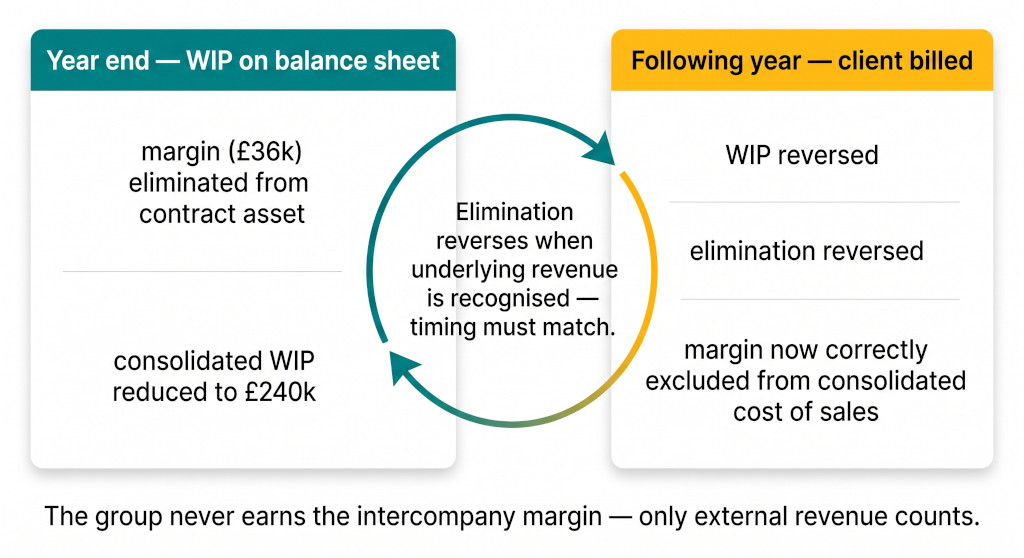
The WIP elimination is a temporary entry. It exists at each year end for as long as the intercompany costs remain in the contract asset and the client has not yet been billed. When Apex Consulting recognises the revenue on the transformation project — typically when it satisfies the performance obligation and bills the client — the contract asset is derecognised. At that point, the consolidation elimination for the previous year reverses automatically: the WIP balance is gone, so there is nothing left to eliminate.
In the year of billing, the consolidated cost of sales includes only the actual salary cost (£240,000), not the transfer price (£276,000). The intercompany margin (£36,000) is excluded from consolidated cost of sales and excluded from consolidated revenue — the group earns the external margin on its actual cost, without inflating either the revenue or the cost base with an internal transfer.
This is the correct result: the consolidated P&L for the year of billing shows external revenue from the client, and cost of sales that reflects the group’s actual outlay for the analysts’ time — the salary cost — with no internal markup distorting either line.
Partial Capitalisation — When Only Some Costs Are in WIP
In practice, Apex Consulting will not capitalise 100% of the secondment cost to a single contract asset. The analysts work across multiple engagements, and only the hours attributable to each specific project are capitalised against that project’s WIP. Some hours may be expensed immediately (for non-capitalised activities such as business development or internal meetings). The elimination must be calculated project by project — the margin fraction is applied only to the portion of the recharge that ended up in a contract asset, not to the portion that was immediately expensed.
| Total recharge from Shared Services to Consulting | £276,000 |
| Portion capitalised to Project A contract asset | £180,000 |
| Portion capitalised to Project B contract asset | £60,000 |
| Portion expensed immediately (non-billable) | £36,000 |
| Margin in Project A WIP (13.04% × £180,000) | £23,478 |
| Margin in Project B WIP (13.04% × £60,000) | £7,826 |
| Margin in expensed portion — already eliminated via P&L elimination | £4,696 |
| Total WIP margin to eliminate from balance sheet | £31,304 |
The portion of the recharge that was immediately expensed (£36,000 of the total recharge, including its margin of £4,696) is handled by the standard P&L elimination — the intercompany income and cost net to zero in the consolidated P&L with no balance sheet impact. Only the capitalised portions require the WIP reduction.
The Information Gap — Why This Elimination Is Often Missed
The standard consolidation process aggregates trial balances. The trial balance of Apex Consulting shows a contract asset but gives no indication of how much of that contract asset originated from intercompany secondment costs and at what transfer price. The trial balance of Apex Shared Services shows intercompany income but does not indicate which of its recharged costs were capitalised by the receiving entity rather than expensed.
Performing this elimination correctly requires information that sits outside the trial balances: specifically, a breakdown from Apex Consulting’s project accounting system showing how much of each contract asset originated from Shared Services recharges, and confirmation from Shared Services of the transfer price applied to each recharge. This information must be gathered as part of the intercompany reconciliation process before the consolidation workings can be completed.
Groups that rely solely on intercompany balance reconciliation — matching the receivable in Shared Services against the payable in Consulting — will clear the balance sheet intercompany positions but will miss the WIP margin entirely, because the payable in Consulting was settled (the cost was capitalised, not left as a creditor) and the receivable in Shared Services was collected. There is no unreconciled intercompany balance to flag the issue. The margin is silent, inside an asset, until someone specifically looks for it.
Intercompany balance reconciliations confirm that matched balances agree — they do not confirm that capitalised intercompany costs have been correctly eliminated from WIP. A clean intercompany reconciliation and an uneliminated WIP margin are entirely compatible. The WIP margin elimination requires a separate step: a schedule of intercompany costs capitalised by each receiving entity, broken down by project, reconciled to the transfer prices used.
Practical Checklist
- At period end, obtain a schedule from each client-facing entity showing the breakdown of its contract assets — specifically which contract assets contain costs recharged from other group entities, and the amounts involved.
- Identify the transfer prices used for each intercompany recharge that was capitalised. Calculate the margin fraction (intercompany margin ÷ transfer price) for each recharge relationship.
- Calculate the WIP margin elimination for each project: margin fraction × intercompany cost in WIP. This is the amount by which the consolidated contract asset is overstated.
- Post the elimination journals: eliminate intercompany income in the seconding entity; reduce the contract asset by the transfer price; reinstate the underlying cost at group cost. Net effect: contract asset at group cost, no intercompany income in P&L.
- Track the elimination by project. When a project is completed and the client is billed, the WIP reverses and the elimination reverses with it. Do not carry forward a WIP elimination against a project that has already been invoiced.
- Review the non-capitalised portion separately. Any intercompany recharge that was immediately expensed (not capitalised to WIP) is handled by the standard P&L elimination and requires no balance sheet adjustment.
- Update the intercompany eliminations schedule annually for changes in transfer pricing. If the margin rate changes between periods, the margin fraction changes, and the WIP elimination must be recalculated on the new basis for costs incurred after the change.
Intercompany secondment costs embedded in contract assets are one of the more elusive consolidation adjustments in professional services groups — not because the calculation is complex, but because the standard consolidation process does not surface them automatically. The intercompany balance reconciliation clears the cash flows; the P&L elimination clears the expensed costs; but the capitalised margin sits silently in WIP until the group accountant specifically goes looking for it. Building the WIP margin review into the standard period-end consolidation checklist — alongside the intercompany balance reconciliation, not instead of it — is the only reliable way to ensure it is caught every period.
For context on the equivalent elimination in a manufacturing group, the guide on intercompany stock unrealised profit elimination covers the same margin fraction mechanics applied to physical inventory rather than services WIP.
WIP margins hiding in your consolidation?
BrizoConsol lets you post project-level WIP eliminations alongside your standard intercompany journals — so the margin fraction is calculated, applied, and tracked to reversal in one place, every period. See It In Action