The Profit That Isn’t There: Eliminating Unrealised Intercompany Margins in a Manufacturing Group
It was the kind of discrepancy that looks small until you trace it back. The group finance manager at a UK manufacturing business was reviewing the half-year consolidation when he noticed that group gross margin was running about 1.5 percentage points higher than the prior half. Both the manufacturing subsidiary and the distribution subsidiary had performed well, but the improvement in group margin seemed disproportionate to what the individual entity P&Ls were showing. He eventually found the source: the provision for unrealised profit on intercompany stock — a consolidation journal that had been in the template for years — had not been rolled forward correctly. The opening reversal had been posted, but the new closing PURP had not. Six months of intercompany stock movements had flowed through to group profit without adjustment.
The unrealised profit problem is one of the most persistent and frequently mishandled areas in manufacturing group consolidation. It arises because the manufacturer and the distributor are separate legal entities, each with their own P&L. The manufacturer earns its margin when it invoices the distributor. The distributor earns its margin when it sells to the external customer. From the group’s perspective, however, profit should only be recognised when a third party has bought the goods. Any margin sitting in the distributor’s unsold closing stock has not yet been earned at group level — and if it is not eliminated, it inflates both group inventory and group profit.
Why Manufacturing Groups Are Particularly Exposed
The provision for unrealised profit — often shortened to PURP — affects any group where one entity sells goods to another at a transfer price above cost. Manufacturing groups face this problem almost universally because their structure is built around it: a production entity makes goods and transfers them downstream to a sales or distribution entity, usually at a transfer price that reflects a commercial margin.
Intercompany eliminations without the manual work.
BrizoConsol identifies and eliminates intercompany balances automatically at consolidation.
The exposure scales with three variables: the volume of intercompany stock transfers, the margin embedded in the transfer price, and the proportion of those transferred goods that remain unsold at the period end. A group that transfers £5 million of goods at a 25% margin and carries 30% of purchases in closing stock at year-end has an unrealised profit of £312,500 sitting in inventory. If that adjustment is missed, group profit is overstated by that amount — and the overstatement persists until the stock is sold to an external customer.
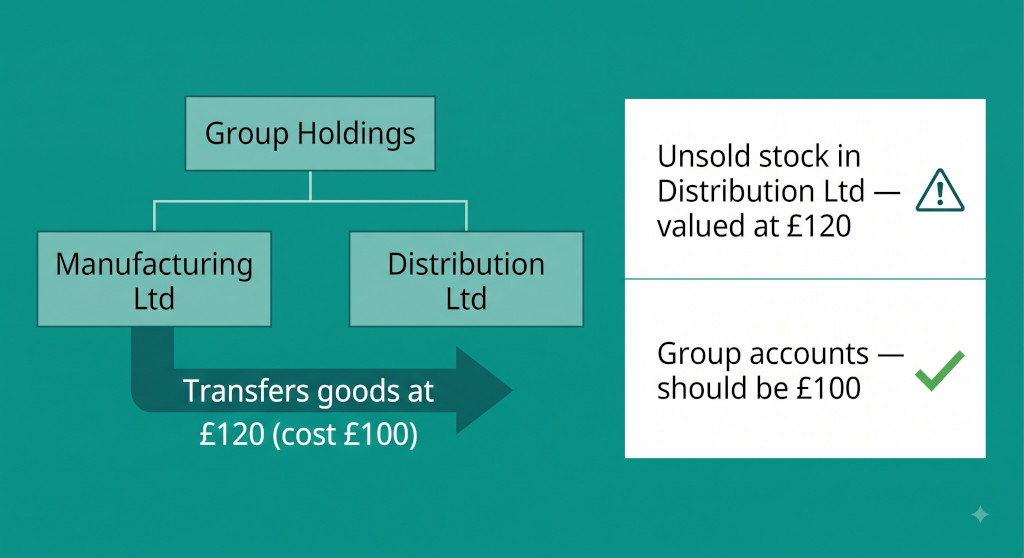
The consolidation principle is that inventory held by a group entity should be valued at the cost to the group — not the cost to the entity holding it. If Manufacturing Ltd produced goods for £100 and invoiced Distribution Ltd at £120, the group’s cost is £100. The £20 margin is unrealised until an external customer buys the goods. It must be stripped out of closing inventory and out of group profit.
Calculating the PURP: The Formula and What You Need to Know
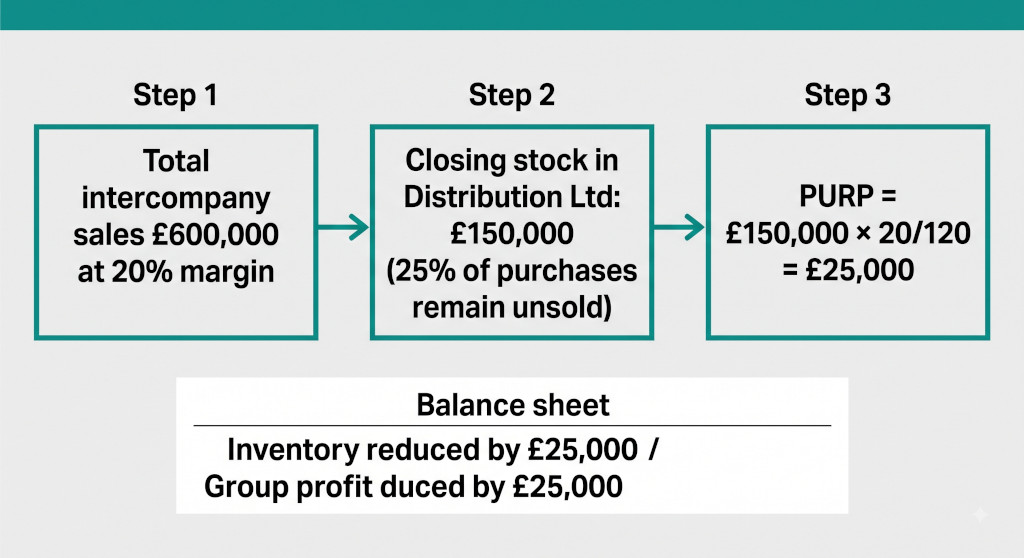
The PURP calculation requires three inputs: the value of closing stock held by the buying entity (Distribution Ltd) that originated from intercompany purchases, the transfer price at which those goods were bought, and the margin percentage embedded in that transfer price.
Consider the worked example. Manufacturing Ltd transfers finished goods to Distribution Ltd at cost plus 20%. During the year, Manufacturing Ltd makes intercompany sales of £600,000. At the year-end, Distribution Ltd holds £150,000 of that stock unsold (25% of what it purchased remains in inventory).
| Closing stock in Distribution Ltd (at transfer price) | £150,000 |
| Margin fraction embedded (20 ÷ 120) | 16.67% |
| Provision for unrealised profit (PURP) | £25,000 |
The margin fraction is 20/120, not 20% — because the £150,000 closing stock figure is at the transfer price (cost plus margin), not at Manufacturing Ltd’s cost. If you apply 20% directly to £150,000 you get £30,000, which overstates the PURP. The correct calculation always takes the margin as a fraction of the transfer price.
Always apply the margin as a fraction of the transfer price, not a percentage of cost. If the markup is 20% on cost, the margin fraction for PURP purposes is 20/120 (16.67%), not 20%. Using the wrong denominator overstates the PURP by the same percentage as the markup itself — a material error for groups with high transfer price margins.
The PURP is £25,000. This is the amount by which group inventory is overstated at the year-end, and by which group profit is overstated if no adjustment is made.
The Year-End PURP Journal
The elimination journal reduces group inventory by the PURP amount and reduces the cost of sales — restoring group profit to the correct figure. The debit goes to cost of sales (increasing the cost recognised at group level by the unrealised margin), and the credit reduces inventory to the group’s cost.
| Account | Dr | Cr |
|---|---|---|
| Cost of sales (group P&L) | £25,000 | |
| Inventory (Distribution Ltd balance sheet) | £25,000 |
Eliminates the unrealised profit embedded in Distribution Ltd’s closing stock. After this journal, inventory is carried at Manufacturing Ltd’s production cost (£125,000) rather than the transfer price (£150,000). Group profit is reduced by £25,000.
After this journal, the consolidated balance sheet shows inventory at £125,000 — the cost to Manufacturing Ltd of producing the unsold goods. The consolidated P&L shows group gross profit net of the unrealised margin. No profit is recognised until Distribution Ltd sells those goods to an external customer in a future period.
What Happens in Year Two: The Opening Reversal and New Closing PURP
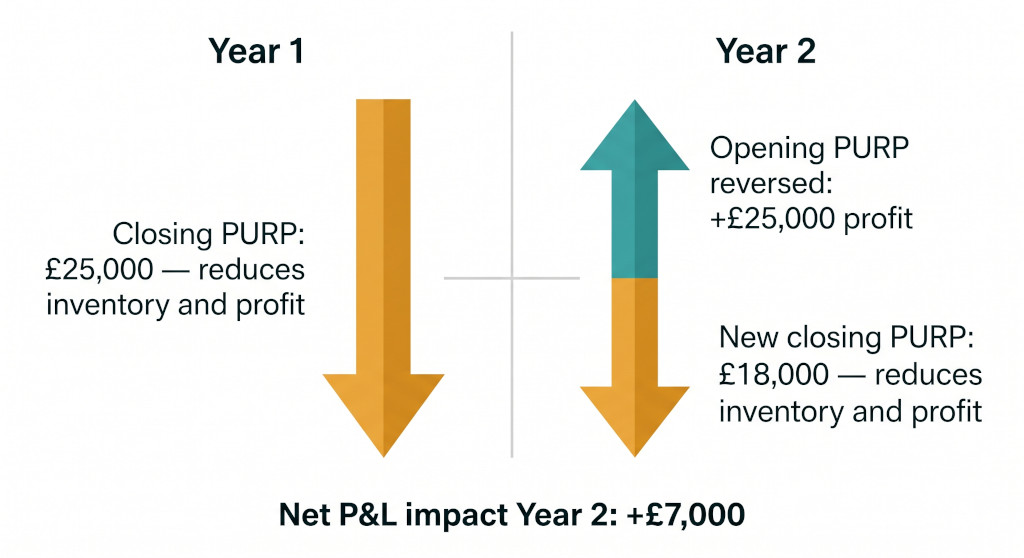
The PURP adjustment does not disappear after year-end — it needs to be handled again at the start of the following period, and a new closing PURP must be calculated for the year-two year-end. This two-step pattern is where many consolidations go wrong.
At the start of year two, the opening PURP from year one (£25,000) must be reversed. This is because, from the group’s perspective, the profit deferred at the year-one close will be recognised in year two when Distribution Ltd sells the goods. The reversal is the mirror image of the closing PURP journal: debit inventory, credit cost of sales. This effectively brings the stock back up to transfer price so that when Distribution Ltd records the cost of sales on selling the goods, the group P&L reflects the correct selling price less the group’s original production cost.
| Account | Dr | Cr |
|---|---|---|
| Inventory (Distribution Ltd balance sheet) | £25,000 | |
| Cost of sales (group P&L) | £25,000 |
Reverses the year-one closing PURP at the start of year two. This releases the deferred profit into the current period as the underlying goods are sold to external customers. In practice this is posted as the opening consolidation journal for the new period, not as an entity-level entry.
Assume that by the year-two close, Distribution Ltd has sold most of those goods but now holds a new batch of unsold intercompany stock valued at £108,000 at transfer price. The new closing PURP is calculated on that fresh balance.
| Closing stock in Distribution Ltd at year two (transfer price) | £108,000 |
| Margin fraction (20 ÷ 120) | 16.67% |
| Closing PURP — year two | £18,000 |
The net P&L impact of the PURP movements in year two is a credit of £7,000 — the opening reversal (£25,000 credit) less the new closing provision (£18,000 debit). This makes intuitive sense: the group held back more profit in year one than it is holding back in year two, so year two gets a net benefit as the previously deferred profit is released.
| Year two PURP movement | P&L impact | Inventory impact |
|---|---|---|
| Opening PURP reversed | +£25,000 (credit to COS) | +£25,000 |
| Closing PURP posted | −£18,000 (debit to COS) | −£18,000 |
| Net impact | +£7,000 | +£7,000 |
Tired of tracking PURP movements manually across periods?
BrizoConsol lets you post recurring consolidation journals with automatic period-on-period tracking — so opening reversals and closing provisions are never out of sync. See It In Action
When the Transfer Price or Margin Changes Mid-Year
Manufacturing groups frequently review and update their internal transfer prices, either annually during budget-setting or when input costs shift materially. A change in transfer price part-way through the year means that the closing stock may contain goods bought at two different transfer prices — and therefore two different embedded margins.
The practical solution is to identify the stock layers separately. If Distribution Ltd bought £300,000 of goods in H1 at the old transfer price (margin 20%) and £300,000 in H2 at the new transfer price (margin 25%), and closing stock of £150,000 can be attributed to H2 purchases, then the PURP should be calculated using the H2 margin fraction. If stock cannot be reliably attributed to a specific purchase tranche, many groups apply a weighted average margin for the year — calculated as total intercompany margin divided by total intercompany sales.
| H1 intercompany sales (margin 20%) | £300,000 |
| H2 intercompany sales (margin 25%) | £300,000 |
| Total intercompany margin (£50,000 + £62,500) | £112,500 |
| Weighted average margin fraction (£112,500 ÷ £600,000) | 18.75% |
| PURP on closing stock of £150,000 | £28,125 |
This weighted average approach is an approximation, but it is reasonable and widely accepted in practice. The key is to document the basis of calculation clearly, apply it consistently from period to period, and revisit it if the margin between the two rates widens materially.
Multiple Product Lines With Different Margins
Manufacturing groups with diverse product ranges often transfer goods at different margins by product category — industrial components at one margin, consumer goods at another, spare parts at a third. Applying a single blended margin to total closing stock will be wrong to the extent that the closing stock mix differs from the sales mix.
The most accurate approach is to segment closing stock by product line and apply the relevant margin fraction to each segment. This requires Distribution Ltd to maintain inventory records that distinguish stock by intercompany source — which most warehouse management systems can do, though the data may need to be extracted specifically for consolidation purposes.
Where a segmented approach is impractical, a blended margin is acceptable, but the degree of approximation should be monitored. If closing stock is systematically weighted towards high-margin product lines (which can happen when fast-moving low-margin products sell quickly and slow-moving high-margin products accumulate), a blended average will consistently understate the PURP. An annual sense-check — comparing the blended PURP against a sample product-line calculation — will reveal whether the approximation is material.
PURP When the Selling Entity Is Not Wholly Owned
The treatment changes when the manufacturing subsidiary has a non-controlling interest. If Manufacturing Ltd is 75% owned by the group (with 25% held externally), the elimination of the unrealised profit affects the group and the NCI in proportion to their ownership.
Under IFRS 10, the full PURP is eliminated regardless of the NCI percentage — the group eliminates 100% of the unrealised margin. However, the profit that is eliminated is attributed between the group and the NCI in proportion to their ownership. This means the NCI’s share of Manufacturing Ltd’s profit is also reduced by 25% of the PURP.
| Total PURP to eliminate | £25,000 |
| Group share (75%) | £18,750 |
| NCI share (25%) | £6,250 |
| Total eliminated (journal remains £25,000) | £25,000 |
The elimination journal is the same (debit cost of sales £25,000, credit inventory £25,000). The allocation between group and NCI happens through the NCI share-of-profit calculation — the NCI’s share of Manufacturing Ltd’s profit is calculated after the PURP has been deducted from that entity’s contribution to group profit. You do not split the journal; you split the result.
FRS 102 groups take a different approach. Under FRS 102, the unrealised profit eliminated may be restricted to the group’s proportionate share where the selling entity has an NCI — meaning only 75% of the PURP would be eliminated in the example above. This differs from IFRS 10, which requires full elimination. If your group reports under FRS 102, check the applicable section and document the basis of your elimination.
The PURP and Inventory Write-Downs
One complication that manufacturing groups sometimes encounter is the interaction between the PURP and an inventory write-down (net realisable value adjustment) at the entity level. If Distribution Ltd has already written down the intercompany stock below the transfer price — because market conditions have deteriorated and the goods cannot be sold above cost — then the closing stock balance is already below the transfer price. In this case, the PURP should be calculated on the written-down balance, not the original transfer price figure.
More importantly, if the write-down has brought Distribution Ltd’s inventory below Manufacturing Ltd’s original production cost, there is effectively no unrealised profit remaining — the group’s inventory is already at or below its cost. In that scenario, no PURP is required, and the write-down recognised in Distribution Ltd’s accounts is the appropriate group-level reflection of the inventory loss. Applying a PURP on top of a write-down that has already erased the margin would produce an incorrect result.
The Intercompany Sales Elimination That Goes Alongside the PURP
The PURP adjustment does not stand alone — it runs alongside the standard intercompany sales elimination that removes Manufacturing Ltd’s revenue and Distribution Ltd’s cost of goods sold in the period. These are two separate journals that address two separate aspects of the same intercompany transaction.
The intercompany sales elimination (debit intercompany revenue, credit intercompany cost of sales) removes the gross flow between the entities from the consolidated P&L, leaving only third-party sales visible at group level. The PURP adjustment then addresses the timing question: of the goods transferred in the period, how much is still unsold and therefore carrying an unrealised margin in closing stock.
A common error is to post only one of these journals. Posting the intercompany sales elimination without the PURP leaves closing inventory overstated. Posting only the PURP without the intercompany sales elimination leaves gross intercompany revenue flowing through the consolidated P&L, inflating both revenue and cost of sales. Both journals are required at every period close. For a broader walkthrough of how intercompany eliminations work across different transaction types, Intercompany Eliminations: A Complete Guide for Group Consolidation covers the full picture.
Practical Checklist for Manufacturing Group PURP
- Identify total intercompany stock purchases in the period — the amount Distribution Ltd bought from Manufacturing Ltd at the transfer price.
- Obtain the closing stock figure — how much of those intercompany purchases remains unsold in Distribution Ltd’s inventory at the period end. Distinguish by product line if margins differ across the range.
- Confirm the applicable margin fraction. If the transfer price is cost plus a fixed markup, calculate the fraction as markup ÷ (100 + markup). If the transfer price changed during the period, calculate a weighted average margin fraction.
- Calculate the closing PURP: closing intercompany stock × margin fraction.
- Post the closing PURP journal: debit cost of sales, credit inventory.
- At the next period open, reverse the prior closing PURP: debit inventory, credit cost of sales. This should be the first journal in the new period’s consolidation run.
- Calculate a new closing PURP at the end of the new period and post accordingly.
- Post the intercompany sales elimination separately — debit intercompany revenue, credit intercompany cost of sales — to remove the gross flow between entities from the consolidated P&L.
- Where the manufacturing entity has an NCI, confirm that the NCI share-of-profit calculation reflects the post-PURP profit, not the entity’s standalone profit.
- Check closing inventory for write-downs. If the closing stock has been written below transfer price, recalculate the PURP on the written-down balance. If the write-down has eliminated the embedded margin entirely, no PURP is needed.
The unrealised profit on intercompany stock is one of those consolidation adjustments that feels mechanical once the formula is established, but which produces significant errors when it slips. A missed opening reversal silently depresses group profit. A missed closing provision silently inflates it. And in a manufacturing group where intercompany transfers are high-volume and continuous, the exposure can be material every single period.
For a broader view of how manufacturing group consolidations are structured across entities — including how to handle intercompany recharges, different depreciation policies, and multi-currency manufacturing operations — the practical guidance in Financial Consolidation for Manufacturing Groups covers those adjacent topics in full.
Stop chasing PURP errors at every close
BrizoConsol automates your intercompany eliminations and tracks period-on-period consolidation journals — so your manufacturing group close is consistent, auditable, and fast. Start Free Trial