How to Consolidate a US GAAP Subsidiary into an SFRS Parent: Which Standard Drives the Journals, and How to Translate USD to SGD
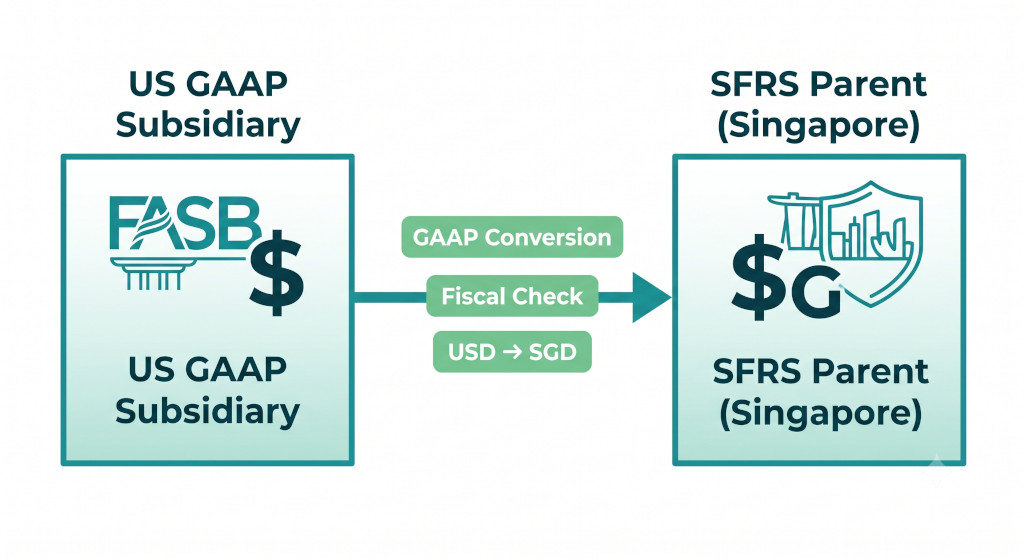
Singapore-headquartered groups that have expanded into the United States — through acquisition or organic growth — often find their US entity reporting under US GAAP while the Singapore parent prepares consolidated accounts under SFRS. The consolidation process requires the US subsidiary’s accounts to be restated to the group’s accounting basis before they can be included in the group numbers. What that restatement looks like depends on which Singapore standard the parent applies.
This is a distinction worth making clearly at the outset, because the two Singapore frameworks produce materially different conversion requirements. An SFRS(I) parent — the standard applied by SGX-listed companies — is a near word-for-word adoption of IFRS, so the US GAAP-to-SFRS(I) conversion journals are essentially the same as US GAAP-to-IFRS. An SFRS for Small Entities parent — used by qualifying non-listed Singapore companies — produces a different set of adjustments, including some that run in the opposite direction to what IFRS would require. The currency translation from USD to SGD is always required regardless of which parent standard applies.
For the full companion guides, see our posts on SFRS vs US GAAP and consolidating an SFRS subsidiary into a US GAAP parent.
Stop building consolidations in spreadsheets.
BrizoConsol automates multi-entity consolidation — setup in minutes, reports the same day.
The Group Structure Used in This Guide
- BrizoSG Holdings Pte Ltd — Singapore parent, reports in SGD, fiscal year 1 January to 31 December
- BrizoUS Inc — US subsidiary, 100% owned, applies US GAAP, reports in USD, fiscal year 1 January to 31 December
- Exchange rates (illustrative): closing USD/SGD 1.352; average USD/SGD 1.340; historical rate at acquisition USD/SGD 1.310
BrizoUS Inc is a technology products business with LIFO inventory costing, qualifying development activities expensed under ASC 730, and office leases accounted for under ASC 842. We address both parent scenarios — SFRS(I) and SFRS for Small Entities — because the conversion journals differ.
Step 1 — Which Standard Does the Singapore Parent Apply?
Step 1
The first step in every consolidation cycle is to confirm BrizoSG Holdings’ applicable standard. This determines which conversion journals are needed before currency translation.
✅ Scenario A: SFRS(I) Parent
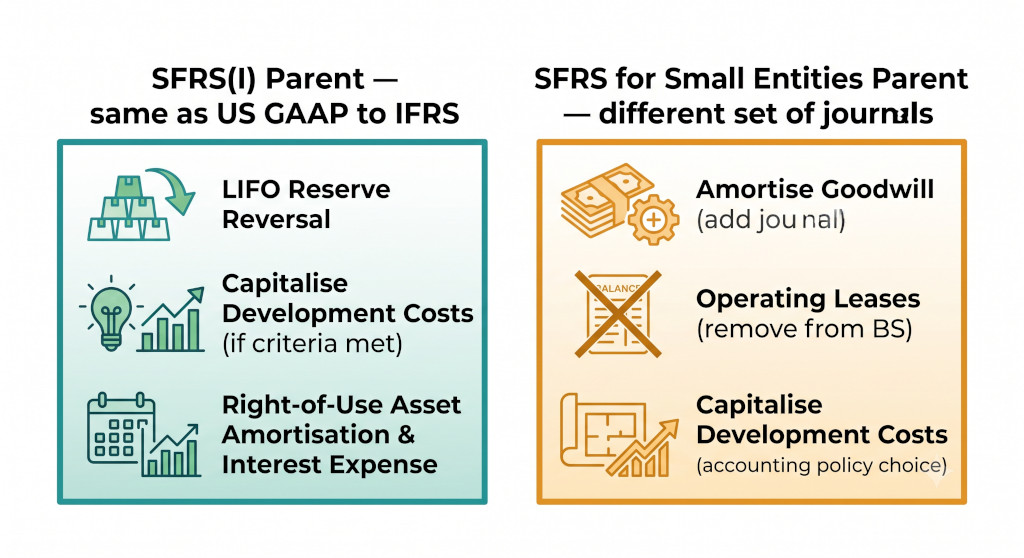
BrizoSG is SGX-listed or has adopted SFRS(I). Since SFRS(I) ≈ IFRS, the conversion journals are identical to those for a US GAAP subsidiary consolidating into an IFRS group: reverse LIFO, capitalise development costs, reclassify ASC 842 operating lease P&L to IFRS 16 presentation. The full journal detail is covered in our US GAAP → IFRS consolidation guide.
⚠️ Scenario B: SFRS for Small Entities Parent
BrizoSG is a non-listed entity applying the simplified Singapore framework. The adjustments differ from the IFRS path in important ways: goodwill amortisation must be introduced (US GAAP has impairment-only, SFRS for SE requires amortisation), and ASC 842 operating lease ROU assets must be removed from the balance sheet (SFRS for SE keeps operating leases off-balance-sheet). Development cost capitalisation applies to both scenarios.
Step 2 — Scenario A: SFRS(I) Parent — Conversion Journals
Step 2
✅ SFRS(I) parent: the conversion work is the same as US GAAP → IFRS
Because SFRS(I) is issued by Singapore’s Accounting Standards Council as a direct equivalent of IFRS — SFRS(I) 2 is IFRS 2, SFRS(I) 16 is IFRS 16, SFRS(I) 1-38 is IAS 38 — the conversion journals needed to bring BrizoUS Inc onto an SFRS(I) basis are identical to those for an IFRS group. The three principal adjustments are summarised below. Full worked journal entries are provided in the companion post Consolidating a US GAAP Subsidiary into an IFRS Parent.
Adjustment A1: LIFO to FIFO — Reverse the LIFO Reserve
IAS 2 (and SFRS(I) 1-2) prohibit LIFO. BrizoUS Inc’s LIFO reserve of USD 2,400,000 must be reversed to bring inventory to FIFO cost. The opening LIFO reserve goes to retained earnings (net of US deferred tax at 21%); the current-year LIFO movement reverses through Cost of Sales.
Journal A1a — Reverse opening LIFO reserve
DR Inventory USD 2,100,000
CR Deferred Tax Liability (21%) USD 441,000
CR Retained Earnings USD 1,659,000
Inventory increases by the opening LIFO reserve; a deferred tax liability is created because LIFO is used for US tax purposes under the LIFO conformity rule. The subsidiary continues to file its US statutory accounts and tax return under LIFO — this journal applies only for group consolidation purposes.
Journal A1b — Reverse current-year LIFO movement
DR Inventory USD 300,000
CR Cost of Sales USD 300,000
Reverses the current-year LIFO charge (the increment in the LIFO reserve during the year) from Cost of Sales — reducing COGS and increasing gross profit on the SFRS(I)-restated income statement.
Adjustment A2: Development Costs — Capitalise Qualifying Expenditure
ASC 730 requires BrizoUS to expense all R&D as incurred. SFRS(I) 1-38 requires capitalisation of development costs once technical and commercial feasibility is established. Qualifying development expenditure — USD 900,000 in the prior year and USD 750,000 in the current year — must be recognised as an intangible asset and amortised over its useful life (four years in this example).
Journal A2 — Capitalise prior-year development costs (opening)
DR Development Costs — Intangible (gross) USD 900,000
CR Accumulated Amortisation USD 225,000
CR Retained Earnings USD 675,000
Current-year: DR Development Costs USD 750,000 / CR R&D Expense USD 750,000 (Journal A2b); DR Amortisation Expense USD 225,000 / CR Accumulated Amortisation USD 225,000 (Journal A2c — current-year charge on prior-year asset). Deferred tax on the capitalised intangible asset (tax base nil) is processed as part of Journal A4.
Adjustment A3: ASC 842 → SFRS(I) 16 Lease P&L Reclassification
Both ASC 842 and SFRS(I) 16 put leases on the balance sheet — the ROU asset and lease liability are recognised under both frameworks. The balance sheet difference is minimal. The P&L difference is presentational: ASC 842 operating leases show a single straight-line operating lease cost; SFRS(I) 16 shows separate depreciation on the ROU asset (above EBIT) and interest on the lease liability (in finance costs). For BrizoUS, this reclassification moves USD 52,000 of lease cost from operating expenses to finance costs, increasing EBIT by the same amount without affecting net profit materially.
Adjustment A4: Deferred Tax
Prepare deferred tax adjustments for all of the above: LIFO reserve reversal (current-year USD 300,000 × 21% = USD 63,000 additional deferred tax liability); development cost intangible asset (carrying value USD 1,200,000 net of amortisation × 21% = USD 252,000 deferred tax liability). Apply the blended US federal and state effective tax rate applicable to BrizoUS’s jurisdictions.
Step 3 — Scenario B: SFRS for Small Entities Parent — Different Adjustments
Step 3
Where BrizoSG Holdings applies SFRS for Small Entities rather than SFRS(I), the conversion journals differ in two important respects. The SFRS for Small Entities framework is simpler than IFRS in some areas — and that simplicity cuts differently when the subsidiary is coming from US GAAP, which in those same areas is actually closer to full IFRS.
Adjustment B1: Goodwill — Introduce Amortisation
US GAAP (ASC 350) requires goodwill to be tested for impairment annually with no amortisation — the same approach as full IFRS. SFRS for Small Entities Section 19, however, requires goodwill to be amortised over its useful economic life (maximum ten years if not reliably estimable). This means converting from US GAAP to SFRS for Small Entities requires introducing goodwill amortisation — the opposite of what happens when converting from IFRS to US GAAP.
BrizoUS goodwill at acquisition: USD 1,200,000. Group amortisation policy under SFRS for Small Entities: ten years. Annual charge: USD 120,000. BrizoSG has held BrizoUS for three years, so cumulative amortisation is USD 360,000.
Journal B1a — Introduce prior-year cumulative goodwill amortisation
DR Retained Earnings USD 240,000
CR Goodwill USD 240,000
Two prior years’ amortisation (USD 120,000 × 2) charged to retained earnings. Reduces goodwill from USD 1,200,000 to USD 960,000 as at the opening balance sheet.
Journal B1b — Charge current-year goodwill amortisation
DR Goodwill Amortisation Expense USD 120,000
CR Goodwill USD 120,000
Current-year amortisation charge. After this journal, goodwill stands at USD 840,000 (USD 1,200,000 − USD 360,000) versus USD 1,200,000 under US GAAP. The gap grows by USD 120,000 each year until goodwill is fully amortised.
Adjustment B2: Leases — Remove ASC 842 Operating Lease from Balance Sheet
This adjustment runs in the opposite direction to SFRS(I) Scenario A. Under ASC 842, BrizoUS recognises operating lease ROU assets and lease liabilities on the balance sheet. Under SFRS for Small Entities, operating leases remain off the balance sheet — only finance leases (those that substantially transfer risks and rewards of ownership) are capitalised. The SFRS for Small Entities treatment is the same position as FRS 102 Section 20.
Journal B2a — Remove ASC 842 operating lease ROU asset and lease liability
DR Lease Liability (operating) USD 960,000
CR Right-of-Use Asset (gross) USD 1,080,000
DR Accumulated Depreciation — ROU USD 155,000
CR Retained Earnings USD 35,000
Removes the ASC 842 operating lease balance sheet items. The net retained earnings credit reflects the cumulative income difference — ASC 842 front-loads total lease cost (depreciation + interest exceeds straight-line rent in early years), so reversing it and reinstating straight-line rent produces a credit to retained earnings in early lease years.
Journal B2b — Replace ASC 842 charges with straight-line operating lease expense
DR Depreciation — ROU Asset USD 155,000
DR Interest Expense — Lease USD 26,000
CR Operating Lease Expense USD 175,000
CR Retained Earnings (net difference) USD 6,000
Reverses the ASC 842 depreciation and interest; reinstates the straight-line operating lease expense of USD 175,000 under SFRS for Small Entities. The USD 6,000 credit reflects the front-loading difference in the current year.
Adjustment B3: Development Costs — Capitalise Qualifying Expenditure
SFRS for Small Entities Section 18 (Intangible Assets Other Than Goodwill) permits — and in some cases requires — the capitalisation of development costs when specified criteria are met, broadly equivalent to the IAS 38 criteria. This adjustment is the same direction as Scenario A: qualifying development spend that BrizoUS expensed under ASC 730 is capitalised under SFRS for Small Entities. The same journals as A2 above apply.
The SFRS for Small Entities scenario demonstrates a consolidation principle worth noting: the direction of GAAP conversion journals is always from the subsidiary’s standard toward the parent’s. When the parent’s standard is simpler than the subsidiary’s in some areas but more demanding in others, you get a mixed picture — some items are added to the balance sheet, some removed. For US GAAP subsidiaries under an SFRS for Small Entities parent, the net effect is typically lower total assets (no operating lease ROU assets), lower goodwill (systematic amortisation introduced), and higher intangible assets (development costs capitalised).
Step 4 — Fiscal Year Considerations
Step 4
BrizoUS Inc and BrizoSG Holdings share a 31 December year-end in this example. Where they differ, SFRS(I) 10 paragraph B93 (for SFRS(I) parents) and SFRS for Small Entities Section 9 (for SFRS for SE parents) both apply a maximum three-month gap — consistent with IFRS 10 and FRS 102. US subsidiaries sometimes operate on a 52/53-week fiscal year ending near but not exactly on 31 December; this nominal gap is treated as immaterial provided it is within a week of the calendar year-end and is consistent period to period. Document the position and confirm with auditors. For a full treatment of the three-month rule and options for misaligned year-ends, see our fiscal year alignment guide.
Step 5 — Currency Translation: USD to SGD
Step 5
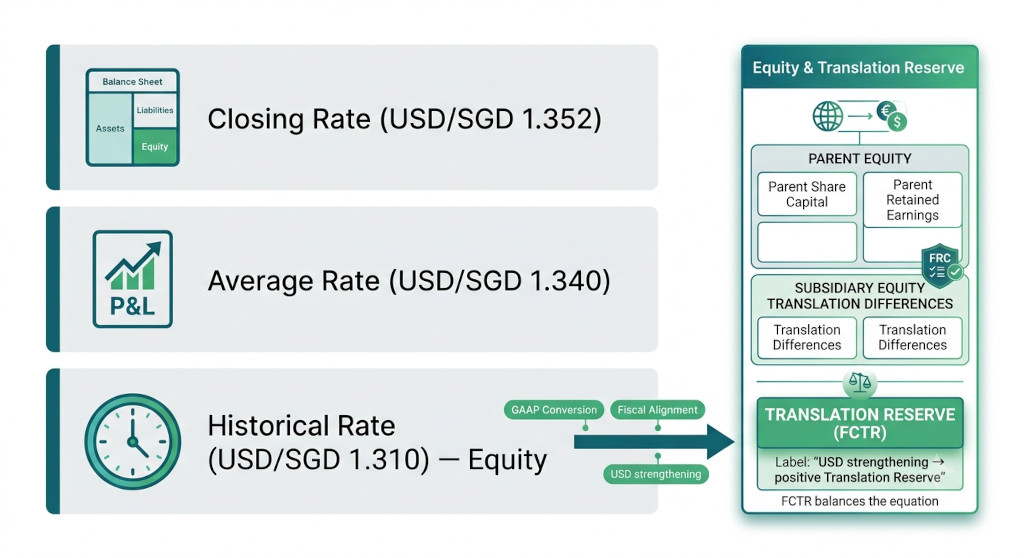
SFRS(I) 1-21 (for SFRS(I) parents) and SFRS for Small Entities Section 30 (for SFRS for SE parents) both use the closing rate / average rate / historical rate methodology — the same as IAS 21. The USD is BrizoUS Inc’s functional currency; the SGD is BrizoSG Holdings’ presentation currency. All translation differences accumulate in the Translation Reserve in equity as other comprehensive income.
| Item | Rate | Note |
|---|---|---|
| Balance sheet — all assets and liabilities | Closing rate (USD/SGD 1.352) | Year-end spot rate; USD 1 buys SGD 1.352 at period end |
| Income statement — revenues and expenses | Average rate (USD/SGD 1.340) | Annual average; approximates transaction-date rates |
| Share capital and share premium | Historical rate (USD/SGD 1.310) | Rate at the date BrizoSG acquired BrizoUS; locked for the life of the investment |
| Opening retained earnings | Brought forward from prior year | Consistent with cumulative prior-period translation |
| Translation Reserve | Balancing figure | Positive when USD strengthens vs SGD; deferred in equity until disposal of BrizoUS |
Worked Translation Example
Using BrizoUS Inc’s SFRS-restated figures in USD after all applicable conversion journals:
| Item | USD (SFRS restated) | Rate | SGD |
|---|---|---|---|
| Income Statement | |||
| Revenue | 12,000,000 | Avg 1.340 | 16,080,000 |
| Cost of Sales (FIFO-restated) | (6,200,000) | Avg 1.340 | (8,308,000) |
| Operating Expenses | (2,600,000) | Avg 1.340 | (3,484,000) |
| Net Profit | 3,200,000 | 4,288,000 | |
| Balance Sheet | |||
| Total Assets | 22,000,000 | Close 1.352 | 29,744,000 |
| Total Liabilities | (11,500,000) | Close 1.352 | (15,548,000) |
| Net Assets | 10,500,000 | 14,196,000 | |
| Equity Reconciliation | |||
| Share Capital (historical rate 1.310) | 3,000,000 | Hist 1.310 | 3,930,000 |
| Opening Retained Earnings (brought forward) | 4,300,000 | Prior year | 5,762,000 |
| Current Year Net Profit | 3,200,000 | Avg 1.340 | 4,288,000 |
| Translation Reserve (balancing figure) | — | Plug | 216,000 |
| Total Equity | 10,500,000 | 14,196,000 | |
The positive Translation Reserve of SGD 216,000 reflects USD strengthening against SGD over the period — the closing rate of 1.352 exceeds both the average rate (1.340) used for the income statement and the historical rate (1.310) used for equity. When the USD strengthens, the SGD value of BrizoUS’s net assets increases, and this gain is captured in the Translation Reserve in equity rather than in profit or loss. It will remain in equity until BrizoUS is sold or wound up, at which point it recycles to the consolidated income statement.
📚 Cross-Standard Consolidation SeriesSFRS Subsidiary → US GAAP ParentUS GAAP Subsidiary → IFRS ParentSFRS Subsidiary → IFRS ParentIFRS Subsidiary → SFRS ParentSFRS Subsidiary → UK GAAP Parent
Practical Checklist: US GAAP Subsidiary into an SFRS Group
✅ Period-End Consolidation Checklist
- Confirm which Singapore standard BrizoSG Holdings applies: SFRS(I) or SFRS for Small Entities — check the basis of preparation in the ACRA-filed accounts
- Confirm BrizoUS Inc’s inventory costing method — if LIFO, calculate opening and closing LIFO reserve and prepare reversal journals (both scenarios)
- Review BrizoUS R&D expenditure: classify into research (expense) and development (capitalise under SFRS(I) 1-38 or SFRS for SE Section 18) — both scenarios
- If SFRS(I) parent: prepare ASC 842 → SFRS(I) 16 P&L reclassification (depreciation + interest replaces single lease cost); balance sheet amounts are broadly the same
- If SFRS for Small Entities parent: remove ASC 842 operating lease ROU assets and lease liabilities from the balance sheet; reinstate straight-line operating lease expense
- If SFRS for Small Entities parent: calculate cumulative goodwill amortisation from acquisition date at the group’s chosen useful life (maximum 10 years); charge prior years to retained earnings and current year to P&L
- Prepare deferred tax adjustments on LIFO reversal and development cost intangible at the applicable US blended tax rate (federal 21% plus state)
- If SFRS(I) parent: check ASC adoption timing — if any new SFRS(I) standard is effective for the current period that BrizoUS has not yet adopted under US GAAP, assess whether a conversion adjustment is needed
- Review VIE entities consolidated by BrizoUS under ASC 810 — assess whether they meet the SFRS(I) 10 control criteria; adjust scope of consolidation if not
- Confirm 31 December year-end alignment; if BrizoUS uses a 52/53-week fiscal year, document the nominal year-end date difference
- Source and document USD/SGD closing rate, average rate, and historical rate from MAS, Bloomberg, or bank rate sheet
- Translate all balance sheet items at closing rate; all income statement items at average rate
- Apply historical rate to share capital; carry forward prior-year translated retained earnings
- Calculate Translation Reserve as the equity balancing figure; record in other comprehensive income — note the direction (positive when USD strengthens vs SGD)
- Load SGD-translated SFRS-restated figures into the group consolidation model
- Eliminate all intercompany balances and transactions; classify USD/SGD loan FX differences as net investment (→ Translation Reserve) or working capital (→ P&L)
Singapore group with a US subsidiary?
BrizoConsol connects Xero, QuickBooks, MYOB, and Zoho Books across all your entities — automating GAAP conversion journals, USD to SGD currency translation, intercompany eliminations, and SFRS consolidated reporting. Start Free Trial