Introducing the BRIZO Consolidation Methodology
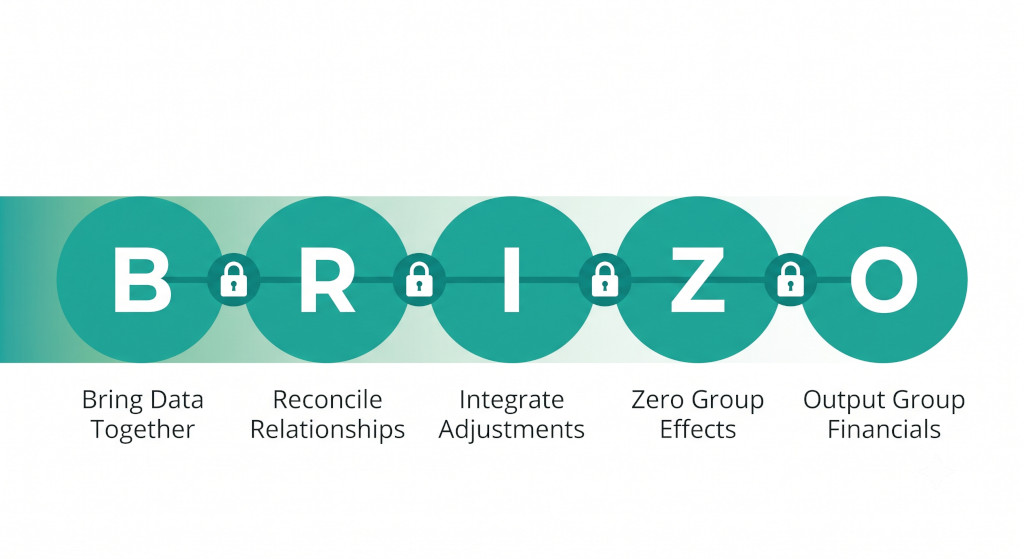
A finance professional can know every consolidation standard cold — IFRS 10, IFRS 3, IAS 21, the lot — and still produce a slightly different-looking set of group accounts every quarter. Not because the accounting was wrong. Because the work was done in the wrong order, and the wrong order means each step was building on something that hadn’t yet been established.
That is the problem BRIZO was designed to solve. Today we are publishing the BRIZO Methodology page — a comprehensive reference for the five-phase consolidation sequence that BrizoConsol is built around. The methodology, the library of supporting publications, and a 13-lesson free video series are all now live at brizoconsol.com/methodology.
The Core Thesis: Consolidation Failures Are Dependency Failures
Most consolidation problems are not caused by accountants misunderstanding the standards. They are caused by the work being done out of sequence. When Phase 3 begins before Phase 2 is complete, every output of Phase 3 is built on a foundation that hasn’t been settled yet. That error doesn’t announce itself — it just quietly shapes everything that follows.
Stop building consolidations in spreadsheets.
BrizoConsol automates multi-entity consolidation — setup in minutes, reports the same day.
“BRIZO treats consolidation as a chain of dependency gates. Each phase establishes a condition that the next phase requires before its output can be relied upon.”
BRIZO doesn’t introduce new accounting rules. It introduces the sequence that makes the rules you already know produce a reliable answer, every time.
Five Dependency Gates
BRIZO is structured as five phases, each with a defined job, a defined set of deliverables, and a defined dependency on the phase before it. Each gate closes before the next opens.
| Gate | Phase | What It Settles | Key Deliverables |
|---|---|---|---|
| B | Bring Data Together | Who is in the group, in what currency, at what date | Confirmed perimeter · Standardised trial balances · Locked rates |
| R | Reconcile Relationships | Every shared balance agreed to one version before any adjustment begins | Agreed ownership map · Reconciled IC matrix · Resolved disputes log |
| I | Integrate Adjustments | The accounting consequence of every ownership relationship — determined once | Goodwill schedule · NCI calculation · CTA schedule · Equity method schedules |
| Z | Zero Group Effects | This period’s intra-group trading removed — rebuilt from scratch each close | Elimination journals · Unrealised profit adjustment · Completeness sign-off |
| O | Output Group Financials | Everything B, R, I, and Z produced fits together into one coherent set | Consolidated P&L, balance sheet, SOCE, cash flow · Disclosure notes · Final sign-off |
One of the most useful distinctions in the methodology is the difference between Phase I and Phase Z. Both involve adjustments — but they are fundamentally different in nature. Phase I adjustments are determined once, when an ownership relationship is established, and carried forward automatically into every future period. Phase Z eliminations are rebuilt from scratch every period, because this period’s intra-group trading is always new information. Mixing up these two categories is one of the most common sources of close-to-close inconsistency in group reporting.
How One Failure Propagates
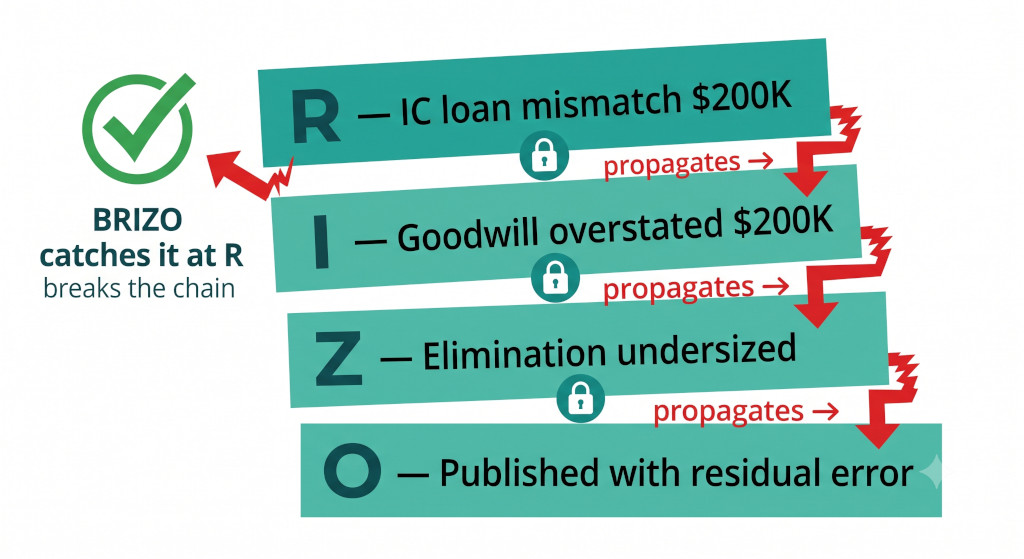
The dependency chain is not abstract. The methodology page includes a concrete failure trace that shows exactly how a single unreconciled intercompany loan at Phase R travels undetected through every downstream phase — overstating goodwill in Phase I, producing an incorrectly sized elimination in Phase Z, and reaching Phase O as an unexplained residual in the group balance sheet. Neither error announced itself at the point it was created. Both were a consequence of a gate that had not properly closed.
This is why the BRIZO sequence is not just a checklist. It is a dependency model. Skipping a gate does not delay its consequences — it disperses them invisibly through every phase that follows.
The Methodology Library
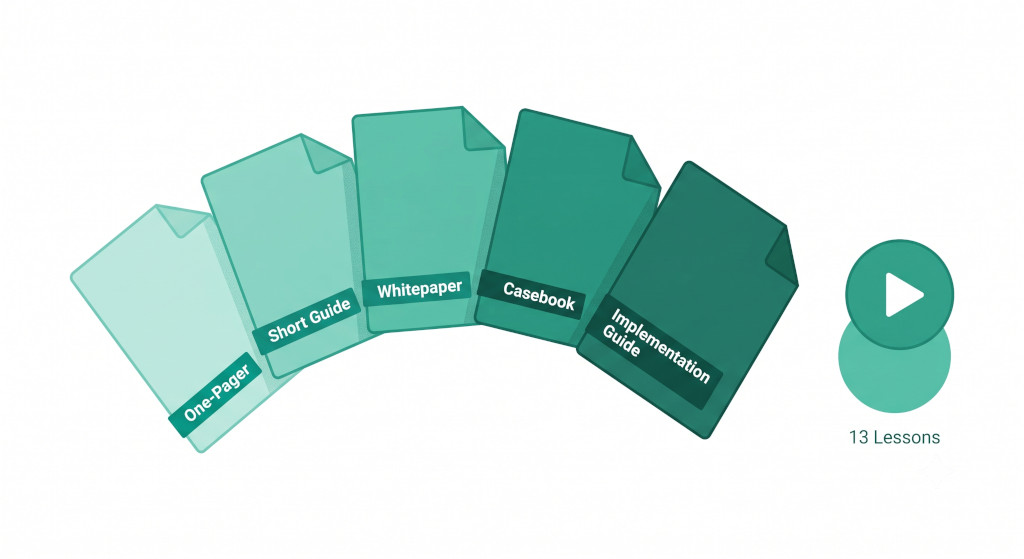
Alongside the methodology page, we have published a library of supporting documents — each aimed at a different depth of engagement with BRIZO.
One-Pager
A two-minute introduction to the five phases and the dependency sequence. Best starting point for anyone new to BRIZO.
Short Guide
A practical walkthrough of all five phases, the I vs Z distinction, and how the gates connect. Best for learning how the methodology works.
Whitepaper
The theoretical foundation — the dependency model, phase logic, and why sequencing produces reliability where standards alone cannot. Best for understanding why BRIZO works.
Casebook
Five real-world consolidation failures diagnosed through the BRIZO methodology, tracing how each phase failure propagated. Best for seeing BRIZO applied in practice.
There is also an Implementation Guide — practical guidance for deploying BRIZO within a finance team, including controls, checklists, role responsibilities, and close-process integration. This is aimed at finance leaders and controllers who want to structure their close around the methodology rather than just understand it.
All five documents are available as free PDF downloads from the methodology page. The suggested reading order is: One-Pager → Short Guide → Whitepaper → Casebook → Implementation Guide.
13 Free Video Lessons on YouTube
For those who prefer to learn by watching, the methodology page also hosts a 13-lesson free video series on YouTube. The series covers every phase of BRIZO in sequence, including the lessons most teams find hardest to internalise: why knowing the standards isn’t the same as knowing the order; what goes wrong downstream when each gate is skipped; and how to build your own consolidation checklist from the five phases.
All 13 lessons are free to watch with no account required. They run from roughly 90 seconds to just under three minutes each — short enough to be practical reference material, not just background reading.
The series is part of the broader BrizoConsol Academy on YouTube, which also includes standalone technical explainers on segment reporting (IFRS 8 vs ASC 280), joint operations vs joint ventures (IFRS 11), and business combinations (IFRS 3), as well as the full Financial Consolidation Fundamentals course on Udemy.
How BRIZO Is Built Into BrizoConsol
BrizoConsol is designed so that the five-phase sequence is not just documented — it is the product. The workflow follows the dependency order: entities and trial balances are established before intercompany reconciliation begins; ownership relationships and adjustments are settled before eliminations are run; and the output phase consolidates everything into a certified group set. The methodology is not bolted on to the software — it is the structure the software is built around.
If you are currently managing your group close in spreadsheets, or using a reporting tool that produces consolidated outputs without enforcing the sequence that makes them reliable, the methodology page is worth an hour of your time before the next close.
Run Your First Structured Consolidation
BrizoConsol connects to Xero, QuickBooks, MYOB, and Zoho Books — and runs your group close in the BRIZO sequence, gate by gate. Start Free Trial