How to Consolidate a Singapore SFRS(I) Subsidiary into a US GAAP Parent: Journals, Fiscal Periods, and Currency Translation
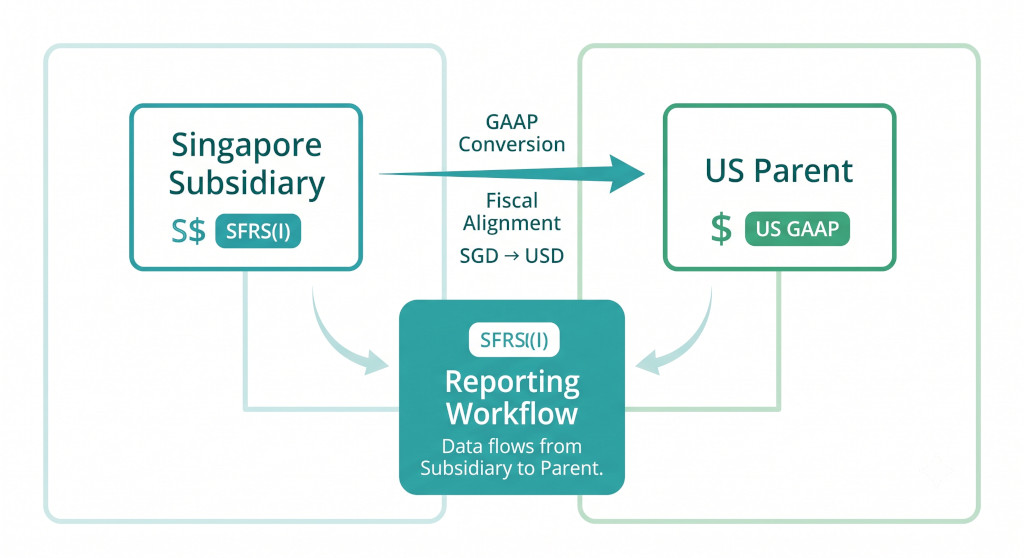
When a US-listed company acquires or establishes a subsidiary in Singapore, the subsidiary prepares its statutory financial statements under SFRS(I) — Singapore’s accounting framework, which closely follows IFRS. But the US parent consolidates under US GAAP. Bridging those two frameworks every reporting period is a practical task that falls squarely on the group finance team.
The process involves three distinct layers of work: converting the subsidiary’s SFRS(I) accounts to US GAAP through adjustment journals; aligning the reporting period if the subsidiary and parent have different fiscal year-ends; and translating the Singapore dollar (SGD) figures into US dollars (USD) using the correct exchange rates. This guide walks through each layer with worked journal entries and a practical example.
If you are new to the conceptual differences between the two frameworks, our SFRS vs US GAAP comparison guide provides the background before you work through the steps below.
Foreign currency consolidation, handled automatically.
BrizoConsol applies the correct CTA/FCTR treatment across all entities — no spreadsheets needed.
The Group Structure Used in This Guide
Throughout this post we use the following example group:
- BrizoCorp Inc — US-listed parent, reports under US GAAP in USD, fiscal year 1 January to 31 December
- BrizoSG Pte Ltd — Singapore subsidiary, 100% owned, reports under SFRS(I) in SGD, fiscal year 1 January to 31 December
- Exchange rates (illustrative): closing rate USD/SGD 1.35 (SGD 1 = USD 0.741); average rate for the year USD/SGD 1.33 (SGD 1 = USD 0.752)
BrizoSG has capitalised development costs, uses the revaluation model for one property, and has an operating lease classified under SFRS(I) 16 that produces a different income statement presentation than US GAAP ASC 842 would require.
Step 1 — GAAP Conversion Adjustment Journals
Step 1
Before translating a single dollar, you need to restate BrizoSG’s SFRS(I) accounts to US GAAP. These are journals prepared in SGD — the subsidiary’s functional currency — and they sit in the group reporting package as local currency GAAP conversion adjustments. They are translated into USD in Step 3.
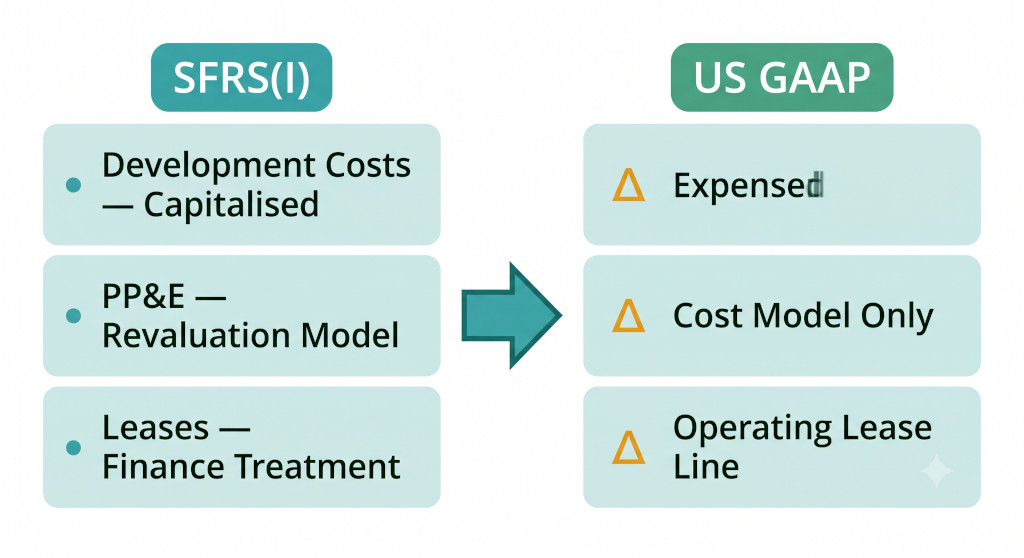
Adjustment 1: Development Costs — Reversal of Capitalisation
BrizoSG has capitalised SGD 600,000 of development costs under SFRS(I) 1-38, which have been amortised by SGD 120,000 to date, leaving a net book value of SGD 480,000. Under US GAAP (ASC 730), these costs must be expensed. The adjustment reverses the asset and reinstates the costs.
Journal 1A — Reverse opening net book value to retained earnings
DR Retained Earnings SGD 480,000
CR Intangible Assets (Dev Costs) SGD 600,000
CR Accumulated Amortisation SGD (120,000)
Reverses opening net book value of capitalised development costs. Retained earnings reduced to reflect cumulative prior-period expensing.
Journal 1B — Reverse current-year amortisation charge
DR Intangible Assets (Dev Costs) SGD 120,000
CR Amortisation Expense SGD 120,000
Removes the current-year amortisation charge from the P&L, as under US GAAP there is no asset to amortise. The corresponding R&D expense was recognised in prior periods.
Journal 1C — Expense current-year development spend
DR R&D Expense SGD 200,000
CR Intangible Assets (Dev Costs) SGD 200,000
Current-year development expenditure that was capitalised under SFRS(I) must be expensed immediately under US GAAP ASC 730.
Adjustment 2: PP&E Revaluation — Revert to Cost Model
BrizoSG holds an office property that was revalued upwards by SGD 300,000 under the SFRS(I) revaluation model. The revaluation surplus sits in other comprehensive income (OCI). Under US GAAP, only the cost model is permitted for PP&E — the surplus must be reversed.
Journal 2 — Reverse revaluation surplus
DR Revaluation Surplus (OCI / Equity) SGD 300,000
CR Property, Plant & Equipment SGD 300,000
Reduces PP&E to historical cost. Revaluation surplus in equity eliminated. Additional depreciation recognised under SFRS(I) on the revalued amount should also be reversed — calculate based on the revalued increment divided by remaining useful life.
Adjustment 3: Operating Lease — Income Statement Reclassification
Under SFRS(I) 16, BrizoSG’s office lease is recorded as a right-of-use (ROU) asset with a corresponding lease liability. The income statement shows depreciation of SGD 80,000 and interest on the lease liability of SGD 12,000. Under US GAAP ASC 842, this would instead be classified as an operating lease with a single straight-line lease expense of SGD 90,000 (the total undiscounted payments divided by the lease term). The P&L presentation differs, but the balance sheet treatment is similar for lessee accounting.
Journal 3 — Reclassify lease expense presentation
DR Operating Lease Expense SGD 90,000
CR Depreciation — ROU Asset SGD 80,000
CR Interest Expense — Lease Liability SGD 12,000
DR / CR Timing difference (lease liability) SGD (2,000)
Net income effect may be immaterial in mid-lease periods but is front-loaded under SFRS(I) 16 vs straight-line under ASC 842. The balancing difference accumulates in the lease liability carrying value over time.
Not every SFRS(I)-to-US GAAP conversion requires all three adjustments. Start by identifying which framework differences actually apply to your subsidiary’s specific accounting policies and transactions — many Singapore subsidiaries will only need one or two conversion journals.
Step 2 — Fiscal Year Differences
Step 2
In this example, BrizoSG and BrizoCorp Inc share the same 31 December year-end, so there is no fiscal period mismatch. But this is not always the case. Many Singapore companies use a 31 March or 30 June year-end.
US GAAP (ASC 810-10-45-12) permits a subsidiary’s fiscal year to differ from the parent’s by up to three months. Where the difference is three months or less, the parent may consolidate the subsidiary using the subsidiary’s most recent annual financial statements, adjusting only for significant transactions that occurred in the gap period.
Where the fiscal year difference exceeds three months, the subsidiary must prepare a special set of financial statements as of the parent’s reporting date. This is a significant administrative burden and is one reason many US-listed groups require their subsidiaries to align fiscal year-ends on acquisition.
Adjusting for Events in the Gap Period
If BrizoSG had a 30 September year-end and BrizoCorp Inc a 31 December year-end (a three-month gap — just within the permitted threshold), any significant transactions occurring between 1 October and 31 December in BrizoSG must be identified and either included in the consolidation or disclosed as subsequent events in BrizoCorp Inc’s consolidated financial statements. These typically include material acquisitions or disposals, significant financing arrangements, or large one-off gains or losses.
Note: If you are acquiring a Singapore subsidiary with a non-December year-end, factor the fiscal year alignment cost into your post-acquisition integration plan. Changing a company’s year-end in Singapore requires ACRA notification and is straightforward procedurally — but it means preparing a short-period set of accounts for the stub period, which takes time and auditor involvement.
Step 3 — Currency Translation: SGD to USD
Step 3
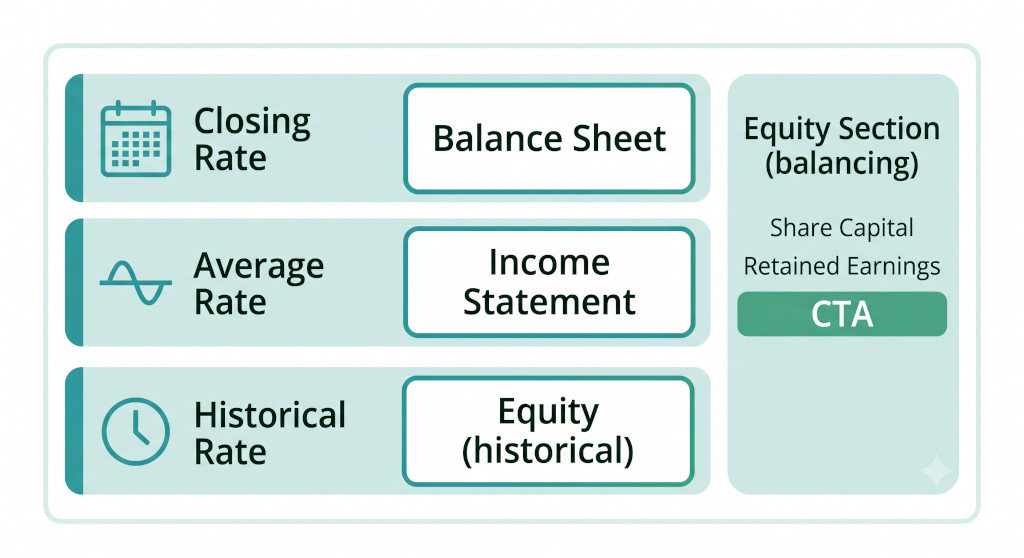
Once the GAAP conversion adjustments have been applied in SGD, you translate the restated financial statements into USD. Both ASC 830 and SFRS(I) 1-21 use the same core translation approach for a foreign subsidiary whose functional currency differs from the parent’s presentation currency.
| Item | Translation Rate | Rationale |
|---|---|---|
| Balance sheet assets and liabilities | Closing rate (spot rate at year-end) | Reflects the economic value of the subsidiary’s net assets in USD at the reporting date |
| Income statement revenues and expenses | Average rate for the period | Approximates the rates in effect when each transaction occurred |
| Share capital and share premium | Historical rate (rate at date of investment) | Equity contributed is a fixed historical transaction |
| Retained earnings (opening) | Carried forward from prior year translation | Consistent with cumulative prior-period translation |
| Cumulative Translation Adjustment (CTA) | Balancing figure | Absorbs all differences arising from using different rates for different statement items; recognised in OCI within equity |
Worked Translation Example
Using BrizoSG’s restated (post-GAAP-conversion) figures and the exchange rates from our example (closing: SGD 1 = USD 0.741; average: SGD 1 = USD 0.752):
| Item | SGD | Rate Used | USD |
|---|---|---|---|
| Income Statement | |||
| Revenue | 8,000,000 | Average 0.752 | 6,016,000 |
| Operating Expenses | (5,800,000) | Average 0.752 | (4,361,600) |
| Net Profit | 2,200,000 | 1,654,400 | |
| Balance Sheet | |||
| Total Assets | 12,500,000 | Closing 0.741 | 9,262,500 |
| Total Liabilities | (6,200,000) | Closing 0.741 | (4,594,200) |
| Net Assets | 6,300,000 | 4,668,300 | |
| Equity Reconciliation | |||
| Share Capital (historical rate 0.720) | 3,000,000 | Historical 0.720 | 2,160,000 |
| Opening Retained Earnings (carried forward) | 1,100,000 | Prior year translation | 808,500 |
| Current Year Net Profit | 2,200,000 | Average 0.752 | 1,654,400 |
| CTA (balancing figure) | — | Plug | 45,400 |
| Total Equity | 6,300,000 | 4,668,300 | |
The CTA of USD 45,400 is recognised in other comprehensive income in BrizoCorp Inc’s consolidated financial statements. It accumulates in equity for as long as BrizoSG remains a subsidiary, and is recycled to the income statement only on disposal of the subsidiary.
The CTA is not an error — it is a mechanical consequence of using different exchange rates for different parts of the financial statements. A strengthening SGD relative to the USD will generate a positive CTA (increasing equity); a weakening SGD will generate a negative CTA. For Singapore subsidiaries of US parents, the SGD/USD movement is worth monitoring quarterly as it can be a meaningful driver of reported group equity.
Step 4 — Intercompany Eliminations at Group Level
Step 4
After the translated, US GAAP-restated BrizoSG figures are loaded into the group consolidation, the standard intercompany eliminations apply exactly as they would for any other subsidiary. Any intercompany balances — loans, trade receivables/payables, management fees, or intercompany sales — between BrizoSG and any other BrizoCorp Inc entity must be eliminated on consolidation.
One nuance to watch: intercompany balances that are denominated in SGD on BrizoSG’s books and in USD on the US parent’s books will have both been translated to USD at different rates (BrizoSG uses the closing SGD/USD rate; the US parent recorded the balance in USD at the rate on the transaction date). This creates a translation difference on the intercompany elimination that must be treated as an FX difference at group level — typically recognised in the consolidated income statement or within the CTA, depending on the nature of the balance.
Practical Checklist: SFRS(I) to US GAAP Consolidation
✅ Month / Quarter-End Consolidation Checklist
- Obtain BrizoSG’s trial balance in SGD under SFRS(I)
- Prepare GAAP conversion journals in SGD: development costs, PP&E revaluation, lease classification, impairment reversals
- Confirm BrizoSG’s reporting period aligns with BrizoCorp Inc’s; if not, identify and adjust for significant gap-period events
- Apply closing rate to all balance sheet items
- Apply average rate to all income statement items
- Apply historical rate to share capital and share premium
- Calculate CTA as the balancing equity item; record in OCI
- Load translated US GAAP figures into group consolidation model
- Eliminate all intercompany balances and transactions between BrizoSG and other group entities
- Identify and treat any FX differences on intercompany eliminations
- Review CTA movement for reasonableness against SGD/USD rate movement in the period
Note: The journal entries and translation mechanics in this guide are illustrative. The specific adjustments required will depend on your subsidiary’s accounting policies, the materiality thresholds agreed with your auditors, and any jurisdiction-specific guidance applicable to your group. Always involve your external auditors when establishing the GAAP conversion framework for the first time.
Consolidating a multi-currency, multi-GAAP group?
BrizoConsol automates currency translation, intercompany eliminations, and group reporting — connecting directly to Xero, QuickBooks, MYOB, and Zoho Books across all your entities. Start Free Trial