Multi-Entity Construction Group Accounting: Consolidating JVs, Intercompany Plant Charges, and Long-Term Contract Revenue
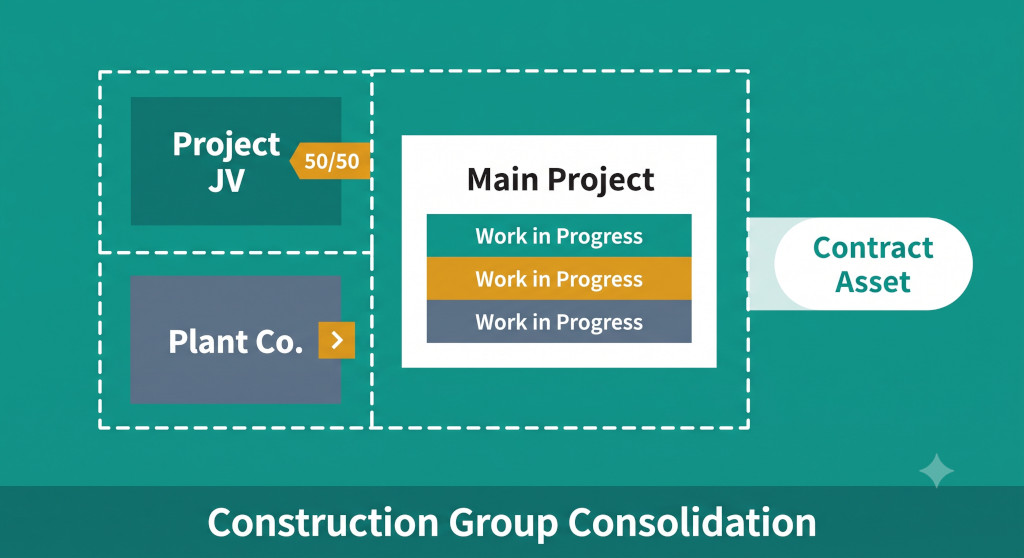
The finance director of a mid-sized civil engineering group had spent twenty years producing consolidated accounts that, in her words, were never quite right at year-end but were always close enough. The intercompany plant hire charges were eliminated, the project JV was equity-accounted, and the long-term contract revenue was percentage-completed by the project managers and fed into the group accounts without adjustment.
When the group was acquired by a listed contractor and its first IFRS-compliant consolidated accounts were prepared under the new parent’s audit team, three issues emerged in the first draft review: the group had been eliminating intercompany plant hire income and expense but had not been eliminating the unrealised profit element still sitting in project WIP; the project JV should have been classified as a joint operation under IFRS 11, not a jointly controlled entity, which meant the group’s share of assets and liabilities should have been consolidated line-by-line rather than equity-accounted; and two long-term contracts had variable consideration in the form of milestone bonuses that met the IFRS 15 constraint for recognition but had not been included in revenue.
None of these errors was unique. They appear in almost every construction group audit, and they share a common root: construction accounting requires the intersection of standard consolidation principles with sector-specific accounting rules that generic consolidation guidance does not address. This guide covers the three consolidation challenges that construction groups consistently find most difficult: project joint ventures and SPVs, intercompany plant and equipment hire, and long-term contract revenue recognition in a multi-entity context.
Intercompany eliminations without the manual work.
BrizoConsol identifies and eliminates intercompany balances automatically at consolidation.
Challenge One: Project Joint Ventures and SPVs
Construction projects are routinely delivered through joint ventures — two or more contractors pooling resource, risk, and expertise for a specific scheme. The accounting question in a multi-entity group context is not just “how do we account for the JV?” but “what kind of arrangement is this, and does the answer change how we prepare the consolidated accounts?”
The starting point under IFRS is IFRS 11. Under FRS 102, the equivalent analysis runs through Sections 15 and 9. The classification depends on the structure of the arrangement and the rights and obligations of the parties — not simply the percentage interest held.
Under IFRS 11, a joint arrangement is either a joint operation or a joint venture. A joint operation arises when the parties have rights to the assets and obligations for the liabilities of the arrangement — even if a separate legal entity has been formed. A joint venture arises when the parties have rights to the net assets of the arrangement — that is, the arrangement operates as a separate entity that owns its own assets and bears its own liabilities, and the investors have a residual claim.
The distinction is not determined by the legal form alone but by the contractual terms and, in the case of a separate vehicle, by whether the vehicle’s design results in the parties having rights to assets and obligations for liabilities, or only rights to net assets. A 50/50 incorporated project company can be either a joint operation or a joint venture under IFRS 11 depending on the contractual and structural facts — the shareholding percentage does not determine the classification.
In construction, the answer varies by structure. An unincorporated construction JV — where contractors pool their own resources under a contractual arrangement without forming a separate company — is almost always a joint operation. Each party recognises its own share of assets used, liabilities incurred, revenue earned, and costs spent on the project, in proportion to its contractual interest. There is no separate entity whose financials need to be consolidated or equity-accounted.
An incorporated project company — a limited company formed specifically for the project, with its own bank account, contracts, and subcontractors — is more likely to be a joint venture under IFRS 11, particularly where the company owns its own assets and is funded by third-party debt secured on the project rather than solely by the contractor partners. In this case, the equity method applies under IFRS: the construction group picks up its share of the project company’s net profit, and the carrying amount of the investment sits as a single line on the consolidated balance sheet. Under FRS 102 Section 15, proportionate consolidation remains an option for such a jointly controlled entity, which can produce a materially different presentation of revenue and gross profit in the consolidated income statement.
The IFRS 11 joint operation vs joint venture distinction is not determined by shareholding: A 50/50 incorporated project company can be either a joint operation or a joint venture under IFRS 11 depending on the contractual and structural facts. Groups that have been equity-accounting an incorporated JV should confirm whether the IFRS 11 analysis actually supports that treatment or whether the arrangement’s terms give the parties rights to assets and obligations for liabilities — in which case proportionate consolidation of the share of assets and liabilities is required, regardless of the separate legal entity. This is one of the most frequently misapplied standards in construction group accounting.
For infrastructure projects, project companies are often special purpose vehicles (SPVs) funded by a combination of equity from the contractor group, senior project finance debt from banks, and sometimes mezzanine or subordinated debt. The consolidation question for an SPV is whether the contractor group controls it under IFRS 10 — meaning it has power over the relevant activities, exposure to variable returns, and the ability to use its power to affect those returns.
Where the contractor holds only a minority equity interest but has provided guarantees, operates the SPV under a facilities management contract, and has decision-making rights over the project, control may exist even without a majority shareholding. The substance of the relationship governs, not the legal ownership percentage.
Construction groups with multiple project JVs should maintain a classification register that documents the IFRS 11 (or FRS 102 Section 15) analysis for each arrangement, updated whenever the contractual terms or structure of an arrangement change. A new funding agreement, a change in decision-making governance, or the addition of a third party to the arrangement can shift the classification. Without a maintained register, the audit process becomes a reconstruction exercise rather than a review.
Challenge Two: Intercompany Plant and Equipment Hire
Many construction groups centralise their plant and equipment in a dedicated subsidiary — a PlantCo or FleetCo entity that owns excavators, cranes, access platforms, and specialist vehicles, and hires them to the project-executing subsidiaries at internal rates. The plant company generates hire income; the project companies book hire expense. At year-end, the group eliminates the intercompany hire income and expense in the standard consolidation — a straightforward intercompany elimination.
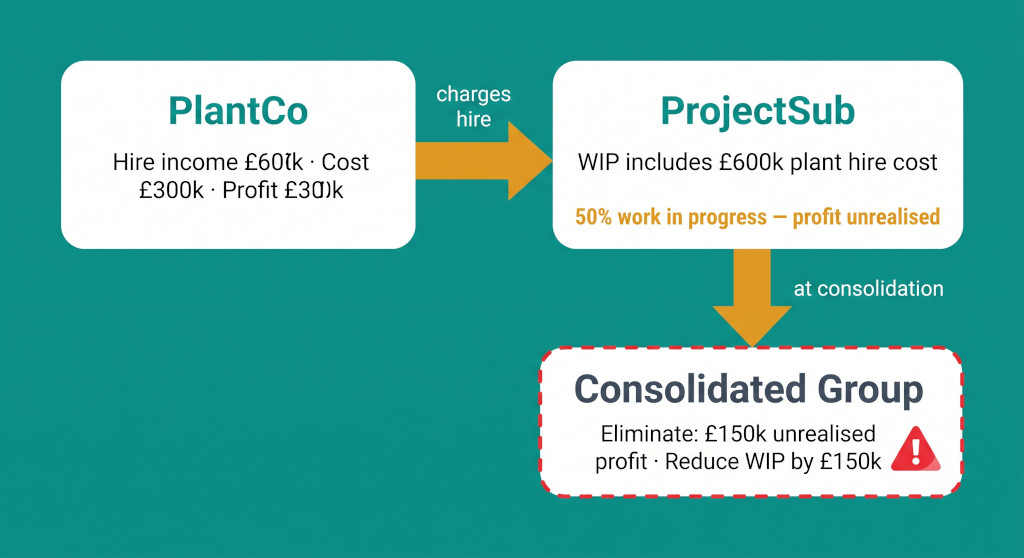
What is less straightforward is the unrealised profit embedded in WIP. When a project entity books plant hire costs into work in progress — because the project has not yet reached a stage at which revenue and costs are recognised — those WIP costs include the profit margin charged by PlantCo. At the group level, that margin is a profit on a transaction between two parts of the same group. The project entity has not yet delivered the service to an external customer; the profit is therefore unrealised from the group’s perspective and must be eliminated.
Worked Example: Unrealised Profit in Construction WIP
PlantCo hires a fleet of excavators to ProjectSub at an internal rate of £600,000 for the year. PlantCo’s cost base for providing those machines (depreciation, fuel, maintenance, operator costs) is £300,000. PlantCo therefore earns a gross profit of £300,000 on the hire — a 50% margin on cost.
ProjectSub includes the full £600,000 plant hire cost in its project cost pool. At year-end, ProjectSub’s stage of completion assessment determines that 50% of the project’s costs are work in progress (revenue not yet recognised) and 50% relate to work already recognised in revenue. Of the £600,000 plant hire, therefore, £300,000 is in WIP and £300,000 has been recognised as part of the cost of revenue already reported.
PlantCo profit on hire: £300,000 (50% margin on £600k)
Proportion in WIP (50%): £300,000 costs in WIP
PlantCo profit embedded in WIP: £300,000 × 50% margin = £150,000
Unrealised profit to eliminate from consolidated WIP: £150,000
Intercompany hire income/expense elimination:
| Dr £ | Cr £ | |
|---|---|---|
| PlantCo Hire Income | 600,000 | |
| ProjectSub Hire Expense | 600,000 | |
| Total | 600,000 | 600,000 |
Being: elimination of intercompany plant hire income and expense — standard consolidation journal.
Unrealised profit in WIP elimination:
| Dr £ | Cr £ | |
|---|---|---|
| Cost of Sales / Retained Earnings | 150,000 | |
| Work in Progress / Contract Assets | 150,000 | |
| Total | 150,000 | 150,000 |
Being: elimination of PlantCo’s 50% margin on the £300,000 of hire costs still sitting in WIP at year-end. Reverses in subsequent periods as the project progresses and WIP is recognised as revenue and cost.
Eliminates PlantCo’s 50% margin on the £300,000 of hire costs still sitting in WIP at year-end. The profit is realised as revenue on the project is recognised in future periods.
The unrealised profit elimination reduces consolidated WIP and increases consolidated cost of sales (or reduces profit) for the period. As the project progresses in subsequent periods and the WIP is recognised as revenue and cost, the unrealised profit is reinstated — the timing difference unwinds automatically as the project completes.
Most construction consolidations eliminate the hire income and expense but miss the WIP step: The standard consolidation workbook eliminates the intercompany income and expense lines, but the unrealised profit in WIP requires a separate analysis of the profit margin on intra-group plant charges and what proportion of those charges remain in work in progress at the balance sheet date. The amounts can be material in a large construction group with a centralised plant operation — and are typically underestimated because the project entities record costs in WIP without visibility of the margin the plant company is earning.
The same principle applies to other intra-group charges that flow into WIP: management fees charged by a head office entity to project companies, intercompany subcontracting where one group entity undertakes specialist work for another, and intercompany professional services charges. Any intra-group profit element that ends up in WIP at year-end creates an unrealised profit elimination requirement in the consolidation.
Challenge Three: Long-Term Contract Revenue in the Group Accounts
Long-term contract revenue recognition under IFRS 15 (or FRS 102 Section 23 for UK GAAP groups) operates on a percentage-of-completion basis — revenue is recognised over time as the performance obligation is satisfied, typically measured by reference to costs incurred as a proportion of total estimated costs (the input method) or by surveys of work performed (the output method). At the project entity level, this is a well-understood discipline. At the consolidated accounts level, it creates specific issues that the project accountants may not consider.
Contract Assets and Contract Liabilities on the Consolidated Balance Sheet
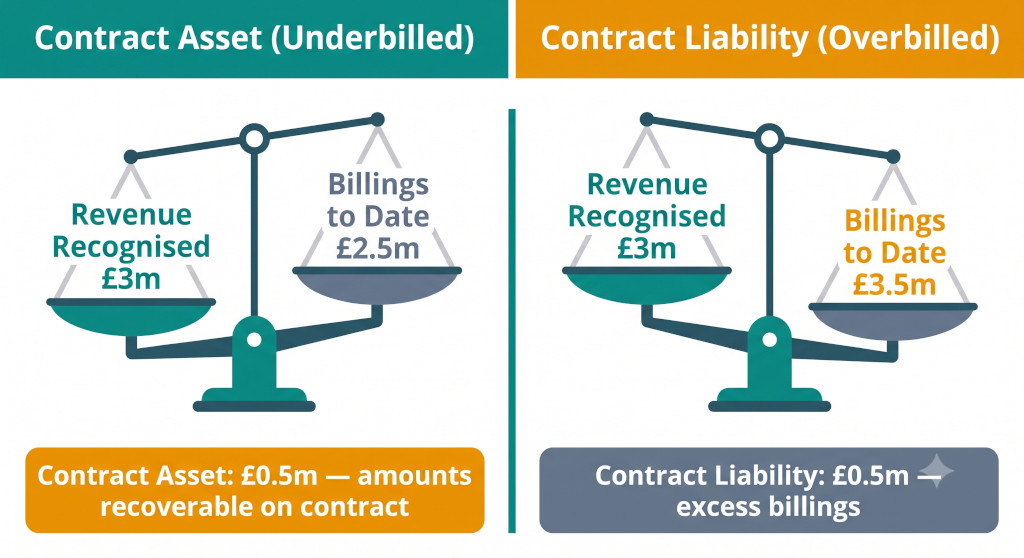
At each balance sheet date, the amount of revenue recognised on a long-term contract is compared to the amount billed (invoiced) to the customer. Where revenue recognised exceeds billings, the difference is a contract asset — an amount recoverable on contracts, often called “unbilled revenue” or “accrued income.” Where billings exceed revenue recognised, the difference is a contract liability — sometimes called “deferred income” or “excess billings” or “payments on account.”
In the consolidated balance sheet, contract assets and contract liabilities from different projects are presented separately — they cannot be offset unless there is a legal right of set-off and settlement is intended on a net basis (which is rare across different projects). A group with fifty active projects may have contract assets on thirty projects and contract liabilities on twenty; the gross amounts appear on the face of the balance sheet, not a net figure.
Revenue Recognition: A Worked Example
A construction subsidiary has a £5 million fixed-price contract to build a distribution centre. At year-end the following data applies:
| Item | £ |
|---|---|
| Contract value | 5,000,000 |
| Estimated total costs | 4,000,000 |
| Costs incurred to date | 2,400,000 |
| Stage of completion (£2.4m ÷ £4.0m) | 60% |
| Revenue recognised (60% × £5.0m) | 3,000,000 |
| Cost of sales recognised (60% × £4.0m) | 2,400,000 |
| Gross profit recognised to date | 600,000 |
| Balance Sheet Position | £ |
|---|---|
| Revenue recognised | 3,000,000 |
| Less: amounts billed to customer (applications for payment) | (2,500,000) |
| Contract asset (amounts recoverable on contract) | 500,000 |
| Of which: retention (5% of amounts billed) | (125,000) |
| Of which: current unbilled revenue | (375,000) |
The retention — the amount withheld by the client pending satisfactory completion — is a monetary asset that sits within the contract asset (or separately disclosed as a retention receivable). Under IFRS 15, retentions are part of the transaction price and are included in revenue as the performance obligation is satisfied; the timing of cash receipt does not affect when revenue is recognised. In practice, groups often disclose retention receivables separately because they are not expected to be received within twelve months and may need to be classified as non-current.
Variable Consideration: Variations, Claims, and Bonuses
Most construction contracts include elements of variable consideration — amounts that depend on future events. Under IFRS 15 paragraph 56, variable consideration is included in the transaction price only to the extent that it is highly probable that a significant reversal of cumulative revenue will not occur when the uncertainty is resolved. Under FRS 102 Section 23, a similar constraint applies: revenue from a claim or variation is only recognised when it is probable it will be accepted by the customer and the amount can be reliably measured.
In practice, this constraint applies to:
- Variation orders not yet formally agreed by the client — include only when it is highly probable the variation will be valued and approved at the estimated amount
- Contractor claims for additional costs caused by client-instructed changes or adverse site conditions — include only when probable to be accepted and reliably measurable
- Incentive bonuses tied to completion milestones — include only when the milestone is highly probable to be achieved within the constraint
- Liquidated damages — reduce the transaction price; may be partially constrained where the contractor believes they have a valid defence
Groups should document their variable consideration assessments at each reporting date. Undisciplined inclusion of speculative claims in WIP or contract assets is one of the most common issues raised in construction group audits.
The onerous contract assessment is a separate but related discipline. IFRS 15 requires a provision for the full estimated loss on a contract as soon as it becomes foreseeable — not spread over the remaining life of the project. At the group level, the same assessment applies on a contract-by-contract basis. Groups that aggregate projects for the onerous contract review — netting profitable contracts against loss-making ones — are applying the standard incorrectly. The IAS 37 provision for an onerous contract must be recognised at the level of the individual contract.
Intercompany Construction Contracts
A complication specific to multi-entity construction groups is the intercompany construction contract — where one group entity acts as main contractor and subcontracts work to another group entity. The main contractor recognises revenue based on stage of completion against the external client; the subcontractor recognises revenue from the intercompany subcontract. At consolidation, the intercompany revenue and cost must be eliminated in full.
Where the subcontractor’s work is complete but the main contractor has not yet recognised revenue on the relevant portion of the project, the elimination creates a temporary mismatch: the subcontractor’s profit is eliminated, the main contractor’s unrealised WIP (which includes the subcontract cost) is reduced, and the group-level margin is recognised only when the main contractor’s stage of completion progresses. This is correct accounting — the group cannot accelerate profit recognition by routing it through an intercompany subcontract — but it requires careful tracking in the consolidation model.
IFRS 15 vs FRS 102 Section 23: Construction Contract Revenue
| Area | IFRS 15 | FRS 102 Section 23 |
|---|---|---|
| Core principle | Recognise revenue when (or as) performance obligations are satisfied; the five-step model applies to all contracts with customers | Recognise revenue by reference to stage of completion when outcome can be estimated reliably; same economic result for most construction contracts |
| Stage of completion method | Input method (costs incurred) or output method (surveys, milestones) — whichever best depicts the entity’s performance | Same — costs incurred as proportion of total estimated costs is the most common method, expressly permitted |
| Variable consideration | Include if highly probable a significant revenue reversal will not occur (the “constraint”) | Include claims and variations when probable to be accepted by customer and reliably measurable — similar outcome in practice |
| Contract modifications (variation orders) | Detailed guidance: treat as separate contract, modification of existing contract, or combination depending on facts — separate performance obligation analysis | Less prescriptive — adjust contract revenue and costs when the variation’s scope and price can be reliably measured |
| Onerous contracts | Expected losses recognised immediately in full (consistent with IAS 37) | Expected losses recognised immediately — same outcome |
| Contract assets and liabilities | Explicit terminology: contract asset / contract liability; presented separately on the balance sheet | Referred to as “amounts recoverable on contracts” and “payments received on account” — same economic concept, less standardised presentation terminology |
| Retentions | Part of the transaction price; recognised as revenue as the performance obligation is satisfied; presented as part of the contract asset or as a separate retention receivable | Recognised as contract receivable when due; same timing in practice |
| Disclosure | Extensive: disaggregation of revenue, contract balances, remaining performance obligations, significant judgements and estimates | Less prescriptive: disclose accounting policy, amount of contract revenue and costs recognised, contract assets and liabilities |
For most construction contracts, IFRS 15 and FRS 102 Section 23 produce the same revenue and profit in each period. The differences are mainly in disclosure depth, the treatment of complex contract modifications, and the variable consideration constraint. Construction groups that report under FRS 102 but have IFRS-reporting partners or clients will find that the substance of the revenue recognition debate is the same under both frameworks — the key judgements are stage of completion methodology, the recoverability of variation and claim revenue, and the onerous contract assessment.
Consolidation Checklist for Construction Groups
- Classify each project JV and SPV
Maintain a classification register with the IFRS 11 (or FRS 102 Section 15) analysis for each arrangement. Confirm whether each is a joint operation (consolidate share of assets/liabilities line by line), joint venture (equity method), or subsidiary (full consolidation). Reassess when contractual terms, governance, or funding change. - Map all intercompany plant hire and subcontracting flows
Identify every intra-group charge that flows into project WIP or contract assets at year-end. For each, determine the profit margin embedded in those charges and calculate the unrealised profit to eliminate from WIP. - Eliminate intercompany hire income and expense — then eliminate the WIP
The two-step elimination (income/expense first; WIP unrealised profit second) should be explicit steps in the consolidation model. Combining them or skipping step two is the most common error. - Validate stage of completion on each material contract
Review the input assumptions: total estimated costs, contingency provisions, and whether any cost overruns are expected. Challenge aggressive stage of completion assessments where costs incurred are ahead of physical progress due to front-loaded procurement. - Assess variable consideration conservatively
Review each contract for unagreed variations, unresolved claims, and contingent bonuses or penalties. Apply the IFRS 15 highly probable constraint or FRS 102 probable and reliable test. Document the conclusion. - Test for onerous contracts on each contract individually
Do not net profitable and loss-making contracts. Where total estimated costs exceed total contract revenue, recognise the full expected loss immediately. - Eliminate intercompany construction subcontracts
For any intra-group subcontracting, eliminate the subcontractor’s revenue and the main contractor’s cost. Ensure that the timing of revenue recognition at the consolidated level follows the main contractor’s stage of completion against the external client — not the subcontractor’s completion of its own scope. - Present contract assets and liabilities gross
Do not offset contract assets and liabilities across projects. Identify any retention amounts within contract assets and disclose whether they are current or non-current based on expected receipt dates.
BrizoConsol handles the construction group consolidation process end-to-end: intercompany eliminations including the WIP unrealised profit step, project JV equity pick-up or proportionate consolidation, and contract asset/liability balances pulled directly from project accounting systems connected via Xero, QuickBooks, MYOB, or Zoho Books. For the general consolidation framework within which these construction-specific steps sit, our month-end close checklist covers the full sequence. For the IFRS 11 joint venture accounting standards underlying the project JV classification, see our FRS 102 associates and joint ventures guide and our forthcoming IFRS 11 post.
Conclusion: Construction Group Consolidation Requires More Than Standard Elimination Rules
The three challenges covered in this guide — JV and SPV classification, intercompany plant hire with unrealised profit in WIP, and long-term contract revenue recognition — do not appear in generic consolidation guidance because they are specific to the construction sector. A finance team that knows how to eliminate management fees and translate a foreign subsidiary will still find these three areas catching them out, because each requires the intersection of standard consolidation mechanics with sector-specific accounting rules.
The classification register for JVs prevents a misapplied equity method or an incorrect proportionate consolidation from persisting unnoticed through multiple years of accounts. The two-step WIP elimination prevents a systematic overstatement of consolidated gross profit on projects where centralised plant earns a margin on intra-group charges. The disciplined variable consideration assessment prevents speculative claims from inflating contract assets and revenue to a level the auditors will not accept.
None of these is particularly difficult to get right once the discipline is in place. The difficulty is in building that discipline into the consolidation process — not as a year-end exercise, but as a monthly close discipline that produces reliable numbers every period.
Construction group consolidation — from project data to group accounts
BrizoConsol connects to your project accounting systems, eliminates intercompany plant hire including the WIP profit step, and produces your consolidated accounts — without a spreadsheet in sight. Start free, no credit card required. Start Free Trial