PropCo/OpCo Intragroup Leases in a Retail Group: Eliminating the Ghost IFRS 16 Assets That Shouldn’t Appear on Your Consolidated Balance Sheet
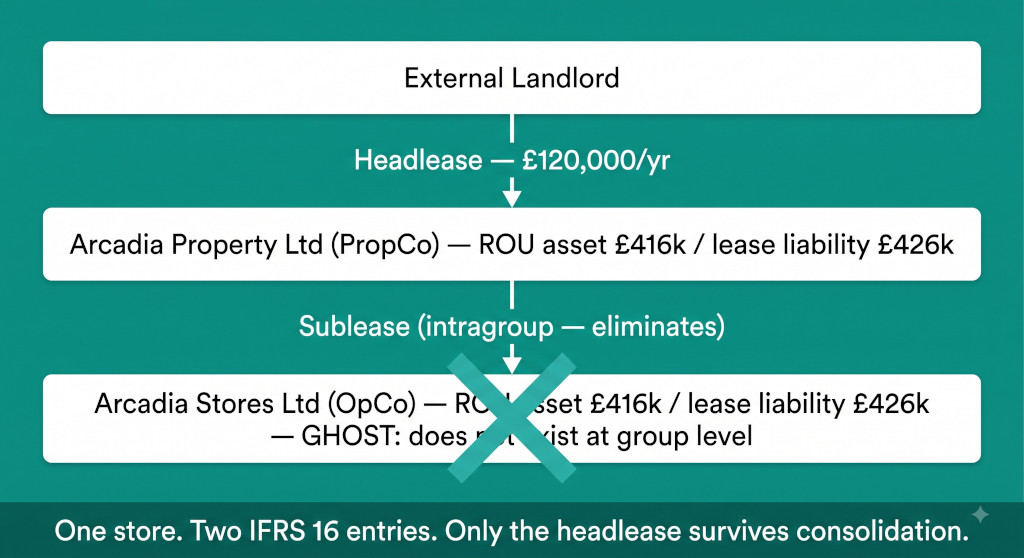
When the group financial controller at Arcadia Retail Group first ran the numbers for the consolidated balance sheet, the total right-of-use assets came to £23.3 million and lease liabilities to £23.9 million. Both figures were almost exactly double what she expected. A thirty-second check confirmed the problem: every store in the group appeared twice — once in Arcadia Property Ltd, the entity holding the headleases, and once in Arcadia Stores Ltd, the entity operating the retail units under a sublease from the property entity.
Under IFRS 16, both entities had correctly recognised a right-of-use asset and a lease liability. At entity level, both sets of entries are technically right. At consolidated level, only one set should survive — the headlease, which represents the group’s actual external obligation to third-party landlords. The sublease balances are a group-level illusion: the group does not owe itself rent. They need to eliminate.
This post works through exactly how that elimination works — balance sheet, P&L, and the retained earnings asymmetry that catches most controllers off guard — using one representative store as the worked example before scaling the logic across a 28-store portfolio.
Stop building consolidations in spreadsheets.
BrizoConsol automates multi-entity consolidation — setup in minutes, reports the same day.
Why Retail Groups Use a PropCo/OpCo Structure
Separating retail property obligations from operating entities is standard practice at scale. The motivations vary by group but typically include some combination of the following: ring-fencing substantial lease liabilities away from the trading entity to protect banking covenant ratios (particularly net debt to EBITDA tests that reference entity-level accounts); providing operational flexibility to assign leases, sublet stores, or exit locations without triggering change-of-control provisions in the operating entity’s facilities; and simplifying the management of a large lease portfolio by concentrating all landlord relationships in a single entity with dedicated property management resource.
From a commercial perspective, the structure works cleanly. The PropCo holds the external lease with the landlord and subleases to the OpCo on identical or near-identical terms. From an IFRS 16 perspective, it creates a structural problem at every consolidation: both entities apply IFRS 16 to their respective lease interests, producing duplicate balance sheet entries that inflate the consolidated position until the sublease is eliminated.
The Arcadia Retail Group Structure
Arcadia Retail Group Ltd owns two subsidiaries within the consolidation perimeter:
| Entity | Role | IFRS 16 position at entity level |
|---|---|---|
| Arcadia Property Ltd | Holds all 28 store headleases from external landlords; subleases each unit to Arcadia Stores at the same rent | Lessee (headlease): recognises ROU asset and lease liability. Lessor (sublease): recognises rental income only (operating sublease treatment) |
| Arcadia Stores Ltd | Operates the retail stores; holds all 28 subleases from Arcadia Property | Lessee (sublease): recognises ROU asset and lease liability for all 28 subleases |
The worked example uses a single representative store to illustrate the mechanics. The store lease has five years remaining, the annual rent is £120,000, and the incremental borrowing rate applied under IFRS 16 is 5%. The sublease is classified as an operating lease (explained further below).
Year 1 Entity-Level IFRS 16 Positions
At the start of the lease, both entities recognise a right-of-use asset and lease liability at the present value of the five annual payments of £120,000 discounted at 5%:
| Annual lease payment | £120,000 |
| Discount rate (IBR) | 5% |
| Lease term | 5 years |
| Present value of lease payments (initial ROU asset / lease liability) | £520,000 |
Through year 1, the IFRS 16 entries in each entity develop as follows:
| IFRS 16 schedule — one store, Year 1 | Arcadia Property Ltd — headlease (£) | Arcadia Stores Ltd — sublease (£) |
|---|---|---|
| Opening ROU asset | 520,000 | 520,000 |
| Depreciation (straight-line over 5 years) | (104,000) | (104,000) |
| Closing ROU asset | 416,000 | 416,000 |
| Opening lease liability | 520,000 | 520,000 |
| Interest (5% × opening balance) | 26,000 | 26,000 |
| Cash lease payment | (120,000) | (120,000) |
| Closing lease liability | 426,000 | 426,000 |
| P&L charge (depreciation + interest) | 130,000 | 130,000 |
| Rental income (Arcadia Property — from sublease) | (120,000) | n/a |
| Net P&L effect — this entity | 10,000 | 130,000 |
Without any elimination, the combined entity-level balance sheet carries £832,000 of ROU assets and £852,000 of lease liabilities for a single store — exactly double the real underlying position. The combined P&L charge is £140,000 net (PropCo £10,000 + OpCo £130,000), against a true underlying cost of £130,000 (depreciation + interest on the headlease). The rental income of £120,000 in PropCo partially offsets this, but the gross double-counting must be resolved.
Elimination Journal 1: The Balance Sheet
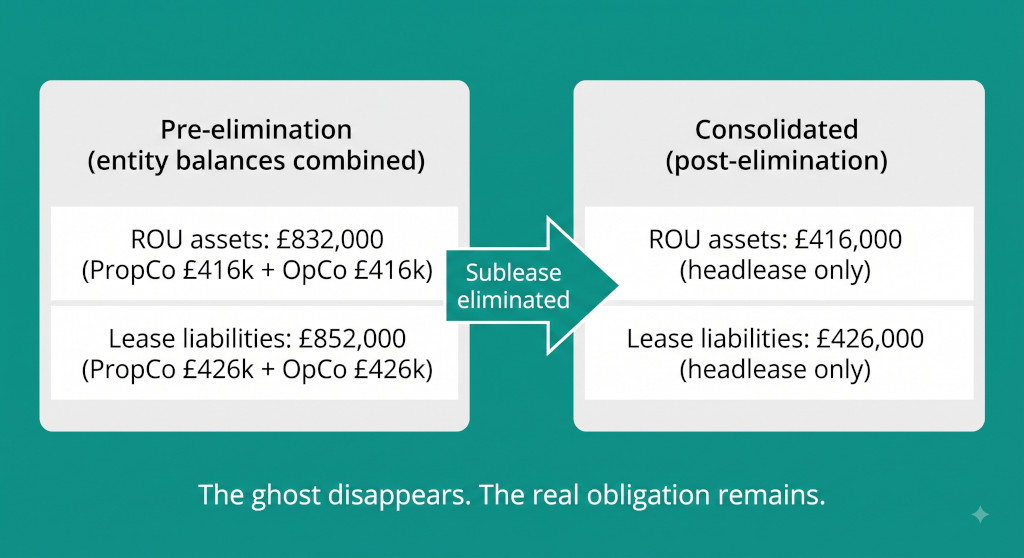
The balance sheet elimination removes Arcadia Stores’ sublease ROU asset and lease liability at their year-end carrying values. The difference between the two (£426,000 liability less £416,000 asset = £10,000) goes to consolidated retained earnings — it represents the cumulative net P&L asymmetry between PropCo’s rental income (£120,000) and OpCo’s IFRS 16 costs (£130,000) that has accumulated in year 1:
| Account | Dr | Cr |
|---|---|---|
| Lease liability — sublease (Arcadia Stores Ltd) | £426,000 | |
| Right-of-use asset — sublease (Arcadia Stores Ltd) | £416,000 | |
| Retained earnings (cumulative P&L asymmetry) | £10,000 |
After this entry, the consolidated balance sheet shows one ROU asset (£416,000 — headlease in PropCo) and one lease liability (£426,000 — headlease in PropCo) per store. The consolidated position correctly reflects only the group’s external obligation. The £10,000 retained earnings credit arises because OpCo’s IFRS 16 costs in year 1 (£130,000) exceed PropCo’s rental income (£120,000) by £10,000 — eliminating the sublease improves consolidated retained earnings by that amount. This asymmetry reverses in later years of the lease as the interest component of OpCo’s IFRS 16 cost declines below the cash rent.
Elimination Journal 2: The P&L
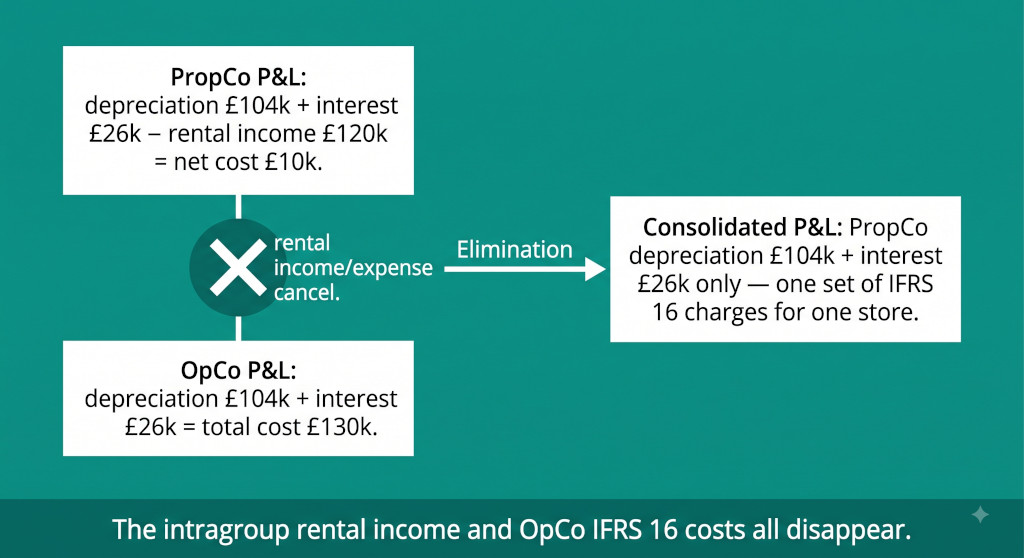
The P&L elimination removes PropCo’s rental income from the sublease and OpCo’s depreciation and interest from the sublease. These are the income and expense items created entirely by the intragroup arrangement:
| Account | Dr | Cr |
|---|---|---|
| Rental income — sublease (Arcadia Property Ltd) | £120,000 | |
| Depreciation expense — sublease ROU (Arcadia Stores Ltd) | £104,000 | |
| Finance cost — sublease interest (Arcadia Stores Ltd) | £26,000 |
This elimination removes the gross intragroup flows from the consolidated P&L. After this entry, the consolidated income statement shows no rental income from the sublease and no IFRS 16 depreciation or interest attributable to OpCo’s sublease. The only IFRS 16 charges on the consolidated P&L are PropCo’s own depreciation (£104,000) and interest (£26,000) on the headlease — the real external obligation. Note that the net effect of removing £120,000 income and £130,000 of costs is a £10,000 improvement in consolidated profit, which is consistent with the £10,000 retained earnings credit in Elimination Journal 1.
After both eliminations, the consolidated accounts show what the group would look like if Arcadia Stores occupied all 28 stores directly under the external leases, with no PropCo intermediary. One ROU asset, one lease liability, one set of depreciation and interest charges per store. The PropCo/OpCo structure is invisible at group level — it affects only the entity accounts.
The P&L Asymmetry Over the Lease Term
The £10,000 difference between PropCo’s rental income (£120,000) and OpCo’s IFRS 16 costs (£130,000) in year 1 is not a permanent feature — it is the IFRS 16 front-loading effect. In early years of a lease, total IFRS 16 costs (depreciation plus interest) exceed the cash rent because the interest component is calculated on a high opening balance. As the lease runs down, interest falls, and total IFRS 16 costs drop below the cash rent. By the end of the lease, the asymmetry has fully self-corrected: cumulative IFRS 16 costs equal cumulative cash rents paid.
| Year | PropCo rental income (£) | OpCo IFRS 16 cost (£) | Net P&L asymmetry (£) | Cumulative retained earnings movement (£) |
|---|---|---|---|---|
| 1 | 120,000 | 130,000 | 10,000 improvement | 10,000 |
| 2 | 120,000 | 125,300 | 5,300 improvement | 15,300 |
| 3 | 120,000 | 122,300 | 2,300 improvement | 17,600 |
| 4 | 120,000 | 120,400 | 400 improvement | 18,000 |
| 5 | 120,000 | 104,100 | (15,900) reduction | 2,100 |
The retained earnings adjustment in the balance sheet elimination reflects the cumulative position at each year end. The adjustment peaks in year 4 and nearly unwinds by year 5 — the small residual (£2,100) reflects rounding in the calculation. Over the full five-year term, the aggregate cash rent (£600,000) and aggregate IFRS 16 costs (£600,000 + small rounding differences) are equal, as expected.
In practice, the consolidation workbook carries the retained earnings adjustment forward from the prior year and adds or subtracts the current year asymmetry. Groups that fail to carry the opening balance forward will misstate the retained earnings elimination each year.
Scaling Across 28 Stores
Arcadia Property holds 28 store headleases. Each has its own lease term, rent, and start date — meaning each is at a different point in its IFRS 16 amortisation schedule and carries a different retained earnings adjustment at each year end. The consolidation workbook needs a separate elimination schedule for every lease, tracking: the sublease ROU asset closing balance (to credit in the balance sheet elimination), the sublease lease liability closing balance (to debit), the year-to-date rental income (to debit in the P&L elimination), and the year-to-date depreciation and interest on the sublease (to credit).
For a 28-store portfolio across which leases range from newly commenced five-year terms to existing ten-year terms in their final year, the total elimination at any year end is the sum of 28 individual calculations. A manual workbook typically maintains a separate tab per lease or a consolidated schedule sorted by lease start date. Either approach is acceptable; the critical requirement is that each lease is tracked individually — a blanket average-rate approximation across all 28 stores will give the wrong retained earnings adjustment whenever the portfolio is skewed toward either early-term or late-term leases.
Opening balance check: at each year end, confirm that the retained earnings adjustment in the consolidation workbook agrees to the prior year’s closing position plus the current year’s asymmetry for every lease. If leases have expired, the adjustment for those leases should be zero and should be removed from the schedule. If new leases have commenced, their adjustments should be added. Any unexplained movement in the aggregate retained earnings figure signals a missing or duplicated lease entry.
Operating vs. Finance Sublease Classification — Why It Matters
The treatment described above assumes the sublease is classified as an operating lease in PropCo’s accounts — the most common outcome for a pass-through retail sublease. Under IFRS 16 paragraph 68, an intermediate lessor classifies a sublease as either an operating lease or a finance lease by reference to the right-of-use asset arising from the headlease, not by reference to the underlying physical asset.
A sublease classified as an operating lease: PropCo retains the headlease ROU asset and lease liability on its balance sheet and recognises straight-line rental income from the sublease. OpCo recognises a separate ROU asset and lease liability for the sublease. At consolidation: eliminate OpCo’s sublease ROU, lease liability, depreciation, and interest; eliminate PropCo’s rental income. The headlease ROU and liability in PropCo survive. This is the treatment shown throughout this post.
A sublease classified as a finance lease: PropCo derecognises the headlease ROU asset and recognises instead a net investment in sublease (a financial asset). PropCo recognises finance income rather than rental income. OpCo still recognises a sublease ROU asset and lease liability. At consolidation: the net investment in sublease in PropCo eliminates against OpCo’s sublease lease liability; any difference (typically arising from IBR differences between the headlease and sublease) goes to retained earnings. The elimination is more complex and the balance sheet impact of the intragroup transaction is different — PropCo carries a financial asset (net investment in sublease) rather than an ROU asset. The correct classification should be assessed at inception of the sublease and documented.
For most retail PropCo/OpCo structures where the sublease is on substantially the same terms as the headlease and for a period that does not represent the major part of the underlying asset’s economic life, operating lease classification is appropriate. Finance lease classification arises where the sublease transfers substantially all the risks and rewards of ownership — unusual for a retail lease structure.
Retail-Specific Lease Term Judgements
Retail leases typically contain break clauses — options to exit the lease at specified points — and renewal options. Both affect the IFRS 16 lease term assessment, which in turn determines the initial ROU asset and lease liability. The lease term under IFRS 16 is the non-cancellable period plus optional periods that the lessee is reasonably certain to exercise.
For retail groups, “reasonably certain” requires judgement at store level. A high-performing flagship location in a prime shopping centre might justify including the renewal option in the lease term. A struggling store in a secondary location where the group is actively considering exit might exclude a break option, shortening the IFRS 16 lease term. These judgements affect both the initial ROU and liability recognition and the ongoing amortisation schedules — and they must be consistently applied at both PropCo level (headlease) and OpCo level (sublease).
A mismatch between lease term judgements in PropCo and OpCo for the same store — where PropCo includes a renewal option and OpCo excludes it, or vice versa — will create a permanent asymmetry in the elimination that is not self-correcting. Before any consolidation, confirm that the lease term used in the IFRS 16 calculation is identical in both entities for every lease in scope.
Covenant Implications at Entity vs. Group Level
The PropCo/OpCo structure is frequently motivated by a desire to keep lease liabilities off the operating entity’s balance sheet for banking covenant purposes. At entity level, this works: Arcadia Stores Ltd carries no lease liabilities — it records only the sublease, and under the operating sublease classification, OpCo recognises its own ROU and liability. Wait — actually under IFRS 16 as lessee, OpCo does recognise a lease liability for the sublease. So the covenant benefit of the PropCo/OpCo structure under IFRS 16 is more limited than it might appear: OpCo still recognises a lease liability for the sublease it receives, even though the external obligation sits in PropCo.
The covenant benefit that does survive is the ring-fencing of the headlease obligation from the operating entity’s legal exposure: if OpCo becomes insolvent, the headlease remains with PropCo, protecting the landlord relationship and the group’s store portfolio. This is a real operational benefit; it is just not the balance sheet benefit that groups using this structure pre-IFRS 16 (under IAS 17) were accustomed to, when the sublease might have been classified as an operating lease in OpCo’s own accounts with no recognition of ROU or lease liability at all.
If a banking covenant references OpCo’s entity-level net debt or EBITDA, and OpCo holds sublease ROU assets and lease liabilities on its entity balance sheet, the PropCo/OpCo structure does not shield the covenant metric from IFRS 16 lease obligations. The protection is legal, not accounting. Finance teams should ensure that covenant definitions in facility agreements are explicit about whether IFRS 16 lease liabilities are included or excluded, and at which entity level.
A Practical Checklist for Retail Groups With PropCo/OpCo Lease Structures
- Build a lease-by-lease elimination schedule. For every store headlease, maintain: the headlease ROU asset closing balance (in PropCo), the headlease lease liability closing balance (in PropCo), the sublease ROU asset closing balance (in OpCo — to eliminate), the sublease lease liability closing balance (in OpCo — to eliminate), the current year rental income in PropCo (to eliminate), and the current year depreciation and interest on OpCo’s sublease ROU and liability (to eliminate).
- Confirm that lease term assumptions are identical in PropCo and OpCo for every lease. The IFRS 16 lease term — including any renewal or break options — must be assessed on the same basis in both entities. A mismatch creates a permanent non-self-correcting asymmetry in the elimination.
- Carry the retained earnings adjustment forward from the prior year. The retained earnings credit in the balance sheet elimination represents the cumulative P&L asymmetry since the lease commenced. This must be carried forward each year and updated for the current year movement. Rebuilding it from scratch each year risks losing continuity.
- Classify the sublease as operating or finance at inception and document the conclusion. For most retail pass-through subleases on identical terms, operating lease classification is correct. If the sublease transfers substantially all the risks and rewards — or if the sublease term represents the major part of the economic life of the underlying ROU asset — finance lease classification may apply, requiring a different elimination methodology.
- For newly commenced leases, add them to the elimination schedule in the first period. New stores entering the portfolio mid-year will have initial ROU and lease liability amounts that differ from year-end amounts; ensure the schedule picks up the commencement-date entries, not just the year-end balances.
- For expired leases, remove them from the elimination schedule. When a lease expires or is terminated, the ROU assets and liabilities in both entities will be nil and the retained earnings adjustment will have fully unwound. Leaving expired leases in the schedule with nil balances creates clutter but no error; failing to remove the associated retained earnings adjustment when a lease is terminated early (where the adjustment has not yet fully unwound) will leave a residual balance that must be written off as part of the termination accounting.
- Reconcile the consolidated IFRS 16 disclosure to the elimination schedule. The consolidated accounts must disclose total ROU assets by class and a maturity analysis of lease liabilities. These disclosures should tie exactly to the headlease schedules in PropCo — zero contribution from OpCo’s sublease balances. If the disclosed maturity profile includes sublease amounts, the elimination has not been applied to the disclosure workings.
Managing IFRS 16 lease eliminations across a multi-store retail portfolio?
BrizoConsol tracks each lease individually, calculates the retained earnings carry-forward automatically, and produces the consolidated IFRS 16 disclosure directly from the elimination schedule. See It In Action