FRS 102 Associates and Joint Ventures: The Equity Method for UK Multi-Entity Groups
A UK manufacturing group held a 35% stake in a specialist components supplier for eleven years, accounting for its share of the supplier’s profits each year in the consolidated accounts without a second thought about whether the accounting treatment was correct. The stake had been acquired as a strategic minority — the group sat on the board, shared product development, and sourced a significant proportion of its inputs through the relationship — but had never controlled the entity. When the group transitioned from old UK GAAP to FRS 102, the auditors confirmed that the equity method treatment under Section 14 was correct and would continue. Three years later, the supplier restructured and the group’s stake was diluted to 14% with no board representation retained. The equity method stopped. From that date, the investment became a financial asset measured under FRS 102 Section 11. What had appeared to be a permanent accounting treatment had in fact always been conditional on the exercise of significant influence — and when that influence ended, so did the method.
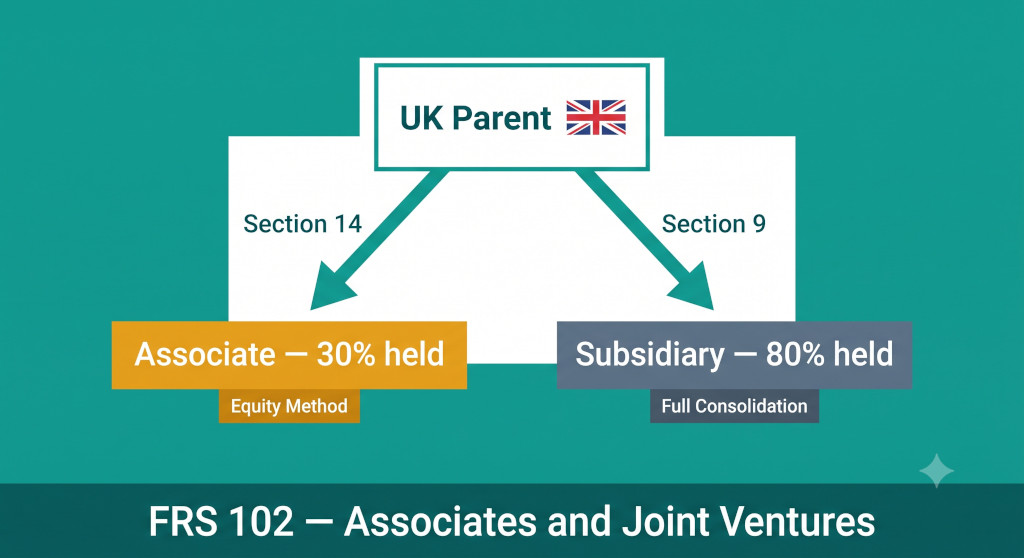
FRS 102 Section 14 governs how a UK entity accounts for its investments in associates in consolidated financial statements. Section 15 governs joint ventures. Both sections prescribe the equity method as the required approach, with a limited exception for jointly controlled entities under Section 15. This guide covers the significant influence test, the equity method mechanics, unrealised profit elimination, the treatment of goodwill within the associate carrying amount, impairment, and the practical differences from IAS 28.
Defining an Associate: The Significant Influence Test
An associate is an entity over which the investor has significant influence and that is neither a subsidiary nor a joint venture of the investor. Significant influence is the power to participate in the financial and operating policy decisions of the investee, without controlling or jointly controlling those policies.
Stop building consolidations in spreadsheets.
BrizoConsol automates multi-entity consolidation — setup in minutes, reports the same day.
FRS 102 paragraph 14.3 establishes a rebuttable presumption that an investor holds significant influence if it holds, directly or indirectly, 20% or more of the voting power of the investee. The presumption works in both directions: a holding of 20% or more is presumed to confer significant influence unless it can be clearly demonstrated otherwise; a holding of less than 20% is presumed not to confer significant influence unless such influence can be clearly demonstrated.
Significant influence is evidenced by factors including representation on the board of directors, participation in policy-making decisions (including dividend policy), material transactions between the investor and investee, interchange of managerial personnel, and provision of essential technical information. An investor that holds 18% but has a board seat and supplies proprietary technology may well exercise significant influence. An investor that holds 25% in a company with a single dominant controlling shareholder who makes all strategic decisions may not.
The 20% threshold is a presumption, not a bright line. FRS 102 requires a substance-over-form assessment. The most common errors are: (a) applying the equity method by default at exactly 20% without assessing whether significant influence is actually exercised; and (b) dropping out of the equity method at exactly 19.9% after a dilution event without assessing whether participation in policy decisions continues. Board representation and material commercial interdependencies are often more decisive indicators of significant influence than the shareholding percentage.
The equity method applies to associates in consolidated financial statements only. In a parent company’s own individual FRS 102 accounts, investments in associates are measured at cost less impairment or at fair value — the equity method does not apply at the individual entity level under FRS 102. This is consistent with the FRS 102 approach to subsidiary investments in individual accounts, and differs from the IAS 27 option to use the equity method in separate (individual) financial statements.
The Equity Method: Core Mechanics
Under the equity method, an investment in an associate is initially recognised at cost — the consideration paid plus transaction costs directly attributable to the acquisition. This cost figure becomes the starting point for all subsequent measurement.
In each subsequent period, the carrying amount of the investment is adjusted to reflect the investor’s share of the associate’s post-acquisition profits, losses, and other comprehensive income, and is reduced by any dividends received from the associate. The investor’s share is calculated using the investor’s percentage ownership of the associate at each reporting date.
The income statement effect of the equity method is a single line: “share of profit (or loss) of associates.” The group does not include the associate’s revenue, costs, or other line items in the consolidated income statement — only the net post-tax profit or loss attributable to the investor’s stake. This is what distinguishes the equity method from full consolidation (where all lines are combined) and from cost/fair value accounting (where only dividends are recognised in income).
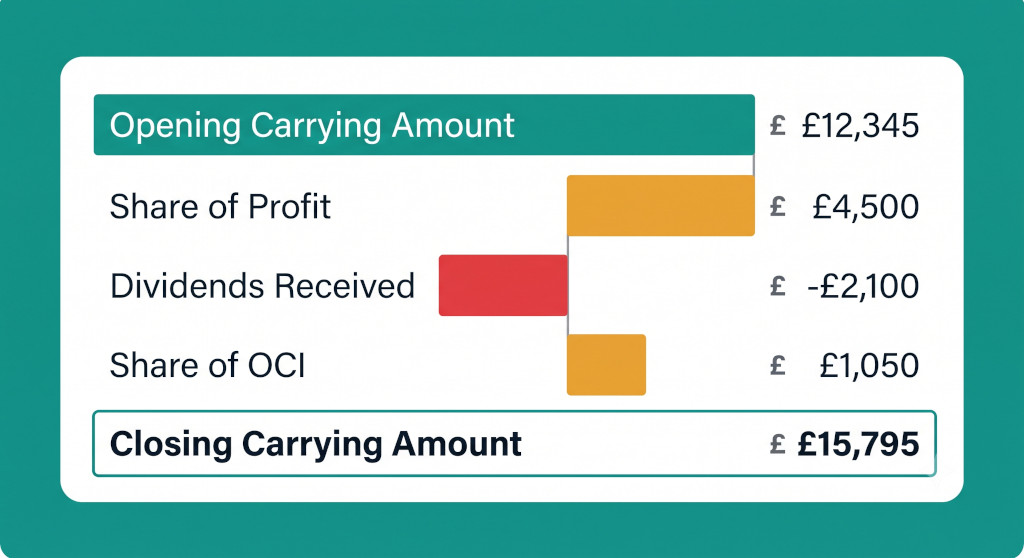
Worked Example: First Year of Equity Accounting
BrizoGroup acquires a 30% stake in PartnerCo for £1,800,000. At the acquisition date, the fair value of PartnerCo’s identifiable net assets is £5,000,000. BrizoGroup’s 30% share is therefore £1,500,000. The premium paid — the goodwill embedded in the associate — is £300,000 (£1,800,000 cost less £1,500,000 share of fair value of net assets).
During Year 1, PartnerCo reports profit after tax of £600,000, pays a dividend of £200,000, and has other comprehensive income of £50,000 (a revaluation surplus).
On acquisition:
Dr Investment in associate £1,800,000
Cr Cash £1,800,000
Initial recognition at cost under FRS 102 Section 14.6.
Year 1 — share of profit (30% × £600,000):
Dr Investment in associate £180,000
Cr Share of profit of associate (P&L) £180,000
Year 1 — dividend received (30% × £200,000):
Dr Cash £60,000
Cr Investment in associate £60,000
Year 1 — share of OCI (30% × £50,000):
Dr Investment in associate £15,000
Cr Other comprehensive income £15,000
Dividend reduces the carrying amount (it represents a return of capital, not income).
| Movement | £ |
|---|---|
| Opening carrying amount (cost) | 1,800,000 |
| Add: share of profit (30% × £600k) | 180,000 |
| Less: dividend received (30% × £200k) | (60,000) |
| Add: share of OCI (30% × £50k) | 15,000 |
| Closing carrying amount | 1,935,000 |
The £1,935,000 appears on BrizoGroup’s consolidated balance sheet as a single line under non-current assets: “Investment in associates.” The P&L includes £180,000 as “share of profit of associates” — no line items from PartnerCo’s own income statement appear in the consolidated accounts. The dividend receipt of £60,000 does not appear in the consolidated P&L because it is a return of capital already included in the carrying amount via the profit pick-up.
Equity method entries calculated automatically every period
BrizoConsol picks up each associate’s share of profit, OCI, and dividend, and rolls the carrying amount — connected to your source data so nothing is missed at close. See It in Action
Goodwill Within the Associate Carrying Amount
The £300,000 goodwill embedded in BrizoGroup’s investment in PartnerCo — the premium paid over the fair value of the investee’s identifiable net assets — is not recognised separately on the consolidated balance sheet. Under FRS 102 Section 14.9, the goodwill is subsumed within the carrying amount of the investment and is not separately amortised through the equity method.
This contrasts with the treatment of goodwill on a subsidiary, where FRS 102 Section 19 requires the goodwill to be separately capitalised and amortised over its useful economic life (maximum ten years if the useful life cannot be reliably estimated). For an associate, the goodwill element sits invisibly within the single-line carrying amount, unamortised, and is only ever separately considered in two contexts: impairment testing and disclosure.
For disclosure purposes, FRS 102 paragraph 14.12(b) requires the investor to disclose the carrying amount of investments in associates; paragraph 14.12(c) requires disclosure of the investor’s share of profit or loss. More detailed disclosure of the goodwill component is not explicitly required by FRS 102 (unlike IFRS, where IAS 28 requires more granular disclosure of the aggregate amounts for associates), though auditors often expect groups to be able to identify and document the goodwill element in their working papers.
Goodwill in associates is not amortised — but it is tested for impairment: Because the goodwill embedded in an associate’s carrying amount is not amortised, the total carrying amount of the associate will not mechanically reduce over time in the way that a subsidiary’s goodwill balance does. This means impairment testing is the only mechanism by which an overpaid acquisition premium is eventually written down. Finance teams should not assume that the equity method’s profit-and-loss pick-up will automatically erode an inflated carrying amount; if the associate’s recoverable amount falls below its carrying amount, an explicit impairment assessment under FRS 102 Section 27 is required.
Unrealised Profit Elimination
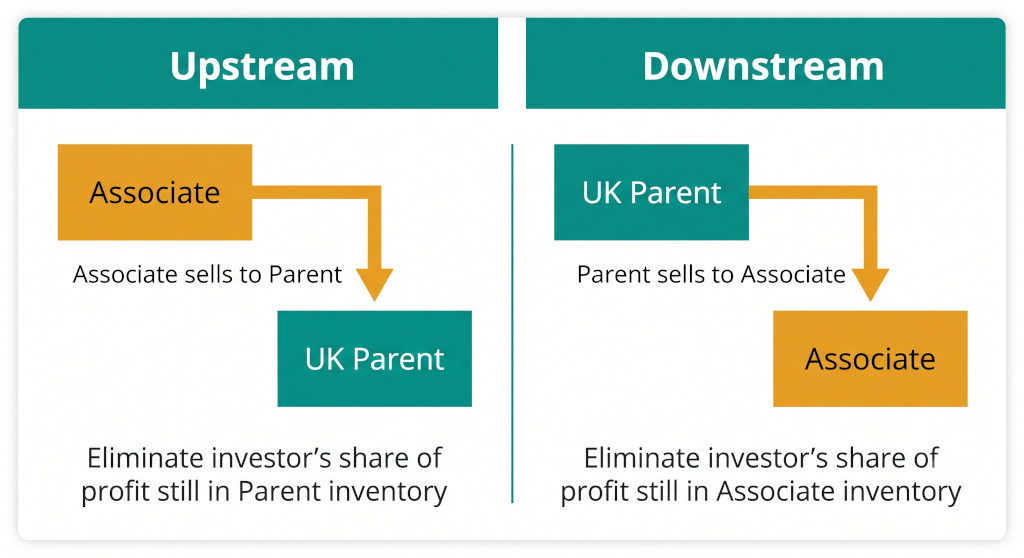
When an investor and its associate transact with each other — trading inventory, providing services, or transferring assets — a proportion of any profit on those transactions may remain unrealised in the consolidated accounts at the balance sheet date. FRS 102 paragraph 14.8 requires the investor to eliminate its proportionate share of such unrealised profits and losses.
Two directions of trade require consideration. In an upstream transaction, the associate sells goods or services to the investor. The profit on that sale sits in the associate’s books; from the investor’s perspective, it has increased its share of the associate’s net assets (via the equity method profit pick-up). If the goods are still held in the investor’s inventory at the balance sheet date, the upstream profit is unrealised at the group level — the group has effectively sold goods to itself. The investor eliminates its share of the unrealised profit by reducing both the carrying amount of the investment and the share of profit recognised in the period.
In a downstream transaction, the investor sells goods or services to the associate. The profit sits in the investor’s own books. If the goods remain in the associate’s inventory at year-end, the group has again recognised a profit on a transaction with an entity it partially owns. The investor eliminates its share of the unrealised profit by reducing consolidated revenue or cost of sales (depending on group accounting policy) and the share of profit of associates.
Worked Example: Downstream Unrealised Profit
BrizoGroup (30% investor in PartnerCo) sells inventory to PartnerCo at a mark-up generating a gross profit of £100,000. At BrizoGroup’s year-end, PartnerCo still holds inventory equivalent to £40,000 of that gross profit — 40% of the goods are unsold.
Unrealised profit in PartnerCo’s inventory: £40,000
BrizoGroup’s proportionate share (30%): £12,000
Eliminate from consolidated P&L and associate carrying amount: £12,000
Dr Share of profit of associates £12,000
Cr Investment in associates £12,000
Elimination of downstream unrealised profit — 30% of £40,000 still held in PartnerCo’s inventory at year-end. FRS 102 para 14.8.
The £12,000 is reinstated in the following year when PartnerCo sells the goods externally and the profit becomes realised. Upstream unrealised profit is treated symmetrically: the investor’s share of the profit in the associate’s books that has not yet flowed through to an external third-party sale is eliminated against the share of profit pick-up.
The proportionate elimination approach (investor’s share only, not 100%) is consistent with FRS 102 and IAS 28. It reflects the fact that the investor does not control the associate — the other shareholders’ proportionate share of the intra-group profit is not eliminated, because from their perspective the transaction with the investor is a genuine arm’s-length transaction. This differs from subsidiary intercompany eliminations, where 100% of unrealised profits are eliminated regardless of the NCI percentage.
Losses Exceeding the Carrying Amount
When an associate incurs losses, the investor’s share of those losses reduces the carrying amount of the investment. Once the carrying amount reaches nil, FRS 102 paragraph 14.8(c) requires the investor to discontinue recognising further losses — unless the investor has incurred legal or constructive obligations or has made payments on behalf of the associate.
This cap is important in practice. A group with a 30% stake in a loss-making associate cannot write that stake below zero in the consolidated balance sheet simply by continuing to pick up its share of losses. Once the carrying amount is nil, the equity method is suspended. If the associate subsequently returns to profit, the investor resumes the equity method only after its share of profits equals its unrecognised share of losses in the suspension period.
Where the investor does have obligations that exceed the carrying amount — for example, a guarantee of the associate’s borrowings or a legal obligation to fund the associate’s losses — those obligations are recognised separately as liabilities, not as negative carrying amounts of the investment.
Impairment of the Associate Investment
At each balance sheet date, the investor must assess whether there is any indication that the investment in the associate may be impaired. Indicators include sustained losses, deteriorating financial position of the associate, loss of key contracts, or significant adverse changes in the associate’s market. If indicators are present, FRS 102 Section 27 applies and the investor calculates the recoverable amount of the investment as a whole (not the goodwill component separately).
The recoverable amount is the higher of fair value less costs of disposal and value in use. If the recoverable amount is below the carrying amount, the difference is recognised as an impairment loss in the consolidated income statement under “share of profit of associates” or as a separate line depending on materiality and the group’s presentation policy.
Unlike subsidiary goodwill, impairment of the associate investment is reversible under FRS 102 if circumstances subsequently improve and the recoverable amount rises above the written-down carrying amount. The reversal is capped at the carrying amount that would have applied had no impairment been recognised. This is consistent with FRS 102 Section 27’s general reversibility of impairment losses for assets other than goodwill.
Joint Ventures Under FRS 102 Section 15
FRS 102 Section 15 covers joint ventures — arrangements where two or more parties have contractually agreed to share control over an economic activity, with decisions about the relevant activities requiring unanimous consent. FRS 102 distinguishes three types:
Jointly controlled operations involve the use of assets and other resources of the venturers without establishing a separate entity. Each venturer recognises in its own consolidated accounts its share of the assets it controls, the liabilities it incurs, the expenses it incurs, and the income from the sale of its share of the output. No separate entity-level financials need to be consolidated.
Jointly controlled assets involve joint ownership of assets contributed to or acquired for the purpose of the joint venture. Each venturer recognises its share of the jointly controlled assets, liabilities incurred in connection with its interest, expenses incurred and its share of jointly incurred expenses, and income from the sale of its share of the output.
Jointly controlled entities involve a separate entity being established, with each venturer having an interest in that entity. FRS 102 paragraph 15.14 requires the equity method to be applied to jointly controlled entities, consistent with the treatment of associates. However — and this is a notable difference from IFRS — FRS 102 paragraph 15.9 also permits the use of proportionate consolidation for jointly controlled entities as an alternative accounting policy. Under proportionate consolidation, the venturer includes its proportionate share of the jointly controlled entity’s assets, liabilities, revenues, and expenses line by line in the consolidated accounts rather than as a single equity-accounted line.
FRS 102 vs IAS 28: What Actually Differs
| Area | FRS 102 Sections 14 & 15 | IAS 28 / IFRS 11 (IFRS) |
|---|---|---|
| Associates — method | Equity method (required) | Equity method (required) |
| Significant influence threshold | 20% presumption — rebuttable | 20% presumption — rebuttable; identical |
| Joint ventures — method | Equity method (required); proportionate consolidation permitted as alternative for jointly controlled entities | Equity method only under IAS 28 / IFRS 11. Proportionate consolidation eliminated for joint ventures by IFRS 11 |
| Goodwill within carrying amount | Embedded in carrying amount; not separately amortised through equity method | Same — embedded; not separately amortised |
| Impairment testing | Indicator-based; test the whole carrying amount (FRS 102 Section 27) | Indicator-based; test the whole carrying amount (IAS 36) — same approach |
| Reversal of impairment | Permitted (Section 27) — capped at pre-impairment carrying amount | Permitted (IAS 36) — same cap; same treatment |
| Losses exceeding carrying amount | Suspend equity method at nil carrying amount; recognise obligations separately | Same (IAS 28 paragraph 38) |
| Individual entity accounts | Cost or fair value only — equity method not permitted in individual accounts | IAS 27 permits equity method in separate (individual) financial statements as an option |
| Unrealised profit elimination | Investor’s proportionate share eliminated | Same (IAS 28 paragraph 28) |
| Disclosure | Carrying amount and share of profit; summarised financial information not required unless material | More extensive: summarised financial information for material associates required; aggregate amounts for immaterial associates |
The most consequential practical difference is the treatment of joint ventures. IFRS 11 eliminated the proportionate consolidation option for joint ventures in 2013, requiring all jointly controlled entities to be equity-accounted under IFRS. FRS 102 retains the proportionate consolidation option. This means a UK group with IFRS-reporting peers may present a joint venture differently in its consolidated accounts — with the venturer’s share of each line item included in revenue, cost of sales, and so on under proportionate consolidation, rather than as a single equity pick-up line. Groups transitioning from FRS 102 to full IFRS adoption need to be aware that any jointly controlled entities currently proportionately consolidated will need to move to the equity method from the IFRS adoption date.
For the full FRS 102 consolidation framework within which associates and joint ventures sit, including the Section 9 subsidiary consolidation requirements, the small group exemption, and the intermediate parent exemption, see our FRS 102 consolidation guide. For the IFRS equivalents, our IFRS 10 guide covers subsidiary consolidation and our forthcoming IAS 28 guide will cover the IFRS equity method in detail.
Practical Checklist: Associates and Joint Ventures in the FRS 102 Close
- Confirm significant influence at each reporting date. Review all minority shareholdings above 10% for indicators of significant influence. Shareholding changes, board composition changes, and changes in commercial interdependency should all trigger a reassessment. Document the conclusion.
- Obtain the associate’s financial statements. The equity method requires the associate’s results for the same period as the investor. If the associate’s year-end differs by more than three months, the investor prepares additional financial statements for the relevant period. For associates with different year-ends within three months, adjustments are made for significant transactions between the two dates.
- Align accounting policies. If the associate uses accounting policies that differ materially from the investor’s FRS 102 policies, adjustments should be made to the associate’s results before picking up the investor’s share. In practice, this is often difficult for minority holdings; document where policy differences exist and whether they are material.
- Calculate and record the equity pick-up. Share of profit, share of OCI, and dividend receipt for the period. Update the carrying amount schedule.
- Identify and eliminate unrealised profits. Review all transactions between the investor and the associate during the period. Identify any inventory or other assets held at year-end that include profit on sales between the parties. Eliminate the investor’s proportionate share.
- Assess for impairment indicators. Review the associate’s trading performance, financial position, and market outlook. If indicators are present, calculate recoverable amount and compare to carrying amount. Document the assessment even where no impairment is recognised.
- Confirm the carrying amount is not below nil. If the associate has incurred losses, check that the carrying amount has not been reduced below nil without corresponding recognised obligations.
- Prepare the disclosure note. FRS 102 requires disclosure of the aggregate carrying amount and share of profit for associates. For material associates, consider whether additional summarised financial information is appropriate for a true and fair view.
BrizoConsol supports the equity method for associates and jointly controlled entities: the share of profit, OCI, and dividends are calculated automatically from the associate’s data each period, the carrying amount is maintained and rolled forward, and unrealised profit eliminations are flagged based on intercompany trading records. For the broader close process, our month-end close checklist covers where associate entries fit in the full consolidation sequence.
Equity method accounting — built into your consolidation
BrizoConsol calculates associate entries automatically each period and keeps carrying amounts current without a separate spreadsheet. Start free, no credit card required. Start Free Trial