Recycling the CTA on Disposal of a Foreign Subsidiary: What Happens to the FCTR When You Sell
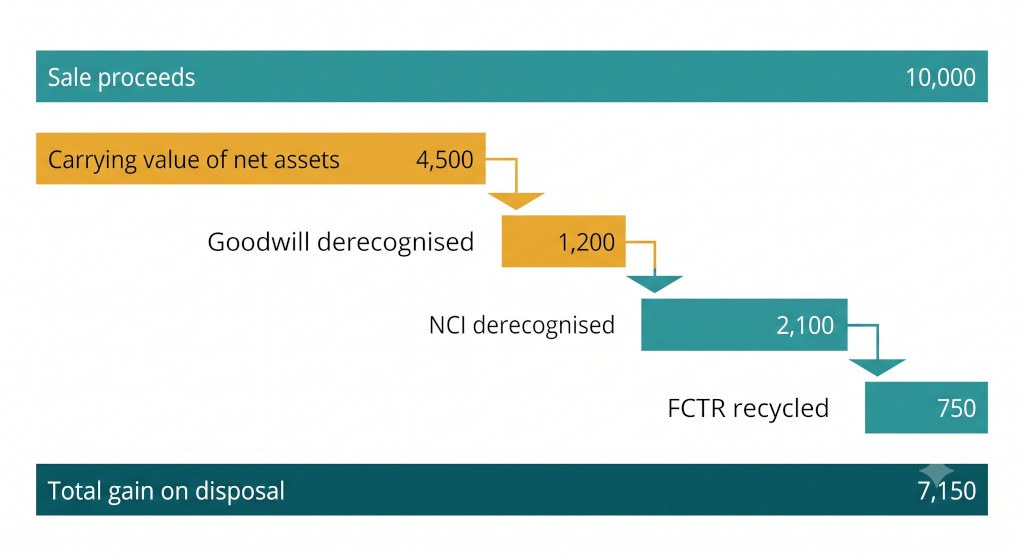
The finance director had been preparing the sale of the Singapore subsidiary for six months. She knew the headline figures: sale proceeds of SGD 12 million, carrying value of net assets around SGD 8 million, goodwill of SGD 1.2 million. She had modelled the gain at roughly GBP 2.1 million and presented it to the board as part of the disposal rationale.
What she hadn’t modelled — what nobody had mentioned during the entire process — was the Foreign Currency Translation Reserve. Over four years of ownership, the FCTR attributable to the Singapore subsidiary had accumulated to GBP 620,000. On disposal, all of it was required to be reclassified from equity to profit or loss. Not as a separate line. As part of the gain on disposal. The reported gain was GBP 2.7 million, not GBP 2.1 million — materially different from what the board had been told to expect.
This is not an unusual story. The currency translation adjustment accumulates quietly in equity for years, attracting little attention at each reporting date. But when the subsidiary is sold, IAS 21 requires the entire accumulated reserve to be reclassified — recycled — to profit or loss as part of the gain or loss on disposal. For groups that have held foreign subsidiaries through a period of significant exchange rate movement, the FCTR can be the largest single component of the disposal result.
Foreign currency consolidation, handled automatically.
BrizoConsol applies the correct CTA/FCTR treatment across all entities — no spreadsheets needed.
What Recycling Means and Why It Happens
During the life of a foreign subsidiary, the currency translation adjustment is recognised in other comprehensive income (OCI) and accumulates in the FCTR within equity. Under IAS 1, items of OCI fall into two categories: those that will subsequently be reclassified to profit or loss when specific conditions are met (sometimes called “recycling” items), and those that will not.
The FCTR is a recycling item. IAS 21.48 states that when a group disposes of a foreign operation, the cumulative amount of exchange differences deferred in the FCTR and attributable to that foreign operation must be reclassified from equity to profit or loss when the gain or loss on disposal is recognised. The logic is straightforward: the FCTR represents a genuine economic gain or loss on the net investment in the foreign subsidiary. While you hold the subsidiary, that gain or loss is unrealised — you haven’t converted it back to your presentation currency. When you sell, the transaction is realised. The FCTR is therefore transferred to the income statement to be included in the total gain or loss on disposal.
This is not optional. It is not a choice of accounting policy. If the FCTR is positive (a cumulative translation gain) and the subsidiary is disposed of, that gain flows through to profit. If the FCTR is negative (a cumulative translation loss), it increases the loss on disposal. The P&L effect depends entirely on what exchange rates have done over the holding period — and it can be material.
What Gets Recycled and What Doesn’t
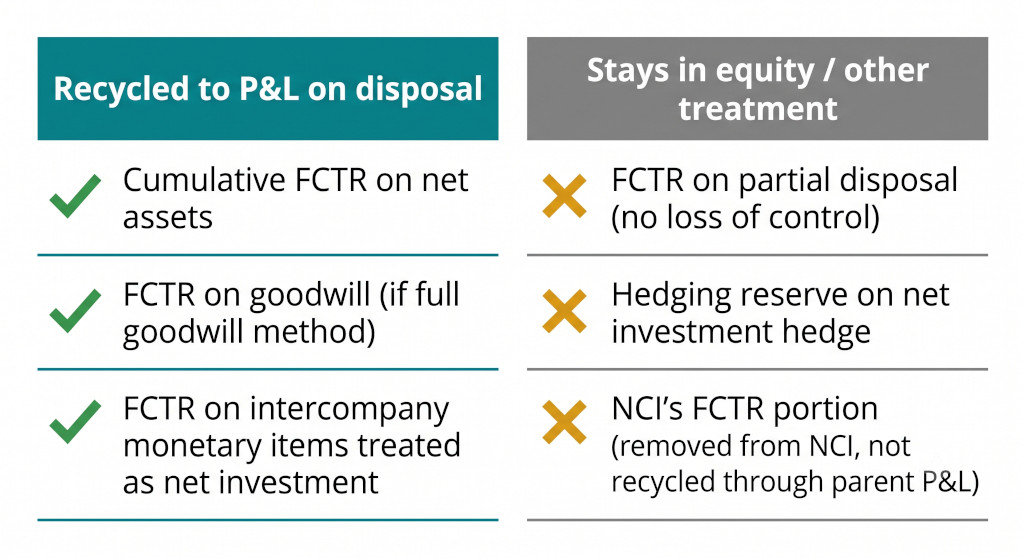
IAS 21 is precise about which items are recycled on disposal of a foreign operation. Understanding the full scope prevents errors in both directions — understating the gain by forgetting to recycle, or overstating it by recycling items that should remain in equity.
Recycled to profit or loss
- Cumulative FCTR on net assets: The full amount of exchange differences accumulated in the FCTR and attributable to the subsidiary being disposed of. This is the main component.
- FCTR on goodwill (if using the full goodwill method): Where goodwill was attributed to the foreign operation and measured in its functional currency, the translation differences on that goodwill are also recycled.
- FCTR on intercompany monetary items forming part of the net investment: Under IAS 21.32, exchange differences on long-term intercompany loans where settlement is neither planned nor likely in the foreseeable future are recognised in OCI and form part of the FCTR. These are recycled on disposal of the foreign operation.
Not recycled — stays in equity or has different treatment
- Partial disposal without loss of control: If the group sells part of its interest in a subsidiary but retains control, this is an equity transaction under IFRS 10. No gain or loss is recognised in profit or loss and the FCTR is not recycled — it is reallocated proportionately between the group’s FCTR and NCI.
- Net investment hedge: Gains and losses on instruments designated as hedges of the net investment in a foreign operation are also accumulated in OCI. These are recycled separately under IFRS 9 hedge accounting rules and should not be commingled with the IAS 21 FCTR recycling.
- NCI’s portion of the FCTR: The NCI’s share of the FCTR (discussed further below) is removed from NCI on disposal but is not reclassified through the parent’s profit or loss — it is simply derecognised as the NCI line is eliminated.
The FCTR recycled to profit or loss on disposal is the cumulative amount attributable to the foreign operation being sold — not just the movement for the current year. Years of accumulated translation differences, potentially in either direction, collapse into the disposal result in a single period.
Treatment of the NCI’s Share of the FCTR
If the subsidiary being disposed of had a non-controlling interest, the FCTR will have been allocated between the parent’s shareholders and the NCI at each reporting date. On disposal of the entire subsidiary, the NCI is derecognised in full — including the NCI’s accumulated share of the FCTR.
The parent’s share of the FCTR is recycled to profit or loss. The NCI’s share is removed from the NCI line in equity and taken to the gain or loss on disposal calculation as a deduction from the consideration received. It does not pass through the parent’s profit or loss as a recycled FCTR item — it passes through as a component of the NCI balance derecognised. The net effect on the disposal calculation is the same, but the presentation differs: the parent’s FCTR recycling appears as a separate line in OCI reclassified to P&L, while the NCI derecognition is included in the gain on disposal calculation itself.
If the FCTR was never correctly split between parent and NCI during the holding period — a common error covered in the post on splitting the CTA in partly-owned foreign subsidiaries — the disposal calculation will be incorrect. Either too much will be recycled through the parent’s P&L, or the NCI derecognition will use the wrong balance.
Worked Example: Disposal of a Wholly-Owned Foreign Subsidiary
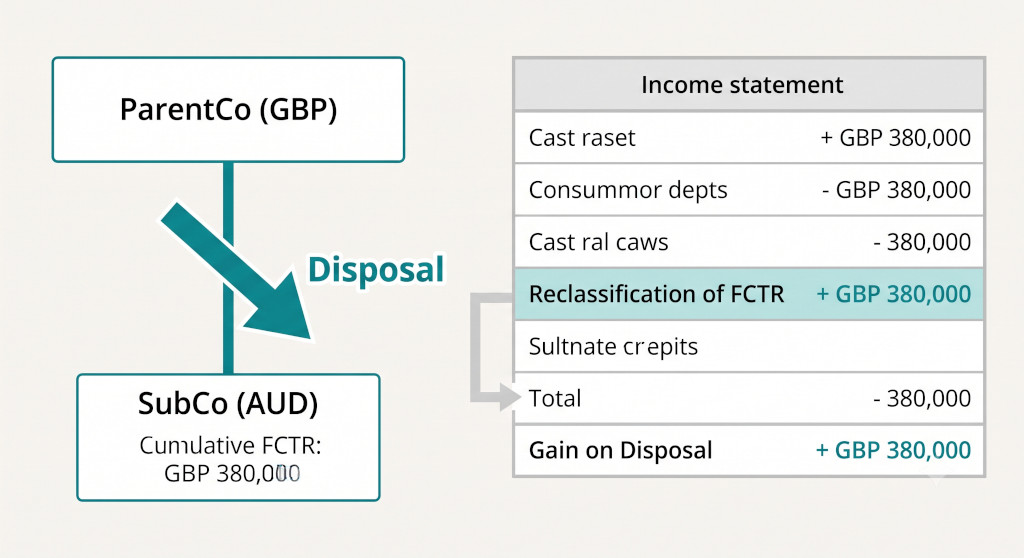
The scenario: ParentCo (UK, GBP presentation currency) sells its 100% owned subsidiary SubCo (Australia, AUD functional currency) on 30 June. At disposal, the relevant figures are:
| Item | GBP | Notes |
|---|---|---|
| Sale proceeds received | 2,800,000 | Cash received from buyer |
| Net assets of SubCo at disposal (translated at closing rate) | (1,950,000) | Derecognised from consolidated balance sheet |
| Goodwill attributable to SubCo | (320,000) | Derecognised; carrying value at disposal date |
| Gain before FCTR recycling | 530,000 | |
| Cumulative FCTR attributable to SubCo (reclassified from equity) | 380,000 | Recycled per IAS 21.48; was positive (AUD strengthened) |
| Total gain on disposal recognised in profit or loss | 910,000 |
The journal entry to record the disposal and the FCTR recycling:
DR Cash / Receivable 2,800,000
DR Foreign Currency Translation Reserve 380,000
CR Net assets of SubCo 1,950,000
CR Goodwill — SubCo 320,000
CR Gain on disposal of foreign subsidiary 910,000
Disposal of SubCo — net assets and goodwill derecognised; FCTR reclassified from equity to profit or loss per IAS 21.48
After this entry, the FCTR balance attributable to SubCo is nil. The GBP 380,000 that sat in equity for four years of accumulation has now passed through the income statement as part of the disposal gain. The consolidated balance sheet is clean; the consolidated income statement reflects the full economic result of the disposal including the currency dimension.
Worked Example: Disposal of a Partly-Owned Foreign Subsidiary
Now assume ParentCo owns only 75% of SubCo, with a 25% NCI. The FCTR was correctly allocated between parent and NCI throughout the holding period. At disposal:
| Item | GBP | Notes |
|---|---|---|
| Sale proceeds received | 2,800,000 | Full consideration for 100% of SubCo |
| Net assets at disposal (translated at closing rate) | (1,950,000) | Derecognised in full |
| Goodwill | (320,000) | Derecognised in full (proportionate method — no NCI goodwill) |
| NCI derecognised | 487,500 | NCI’s 25% share of net assets at disposal: GBP 1,950,000 × 25% |
| Gain before FCTR recycling | 1,017,500 | |
| Parent’s share of FCTR recycled (75%) | 285,000 | GBP 380,000 × 75% — reclassified from parent’s FCTR to P&L |
| Total gain on disposal (parent’s share) | 1,302,500 |
The NCI’s share of the FCTR (GBP 95,000 = GBP 380,000 × 25%) is removed from the NCI balance as part of the derecognition of NCI — not recycled through the parent’s P&L. The journal entry is:
DR Cash / Receivable 2,800,000
DR Foreign Currency Translation Reserve (parent) 285,000
DR Non-Controlling Interest 582,500
CR Net assets of SubCo 1,950,000
CR Goodwill — SubCo 320,000
CR Gain on disposal of foreign subsidiary 1,397,500
NCI derecognised = GBP 487,500 (net assets) + GBP 95,000 (NCI share of FCTR) = GBP 582,500. Parent FCTR of GBP 285,000 reclassified to P&L per IAS 21.48.
Watch out: If the FCTR was never split between parent and NCI during the holding period, the full GBP 380,000 will sit in the parent’s FCTR at disposal date. Recycling the full amount overstates the parent’s gain — GBP 95,000 of NCI’s FCTR should be removed from NCI, not recycled through the parent’s income statement.
Partial Disposals: Loss of Control vs No Loss of Control
The recycling rules apply in full when the parent disposes of enough of its interest to lose control of the subsidiary — i.e., a disposal that triggers deconsolidation. Where the parent sells part of its stake but retains control, different rules apply.
Disposal with loss of control
When control is lost, the entire subsidiary is deconsolidated. All assets, liabilities, goodwill, and the NCI are removed from the consolidated balance sheet. The cumulative FCTR attributable to the foreign operation is recycled in full. If the parent retains a residual interest (say, it sells 60% of a wholly-owned subsidiary and retains 40%), that residual interest is remeasured to fair value at the date control is lost, and the remeasurement gain or loss is included in the total gain on disposal recognised in profit or loss.
Partial disposal without loss of control
When the parent sells part of its interest but remains in control (say, it sells 20% of a 75% stake and retains 55%), this is an equity transaction under IFRS 10. No gain or loss is recognised in profit or loss, and the FCTR is not recycled. Instead, it is reallocated: the proportion of the FCTR that now belongs to the enlarged NCI is reclassified within equity from the parent’s FCTR to NCI. The total FCTR balance is unchanged; only the split between parent and NCI changes.
The distinction between losing control and retaining control is the single most important factor in determining whether the FCTR is recycled. Groups planning partial disposals should map the exact ownership percentages before and after transaction to confirm which accounting treatment applies — and model the P&L impact accordingly.
Track Your FCTR Accurately Before a Disposal
BrizoConsol automatically calculates and allocates the FCTR for each foreign subsidiary in your group — so when a disposal occurs, you know exactly what will be recycled. No reconstruction, no guesswork.Start Free Trial
Negative FCTR: When Recycling Increases the Loss
Everything above assumed a positive FCTR — a cumulative translation gain, typically arising when the subsidiary’s functional currency has strengthened against the parent’s presentation currency over the holding period. But the FCTR can equally be negative, and when it is, the recycling on disposal increases the loss rather than the gain.
Suppose ParentCo had held its Australian subsidiary through a period when AUD weakened significantly against GBP. Over six years, the FCTR has accumulated to negative GBP 290,000 — a cumulative translation loss. The subsidiary’s net assets have grown in AUD terms, but that growth has been partially offset when translated into GBP. On disposal, that negative FCTR of GBP 290,000 is reclassified from equity to profit or loss, reducing the gain (or adding to the loss) on disposal.
Groups that have held foreign subsidiaries through prolonged currency weakness should model the FCTR recycling impact carefully before completing a disposal — particularly where the disposal price is close to the carrying value of net assets, because a large negative FCTR could turn a modest gain into a loss.
Where Finance Teams Get This Wrong
Not recycling the FCTR at all
The most common error, particularly in groups where the FCTR is held in equity and rarely discussed. The disposal is recorded by derecognising net assets and goodwill against the sale proceeds, and the gain is struck without any reference to the FCTR. The FCTR balance continues to sit in equity even though the subsidiary it relates to no longer exists — a ghost balance with no associated asset. Auditors will catch this, but by the time it surfaces, restating the disposal result can have tax and disclosure consequences.
Recycling only the current-year CTA movement
A team correctly understands that the CTA must be recycled but takes only the movement for the disposal year rather than the cumulative balance. If the subsidiary has been held for four years and the annual CTA movements were GBP 50,000, GBP 120,000, GBP 90,000, and GBP 30,000, only GBP 290,000 should be recycled — not just GBP 30,000. The cumulative total is what IAS 21.48 requires.
Recycling the NCI’s portion through parent P&L
Where a subsidiary has an NCI and the FCTR has been correctly split, the NCI’s portion should be derecognised as part of the NCI balance — not recycled through the parent’s income statement. Teams that have tracked the FCTR as a single figure (not split) and then recycle the full amount overstate the parent’s gain and leave the NCI balance in error.
Ignoring FCTR on intercompany loans
IAS 21.32 requires exchange differences on long-term intercompany monetary items that form part of the net investment to be accumulated in OCI alongside the FCTR. These items are also recycled on disposal. Groups with significant intercompany funding structures — particularly where the parent has provided long-term loans to the foreign subsidiary — should ensure these are included in the FCTR recycling calculation, not just the net assets CTA.
How BrizoConsol Supports Disposal Accounting
BrizoConsol tracks the cumulative FCTR for each foreign subsidiary throughout the holding period, allocating it correctly between parent shareholders and NCI at each reporting date. When a disposal occurs, the platform provides the FCTR balance attributable to the subsidiary — the exact figure needed for the IAS 21.48 recycling calculation.
Because the FCTR has been built up accurately from period-by-period CTA calculations — rather than estimated or approximated — the disposal journal can be prepared with confidence. There is no need to reconstruct several years of historical FCTR movements from scratch, which is the alternative finance teams face when the FCTR has not been tracked systematically.
For groups with partly-owned foreign subsidiaries, the parent’s share and the NCI’s share of the FCTR are maintained separately, so the disposal accounting distinguishes correctly between the amount recycled through profit or loss and the amount removed from the NCI balance.
Summary
When a foreign subsidiary is disposed of and control is lost, IAS 21.48 requires the cumulative FCTR attributable to that foreign operation to be reclassified from equity to profit or loss as part of the gain or loss on disposal. This is not optional — it is a mandatory reclassification that can materially affect the reported result of a disposal.
The practical steps at disposal:
- Identify the cumulative FCTR attributable to the subsidiary being sold — the total balance accumulated since acquisition, not just the current-year movement
- If there is an NCI, confirm how the FCTR has been split between parent and NCI throughout the holding period
- Recycle the parent’s share of the FCTR to profit or loss as part of the disposal gain or loss
- Derecognise the NCI’s share of the FCTR as part of the NCI balance removed on disposal — not through the parent’s P&L
- Check whether any FCTR on intercompany loans treated as net investment also needs to be recycled
- Confirm whether the transaction results in loss of control — if not, no recycling occurs; only an equity reallocation between parent FCTR and NCI
The FCTR recycling impact should be modelled before a disposal completes — not discovered during the preparation of the disposal accounts. Groups that have tracked their FCTR accurately throughout the holding period, including the correct split between parent and NCI, are in a position to do this. Those that haven’t face a reconstruction exercise at exactly the moment they can least afford one.
Know Your FCTR Before the Disposal Closes
BrizoConsol maintains an accurate, period-by-period FCTR for every foreign subsidiary in your group. When a disposal occurs, the recycling figure is already there — correctly split between parent and NCI, ready to go into the disposal accounts. Start Free Trial