MYOB Business Plans for Multi-Entity Groups: Which Plan Do You Actually Need?
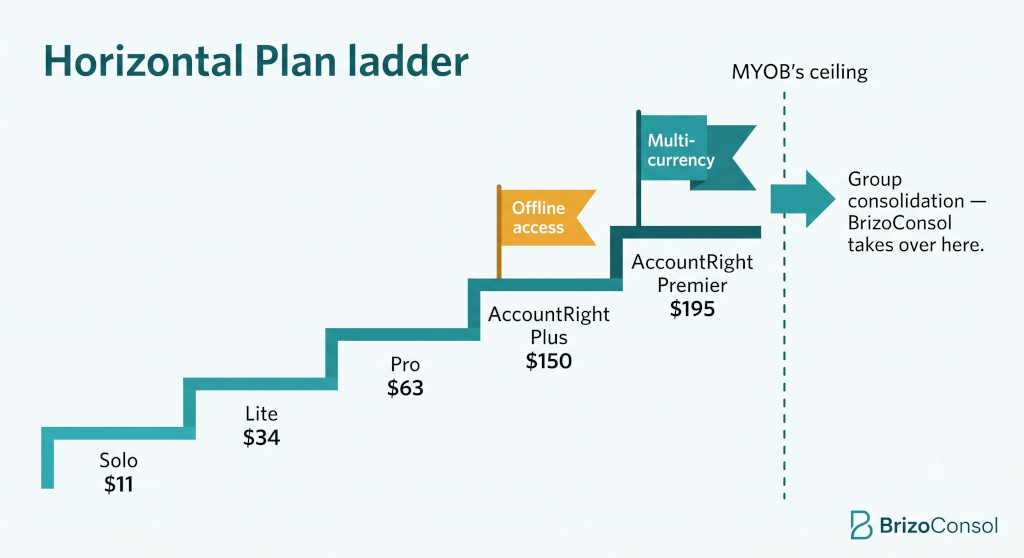
The CFO of a Brisbane-based holding group called us after spending two hours trying to understand why their MYOB subscription couldn’t produce a consolidated profit and loss for the group. They were on MYOB Business AccountRight Plus — the second-highest tier — and had assumed it would cover everything they needed. It didn’t. Not because they’d chosen the wrong plan, but because consolidated group accounts are not something any MYOB Business plan produces, regardless of which tier you’re on.
Before getting to that ceiling, though, there is a genuine plan-selection question for multi-entity MYOB groups. MYOB has retired the standalone Essentials and AccountRight products and consolidated its offering into a single platform — MYOB Business — with five plan tiers. For groups with foreign subsidiaries, groups needing offline access, and groups managing multiple companies, the choice of plan matters. Getting it wrong means either paying for features you don’t use or missing capabilities that your group actually requires.
This guide covers what happened to the old MYOB product lineup, what each current MYOB Business plan includes, which plan multi-entity groups actually need, and what happens when MYOB reaches its limit.
Consolidate your MYOB entities in minutes.
BrizoConsol connects to MYOB and automates your group financial statements.
What Happened to MYOB Essentials and MYOB AccountRight
For years, MYOB operated two separate products in parallel: MYOB Essentials, a simpler cloud-based tool for small businesses, and MYOB AccountRight, a more capable platform with both desktop and online access for more complex operations. Both have now been retired for new customers.
MYOB merged both products into a single platform called MYOB Business. The AccountRight name survives, but only as the branding for the two highest plan tiers within MYOB Business — AccountRight Plus and AccountRight Premier. They are not a separate product; they are the upper end of the same subscription ladder.
If you are an existing Essentials or AccountRight customer, your subscription continues to work as it always has. You are not forced to migrate immediately. But if you add a new entity to your group, that entity needs to go on MYOB Business. And if your group ever needs to move up in capability — more users, multi-currency, offline access — the upgrade path now runs through MYOB Business plan tiers.
The product naming creates real confusion: “MYOB AccountRight Plus” and “MYOB AccountRight Premier” sound like separate products, but they are plan tiers within MYOB Business. You cannot buy “AccountRight” in isolation any more. Everything is MYOB Business, and the plan you select determines what you get.
The Five MYOB Business Plans: What Each Includes
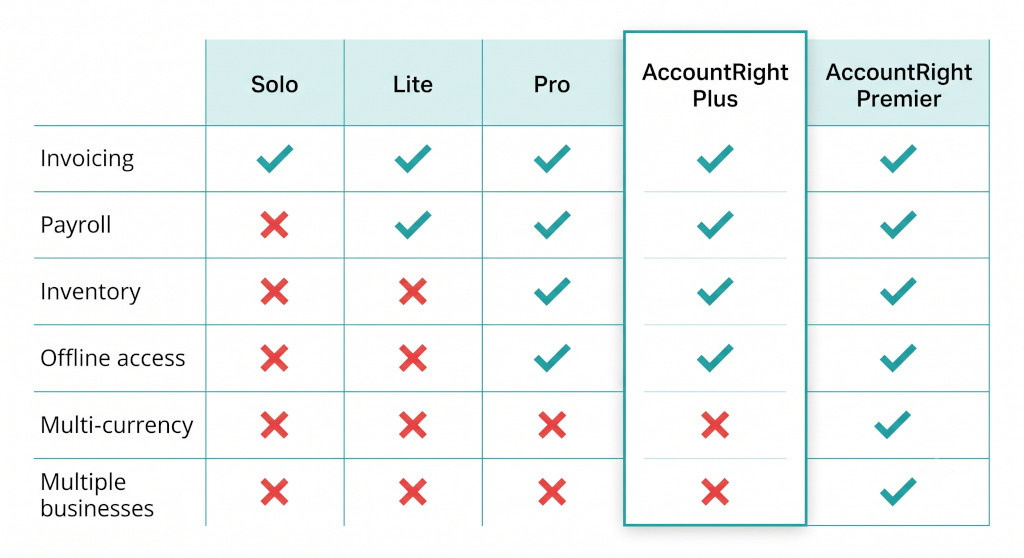
Solo by MYOB
~$11/mo
InvoicingExpense trackingNo payrollNo bank reconciliation
Mobile-only app for sole traders. Single user, no employees, no multi-entity capability. Not relevant for any group context.
MYOB Business Lite
~$34/mo per entity
InvoicingBank reconciliationGSTNo payrollNo multi-currency
Entry-level cloud plan for single entities with no employees and no foreign currency transactions. Sufficient for a dormant holding company or a domestic SPV with no staff. Not suitable for any operating entity with employees or overseas dealings.
MYOB Business Pro
~$63/mo per entity
Full payroll (STP 2)InventoryTime billingNo multi-currencyCloud only
The standard cloud plan for operating entities with employees, inventory, and domestic-only revenue. Suitable for Australian or New Zealand entities that invoice only in local currency. If any entity raises foreign currency invoices or pays overseas suppliers in their local currency, Pro is insufficient — you need AccountRight Premier.
MYOB Business AccountRight Plus
~$150/mo per entity
Offline/desktop accessAdvanced inventoryBudgetingNo multi-currency
The desktop-and-cloud plan for entities that need offline access or advanced features not available in the cloud-only tiers. Suitable for entities with complex inventory, manufacturing, or operations in areas with unreliable internet. Note: despite being the second-highest plan, AccountRight Plus does not include multi-currency. If your entity transacts in foreign currencies, you need Premier.
MYOB Business AccountRight Premier
~$195/mo per entity
Multi-currencyOffline/desktop accessMultiple businesses on one accountAdvanced reporting
The top-tier plan, and the only one that supports multi-currency transactions. If your entity has foreign subsidiaries, pays overseas suppliers in their local currency, or raises invoices in AUD to overseas clients who pay in foreign currency, Premier is the minimum viable plan. Also allows multiple businesses to be managed under one MYOB subscription, which can reduce cost for groups with several entities — though this is not the same as consolidation.
What “Multiple Businesses” in AccountRight Premier Actually Means
AccountRight Premier’s ability to manage multiple businesses on one subscription is useful for cost management — you can add additional company files under one account rather than subscribing separately for each entity. Some groups use this to keep all their MYOB company files accessible from a single login and a single subscription fee.
What it does not mean is that MYOB has consolidated those businesses. Each company file remains entirely separate. You cannot run a report that shows combined revenue across all entities in your group, cannot see consolidated assets and liabilities, and cannot identify or eliminate intercompany transactions. Premier simply makes it cheaper to maintain multiple separate MYOB files — it does not make them into a group.
This is the most common misconception we encounter with MYOB Premier users. A group CFO who sees “multiple businesses” in the Premier plan description often assumes it means group reporting is included. It is not. Each company file in Premier is exactly as isolated as it would be on separate subscriptions — the only difference is the subscription cost. Group consolidated accounts require a tool outside MYOB, regardless of which plan you are on.
Which Plan Does Your Multi-Entity Group Actually Need?
The right plan depends on what each individual entity does, not what the group does as a whole. MYOB is an entity-level accounting system — you select a plan for each company file based on that company’s requirements.
| Entity type | Recommended plan | Key reason |
|---|---|---|
| Dormant holding company (no trading, no staff) | Lite (~$34/mo) | Basic bookkeeping only — no payroll, no multi-currency needed |
| Domestic operating entity with employees, AUD only | Pro (~$63/mo) | Full payroll and accounting; no foreign currency requirement |
| Entity with complex inventory, offline access required | AccountRight Plus (~$150/mo) | Desktop access and advanced inventory; if no foreign currency |
| Any entity with foreign currency transactions | AccountRight Premier (~$195/mo) | Only plan with multi-currency support |
| Group wanting multiple files under one subscription | AccountRight Premier (~$195/mo) | “Multiple businesses” feature is Premier-only |
For a typical three-entity group — a UK holding company, an Australian operating subsidiary, and a New Zealand subsidiary — the most common setup is: Lite or Pro for the holding company (if it is dormant or has limited activity), and AccountRight Premier for each subsidiary that transacts in foreign currencies or needs offline access. The monthly cost for all three entities combined is likely to be in the range of AUD 350–450 per month before any discounts.
The Multi-Currency Reality: What AccountRight Premier Gives You
Multi-currency in MYOB AccountRight Premier means the entity can record transactions in foreign currencies — raise invoices to overseas clients in their local currency, pay overseas suppliers in USD or EUR, and track the resulting foreign exchange gains and losses in that entity’s accounts.
What it does not do is anything at the group level. If your group has an Australian holding company (AUD) and a UK subsidiary (GBP), each runs its own MYOB company file in its own currency. The UK subsidiary’s accounts are in GBP. To prepare consolidated group accounts in AUD, someone needs to:
- Export the UK subsidiary’s GBP figures
- Apply the correct exchange rates (closing rate for balance sheet items, average rate for income statement items) to translate to AUD
- Compute the Currency Translation Adjustment and post it to the foreign currency translation reserve
- Combine the translated subsidiary figures with the holding company’s AUD figures
- Identify and eliminate all intercompany transactions between the two entities
- Produce a consolidated income statement, balance sheet, and cash flow statement
None of these steps happen inside MYOB. Premier gives each entity the ability to record in its own currency. The translation and consolidation are a separate exercise.
The MYOB Ceiling: What No Plan Can Do
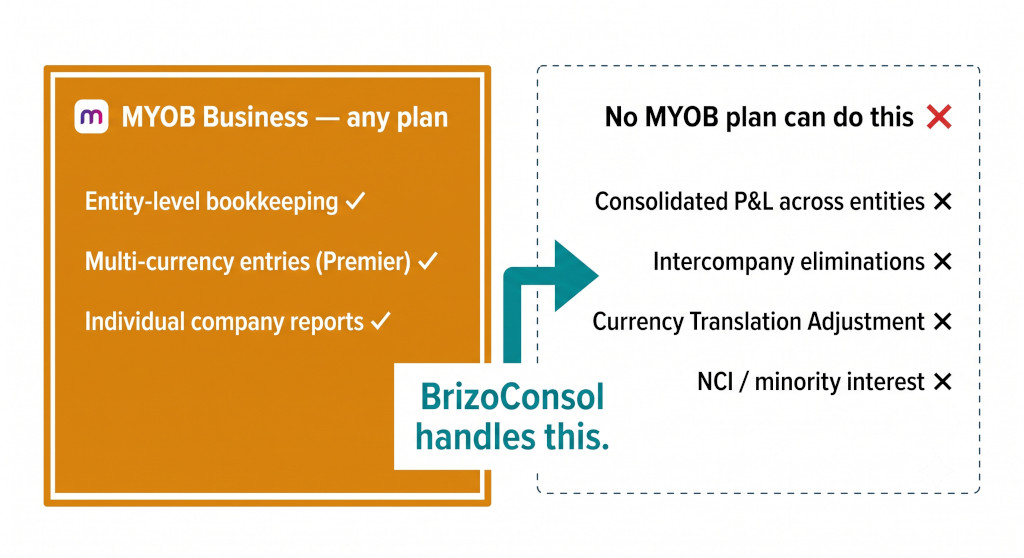
No MYOB Business plan — at any tier — can produce:
- A consolidated income statement across multiple MYOB company files
- A consolidated balance sheet showing group net assets after intercompany eliminations
- Automatic elimination of intercompany transactions (sales, loans, management fees)
- Currency Translation Adjustment (CTA / FCTR) for foreign subsidiaries
- Non-controlling interest (NCI / minority interest) calculation and presentation
- A consolidated cash flow statement
- Group reporting where some entities use Xero, QuickBooks, or other systems
This is not a limitation of any particular plan — it is a structural reality of MYOB’s design. MYOB is an entity-level bookkeeping and accounting system. It is very good at what it does: recording transactions, managing payroll, tracking inventory, and producing financial statements for a single legal entity. Group consolidation is a fundamentally different function that requires data from multiple entities to be combined, translated, and adjusted — and that is not what MYOB was built to do.
Groups that try to bridge this gap with spreadsheets consistently report the same pain points: extracting data from each MYOB file takes time, exchange rate lookups are manual, intercompany reconciliations are built from scratch each quarter, and the final consolidated accounts are difficult to audit. A spreadsheet that took four hours to build in the first quarter typically takes two hours by the fourth — but it still takes two hours, every quarter, with no audit trail and significant key-person risk.
The question is not which MYOB plan to choose for consolidation. No plan offers consolidation. The question is which MYOB plan each entity needs for its own bookkeeping, and what tool sits alongside MYOB to produce group accounts.
BrizoConsol Alongside MYOB: How It Works
BrizoConsol connects to MYOB Business — both the AccountRight tiers and the cloud plans — via OAuth. It pulls each entity’s chart of accounts and general ledger data on a nightly basis, applies intercompany eliminations and currency translation automatically, and produces consolidated financial statements for the group as a whole.
For groups with mixed software — a holding company on MYOB and subsidiaries on Xero, QuickBooks, or Zoho Books — BrizoConsol connects to each platform simultaneously. The group accounts draw on data from all connected sources, regardless of which accounting system each entity uses. The consolidation applies the correct translation rates, computes the CTA, allocates minority interest where subsidiaries are partly owned, and produces a single set of consolidated accounts that meets the requirements of your auditors, your board, and your bank.
The MYOB company files remain unchanged. BrizoConsol reads from MYOB; it does not write back to it. Each entity continues to maintain its own books in MYOB exactly as before — the only difference is that the group now has a clean consolidated view alongside the entity accounts.
A Practical Decision Framework
For a multi-entity group using MYOB, the decisions flow in a specific order:
- For each entity, determine the right MYOB Business plan based on that entity’s specific needs: does it have employees (needs Pro or above)? Does it transact in foreign currencies (needs Premier)? Does it require offline or desktop access (needs Plus or Premier)?
- If multiple entities need foreign currency support, Premier for each such entity is the minimum. The “multiple businesses” feature in Premier can reduce cost if two or more entities are on the same subscription.
- For group consolidated accounts, select a consolidation tool that connects to MYOB — BrizoConsol integrates with MYOB Business and AccountRight via API and handles the consolidation mechanics that MYOB cannot.
- If the group has entities on different accounting systems (Xero, QuickBooks, Zoho Books), confirm that the consolidation tool connects to all of them. BrizoConsol does.
There is no scenario in which a higher MYOB plan replaces the need for a consolidation tool. The two serve different functions: MYOB handles the entity-level bookkeeping; a consolidation tool handles the group-level reporting. Both are required for a group that needs proper consolidated accounts.
MYOB Handles Your Books. BrizoConsol Produces Your Group Accounts.
Connect your MYOB entities — plus any Xero, QuickBooks, or Zoho Books entities — and get a consolidated P&L, balance sheet, and cash flow statement for your whole group. Intercompany eliminations, CTA, and NCI handled automatically. Start Free Trial