Deferred Tax in Group Consolidation: How Consolidation Adjustments Create Tax Differences
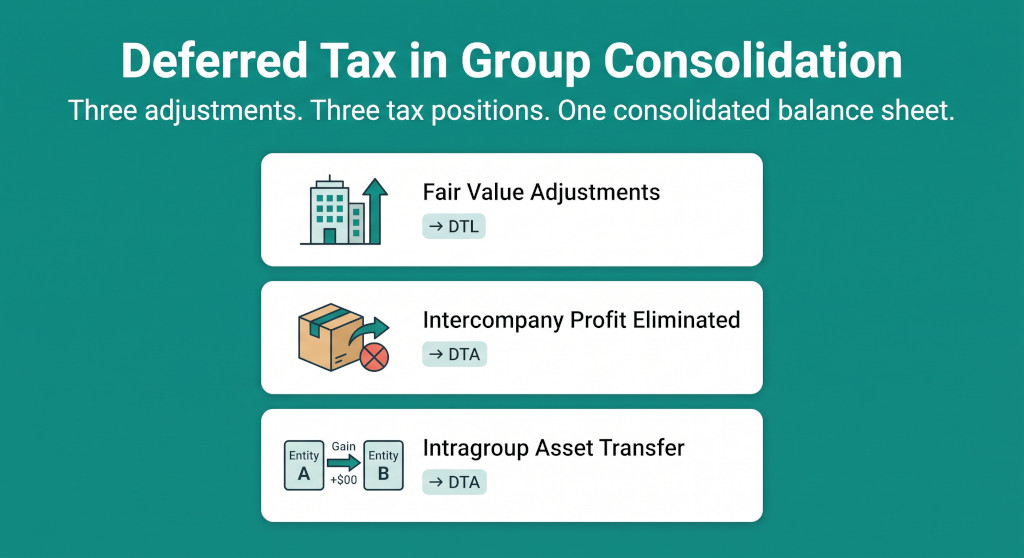
The consolidated deferred tax position is not the sum of the entities’ individual deferred tax balances. Group consolidation introduces adjustments — fair value uplifts at acquisition, elimination of unrealised intercompany profits, intragroup asset transfers — that create temporary differences in the consolidated accounts that do not exist in any entity’s individual financial statements. These group-level temporary differences require their own deferred tax calculations, posted as consolidation journals, and maintained each period as the underlying adjustments unwind.
Most finance teams apply deferred tax to temporary differences identified within individual entities. Far fewer apply it correctly to the adjustments they are making in the consolidation workbook. The result is a consolidated tax charge and deferred tax balance that is technically wrong — not because the entities’ numbers are wrong, but because the consolidation adjustments have created new temporary differences that are being ignored.
This guide covers the three main sources of consolidation-level deferred tax — fair value adjustments at acquisition, unrealised intercompany profit eliminations, and intragroup asset transfers — with a worked example and consolidation journal for each. It also addresses the special treatment of goodwill and the practical question of where these deferred tax entries sit in the consolidation workbook.
Stop building consolidations in spreadsheets.
BrizoConsol automates multi-entity consolidation — setup in minutes, reports the same day.
The principles apply under IAS 12 (IFRS groups) and FRS 102 Section 29 (UK GAAP groups). Where the two frameworks differ materially, the difference is noted.
Why Consolidation Adjustments Create Deferred Tax
A deferred tax asset or liability arises whenever the carrying amount of an asset or liability in the financial statements differs from its tax base — the amount attributed to that asset or liability for tax purposes. This difference is a temporary difference: it will reverse in future periods as the asset is used, sold, or the liability settled.
Consolidation adjustments create temporary differences because they change the carrying amount of assets and liabilities in the consolidated financial statements without changing the tax base. Tax is assessed on individual entities, not on the group. The tax base of any asset is therefore always determined by what the entity holding that asset can deduct for tax — the consolidation has no effect on what the tax authority recognises. So when the consolidation increases an asset’s carrying amount (FV adjustment) or decreases it (profit elimination), the tax base stays exactly where it was in the entity’s books.
A critical point: the deferred tax on consolidation adjustments is recognised in the consolidation workbook, not in any entity’s individual accounts. These are consolidation-only journals. The entities’ own deferred tax positions are unaffected. The consolidated deferred tax balance is the sum of all entity DT positions plus the adjustments calculated in the consolidation.
1 Fair Value Adjustments at Acquisition
Creates a deferred tax liability — carrying amount increases above tax base
The accounting position
Under IFRS 3 and FRS 102 Section 19, when a parent acquires a subsidiary, the subsidiary’s identifiable assets and liabilities are recognised at fair value in the consolidated accounts at the acquisition date. Where the subsidiary’s assets are worth more than their book value — most commonly for property, plant and equipment, intangible assets, and investment properties — the consolidated carrying amount is increased to fair value. The tax base of those assets does not change: the tax authority still recognises the original cost (or the historical depreciated cost), not the group’s revalued figure.
The result is a temporary difference: consolidated carrying amount (at fair value) exceeds tax base (at original cost). A taxable temporary difference generates a deferred tax liability — the group will pay more tax in the future as it earns income from the revalued asset without being able to deduct the full fair value for tax purposes.
The goodwill interaction — why this matters at acquisition
The deferred tax liability on fair value adjustments is not merely a balance sheet adjustment — it directly affects the calculation of goodwill. Under IFRS 3, goodwill is calculated as:
Goodwill formula
| Consideration transferred | £X |
| + NCI at acquisition (at FV or proportionate share) | £X |
| + Fair value of previously held interest (if any) | £X |
| Total cost of investment | £X |
| Less: fair value of identifiable net assets acquired | (£X) |
| Goodwill | £X |
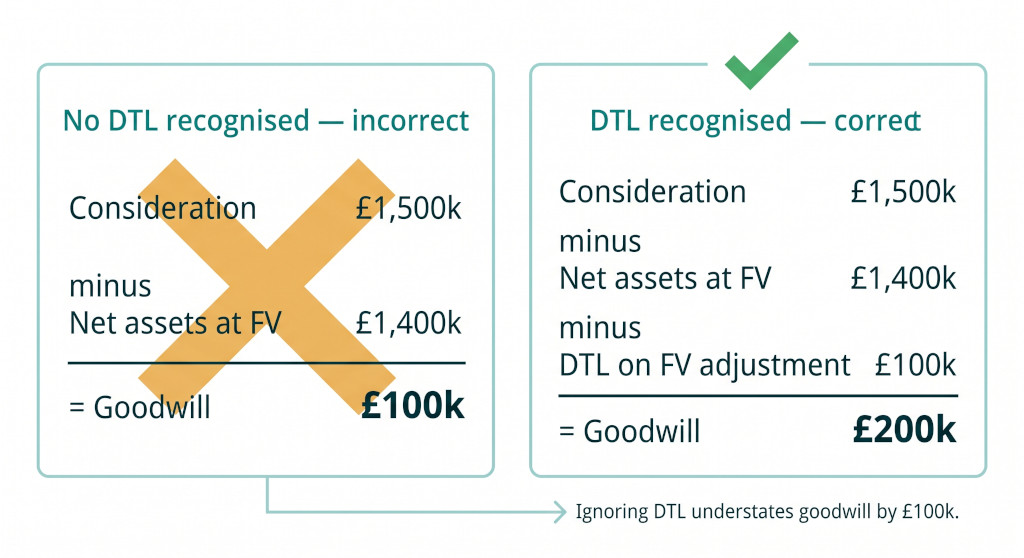
The “fair value of identifiable net assets acquired” is calculated after recognising the DTL on FV adjustments. The DTL reduces the net identifiable assets, which increases goodwill. Failing to recognise the DTL at acquisition therefore understates goodwill — not by a small rounding amount but by the full DTL amount.
Worked example: property FV adjustment at acquisition
HoldCo acquires 100% of SubCo on 1 January 2026 for £1,500,000. At the acquisition date:
| SubCo asset/liability | Book value (£) | Fair value (£) | FV adjustment (£) |
|---|---|---|---|
| Land and buildings | 800,000 | 1,200,000 | 400,000 |
| All other net assets | 200,000 | 200,000 | — |
| Total net assets | 1,000,000 | 1,400,000 | 400,000 |
The land and buildings have a tax base of £800,000 (SubCo’s original cost — the tax authority does not revalue). Tax rate: 25%.
DTL on FV adjustment
| FV adjustment on land and buildings | 400,000 |
| Tax base of land and buildings | 800,000 |
| Consolidated carrying amount | 1,200,000 |
| Temporary difference (carrying > tax base) | 400,000 |
| Tax rate | 25% |
| DTL to recognise | 100,000 |
Goodwill calculation — with and without DTL
| Item | Without DTL (£) | With DTL (£) |
|---|---|---|
| Consideration transferred | 1,500,000 | 1,500,000 |
| Net assets at fair value (before DT) | (1,400,000) | (1,400,000) |
| DTL on FV adjustment | — | 100,000 |
| Goodwill recognised | 100,000 | 200,000 |
Ignoring the DTL understates goodwill by £100,000. This is not an immaterial error.
Consolidation journal — acquisition date (FV adjustment + DTL)
| Account | Dr (£) | Cr (£) |
|---|---|---|
| Land and buildings (FV uplift) | 400,000 | |
| Goodwill | 200,000 | |
| Net assets of SubCo (at book value) | 1,000,000 | |
| Investment in SubCo (eliminated) | 1,500,000 | |
| Deferred tax liability | 100,000 |
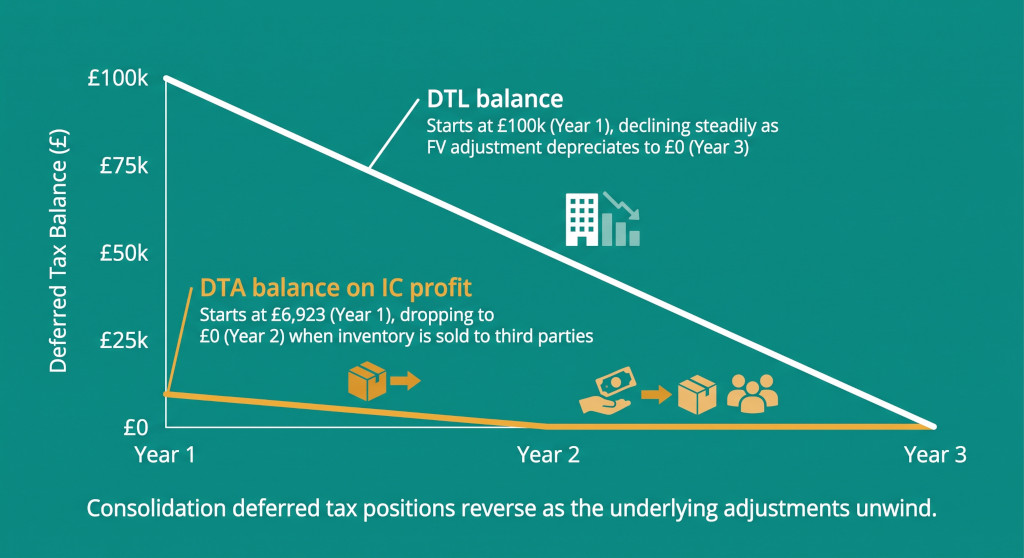
The DTL credits the deferred tax liability in the consolidated balance sheet. It is a permanent feature of the consolidation — it does not exist in SubCo’s individual accounts — and must be reversed each period as the land and buildings are depreciated or sold and the temporary difference unwinds.
Reversal in subsequent periods
As the FV adjustment depreciates (or, for land, when the property is eventually sold), the temporary difference reduces. Depreciation of the uplift in the consolidated accounts reduces the consolidated carrying amount of the asset, bringing it closer to the tax base. Each period, a proportion of the DTL reverses — the consolidation journal credits the P&L tax charge and debits the DTL. This is why the consolidated effective tax rate will be lower than the simple sum of entity tax rates: the DTL reversal produces a credit to the consolidated tax charge that does not appear in any entity’s accounts.
2 Unrealised Intercompany Profit Eliminations
Creates a deferred tax asset — consolidated carrying amount falls below tax base
The accounting position
When a group entity sells goods to another group entity with a margin, and the buying entity still holds some of those goods in closing inventory, the consolidated accounts must eliminate the unrealised profit — the margin embedded in the inventory that the group has not yet earned from an external customer. The elimination reduces the inventory carrying amount in the consolidated accounts. But the tax base of that inventory remains at the price the buying entity paid — the amount it will deduct when the goods are eventually sold to external parties.
The result is the reverse of the FV adjustment situation: consolidated carrying amount (lower, after elimination) is below tax base (the buyer’s cost). An asset where carrying amount is less than the tax base generates a deferred tax asset — the group will receive a future tax benefit (higher deductible cost) without the corresponding consolidated profit recognition it has already reversed.
In practical terms: the selling entity has already paid current tax on the profit. The group has eliminated that profit from the consolidated accounts. A DTA is recognised because the group is entitled to the future tax deduction (when the buyer sells externally) but has already paid tax today.
Worked example: unrealised profit in closing inventory
SupplyCo sells goods to DistributorCo at cost plus 30%. DistributorCo’s closing inventory at 31 December 2026 includes £120,000 of goods purchased from SupplyCo. Both entities pay corporate tax at 25%.
Unrealised profit in closing inventory
| DistributorCo’s closing IC inventory | 120,000 |
| Intercompany margin fraction (30 ÷ 130) | 23.08% |
| Unrealised profit to eliminate | 27,692 |
Temporary difference and DTA
| DistributorCo’s inventory carrying amount (= tax base) | 120,000 |
| Less: unrealised profit eliminated | (27,692) |
| Consolidated carrying amount of inventory | 92,308 |
| Tax base (DistributorCo’s cost — deductible on sale) | 120,000 |
| Temporary difference (tax base > carrying amount) | 27,692 |
| Tax rate (DistributorCo’s rate — the entity that holds the asset) | 25% |
| DTA to recognise | 6,923 |
The standard elimination journal removes the unrealised profit from COGS and inventory. A second consolidation journal then recognises the DTA:
Consolidation journal (a) — eliminate unrealised profit
| Account | Dr (£) | Cr (£) |
|---|---|---|
| Cost of goods sold (increase — profit reversed out of COGS) | 27,692 | |
| Inventory (reduce to group cost) | 27,692 |
Standard unrealised profit elimination journal. See intercompany eliminations: a complete guide for group consolidation for the full mechanics.
Consolidation journal (b) — recognise DTA on eliminated profit
| Account | Dr (£) | Cr (£) |
|---|---|---|
| Deferred tax asset | 6,923 | |
| Income tax expense (deferred tax credit) | 6,923 |
The DTA is recognised as a credit to the consolidated tax charge. It reverses in the period when DistributorCo sells the goods to external customers — at that point, the inventory is de-recognised, the profit is recognised in the consolidated P&L, and the DTA is released. The journal in the reversal period: Dr Tax expense £6,923 / Cr DTA £6,923.
Which tax rate to use: Use the tax rate of the entity that holds the temporary difference — in this case, DistributorCo (the buyer), because the temporary difference arises from the difference between DistributorCo’s cost of inventory (tax base) and the consolidated carrying amount. If DistributorCo and SupplyCo have different tax rates, use DistributorCo’s rate, not SupplyCo’s. IAS 12 does not permit using the selling entity’s rate simply because it is the entity that paid the current tax on the profit.
Recalculating the DTA each period
The DTA on unrealised intercompany profit is recalculated at every reporting date. The closing inventory figure changes, the proportion of IC goods in closing inventory changes, and the margin rate may change if the intercompany pricing is renegotiated. The consolidation journal in each period must reflect the current period’s calculation — not simply roll forward the prior period’s DTA. In practice: calculate the unrealised profit and the DTA from scratch each period; the movement between periods is the deferred tax charge or credit for the period.
3 Intragroup Asset Transfers (PPE)
Creates a deferred tax asset — reverses over the asset’s remaining life
The accounting position
When one group entity sells a fixed asset to another group entity at a gain, the receiving entity capitalises the asset at the transfer price. For tax, the receiving entity also uses the transfer price as its depreciable base — it will claim depreciation (capital allowances) on the full transfer price. At consolidation, the gain is eliminated and the asset is carried at the original cost. This produces a temporary difference: consolidated carrying amount (original cost, net of original depreciation) is lower than the tax base (transfer price, which is the depreciable base for the receiving entity). Carrying amount below tax base for an asset → DTA.
Intragroup PPE transfer — DTA calculation
| Equipment sold by AssetCo to OperationCo — transfer price | 300,000 |
| AssetCo’s original cost (consolidated carrying = tax base for AssetCo) | 200,000 |
| Gain eliminated at consolidation | 100,000 |
| Consolidated carrying amount (at original cost) | 200,000 |
| Tax base (OperationCo capitalises and depreciates at transfer price) | 300,000 |
| Temporary difference (tax base > carrying amount) | 100,000 |
| Tax rate (OperationCo’s rate) | 25% |
| DTA to recognise | 25,000 |
The DTA reverses over the asset’s remaining useful life. Each year, OperationCo depreciates the asset at the transfer price for tax, while the consolidated accounts depreciate it at original cost. The excess tax depreciation (depreciation on the eliminated gain element) reduces the temporary difference by that amount annually. When the asset is fully depreciated or sold, the DTA has fully reversed.
Goodwill: The Special Prohibition
Where goodwill is recognised in the consolidated accounts and the tax base of that goodwill is zero — which is typical, as most jurisdictions do not allow a tax deduction for goodwill arising on acquisition — a taxable temporary difference arises: consolidated carrying amount (goodwill balance) exceeds tax base (zero). Under normal IAS 12 rules, this would generate a DTL.
IAS 12 paragraph 15(a) specifically prohibits recognising a deferred tax liability on this difference. The prohibition exists because recognising a DTL on goodwill would reduce the net identifiable assets at acquisition, which would increase goodwill further, which would increase the DTL, in a circular loop that cannot be resolved. The standard therefore carves out goodwill entirely: no deferred tax is recognised on temporary differences arising from the initial recognition of goodwill, and no subsequent DTL is recognised as goodwill is impaired or amortised.
FRS 102 Section 29.15A applies a similar carve-out for goodwill arising on business combinations. Under FRS 102, goodwill is amortised rather than subject to annual impairment testing — but the deferred tax prohibition on the initial goodwill difference is the same.
If the tax base of goodwill is not zero — for example, where local tax law allows a deduction for purchased goodwill amortised over a fixed period — a temporary difference does arise and deferred tax must be considered. The prohibition in IAS 12 para 15(a) applies specifically to the initial recognition of goodwill where no deferred tax was recognised for the associated asset. In practice, most UK and international acquisitions result in a zero tax base for consolidated goodwill.
Investment in Subsidiaries: Outside Basis Differences
A further source of group-level deferred tax arises from the so-called outside basis difference: the difference between the parent’s carrying amount of its investment in subsidiaries (in the parent’s individual accounts) and the tax base of that investment. As a subsidiary accumulates retained earnings, its equity grows — but the parent’s cost of investment for tax purposes typically stays at the original acquisition cost. The retained earnings that have built up in the subsidiary represent a potential future taxable receipt (via dividend or sale proceeds) that would be taxable in the parent’s hands.
Under IAS 12 paragraphs 39–40, a parent must recognise a DTL for taxable temporary differences associated with investments in subsidiaries, unless the parent is able to control the timing of the reversal of the temporary difference and it is probable that the difference will not reverse in the foreseeable future. In practice, most groups satisfy this exception — the parent controls whether dividends are paid and has no current plans to sell the subsidiary — and so no DTL is recognised for undistributed subsidiary earnings. However, where a disposal is planned, or where minority shareholders could force a dividend, the exception may not apply and a DTL must be recognised.
IFRS vs FRS 102: Practical Differences
IAS 12 uses a temporary difference approach — comparing carrying amounts to tax bases to identify all temporary differences. FRS 102 Section 29 uses a timing difference plus approach — identifying differences between taxable profits and accounting profits and their expected reversal, with specified extensions to cover revaluations and certain other items.
For most of the consolidation scenarios covered in this post, the practical outcome is the same: FV adjustments at acquisition create a DTL, unrealised IC profits create a DTA, and intragroup PPE transfers create a DTA, under both frameworks. The terminology differs — FRS 102 speaks of “timing differences” rather than “temporary differences” — but the direction and approximate magnitude of the deferred tax are generally consistent. Groups preparing accounts under FRS 102 should confirm the precise application with their auditors, particularly for complex acquisitions where the FV adjustments span multiple asset categories with different expected reversal profiles. For a broader comparison of the two frameworks, see IFRS vs UK GAAP: key differences in financial reporting.
Where These Entries Sit in the Consolidation Workbook
Consolidation deferred tax entries are consolidation-only adjustments. They are calculated and posted in the consolidation workbook — not in any entity’s accounting system. The entities are not involved and their own deferred tax positions are not changed.
Practically: the consolidation workbook should have a dedicated deferred tax schedule that tracks each source of consolidation DT separately — a row for each FV adjustment by asset class (tracked from acquisition to disposal), a row for each IC trading relationship (recalculated each period from the unrealised profit calculation), and a row for any intragroup asset transfer (tracked from the transfer date to full depreciation or sale). The schedule must be updated every period and the movements from period to period drive the deferred tax charge or credit in the consolidated income statement.
The consolidated tax charge comprises three components: the sum of all entities’ current tax charges, the sum of all entities’ deferred tax movements, and the consolidation deferred tax movements from the schedule above. All three are required to arrive at the consolidated tax charge that agrees to the group’s effective tax rate.
For a full example of a consolidation that includes acquisition accounting, intercompany eliminations, and the associated tax entries in context, see a complete consolidation worked example. For the acquisition accounting that gives rise to FV adjustments and goodwill, see acquisition accounting in group consolidation: a step-by-step guide to IFRS 3. For goodwill measurement and impairment, see goodwill in group consolidation: calculation, impairment, and common errors.
Summary: Three Consolidation Scenarios, Three DT Positions
| Consolidation adjustment | Effect on consolidated carrying amount | Tax base | DT position | Reversal |
|---|---|---|---|---|
| FV uplift on acquired assets | Increases above entity book value | Unchanged (entity’s original cost) | DTL | As asset depreciates or is sold |
| Unrealised IC profit in inventory | Decreases (profit eliminated from inventory) | Buyer’s cost (= transfer price) | DTA | When inventory is sold to external parties |
| Intragroup PPE transfer gain | Decreases (gain eliminated) | Buyer’s capitalised cost (= transfer price) | DTA | Over asset’s remaining depreciable life |
| Goodwill (zero tax base) | Goodwill balance > zero | Zero | Prohibited (IAS 12 para 15a) | N/A |
Group consolidation that handles the technical details
BrizoConsol tracks consolidation adjustments from acquisition through subsequent periods, supports deferred tax entries in the consolidation workbook, and keeps your consolidated tax charge reconciled to the group’s effective rate. See how it works for your group. See It in Action
Practical Checklist: Deferred Tax in Group Consolidation
- At each acquisition: identify every fair value adjustment by asset class; calculate the DTL (FV adjustment × asset’s applicable tax rate); include the DTL in the net identifiable assets figure before calculating goodwill.
- Check for non-deductible FV adjustments. Where an asset has a zero tax base regardless of the FV adjustment (for example, certain intangible assets not deductible for tax), the entire consolidated carrying amount is a temporary difference — the DTL is correspondingly larger.
- Maintain a FV adjustment schedule tracking each FV uplift from acquisition date, its expected depreciation/amortisation life, the annual reversal of the DTL, and the cumulative unwinding. Update each period.
- At each reporting date: recalculate the unrealised IC profit for each intercompany trading relationship; compute the DTA using the buying entity’s tax rate; post the consolidation journal for the net movement (increase or decrease from prior period).
- For any intragroup PPE transfer: track the eliminated gain and the annual DTA reversal based on the asset’s depreciable life. Remove the DTA from the schedule when the asset is fully depreciated or sold to a third party.
- Confirm the goodwill prohibition is applied. Do not recognise a DTL for the temporary difference on goodwill with a zero tax base.
- Assess outside basis differences. Evaluate whether any undistributed subsidiary earnings could be distributed or taxed in circumstances the group does not control — if so, a DTL may be required.
- Reconcile the consolidated effective tax rate. The standard rate applied to consolidated profit before tax should equal the sum of all entity tax charges plus consolidation DT movements. Unexplained differences in the rate reconciliation are often consolidation deferred tax that has not been captured.
Technical consolidation made manageable
BrizoConsol supports multi-entity groups through the full technical consolidation process — from acquisition accounting and FV adjustments to intercompany eliminations and period-end deferred tax schedules. Start with a free trial. Start Free Trial