How to Consolidate a UK GAAP (FRS 102) Subsidiary into an SFRS Parent: Two Very Different Conversion Paths
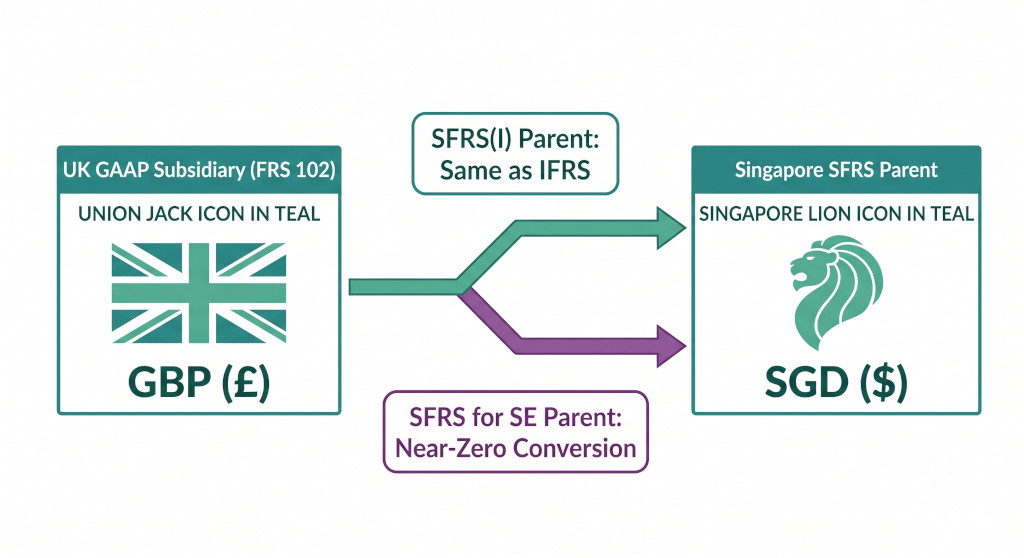
Singapore holding companies that own UK operating businesses face a consolidation question that looks deceptively straightforward: how different is FRS 102 from SFRS? The answer depends entirely on which SFRS framework the Singapore parent applies — and the two outcomes are almost opposites of each other.
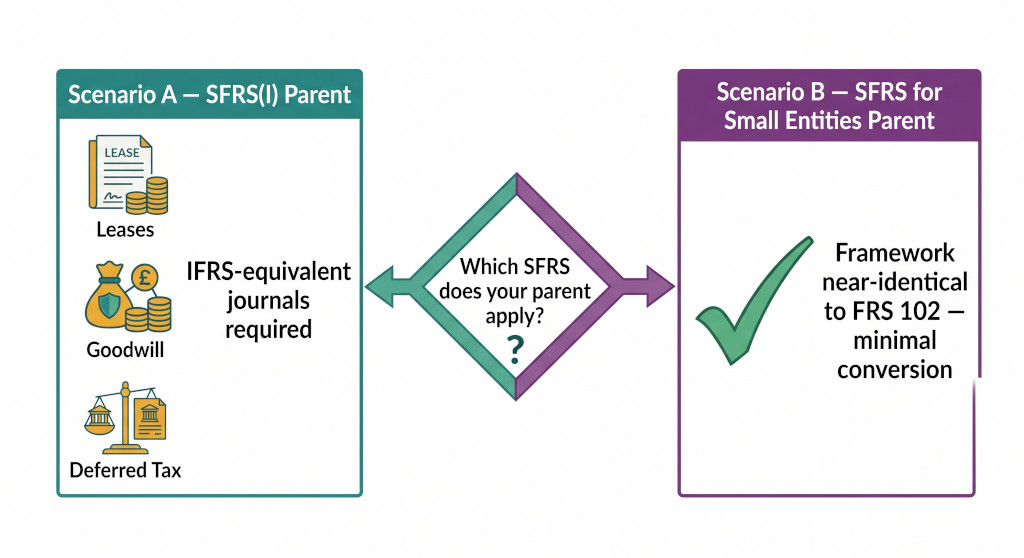
If the Singapore parent applies SFRS(I) — the full IFRS-aligned standard for SGX-listed entities and larger unlisted groups — consolidating a UK FRS 102 subsidiary requires the same conversion journals as consolidating into any IFRS parent: add IFRS 16 lease recognition and reverse FRS 102 goodwill amortisation. If the Singapore parent applies SFRS for Small Entities — the simplified standard for eligible unlisted companies — the conversion workload is near zero, because FRS 102 and SFRS for SE share the same simplified treatments for leases and goodwill.
This guide covers both scenarios in full, explains how to choose between them, and closes with a GBP-to-SGD currency translation worked example.
Stop building consolidations in spreadsheets.
BrizoConsol automates multi-entity consolidation — setup in minutes, reports the same day.
The Group Structure Used in This Guide
- BrizoSG Holdings Pte Ltd — Singapore parent, 100% owns BrizoUK Ltd; presents consolidated accounts in SGD
- BrizoUK Ltd — UK wholly-owned subsidiary, applies FRS 102, reports in GBP, fiscal year 1 January to 31 December
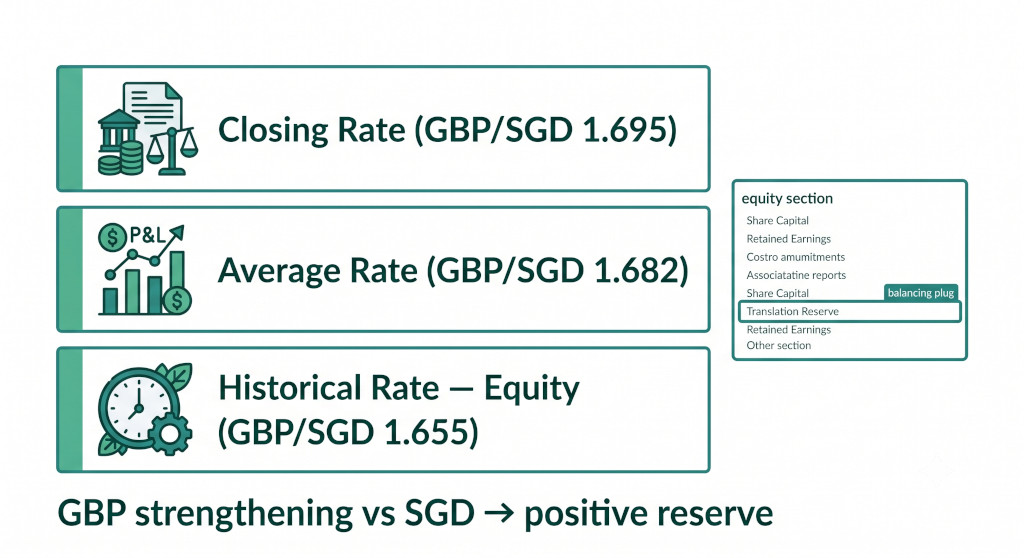
- Exchange rates (illustrative): closing GBP/SGD 1.695; average GBP/SGD 1.682; historical rate at acquisition GBP/SGD 1.655
BrizoUK Ltd holds office leases (operating leases under FRS 102 Section 20) and carries goodwill from a prior acquisition that it amortises over ten years under FRS 102 Section 19. These are the two areas where FRS 102 diverges from SFRS(I) — and where it aligns with SFRS for Small Entities.
Step 1 — The Decisive Question: Which SFRS Framework Does the Parent Apply?
Step 1
Singapore companies must apply the framework prescribed by their regulatory status. The choice is not discretionary once eligibility criteria are met:
| Framework | Who Must / May Use It | Basis |
|---|---|---|
| SFRS(I) | SGX-listed companies; companies that choose to adopt it (irrevocable) | Word-for-word adoption of IFRS issued by IASB; administered by ASC |
| Full FRS (non-SFRS(I) SFRS) | Large unlisted companies not using SFRS(I) | Singapore FRS standards; largely aligned with IFRS but administered separately |
| SFRS for Small Entities | Unlisted companies meeting two of three: revenue ≤ SGD 10m; assets ≤ SGD 10m; employees ≤ 50 (using ACRA’s qualifying criteria) | Based on IFRS for SMEs; mirrors IFRS for SMEs / FRS 102 in most areas |
Confirm BrizoSG Holdings’ applicable framework from its most recent ACRA filing before proceeding. If the parent is SGX-listed, it is SFRS(I). If it is a private holding company below the size thresholds, it may be SFRS for Small Entities.
Step 2 — GAAP Conversion Journals
Step 2
All conversion journals are prepared in GBP — BrizoUK Ltd’s functional currency — before translation to SGD in Step 5.
Scenario A — SFRS(I) Parent
Same Conversion Journals as an IFRS Parent
SFRS(I) is a word-for-word adoption of IFRS. SFRS(I) 16 = IFRS 16. SFRS(I) 3 = IFRS 3. SFRS(I) 1-36 = IAS 36. The GAAP conversion journals required to bring BrizoUK’s FRS 102 accounts onto SFRS(I) are therefore identical to those needed for an IFRS parent. Two adjustments are required:
Adjustment 1: Leases — Recognise SFRS(I) 16 / IFRS 16 ROU Asset and Lease Liability
BrizoUK’s office and warehouse leases are off the FRS 102 balance sheet under Section 20. SFRS(I) 16 requires them on the balance sheet as an ROU asset and lease liability.
Lease data (as if SFRS(I) 16 / IFRS 16 had always applied):
- ROU asset (gross): GBP 960,000
- Accumulated SFRS(I) 16 depreciation (2 years of 7-year term): GBP 274,000
- Net ROU asset: GBP 686,000
- Lease liability (PV of 5 remaining years at 4% IBR): GBP 712,000
- Current-year depreciation: GBP 137,000; current-year interest: GBP 30,000
- FRS 102 straight-line rent expense: GBP 160,000
Journal A1a — Recognise opening SFRS(I) 16 lease on balance sheet
DR Right-of-Use Asset (gross) GBP 960,000
CR Accumulated Depreciation — ROU Asset GBP 274,000
CR Lease Liability GBP 712,000
DR Retained Earnings GBP 26,000
Introduces the ROU asset (net GBP 686,000) and lease liability (GBP 712,000). The debit to retained earnings reflects the cumulative timing difference between SFRS(I) 16 front-loaded cost and FRS 102 straight-line rent over the two years elapsed.
Journal A1b — Reclassify current-year lease P&L
DR Operating Lease Expense GBP 160,000
CR Depreciation — ROU Asset GBP 137,000
CR Finance Costs — Lease Interest GBP 30,000
DR Retained Earnings (net timing difference) GBP 7,000
Removes straight-line lease expense; recognises SFRS(I) 16 depreciation (within operating expenses) and interest (within finance costs). EBITDA increases as lease costs move below the EBITDA line.
Adjustment 2: Goodwill — Reverse FRS 102 Amortisation
BrizoUK acquired a competitor four years ago. Goodwill: GBP 800,000. FRS 102: amortised at GBP 80,000/year over ten years. Cumulative amortisation: GBP 320,000. FRS 102 carrying value: GBP 480,000. SFRS(I) carrying value (impairment-only, no impairment identified): GBP 800,000.
Journal A2a — Reverse prior cumulative goodwill amortisation
DR Goodwill GBP 240,000
CR Retained Earnings GBP 240,000
Three prior years of GBP 80,000 amortisation reversed through opening retained earnings. Goodwill rises from GBP 480,000 to GBP 720,000 on the opening SFRS(I) balance sheet.
Journal A2b — Reverse current-year goodwill amortisation
DR Goodwill GBP 80,000
CR Goodwill Amortisation Expense GBP 80,000
Current-year amortisation reversed; goodwill restored to GBP 800,000 acquisition cost. Triggers a mandatory annual SFRS(I) 1-36 (= IAS 36) impairment test — the impairment review must be completed before finalising the SFRS(I) carrying value.
Impairment test required before closing: Restoring goodwill to GBP 800,000 is the starting point, not the conclusion. SFRS(I) 1-36 requires an annual impairment test comparing the cash-generating unit’s carrying amount (now including GBP 800,000 goodwill) against its recoverable amount. Any impairment identified reduces the SFRS(I) goodwill balance — and SFRS(I) impairment losses on goodwill cannot subsequently be reversed.
Deferred Tax (Scenario A)
Deferred tax follows the same analysis as for an IFRS parent. On the lease: DTL on the ROU asset (GBP 686,000 × 25% UK corporation tax = GBP 171,500); DTA on the lease liability (GBP 712,000 × 25% = GBP 178,000) — net DTA of approximately GBP 6,500. On goodwill: confirm whether the acquisition was a share purchase (typical UK structure, tax base = nil, no DT adjustment) or an asset purchase (tax base may be positive, DT journal required). See the UK GAAP to IFRS guide for the full deferred tax analysis.
Scenario B — SFRS for Small Entities Parent
Near-Zero Conversion: The Frameworks Already Agree
SFRS for Small Entities is based on the IFRS for SMEs standard — the same foundation from which FRS 102 was derived. The two frameworks are closely aligned on the two areas that typically drive conversion journals in other cross-standard combinations:
FRS 102 — BrizoUK Ltd
Leases (Section 20): Operating leases off balance sheet; straight-line rent in P&L.
Goodwill (Section 19): Amortised over useful economic life; max 10 years if life uncertain.
Financial instruments (Sections 11 & 12): Basic / other classification; simplified.
SFRS for Small Entities — BrizoSG Holdings
Leases (Section 20): Operating leases off balance sheet; straight-line rent in P&L. Same as FRS 102.
Goodwill (Section 19): Amortised over useful economic life; max 10 years if life uncertain. Same as FRS 102.
Financial instruments (Sections 11 & 12): Basic / other classification; simplified. Same as FRS 102.
There is no lease conversion journal — both frameworks leave operating leases off the balance sheet. There is no goodwill amortisation reversal — both frameworks amortise goodwill. The two adjustments that dominate every other cross-standard conversion path in this series simply do not arise here.
When the Singapore parent applies SFRS for Small Entities, consolidating a UK FRS 102 subsidiary is the closest thing in this series to a pure currency translation exercise. The accounting policies align; the numbers just need to be converted from GBP to SGD.
What to Check Even When the Frameworks Align
A near-zero conversion is not a zero-work exercise. Review these areas each period:
- Development costs: Both frameworks allow capitalisation of qualifying development expenditure. Check that BrizoUK’s capitalisation policy is consistent with BrizoSG’s group policy. Differences in thresholds, useful life, or amortisation method can produce small adjustments even where the principle is the same.
- Investment property: SFRS for SE Section 16 and FRS 102 Section 16 are aligned — fair value through profit or loss if reliably measurable, cost model otherwise. Confirm that BrizoUK’s chosen policy matches the group’s.
- Group accounting policies: Even where two frameworks permit the same accounting treatment, the group may prescribe a specific policy. BrizoSG should document group-wide accounting policies and confirm BrizoUK applies them consistently for consolidation purposes.
- Intercompany eliminations: Any unrealised profits in inventory or fixed assets transferred between BrizoUK and other group entities must be eliminated regardless of framework alignment.
Step 3 — Financial Instruments: Brief Review
Step 3
For Scenario A (SFRS(I) parent), financial instruments require the same IFRS 9 review as any IFRS consolidation — check for ECL uplift on trade receivables and reclassification of any non-basic instruments. For Scenario B (SFRS for SE parent), both frameworks use the same basic/other classification and the same incurred-loss impairment model, so the review is confirmatory rather than substantive. Identify any instruments that sit in “other financial instruments” under FRS 102 Section 12 and confirm that BrizoSG’s SFRS for SE Section 12 treatment is consistent.
Step 4 — Fiscal Year Alignment
Step 4
BrizoUK Ltd uses a 31 December year-end. Singapore private companies may choose any financial year — confirm BrizoSG Holdings’ year-end. If the gap between BrizoUK’s reporting date and BrizoSG’s parent reporting date exceeds three months, BrizoUK should prepare stub-period accounts or management accounts adjusted for significant transactions in the gap period, consistent with the three-month rule under SFRS(I) 10 para B93 (Scenario A) or SFRS for SE Section 9 (Scenario B). See our fiscal year alignment guide for country-by-country details.
Singapore year-end flexibility: Unlike India (mandatory 31 March) or Japan (typically 31 March), Singapore companies may adopt any financial year-end and change it with ACRA notification. BrizoSG Holdings could align its year-end with BrizoUK’s 31 December to eliminate the gap and simplify the consolidation process — worth considering if the group contains multiple UK entities.
Step 5 — Currency Translation: GBP to SGD
Step 5
BrizoUK Ltd’s functional currency is GBP; BrizoSG Holdings presents in SGD. Translation follows IAS 21 / SFRS(I) 21 (Scenario A) or SFRS for SE Section 30 (Scenario B) — the mechanics are identical under both: closing rate for the balance sheet, average rate for the income statement, historical rate for equity components, and the translation reserve as the equity balancing figure deferred in other comprehensive income (or equity under SFRS for SE).
| Item | Rate | Note |
|---|---|---|
| Balance sheet — all assets and liabilities | Closing rate (GBP/SGD 1.695) | Year-end spot rate; GBP 1 converts to SGD 1.695 |
| Income statement — revenues and expenses | Average rate (GBP/SGD 1.682) | Annual average; approximates transaction-date rates for steady trading |
| Share capital | Historical rate (GBP/SGD 1.655) | Rate on the date BrizoSG acquired BrizoUK; fixed permanently for the investment |
| Opening retained earnings | Brought forward | Cumulative from prior periods; consistent with prior-year translation |
| Translation Reserve | Balancing figure | Deferred in equity; released to P&L on disposal of BrizoUK |
Worked Translation Example (Scenario A — IFRS-restated GBP figures)
| Item | GBP (IFRS/SFRS(I) restated) | Rate | SGD |
|---|---|---|---|
| Income Statement | |||
| Revenue | 8,000,000 | Avg 1.682 | 13,456,000 |
| Cost of Sales | (4,100,000) | Avg 1.682 | (6,896,200) |
| Operating Expenses (incl. ROU depreciation; excl. goodwill amortisation reversed) | (1,950,000) | Avg 1.682 | (3,279,900) |
| Finance Costs — Lease Interest | (30,000) | Avg 1.682 | (50,460) |
| Net Profit | 1,920,000 | 3,229,440 | |
| Balance Sheet | |||
| Total Assets (incl. ROU asset GBP 686k; goodwill GBP 800k restored) | 12,000,000 | Close 1.695 | 20,340,000 |
| Total Liabilities (incl. lease liability GBP 712k) | (6,200,000) | Close 1.695 | (10,509,000) |
| Net Assets | 5,800,000 | 9,831,000 | |
| Equity Reconciliation | |||
| Share Capital | 1,500,000 | Hist 1.655 | 2,482,500 |
| Opening Retained Earnings (brought forward) | 2,380,000 | Prior year | 3,880,660 |
| Current Year Net Profit | 1,920,000 | Avg 1.682 | 3,229,440 |
| Translation Reserve (balancing figure) | — | Plug | 238,400 |
| Total Equity | 5,800,000 | 9,831,000 | |
The positive translation reserve of SGD 238,400 reflects GBP strengthening against the Singapore dollar over the period — the closing rate of 1.695 exceeds the average (1.682) and historical (1.655) rates. The SGD value of BrizoUK’s net assets has risen without any underlying operational change; this unrealised translation gain is deferred in equity and will be recycled to the consolidated income statement only when BrizoUK is sold or liquidated.
Intercompany GBP/SGD loans: If BrizoSG Holdings has extended a SGD-denominated loan to BrizoUK Ltd, the GBP equivalent of that loan fluctuates each period as exchange rates move. Under IAS 21 / SFRS(I) 21, if the loan is part of the group’s net investment in BrizoUK (i.e., it is not expected to be settled in the foreseeable future), exchange differences on the loan are deferred in the translation reserve rather than taken to BrizoSG’s income statement. If the loan is a normal working capital facility expected to be repaid, exchange differences flow through the P&L each period. Confirm the nature of each intercompany instrument before applying the translation treatment.
Singapore Regulatory Notes
BrizoSG Holdings must file its audited consolidated financial statements with ACRA via BizFile+ within five months of its financial year-end (private company) or four months (public company). The SFRS framework applied — SFRS(I) or SFRS for Small Entities — must be disclosed in the accounting policies note. A switch from SFRS for Small Entities to SFRS(I) is a one-way door; once made, the adoption is irrevocable and requires a full set of SFRS(I) 1 first-time adoption disclosures.
Practical Checklist: FRS 102 Subsidiary into an SFRS Group
✅ Period-End Consolidation Checklist
- Confirm which SFRS framework BrizoSG Holdings applies (SFRS(I) or SFRS for Small Entities) — check the most recent ACRA filing or signed financial statements
- If SFRS(I): Treat as an IFRS consolidation — proceed through Scenario A journals
- List all operating leases held by BrizoUK; exclude short-term (≤ 12 months) and low-value leases from SFRS(I) 16 scope
- Calculate ROU asset (gross and accumulated depreciation) and lease liability (PV of future payments at IBR) under SFRS(I) 16
- Prepare Journal A1a (balance sheet recognition) and A1b (P&L reclassification)
- Calculate cumulative FRS 102 goodwill amortisation; prepare Journal A2a (prior years to retained earnings) and A2b (current year to income statement)
- Complete SFRS(I) 1-36 impairment review on restored goodwill — document recoverable amount assessment
- Prepare deferred tax on ROU asset and lease liability; confirm goodwill tax base before deciding on DT adjustment
- If SFRS for Small Entities: Confirm leases and goodwill policies are consistent between frameworks — no conversion journal expected
- Under both scenarios: review development cost capitalisation policy consistency; confirm investment property treatment alignment
- Eliminate all intercompany balances, transactions, and unrealised profits
- Confirm year-end alignment; if gap exists, assess against three-month rule and prepare gap-period adjustments for significant events
- Source and document GBP/SGD closing rate, average rate, and historical rate at acquisition date
- Translate balance sheet at closing rate; income statement at average rate; share capital at historical rate
- Calculate translation reserve as the equity balancing figure; record in OCI (SFRS(I)) or equity (SFRS for SE)
- Classify GBP/SGD intercompany loans as net investment (→ translation reserve) or working capital (→ P&L)
- File ACRA consolidated accounts within the applicable statutory deadline
Singapore holding company with a UK subsidiary?
BrizoConsol connects Xero, QuickBooks, MYOB, and Zoho Books — automating GAAP conversion journals, GBP-to-SGD translation, intercompany eliminations, and SFRS consolidated reporting for Singapore groups with cross-border subsidiaries. Start Free Trial