MYOB Consolidation: Group Financials MYOB Can’t Produce
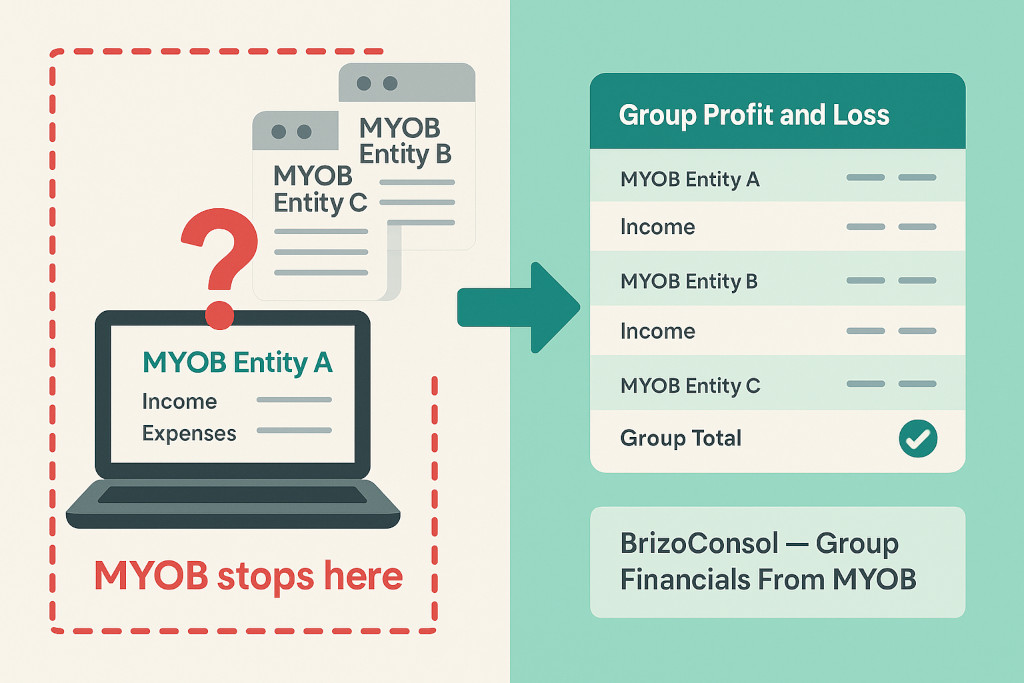
You are the CFO of a group with four operating entities, all running MYOB. The quarter is ending. The board wants consolidated financials by Friday. And you are sitting in front of four separate MYOB files, each complete and reconciled, knowing that the real work — the work MYOB cannot do — is about to begin.
The spreadsheet is already open. You have done this before. You will pull each trial balance manually, stack them in columns, eliminate the intercompany transactions by hand, apply the exchange rate adjustments, and pray that nothing moves while you are building the model. It will take two days. There will be at least one error you only catch on the second review. And next quarter, you will do it all again.
This is the MYOB consolidation problem. It is not a MYOB failure — MYOB AccountRight and MYOB Business are excellent accounting platforms for managing individual entities. The problem is structural: MYOB is built to manage books for a single company, and there is no native mechanism for combining multiple MYOB files into a single consolidated set of financial statements.
Consolidate your MYOB entities in minutes.
BrizoConsol connects to MYOB and automates your group financial statements.
This guide explains exactly what MYOB can and cannot do for multi-entity groups, and what consolidation software adds on top.
What MYOB Can and Cannot Do for Multi-Entity Groups
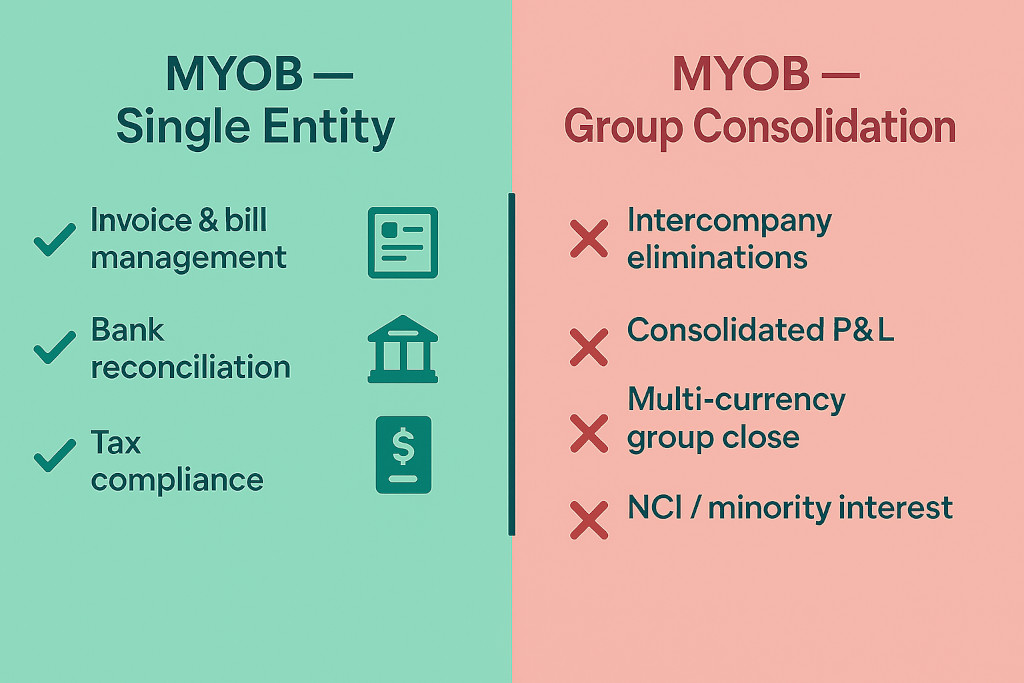
MYOB’s strengths are well established. For managing the books of a single entity — processing invoices, reconciling bank accounts, managing payroll, producing BAS and tax compliance — it is reliable, well-supported, and widely used across Australia, New Zealand, and the broader Asia-Pacific market. For what it is designed to do, it does it well.
What it is not designed to do is group consolidation. Specifically:
| Requirement | MYOB (single-entity) | What multi-entity groups need |
|---|---|---|
| Entity-level P&L and Balance Sheet | ✓ Built in | Plus a consolidated group view |
| Intercompany transaction elimination | ✗ Not available | Automatic identification and elimination |
| Consolidated P&L across entities | ✗ Not available | Group P&L combining all entities, net of eliminations |
| Consolidated Balance Sheet | ✗ Not available | Group balance sheet with investment eliminations |
| Multi-currency group reporting | ✗ Not in consolidation context | Translation at average and closing rates, CTA to equity |
| Non-controlling interest (NCI) | ✗ Not available | NCI share of profit and net assets, presented separately |
| Audit trail on consolidation adjustments | ✗ Not available | Full history of every elimination and adjustment |
The consequence is that every multi-entity MYOB group currently handles consolidation somewhere outside MYOB — in Excel, in a reporting tool bolted on top, or through a manual process that a single controller knows how to run and that no one else fully understands.
The Hidden Cost of Spreadsheet Consolidation
Most finance teams running MYOB consolidation in Excel have adapted to it so thoroughly that they no longer see it as a problem. It is simply how the close works. But the costs accumulate in ways that are easy to miss.
Time. A manual MYOB consolidation for a four-entity group typically takes two to four working days at month-end. For a group with six or eight entities, or with foreign currency subsidiaries, that stretches further. At twelve months per year, a team spending three days on manual consolidation is investing over five weeks annually on a process that produces no analytical value — only a number.
Errors. Manual consolidation models are fragile. A formula that references the wrong column, a rate applied to the wrong period, an intercompany balance that does not agree between entities — these are not exceptional events. They are routine. The question is not whether errors occur, but how many remain undetected when the consolidated report goes to the board.
Dependency risk. In most groups, one person maintains the consolidation model. When that person leaves or is unavailable at month-end, the group’s ability to produce financials pauses with them. That is an operational risk that no board should be comfortable with.
“The spreadsheet consolidation always worked — right up until it didn’t. And by the time we found the error, it was already in the board report.”
How MYOB Consolidation Works With BrizoConsol
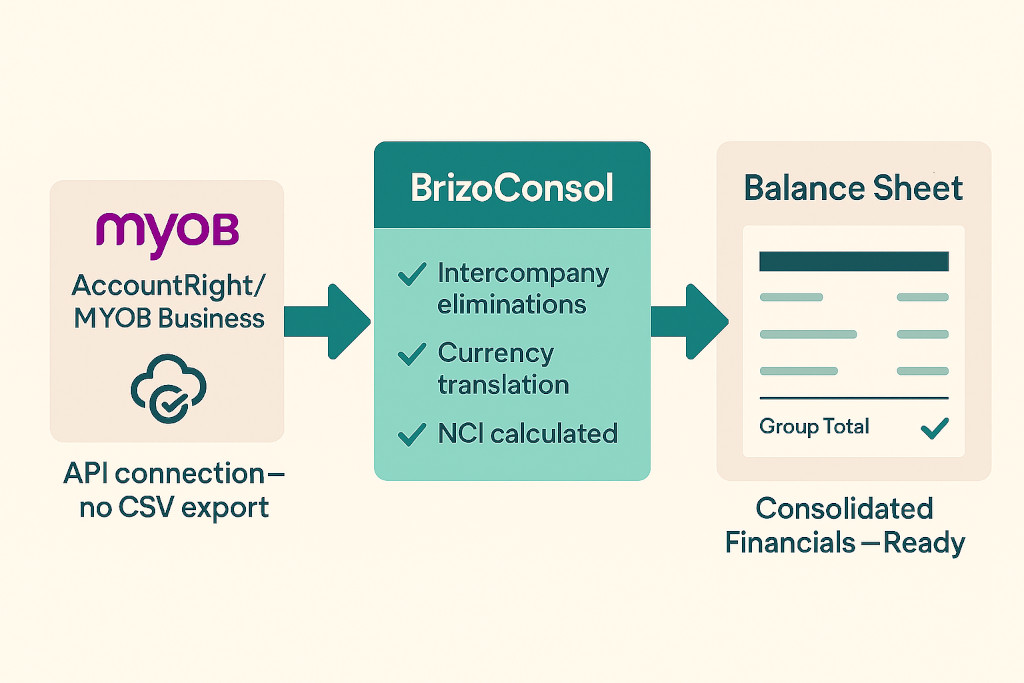
BrizoConsol connects directly to MYOB via API — both MYOB AccountRight and MYOB Business are supported. There are no CSV exports, no manual trial balance uploads, and no copy-paste steps. Once the connection is established, BrizoConsol pulls the latest data from each MYOB entity continuously, and the consolidated view updates as the underlying books move.
What happens on top of that data is where the consolidation work takes place:
Intercompany Eliminations
BrizoConsol identifies intercompany transactions — sales, loans, management fees, dividends — using account mapping and entity relationship definitions set up during onboarding. Elimination journals are suggested automatically and applied to the consolidated figures without manual calculation. Every elimination is logged with a full audit trail. For a practical walkthrough of how intercompany eliminations work across entity types, see our practical guide to intercompany eliminations.
Multi-Currency Group Reporting
For MYOB groups with subsidiaries in different currencies — a common structure for Australian groups with NZ, UK, or Southeast Asian entities — BrizoConsol handles currency translation automatically. P&L items are translated at the period average rate. Balance sheet items use the closing rate. Equity items carry their historical rates. The resulting currency translation adjustment (CTA) is posted to the foreign currency translation reserve in equity, exactly as required under IAS 21 and AASB 121. For a full technical walkthrough of the CTA calculation, see our guide on how to calculate the cumulative translation adjustment in group consolidation.
Non-Controlling Interest
Where a MYOB entity is partially owned by external investors, BrizoConsol calculates the minority shareholders’ share of net assets and profit automatically, using the NCI percentage configured per entity. The NCI balance is presented separately in the consolidated equity section and on the face of the consolidated income statement — consistent with IFRS, Australian Accounting Standards (AASB), and US GAAP requirements.
Consolidated Reports on Demand
Once eliminations, currency translation, and NCI are applied, BrizoConsol generates a consolidated P&L, Balance Sheet, and Cash Flow Statement in real time. The reports can be filtered by entity, by region using Virtual Groups, or by reporting period. Drill-down from any consolidated line to the underlying transaction in any MYOB entity takes a matter of seconds.
A Practical Example: Hargreaves Pacific Group
Hargreaves Pacific is an Australian holding company with three operating subsidiaries:
- Hargreaves AU Pty Ltd — Parent and principal operating entity (AUD, MYOB AccountRight)
- Hargreaves NZ Ltd — Distribution subsidiary (NZD, MYOB Business)
- Hargreaves UK Ltd — Sales office (GBP, MYOB AccountRight)
Before BrizoConsol, the group’s financial controller spent three days at month-end pulling trial balances from each MYOB file, converting NZD and GBP figures to AUD using a rate table in Excel, eliminating a recurring management fee from the parent to each subsidiary, and producing a consolidated P&L and Balance Sheet. The model had 14 linked tabs. New team members could not use it without a two-hour walkthrough.
With BrizoConsol connected to all three MYOB files via API, the same close now takes less than half a day. The management fee eliminations run automatically. Currency translation applies current AASB 121 rates without manual input. The consolidated P&L is available in BrizoConsol from the moment each entity’s period is locked in MYOB. The controller’s role shifted from building the model to reviewing the output — which is where their expertise is actually needed.
| Task | Manual (Excel) | BrizoConsol |
|---|---|---|
| Trial balance extraction (3 entities) | ~3 hours | Automatic via API |
| Currency translation (NZD + GBP → AUD) | ~2 hours | Automatic — rates configurable |
| Management fee elimination | ~1 hour | Automatic — entity relationship defined once |
| Consolidated P&L and Balance Sheet | ~4 hours build + review | On demand, real-time |
| Audit trail documentation | Manual notes in Excel | Full timestamped trail per adjustment |
| Total controller time | ~3 days | <0.5 days |
Who Needs MYOB Consolidation Software?
Not every MYOB group needs consolidation software immediately. A group with two simple entities, minimal intercompany activity, and a single functional currency can manage with a careful spreadsheet model — for a while. But the inflection point comes faster than most groups expect:
- When a third or fourth entity is added, the spreadsheet model grows in complexity faster than the business.
- When the group acquires an entity with a different functional currency, manual translation becomes a material audit risk.
- When the board requires monthly consolidated reporting rather than quarterly, the manual process can no longer be sustained alongside the team’s other responsibilities.
- When the group undertakes an acquisition involving NCI, the complexity of the equity section makes manual consolidation impractical.
- When auditors begin to ask for a documented, traceable audit trail on every consolidation adjustment.
At any of these points, the cost of continuing with a manual process — in time, in error risk, and in operational fragility — exceeds the cost of dedicated MYOB consolidation software. For a deeper look at what financial consolidation software does across integrations, see our overview of what financial consolidation software does and why your group needs it.
MYOB Consolidation Without Changing Your Accounting Software
One of the most common concerns finance leaders raise when evaluating consolidation software is disruption. The entities are already running MYOB. The teams know the software. An ERP migration is not on the table. Will a consolidation platform require changing any of that?
With BrizoConsol, the answer is no. BrizoConsol connects to MYOB via API and sits above the existing accounting systems — it does not replace them. Each MYOB entity continues to operate exactly as it does today. BrizoConsol reads the data, applies consolidation adjustments, and produces the group view. The entities’ day-to-day accounting workflows are untouched.
BrizoConsol also supports mixed-platform groups. If the parent runs MYOB but a subsidiary runs Xero, QuickBooks, or Zoho Books, BrizoConsol connects to all of them simultaneously and consolidates across the different platforms. Entities that prepare financials in Excel can be imported directly. The consolidation layer is platform-agnostic — it is the group view that matters, not which tool each entity uses below it.
Running a multi-entity MYOB group?
BrizoConsol connects directly to MYOB AccountRight and MYOB Business via API — no CSV exports, no manual uploads. Eliminations, currency translation, and consolidated reporting run automatically on top of your existing MYOB setup. Start Free Trial