How to Consolidate a Subsidiary After a Change in Ownership
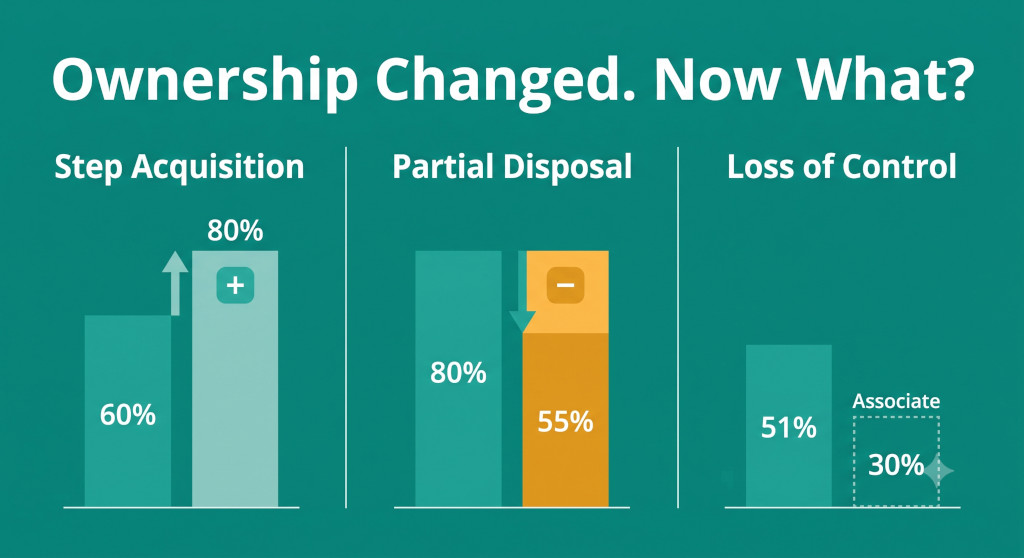
Two years ago the group acquired a 60% stake in a specialist logistics business. It was consolidated from day one, goodwill was recognised, and the 40% minority interest has been rolling forward normally in each close. Now the board has approved buying out an additional 20% from the minority shareholder. Simultaneously, the group has agreed to sell 25 percentage points of its stake in a separate subsidiary — from 80% to 55% — to a new strategic investor, while retaining operational control.
Marco, the group financial controller, knows how to consolidate an entity from scratch. He’s done it twice. But these two transactions are different: the entities are already consolidated. The question isn’t how to bring them in — they’re already in. The question is what changes in the consolidation when the ownership percentage moves, and whether those changes flow through the P&L or through equity. Those two destinations produce very different outcomes for reported earnings, and Marco needs to get it right before the board sees the numbers.
Ownership changes in an already-consolidated subsidiary fall into three distinct scenarios, each with its own accounting treatment. The critical dividing line is control: whether the group retains control of the subsidiary after the transaction or loses it. Everything else follows from that distinction.
Stop building consolidations in spreadsheets.
BrizoConsol automates multi-entity consolidation — setup in minutes, reports the same day.
The Governing Principle: Control Is the Dividing Line
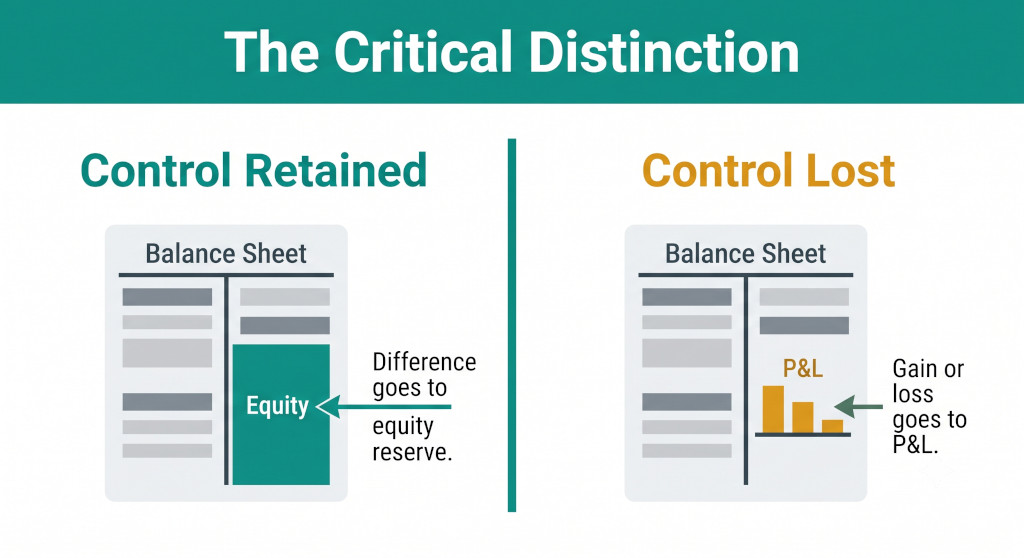
Under IFRS 10, a change in ownership percentage that does not result in a change in control status is treated as a transaction between equity holders. No gain or loss is recognised in the income statement. The difference between the consideration paid or received and the carrying amount of the NCI interest that changed hands is recognised directly in equity — typically in a separate “transactions with non-controlling interests” reserve.
A change in ownership that does result in a change in control — most commonly the loss of a controlling interest — is an entirely different event. The subsidiary is derecognised in its entirety. A gain or loss, calculated by reference to the fair value of the proceeds and any retained interest versus the carrying amount of the net assets and goodwill being given up, goes through the income statement. If a foreign subsidiary is disposed of, the accumulated currency translation adjustment (CTA) that has been sitting in OCI is also recycled to the P&L at the point of disposal.
The distinction matters enormously for reported earnings. A partial disposal that retains control produces no income statement impact — the difference is absorbed quietly in equity. A partial disposal that loses control can produce a significant gain or loss in the income statement, depending on the carrying values and fair values involved. Getting the control assessment wrong in either direction misstates both profit and equity.
The three scenarios below cover the most common ownership change situations. Each uses a consistent numerical example so the mechanics can be traced from start to finish.
Scenario A: Buying More Shares While Retaining Control (Step Acquisition Within a Subsidiary)
The group already holds 60% of Meridian Logistics and consolidates it. It now purchases a further 20% from the minority shareholder for £480,000 cash. After the transaction the group holds 80% and still has control — control was present before and remains present after. This is a transaction with the NCI, not an acquisition of a new business.
Under IFRS 10, no new goodwill is calculated. The goodwill recognised when the group first acquired its 60% stake remains unchanged. What changes is the split of equity between the group and the NCI: the NCI’s carrying amount decreases (they now hold 20% instead of 40%), and the group’s equity changes by the difference between the consideration paid and the NCI carrying amount that was acquired.
First, establish the NCI carrying amount for the 20% being acquired:
NCI carrying amount at transaction date:
Total NCI balance (40% interest)             £940,000
NCI share being acquired (20% / 40% = 50%)   £470,000
The group paid £480,000 for an NCI carrying amount of £470,000.
The difference — £10,000 — is not a goodwill increment and is not a loss. It is a deduction from the group’s equity reserve:
| DR | CR | |
| Non-controlling interest (equity) | £470,000 | |
| Equity reserve — NCI transactions | £ 10,000 | |
| Cash | £480,000 |
Purchase of additional 20% NCI in Meridian Logistics. No new goodwill is recognised. The £10,000 excess of consideration over NCI carrying amount reduces the equity attributable to the parent’s shareholders. If the consideration had been less than the NCI carrying amount, the difference would have increased the parent’s equity reserve.
After this entry the NCI balance represents 20% of Meridian Logistics’ net assets, and the group’s equity has absorbed the premium paid. The consolidated balance sheet still shows the same goodwill, the same assets and liabilities, and the same total equity — only the split between parent equity and NCI has changed. No P&L line is affected.
Common mistake: Calculating a “second tranche” of goodwill on the additional 20% purchase as though it were a new acquisition. This is wrong under IFRS 10. A transaction with the NCI while control is maintained does not trigger a remeasurement of the subsidiary’s net assets or a recalculation of goodwill. The existing goodwill balance carries forward unchanged.
Scenario B: Selling Some Shares While Retaining Control (Partial Disposal)
The group holds 80% of Helix Distribution and has now sold 25 percentage points to a strategic investor for £620,000 cash. After the sale the group holds 55% — still a majority, still in control. Again, this is a transaction between equity holders and produces no P&L impact.
The mechanics mirror Scenario A in reverse: the NCI increases from 20% to 45%, and the cash received is compared to the NCI carrying amount that was effectively transferred to the new shareholder.
NCI carrying amount for 25% being sold:
Total net assets of Helix Distribution            £2,200,000
25% share transferred to new investor             £  550,000 (measured at carrying amount, not fair value)
The group received £620,000 for a carrying amount of £550,000.
The £70,000 difference is a credit directly to the group’s equity reserve — not to the income statement:
| DR | CR | |
| Cash | £620,000 | |
| Non-controlling interest (equity) | £550,000 | |
| Equity reserve — NCI transactions | £ 70,000 |
Partial disposal of 25% of Helix Distribution to strategic investor at £620,000. Group retains 55% and continues to control. NCI increases by the carrying amount of the 25% interest transferred. Excess of proceeds over carrying amount credited to equity reserve, not P&L.
The subsidiary remains fully consolidated. Every asset, liability, and income statement line continues to be included at 100%, with the NCI now taking 45% of post-disposal profit rather than 20%. Goodwill is unaffected. Total equity is unchanged; only its composition has shifted. For a full explanation of how the NCI balance evolves in the equity statement across these events, see NCI in the Consolidated Statement of Changes in Equity.
Managing complex ownership structures in your consolidation?
BrizoConsol handles NCI, step acquisitions, and partial disposals automatically — with the equity movements tracked and auditable at every close.See It In Action
Scenario C: Losing Control — the Disposal That Changes Everything
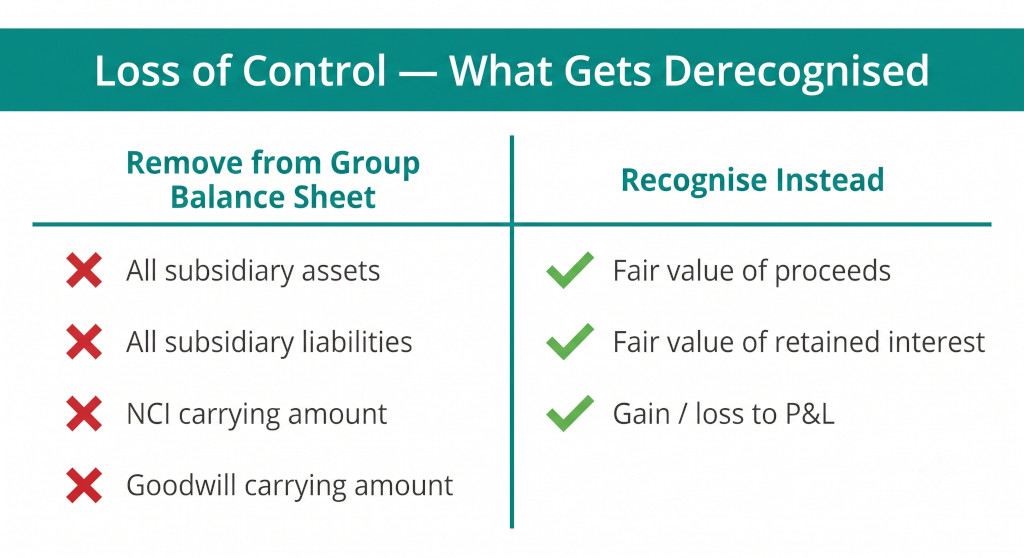
Scenario C is where the accounting changes fundamentally. Suppose the group sells 40 percentage points of its 75% stake in Vantage Technology, reducing its holding to 35%. At 35%, the group no longer has a majority interest and — assuming no contractual control rights — no longer controls Vantage. The subsidiary must be derecognised entirely, and the retained 35% interest restarts as an associate, measured initially at fair value.
The disposal date balance sheet for Vantage Technology (carrying amounts in the consolidated statements immediately before the transaction) is as follows:
| Item | Carrying Amount £’000 |
|---|---|
| Non-current assets (net of depreciation) | 3,100 |
| Goodwill (net of any impairment) | 880 |
| Current assets | 1,420 |
| Current liabilities | (740) |
| Non-current liabilities | (960) |
| Net assets (100%) | 3,700 |
| NCI carrying amount (25% × £3,700k) | 925 |
| Accumulated CTA in OCI (group’s share) | 142 |
The group sold its 40 percentage point tranche for £1,800,000 cash. The fair value of the retained 35% interest at disposal date is £1,540,000 (assessed independently). The gain or loss on disposal is calculated as follows:
Gain on disposal — loss of control calculation:
Proceeds received for 40% sold                    £1,800,000
Fair value of retained 35% interest               £1,540,000
NCI carrying amount derecognised                  £  925,000
CTA recycled from OCI to P&L                      £  142,000
─────────────────────────────────────────────────
Total                                             £4,407,000
Less: Net assets derecognised (100%)             (£3,700,000)
Less: Goodwill derecognised                      (£  880,000)
─────────────────────────────────────────────────
Loss on disposal recognised in P&L               (£  173,000)
Despite receiving £1.8 million in cash and retaining a £1.54 million interest — total value of £3.34 million — the group recognises a loss of £173,000. This is because the net assets being given up (£3,700,000 at carrying amount) plus the goodwill being written off (£880,000) total £4,580,000. The value received (£4,407,000 including the NCI derecognition and CTA recycling) falls short. The loss reflects that the consolidated carrying amounts were higher than the disposal values implied — often because goodwill had not been impaired even though the market transaction implies a value below book.
The full derecognition journal is:
| DR | CR | |
| Cash (proceeds) | £1,800,000 | |
| Investment in associate (fair value of retained 35%) | £1,540,000 | |
| NCI — derecognised | £ 925,000 | |
| CTA recycled from OCI | £ 142,000 | |
| Loss on disposal (P&L) | £ 173,000 | |
| Non-current assets | £3,100,000 | |
| Goodwill | £ 880,000 | |
| Current assets | £1,420,000 | |
| Current liabilities | £ 740,000 | |
| Non-current liabilities | £ 960,000 | |
| OCI — CTA reserve | £ 142,000 |
Full derecognition of Vantage Technology at date control is lost. Retained 35% interest recognised at fair value and subsequently accounted for under the equity method. CTA accumulated in OCI recycled to P&L (reclassification adjustment). Loss on disposal of £173,000 recognised in profit or loss.
From the disposal date forward, Vantage Technology is no longer consolidated. Its assets and liabilities disappear from the group balance sheet, its revenue and costs disappear from the P&L, and only the group’s share of Vantage’s post-disposal profit will appear — as a single line, “share of profit of associate” — under the equity method. For the mechanics of the CTA recycling and how it flows through the statements, see Recycling the CTA on Disposal of a Foreign Subsidiary. For how the equity method works in subsequent periods, see Equity Method Accounting in Group Consolidation.
What Happens to Goodwill When Ownership Changes
Goodwill treatment across the three scenarios is consistently one of the most misunderstood elements of ownership change accounting.
In Scenario A (buying more NCI, control retained), goodwill does not change. The original goodwill from the initial acquisition continues to be carried and tested for impairment. No additional goodwill arises from the top-up purchase.
In Scenario B (selling NCI, control retained), goodwill also does not change. Partial disposal to an NCI investor while retaining control is a transaction within equity and does not trigger a goodwill recalculation or partial write-off. The full goodwill balance continues to be tested at the cash-generating unit level.
In Scenario C (losing control), the entire goodwill balance associated with the subsidiary is derecognised in the disposal journal. There is no apportionment of goodwill between the disposed portion and the retained interest — all of it goes, because the subsidiary is no longer consolidated at all. The retained interest restarts as a fresh investment at fair value with no goodwill attached to it; any future goodwill arising from that associate is embedded in the equity method carrying amount. For a detailed explanation of how goodwill is calculated and carried across these scenarios, see Goodwill in Group Consolidation: How to Calculate and Account for It.
The Partial-Year P&L in the Year of the Ownership Change
In Scenarios A and B, the subsidiary remains consolidated throughout the year. Its full-year revenue, costs, and profit are included in the consolidated P&L. The ownership change affects the NCI’s share of post-transaction profit: from the transaction date forward, the NCI percentage is the new percentage. For the pre-transaction period it is the old percentage. The NCI charge in the P&L for the year is therefore a time-weighted blend, not a single-percentage calculation applied to the full year.
In Scenario C, the subsidiary is included in the P&L only up to the disposal date — from 1 January to the date control is lost. From that date, only the equity method share of Vantage’s profit is included, as a single line below operating profit. The subsidiary’s revenue, costs, depreciation, and other items disappear from the consolidated income statement from the disposal date forward. If the disposal occurs at, say, 30 September in a December year-end group, nine months of Vantage’s full P&L is consolidated and three months is replaced by a single equity method line.
Common mistake in Scenario C: Continuing to include the former subsidiary’s revenue and costs in the consolidated P&L after control is lost. This inflates group revenue and costs for the full year when only a partial year is warranted, and may materially misstate the group’s operating margin if the disposed entity had a different profitability profile from the rest of the group. The disposal date must be identified precisely and the consolidation cut applied from that date, not from the nearest month-end.
The Control Assessment: Harder Than It Looks
The correct treatment in all three scenarios depends entirely on whether control is retained or lost — and the control assessment is not always straightforward. Ownership percentage is the primary indicator, but IFRS 10 requires consideration of all facts and circumstances. A group with 48% of the votes but a contractual right to appoint a majority of board members may still have control. A group that reduces from 60% to 52% retains control. A group that reduces from 60% to 49% and simultaneously loses its board majority may have lost control even though it retains the largest single stake.
Before accounting for any ownership change, the control assessment must be refreshed. The questions to ask are: after the transaction, does the group have the power to direct the relevant activities of the entity? Does it have exposure to, or rights over, variable returns from the entity? Can it use its power to affect those returns? If the answer to all three is yes, control is retained and the equity-accounting route applies. If any element of control has been lost, the full derecognition route applies. The accounting difference between these two paths is significant — one produces no P&L impact, the other can produce a material gain or loss — so the control assessment deserves careful documentation before any journal is posted.
Practical Checklist: Consolidating an Ownership Change
- Identify the transaction date precisely. The date on which the ownership change legally completed — transfer of shares and contractual rights — is the accounting date. Approximate this to the nearest reporting period only if the difference is immaterial.
- Perform a fresh control assessment. After the transaction, document whether the group has power, variable returns exposure, and the ability to use power to affect returns. The conclusion drives everything that follows.
- If control is retained (Scenarios A or B): calculate the NCI carrying amount for the interest changing hands. The difference between consideration and NCI carrying amount goes to an equity reserve — it does not affect P&L, goodwill, or the carrying values of the subsidiary’s assets and liabilities.
- If control is lost (Scenario C): prepare the derecognition calculation. Identify: proceeds received, fair value of any retained interest, NCI carrying amount at disposal date, accumulated CTA in OCI attributable to the group. Derecognise all assets, liabilities, and goodwill at their carrying amounts. Recognise the proceeds and retained interest at fair value. The residual is the gain or loss in P&L.
- Check goodwill treatment. In Scenarios A and B, goodwill is unchanged. In Scenario C, the full goodwill balance is derecognised in the disposal entry.
- Recalculate the NCI’s share of P&L for the year. In Scenarios A and B, use the old NCI percentage up to the transaction date and the new percentage from the transaction date forward. Do not apply the new percentage to the full year.
- In Scenario C, cut the subsidiary’s P&L at the disposal date. Include the subsidiary’s revenue and costs only to the date of disposal. From disposal date, include only the equity method share of the retained interest’s profit.
- Recycle the CTA in Scenario C. Any accumulated foreign currency translation reserve attributable to the group’s interest in the disposed subsidiary must be reclassified from OCI to P&L as part of the disposal gain or loss calculation.
- Update the NCI roll-forward. In all three scenarios, the NCI balance in the equity statement needs to reflect the transaction. In Scenarios A and B this is an adjustment to the NCI column. In Scenario C the NCI column is closed out entirely at the disposal date.
- Document the control assessment and the disposal calculation. Both will be subject to audit scrutiny. The fair value of the retained interest in Scenario C is particularly sensitive — auditors will want to understand the valuation basis and whether it is supportable. For a broader view of how to structure consolidated financials for audit review, see How to Prepare for Audit with Consolidated Financials.
Ownership changes are among the most technically demanding events in group accounting precisely because the correct treatment depends on a threshold judgement — control retained versus control lost — that is not always obvious from the ownership percentage alone. The key discipline is to make that judgement carefully and document it thoroughly before any entry is posted, because the downstream accounting implications are significant and difficult to reverse once the consolidation has been closed. For the mechanics of the initial acquisition that established the subsidiary in the first place, and for the fair value and goodwill calculations that underpin all three scenarios here, see Acquisition Accounting in Group Consolidation: A Step-by-Step Guide to IFRS 3.
Ownership changes handled cleanly from the first close
BrizoConsol tracks NCI balances, step acquisition entries, and disposal calculations with a full audit trail — so every ownership change is documented and every equity movement is reconcilable. Start Free Trial