Selling a Machine to Your Own Subsidiary: Why the Disposal Gain Is Fictional and What to Do With It
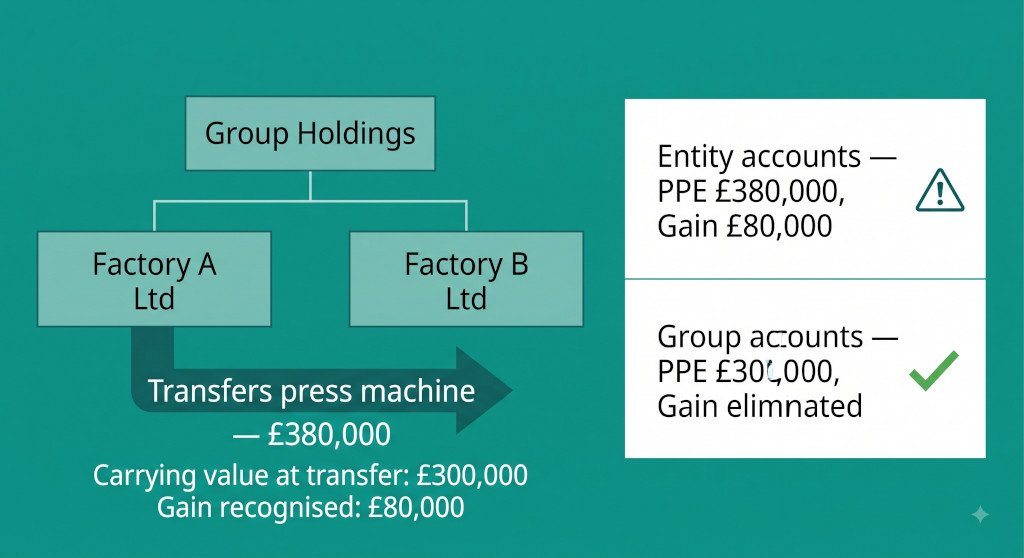
When a manufacturing group restructures its production capacity, it is common for assets to move between entities. A pressing machine that Factory A no longer needs becomes exactly what Factory B requires for a new product line. The transaction is straightforward operationally — the machine is relocated, insured under the new entity, and Factory B starts using it. The accounting, however, creates a problem that surfaces quietly in the consolidation months or even years later.
Factory A, transferring the machine, processes the transaction as a disposal. It derecognises the asset at its carrying value and recognises the transfer price as proceeds — producing a gain or a loss on disposal in its P&L. Factory B capitalises the machine at the transfer price, begins depreciating it over the asset’s remaining useful life, and records a trade payable to Factory A. From the perspective of each entity, the accounting is correct. From the perspective of the group, both entries are wrong. No disposal has taken place at group level — the machine has simply moved address. The gain is fictional, the PPE is overstated, and every depreciation charge that follows is calculated on an inflated base.
This problem is not limited to presses and heavy machinery. It arises whenever any fixed asset — tooling, vehicles, production equipment, IT infrastructure — moves between group entities at a price above carrying value. It is also distinct from the scenario where a construction subsidiary builds a new asset for a sibling entity. That problem involves capitalising internally generated revenue. This problem involves eliminating an internal disposal transaction — and it has a slightly different shape in the consolidation journals.
Stop building consolidations in spreadsheets.
BrizoConsol automates multi-entity consolidation — setup in minutes, reports the same day.
Setting Up the Worked Example
Factory A Ltd and Factory B Ltd are both wholly owned subsidiaries of Manufacturing Group Holdings Ltd. Factory A has a hydraulic press on its balance sheet with the following history:
| Item | Amount |
|---|---|
| Original cost (acquired 5 years ago) | £500,000 |
| Accumulated depreciation (5 years at £50,000/yr) | £(250,000) |
| Carrying value at date of transfer | £250,000 |
Factory A transfers the press to Factory B for £330,000 — reflecting a fair commercial price and the remaining economic value of the machine. Factory B’s engineers assess the remaining useful life at five years and will depreciate it on a straight-line basis. Factory A recognises a gain on disposal of £80,000 (£330,000 proceeds less £250,000 carrying value). Factory B capitalises the press at £330,000.
| Transfer price (proceeds to Factory A) | £330,000 |
| Carrying value at transfer (Factory A) | (£250,000) |
| Gain on disposal — Factory A P&L | £80,000 |
At group level, the carrying value of the press before and after the transfer is still £250,000. The group has not transacted with anyone outside the group. No gain should appear in the consolidated P&L, and the press should not appear at £330,000 in the consolidated balance sheet.
The consolidation principle is that an intragroup asset transfer is not a disposal event at group level. The asset continues to be recognised at its carrying value in the group — which is the original cost less accumulated depreciation calculated from the date the group first acquired the asset, regardless of how many times it has moved between entities.
Step 1 — Eliminate the Disposal Gain and Restore the Carrying Value
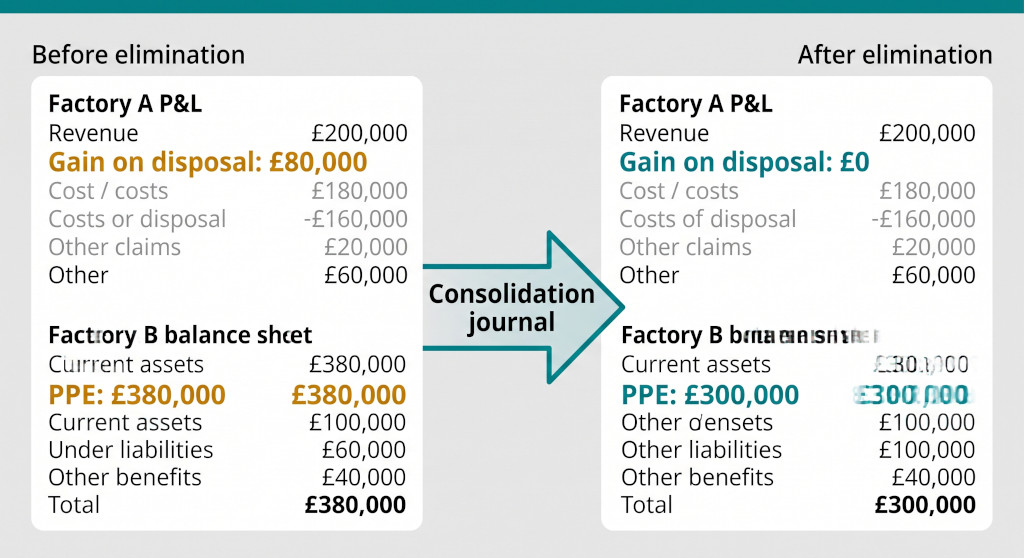
In the year of transfer, the elimination has two effects: it removes the disposal gain from Factory A’s P&L, and it reduces the PPE balance in Factory B’s books from the transfer price to the group carrying value.
Factory B has capitalised the press at £330,000. The group carrying value is £250,000. The difference — £80,000 — is exactly equal to the gain Factory A recognised. The elimination journal removes the gain and corrects the PPE simultaneously.
| Account | Dr | Cr |
|---|---|---|
| Gain on disposal of plant (Factory A — P&L) | £80,000 | |
| PPE — cost (Factory B — balance sheet) | £80,000 |
Eliminates the intragroup disposal gain recognised by Factory A and reduces Factory B’s capitalised cost from £330,000 to the group carrying value of £250,000. The group P&L no longer shows a gain; consolidated PPE is carried at the pre-transfer carrying value.
The intercompany settlement also needs to be eliminated. Factory B owes Factory A £330,000 for the machine. Factory A shows a receivable for the same amount. These cancel at group level.
| Account | Dr | Cr |
|---|---|---|
| Intercompany payable — Factory A (Factory B) | £330,000 | |
| Intercompany receivable — Factory B (Factory A) | £330,000 |
Eliminates the intercompany settlement balance. If cash has already been paid, the cash flows in each entity cancel each other at group level and no balance sheet elimination is needed — this journal applies only if an outstanding payable/receivable remains at period-end.
You must also deal with Factory A’s accumulated depreciation that was derecognised on disposal. When Factory A disposed of the press, it wrote off the £250,000 accumulated depreciation against the cost. The group, however, is treating this as a continuing asset — it needs to reinstate the accumulated depreciation position from the group’s perspective. After five years at £50,000/year, the group’s accumulated depreciation on the press is £250,000.
| Account | Dr | Cr |
|---|---|---|
| PPE — cost (Factory B) | £500,000 | |
| Accumulated depreciation — PPE (Factory B) | £250,000 | |
| PPE — cost (Factory B) [net of prior two journals] | £250,000 |
Restatement approach — in practice, the combined effect of the gain elimination and accumulated depreciation reinstatement is often presented as a single net journal. The consolidated PPE schedule shows the press at its original cost of £500,000 with accumulated depreciation of £250,000, giving a net book value of £250,000 — the same carrying value the asset had immediately before transfer.
In practice, many consolidators present the net effect rather than three separate journals. The net result is: Factory B’s PPE cost is restated to £500,000 (the original cost to the group), accumulated depreciation is reinstated at £250,000, and the gain on disposal is eliminated. The consolidated balance sheet carries the press at £250,000 net book value — exactly where it was before the transfer.
Step 2 — The Annual Depreciation Adjustment
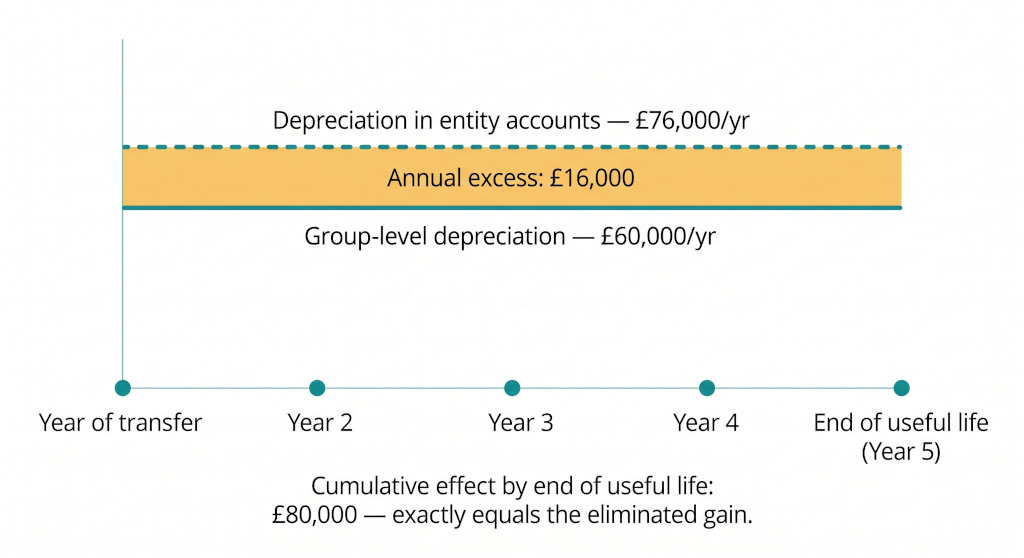
Factory B depreciates the press at £330,000 ÷ 5 years = £66,000 per year. But the group’s cost basis for the asset is £250,000 with a 5-year remaining life, giving a group-level annual charge of £50,000. The difference is £16,000 per year — and this excess must be eliminated in every period for the remaining useful life of the asset.
| Depreciation in Factory B entity accounts (£330,000 ÷ 5 yrs) | £66,000 |
| Depreciation at group carrying value (£250,000 ÷ 5 yrs) | £50,000 |
| Annual excess depreciation to reverse | £16,000 |
| Account | Dr | Cr |
|---|---|---|
| Accumulated depreciation — PPE (Factory B) | £16,000 | |
| Depreciation charge (P&L) | £16,000 |
Reverses the annual excess depreciation arising from Factory B’s inflated cost base. Posted each period for the remaining 5-year useful life of the press. Over five years, the cumulative reversal totals £80,000 — exactly equal to the gain eliminated in the year of transfer.
Over the five-year remaining life, the cumulative depreciation reversal totals £80,000 — exactly equal to the disposal gain eliminated in the year of transfer. This is not a coincidence. The gain and the depreciation tail are mathematically linked: the gain arose because the transfer price exceeded the carrying value, and the depreciation tail arises because Factory B is depreciating from that higher base. By the time the asset is fully depreciated, the entire gain will have been “released” back through the annual depreciation reversals, and the consolidated position will be as if the asset was always held at its original cost.
The annual depreciation reversal must be added to your consolidation template as a recurring journal. Without it, each period’s consolidated P&L overstates the depreciation charge by £16,000. Over five years that is £80,000 of understated group profit — ironically, the same amount as the gain that was eliminated in year one. The two errors offset each other perfectly, which means a group that eliminates the gain but forgets the depreciation reversal will show the same total profit over the asset’s life as if it had done neither adjustment. But the timing is wrong in every individual period, and the balance sheet will be wrong throughout.
How the Consolidated Balance Sheet Looks Year by Year
| Period | PPE cost (group) | Accumulated depreciation | Net book value | Annual depreciation reversal |
|---|---|---|---|---|
| Year of transfer | £500,000 | £250,000 | £250,000 | — |
| Year 1 post-transfer | £500,000 | £300,000 | £200,000 | £16,000 |
| Year 2 post-transfer | £500,000 | £350,000 | £150,000 | £16,000 |
| Year 3 post-transfer | £500,000 | £400,000 | £100,000 | £16,000 |
| Year 4 post-transfer | £500,000 | £450,000 | £50,000 | £16,000 |
| Year 5 post-transfer (fully depreciated) | £500,000 | £500,000 | £0 | £16,000 |
The asset reaches a nil net book value after five further years — as it would have done if it had always been held by Factory B at cost to the group. The accumulated depreciation reversals total £80,000 over five years, releasing back to the P&L the gain that was eliminated in the year of transfer.
Recurring consolidation journals that never slip
BrizoConsol lets you set up recurring group journals for events like asset transfer depreciation adjustments — so the annual reversal posts automatically at each close, and you can audit the full history of every group journal in one place.See It In Action
When the Transfer Price Is Below Carrying Value
Not all intragroup asset transfers produce a gain. If Factory A transfers the press at £200,000 — below the £250,000 carrying value — it recognises a loss on disposal of £50,000. At group level, this loss is also eliminated: no disposal has taken place, and no loss should appear in the consolidated P&L. However, a transfer below carrying value raises an additional question. Does the lower transfer price indicate that the asset is impaired?
If the asset’s recoverable amount (under IAS 36) has genuinely fallen below £250,000, then the impairment is a group-level economic event that should be recognised in the consolidated accounts — the loss is real. In that case, the consolidation should eliminate the intercompany loss, but separately test the asset for impairment at group level and recognise any impairment that is justified by recoverable amount, not by the internal transfer price.
If the transfer price was set below carrying value for other reasons — a group policy of transferring assets between entities at depreciated replacement cost, for instance, or a commercial negotiation between the entities — and the asset’s recoverable amount is in fact higher, then the full loss is eliminated and no impairment is recognised. The asset continues at its carrying value in the group accounts.
Partially Owned Subsidiaries
When the transferring or receiving entity has an NCI, the eliminated gain affects the NCI calculation. If Factory A is 80% owned by the group, the £80,000 gain eliminated from Factory A’s P&L reduces the profit attributable to Factory A’s NCI by £16,000 (20% of £80,000). Similarly, each year’s depreciation reversal of £16,000 increases the profit attributable to Factory B — which if Factory B has an NCI, increases the NCI’s share proportionately.
The journals remain the same. The NCI allocation is adjusted through the share-of-profit calculation, not through the elimination journals themselves. This is consistent with IFRS 10’s full consolidation approach — the entire gain is eliminated, not just the group’s proportionate share.
Deferred Tax on the Eliminated Gain
In most jurisdictions, the disposal of a fixed asset is a taxable event for the transferring entity, regardless of whether the transaction is intragroup. Factory A will typically include the gain in its taxable profits for the year of transfer. Factory B, meanwhile, will claim capital allowances (or depreciation deductions) on its tax base — which may be the transfer price, depending on local tax rules.
This creates a temporary difference at group level. The consolidated accounts have eliminated the gain and reduced PPE to £250,000, but the tax position reflects a higher tax base. A deferred tax asset arises in the year of transfer — representing the tax benefit of the excess future depreciation deductions in Factory B’s tax computation versus the group’s depreciation for accounting purposes. As the annual depreciation reversals unwind the gain over five years, the deferred tax asset also unwinds. The mechanics of this deferred tax calculation are specific to each tax jurisdiction and are best prepared in conjunction with the group’s tax advisers, but the existence of the temporary difference should not be overlooked at consolidation.
Practical Checklist for Intragroup Plant Transfers
- Identify all intragroup asset disposals in the period. Review each entity’s disposal schedule and flag any proceeds paid to or received from another group entity.
- Calculate the gain or loss on each intragroup disposal — transfer price less carrying value in the transferring entity at the date of transfer.
- Post the year-of-transfer elimination: remove the gain from the P&L, reduce the receiving entity’s PPE cost to the group carrying value, and reinstate the transferring entity’s accumulated depreciation (or present as a net journal).
- Eliminate the intercompany settlement balance (payable/receivable) if it remains outstanding at the reporting date.
- Calculate the annual depreciation excess: receiving entity’s annual depreciation based on transfer price less group-level depreciation based on original carrying value.
- Add the annual depreciation reversal to the recurring consolidation journal template — it must be posted in every period for the asset’s remaining useful life.
- Note the useful life assessed by the receiving entity. If it differs from the remaining life used by the transferring entity, use the receiving entity’s assessment for the depreciation reversal calculation.
- Consider deferred tax. Document the temporary difference created by the gain elimination and any excess depreciation, and calculate the deferred tax asset with reference to the applicable tax rate.
- For transfers below carrying value, determine whether the lower price reflects genuine impairment (in which case test at group level and recognise accordingly) or is an artefact of internal pricing (in which case eliminate the loss and carry the asset at its pre-transfer carrying value).
- At the end of the asset’s useful life, confirm that the accumulated depreciation reversals have totalled the same amount as the gain eliminated in the year of transfer. If they do not match, investigate — the depreciation reversal calculation may have used an incorrect base.
Intragroup plant transfers are one of those consolidation events that create a long tail of adjustments — a single machine moved between subsidiaries can generate a recurring journal for a decade or more. The discipline of logging the event in the consolidation template at the time it happens, with the annual reversal amount clearly documented, is what prevents the adjustment from being forgotten in later years when institutional memory of the original transaction has faded.
For context on how these plant transfer eliminations sit alongside the broader consolidation process for a manufacturing group, Financial Consolidation for Manufacturing Groups covers the full close structure. And for the foundational mechanics of intercompany elimination journals across different transaction types, Intercompany Eliminations: A Complete Guide for Group Consolidation is the reference starting point.
Ready to take control of your manufacturing group consolidation?
BrizoConsol handles intercompany eliminations, recurring journals, and consolidated reporting across all your entities — so your close is consistent, auditable, and fast every period. Start Free Trial