Intercompany Eliminations: A Complete Guide for Group Consolidation
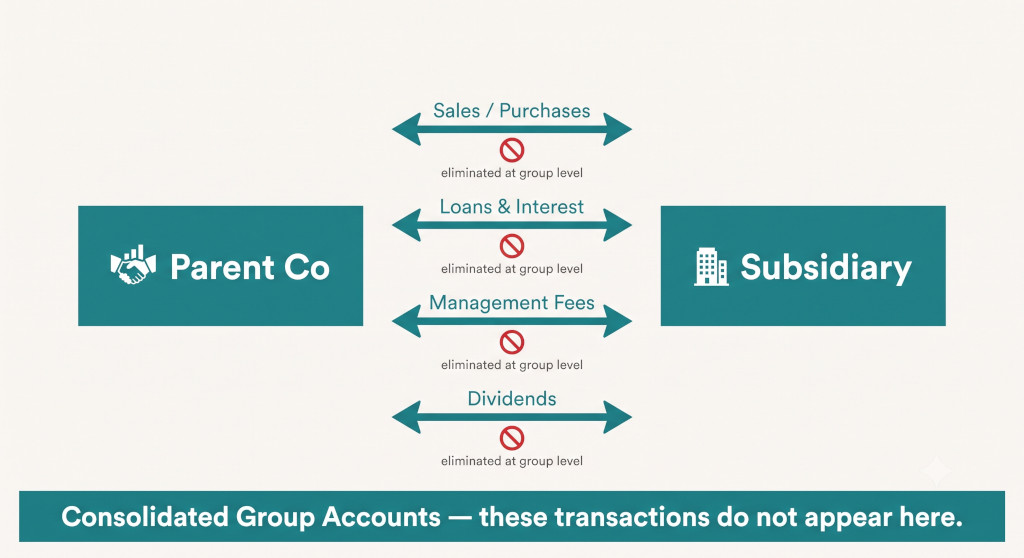
When a parent company sells goods to its subsidiary, both sides of that transaction end up in the accounting records. The parent records revenue; the subsidiary records a purchase. From the perspective of either entity in isolation, that is entirely correct. From the perspective of the group, it is a fiction — no value has been created or transferred outside the group. The group has, in effect, sold goods to itself.
Intercompany eliminations exist to remove this fiction from the consolidated accounts. Every transaction between group entities — sales, loans, interest, dividends, management fees, and more — must be identified and eliminated before a consolidated income statement and balance sheet can be produced. The result is a set of accounts that presents the group as if it were a single company, with only transactions between the group and the outside world reflected in the numbers.
This guide covers every category of intercompany elimination, with worked journal entries for each, so that finance teams can approach their consolidation with a systematic checklist rather than rediscovering the same adjustments every quarter.
Intercompany eliminations without the manual work.
BrizoConsol identifies and eliminates intercompany balances automatically at consolidation.
Why Eliminations Are Required
The underlying principle is straightforward: consolidated accounts should show only the group’s transactions with external parties. Transactions between entities within the group are internal transfers — they may generate accounting entries in each entity’s books, but they do not represent economic activity from the group’s perspective.
Consider a simple three-entity group: a holding company, a manufacturing subsidiary, and a distribution subsidiary. During the year, the manufacturing subsidiary sells £500,000 of goods to the distribution subsidiary. Without elimination, the consolidated income statement would show £500,000 of revenue (from the manufacturing subsidiary’s books) and £500,000 of cost of sales (in the distribution subsidiary’s books). Both figures would be correct at entity level, but including them in the consolidated accounts would overstate the group’s revenue and gross profit, since no sale to a third party has yet occurred.
The elimination removes both the revenue and the cost — the consolidated accounts show neither, unless and until the distribution subsidiary sells those goods to an external customer.
The consolidation standard — whether IFRS 10, FRS 102 Section 9, or equivalent — requires that intragroup transactions, balances, income, and expenses be eliminated in full. There is no threshold below which eliminations can be skipped; materiality applies to whether an error in the consolidated accounts is significant, not to whether eliminations should be attempted at all.
The Six Types of Intercompany Elimination
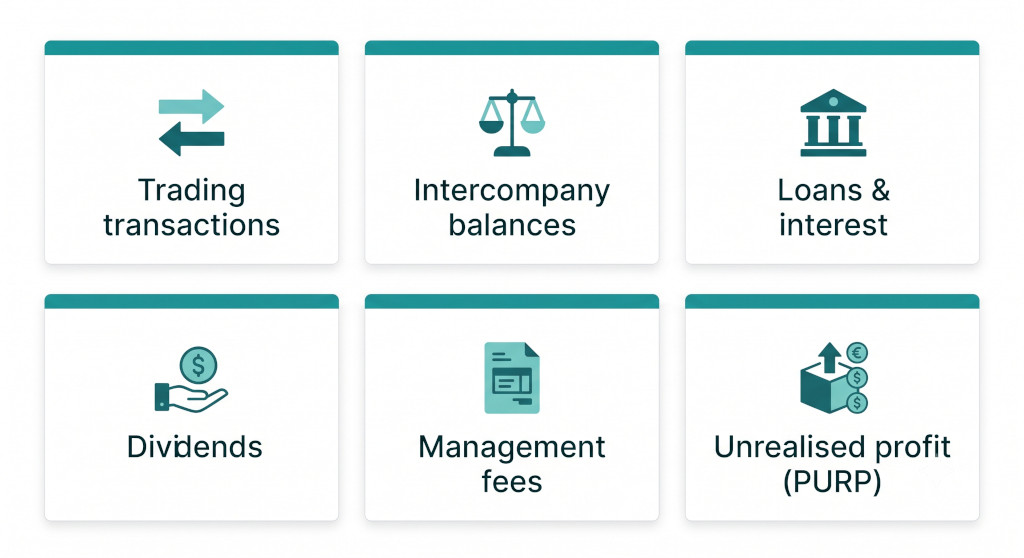
Most consolidations involve some or all of the following six categories. We use a consistent group throughout: Atlas Group, comprising Atlas Holdings Ltd (parent), Atlas Manufacturing Ltd (100% subsidiary), and Atlas Distribution Ltd (100% subsidiary).
1. Intercompany Trading Transactions
Elimination Type 1
Where one group entity sells goods or services to another group entity, both the revenue recorded by the seller and the cost recorded by the buyer must be eliminated from the consolidated income statement.
The facts: During the year, Atlas Manufacturing sold £500,000 of goods to Atlas Distribution at cost plus 20%, i.e., at a selling price that included a £83,333 profit margin. Atlas Distribution sold all of these goods to external customers by the year-end.
Because all goods have been sold externally, the full elimination is straightforward — revenue and cost cancel exactly, with no residual unrealised profit issue (that arises only where goods remain in inventory at year-end, covered under Type 6 below).
Journal 1 — Eliminate intercompany trading revenue and cost of sales
| Account | Dr (£) | Cr (£) |
|---|---|---|
| Revenue (Atlas Manufacturing) | 500,000 | |
| Cost of sales (Atlas Distribution) | 500,000 |
The net effect on consolidated profit is zero — the intercompany profit margin (£83,333) was already realised through Atlas Distribution’s sale to external customers, so it remains in the consolidated income statement as part of Atlas Distribution’s gross profit. Only the gross revenue and the matching cost between group entities are removed.
2. Intercompany Balances (Receivables and Payables)
Elimination Type 2
Every intercompany receivable in one group entity must be matched to the corresponding intercompany payable in another. Both are eliminated — they represent amounts owed between group members, which from the group’s perspective do not exist.
The facts: At year-end, Atlas Distribution owes Atlas Manufacturing £60,000 for goods purchased but not yet paid. Atlas Manufacturing shows £60,000 as a trade receivable; Atlas Distribution shows £60,000 as a trade payable.
Journal 2 — Eliminate intercompany receivable and payable
| Account | Dr (£) | Cr (£) |
|---|---|---|
| Trade payable — intercompany (Atlas Distribution) | 60,000 | |
| Trade receivable — intercompany (Atlas Manufacturing) | 60,000 |
Intercompany balance mismatches. In practice, the receivable in one entity rarely equals the payable in the other at the year-end cut-off. Goods-in-transit, timing differences on payment runs, and accruals recorded by one side but not the other are the most common causes. The mismatch must be identified and resolved before the elimination journal is posted — it cannot simply be forced. A difference left unresolved will cause the consolidated balance sheet to fail to balance.
3. Intercompany Loans and Interest
Elimination Type 3
Loans between group entities generate two separate eliminations: the loan balance itself (asset in the lender, liability in the borrower), and the interest charged on it (income in the lender, expense in the borrower).
The facts: Atlas Holdings has lent £800,000 to Atlas Manufacturing to fund a factory expansion. During the year, Holdings charged 5% interest — £40,000 — on the outstanding balance.
Journal 3a — Eliminate intercompany loan balance
| Account | Dr (£) | Cr (£) |
|---|---|---|
| Intercompany loan payable (Atlas Manufacturing) | 800,000 | |
| Intercompany loan receivable (Atlas Holdings) | 800,000 |
Journal 3b — Eliminate intercompany interest
| Account | Dr (£) | Cr (£) |
|---|---|---|
| Interest income (Atlas Holdings) | 40,000 | |
| Interest expense (Atlas Manufacturing) | 40,000 |
Note that if interest has accrued but not yet been paid at the year-end, there will also be an intercompany accrual to eliminate: accrued interest receivable in Holdings and accrued interest payable in Manufacturing. This is a balance-sheet elimination (Journal 2 type) applied to the accrued interest specifically.
4. Intercompany Dividends
Elimination Type 4
When a subsidiary pays a dividend to its parent, the parent records dividend income in its profit or loss. The subsidiary records a reduction in retained earnings. From the group’s perspective, no wealth has been created — money has moved from one pocket to another. The dividend income must be eliminated, and the movement in the subsidiary’s retained earnings is already captured within the group’s consolidated retained earnings (the subsidiary’s post-acquisition reserves belong to the group).
The facts: Atlas Manufacturing paid a £120,000 dividend to Atlas Holdings during the year. Holdings recorded £120,000 of dividend income; Manufacturing’s retained earnings were reduced by £120,000.
Journal 4 — Eliminate intercompany dividend
| Account | Dr (£) | Cr (£) |
|---|---|---|
| Dividend income (Atlas Holdings P&L) | 120,000 | |
| Dividends paid (Atlas Manufacturing equity) | 120,000 |
If the dividend was declared but not yet paid at the year-end, it would appear as a dividend payable in Manufacturing’s accounts and a dividend receivable in Holdings’ accounts — both of which require the balance-sheet elimination from Journal 2 in addition to the P&L elimination above.
5. Management Fees and Recharges
Elimination Type 5
Many groups operate a central management company or holding company that provides services — accounting, HR, IT, procurement, brand licensing — to operating subsidiaries, charging a management fee or cost recharge. The fee is income for the service provider and an expense for the recipient. Both must be eliminated on consolidation.
The facts: Atlas Holdings provides group management services and charges each subsidiary a quarterly management fee. During the year, Manufacturing paid £48,000 and Distribution paid £36,000 — total fees of £84,000 recorded as income by Holdings.
Journal 5 — Eliminate intercompany management fees
| Account | Dr (£) | Cr (£) |
|---|---|---|
| Management fee income (Atlas Holdings) | 84,000 | |
| Management fee expense (Atlas Manufacturing) | 48,000 | |
| Management fee expense (Atlas Distribution) | 36,000 |
Management fees are one of the most administratively intensive eliminations because they tend to generate accrual mismatches. Holdings may accrue the fee at the end of each quarter; a subsidiary may only recognise it when invoiced. A rigorous intercompany reconciliation process — confirming that both sides of each fee have been recorded before the elimination is applied — is the only reliable way to avoid consolidation differences here.
6. Unrealised Profit in Inventory (PURP)
Elimination Type 6
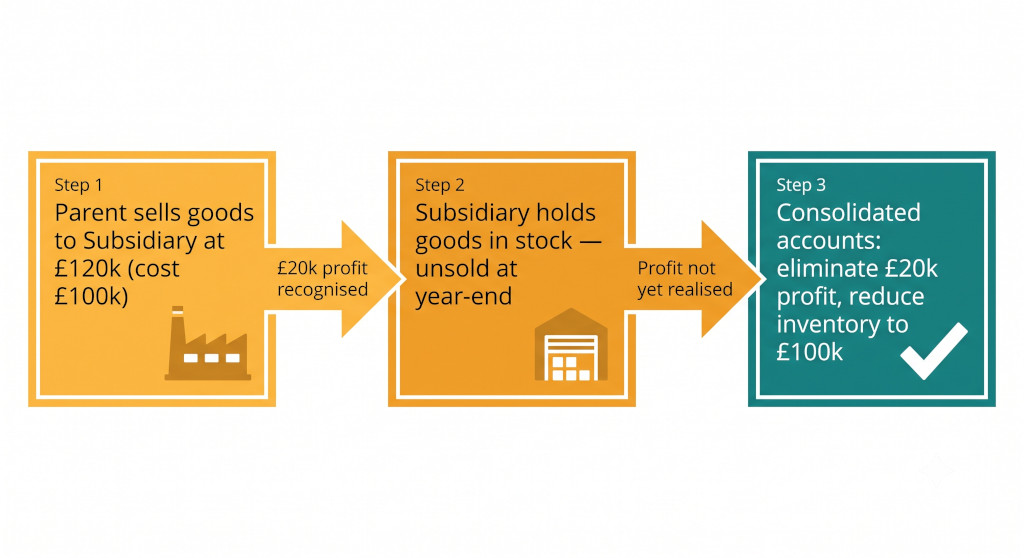
This is the most conceptually involved of the six elimination types. When one group entity sells goods to another at a markup, and the buying entity still holds some or all of those goods in inventory at the year-end, the seller’s profit on those unsold goods has not yet been earned from the group’s perspective — the goods have not been sold to an external customer. The unrealised element of the profit must be eliminated from both the consolidated income statement (by reducing the seller’s profit) and the consolidated balance sheet (by reducing the carrying amount of inventory to its cost to the group).
This adjustment is known as the Provision for Unrealised Profit, or PURP.
Calculating the PURP
The facts: During the year, Atlas Manufacturing sold £300,000 of goods to Atlas Distribution at cost plus 25%, meaning Manufacturing’s cost for these goods was £240,000 and its profit was £60,000. At the year-end, Atlas Distribution still holds £90,000 (at its cost, i.e., the transfer price) of these goods in inventory — they have not yet been sold to external customers.
The unrealised profit in the closing inventory is calculated by applying the profit margin to the inventory value at the transfer price:
| Item | Calculation | Amount (£) |
|---|---|---|
| Inventory held by Distribution at transfer price | Given | 90,000 |
| Profit margin on transfer (25/125 of transfer price) | £90,000 × 25/125 | 18,000 |
| Inventory at cost to the group (£90k − £18k) | £90,000 − £18,000 | 72,000 |
| PURP — unrealised profit to eliminate | 18,000 |
Journal 6 — Eliminate unrealised profit in closing inventory (PURP)
| Account | Dr (£) | Cr (£) |
|---|---|---|
| Cost of sales / Retained earnings (Manufacturing) | 18,000 | |
| Inventory (Atlas Distribution balance sheet) | 18,000 |
The debit reduces the seller’s profit — Manufacturing’s gross profit is restated to reflect the fact that £18,000 of its reported margin has not yet been earned from the group’s perspective. The credit reduces the carrying amount of inventory in the consolidated balance sheet from £90,000 (the transfer price) to £72,000 (the cost to the group as a whole).
What happens in subsequent periods
In the following year, when Atlas Distribution sells those goods to an external customer, the profit becomes realised from the group’s perspective. The PURP from the prior year is reversed — the opening inventory adjustment unwinds, and the profit flows through to the consolidated income statement when the external sale occurs. This reversal is typically handled by including the prior-year PURP as an opening retained earnings adjustment in year two.
A common error is to eliminate the PURP against the wrong entity’s profit. The debit should be to the selling entity’s profit (or retained earnings if the prior period PURP is reversing), not to the buying entity’s cost of sales. Getting this wrong does not affect the net elimination figure, but it misstates the margin of each subsidiary in the segment reporting, which can be significant for management reporting purposes.
PURP on fixed assets (upstream asset transfers)
A less common but equally important variant arises when one group entity sells a fixed asset to another at a profit. For example, Manufacturing sells a piece of equipment to Distribution for £150,000, when its original cost was £100,000 and its net book value was £80,000 — generating a profit of £70,000 in Manufacturing’s accounts. From the group’s perspective, the asset cost £100,000 (its original cost to the group) and has a net book value of £80,000 — no profit has been earned by selling it to another group entity.
The elimination reduces the asset to its net book value to the group (£80,000), eliminates the profit in Manufacturing (£70,000), and also adjusts the depreciation charged in subsequent years, since Distribution is depreciating the asset from a £150,000 base rather than the group’s £80,000 base.
Eliminations in Practice: A Consolidated View
Running all six eliminations together, the effect on the Atlas Group consolidated accounts can be summarised:
| Elimination | Income Statement Effect | Balance Sheet Effect |
|---|---|---|
| 1. Trading transactions | Revenue −£500k; Cost of sales −£500k | None (all goods sold externally) |
| 2. Intercompany balances | None | Receivables −£60k; Payables −£60k |
| 3. Loan and interest | Interest income −£40k; Interest expense −£40k | Loan receivable −£800k; Loan payable −£800k |
| 4. Dividends | Dividend income −£120k; Retained earnings +£120k | Dividend receivable/payable eliminated if outstanding |
| 5. Management fees | Fee income −£84k; Fee expense −£84k | Accruals eliminated if outstanding |
| 6. PURP (inventory) | Cost of sales +£18k (profit reduced) | Inventory −£18k |
The net effect on consolidated profit across eliminations 1–5 is zero — each item eliminated from one entity is matched by an equal elimination from another, so the group’s total profit is unchanged. The exception is the PURP (elimination 6), which reduces consolidated profit by £18,000 — the unrealised profit that has not yet been earned through an external sale.
The Investment in Subsidiary Elimination
There is a seventh elimination that sits outside the six operational types above but is fundamental to every consolidation: the elimination of the parent’s investment in each subsidiary against the subsidiary’s equity at the date of acquisition.
In Atlas Holdings’ entity accounts, the investment in each subsidiary appears as a financial asset at cost. In each subsidiary’s accounts, that cost is reflected as the subsidiary’s share capital (and any share premium). These mirror each other and must be eliminated. Any difference between the cost of the investment and the fair value of the subsidiary’s net assets at acquisition is goodwill, which is then carried as a separate intangible asset in the consolidated balance sheet and tested for impairment annually.
This elimination is performed once — at the acquisition date — and the resulting goodwill is then carried forward and not re-eliminated each period. It is the starting point of every consolidation, before any of the six operational eliminations are applied.
Common Errors and How to Avoid Them
The most frequent problems in intercompany eliminations fall into four categories.
Missing transactions. Not all intercompany transactions are labelled as such in the underlying accounting system. A management fee may be booked as “consultancy income” in the parent and “professional fees” in the subsidiary, with no intercompany flag on either side. A comprehensive intercompany schedule — agreed between all group entities before the close — is the only reliable way to ensure every transaction is captured.
Timing differences creating balance mismatches. The most common cause of a consolidation that does not balance is an intercompany receivable that does not equal the corresponding payable. This almost always has an innocent cause — a payment in transit, an invoice not yet received, or an accrual booked by one side only. The fix is methodical: reconcile every intercompany balance before posting any elimination journal. Do not proceed until both sides agree, or the difference is explained and adjusted.
PURP calculated on the wrong margin. The profit margin used in the PURP calculation must be the seller’s margin on the intragroup sale, not the buyer’s margin on its eventual external sale. Using the wrong rate produces a PURP that is either over- or understated, which carries through to retained earnings in subsequent periods as it reverses.
Omitting the PURP reversal in the following year. When the prior-year PURP reverses (because the goods have now been sold externally), the reversal must be explicitly posted in year two. Some consolidation processes eliminate only the closing PURP without including the reversal of the prior-year PURP as an opening adjustment, which understates the current year’s consolidated profit by the prior-year PURP amount.
Automate Your Intercompany Eliminations
BrizoConsol detects intercompany transactions across all connected entities, matches them, flags mismatches for review, and posts the elimination journals automatically — so your consolidation close takes hours, not days. Start Free Trial
Intercompany Eliminations in Foreign Currency Groups
Where a group includes foreign subsidiaries, intercompany transactions introduce a further complication: the transaction may be denominated in one currency, recorded in the subsidiary’s local currency, and then translated to the parent’s presentation currency at the consolidation stage. The exchange rate used for translation differs depending on whether the item is a balance sheet item (closing rate) or an income statement item (average rate), which means that even after a correctly matched intercompany balance has been eliminated, a residual currency translation difference may remain.
This difference is not an error — it is a natural consequence of applying different rates to the two legs of the same transaction. It is recognised as part of the group’s Currency Translation Adjustment (CTA) and accumulated in the foreign currency translation reserve within equity. It does not affect the group’s reported profit or loss.
For groups managing multiple currencies, getting the intercompany elimination and the CTA calculation right simultaneously is one of the most technically demanding aspects of monthly consolidation. BrizoConsol handles both automatically — eliminating the intercompany balances and computing the residual translation difference in the same calculation step.
Multi-Currency Groups, One Clean Consolidation
From intercompany eliminations to CTA calculation, BrizoConsol handles the full consolidation close for multi-entity, multi-currency groups — connected to Xero, QuickBooks, MYOB, and Zoho Books. Start Free Trial