Why Your Month-End Close Keeps Slipping (And How to Get It Back Under Control)
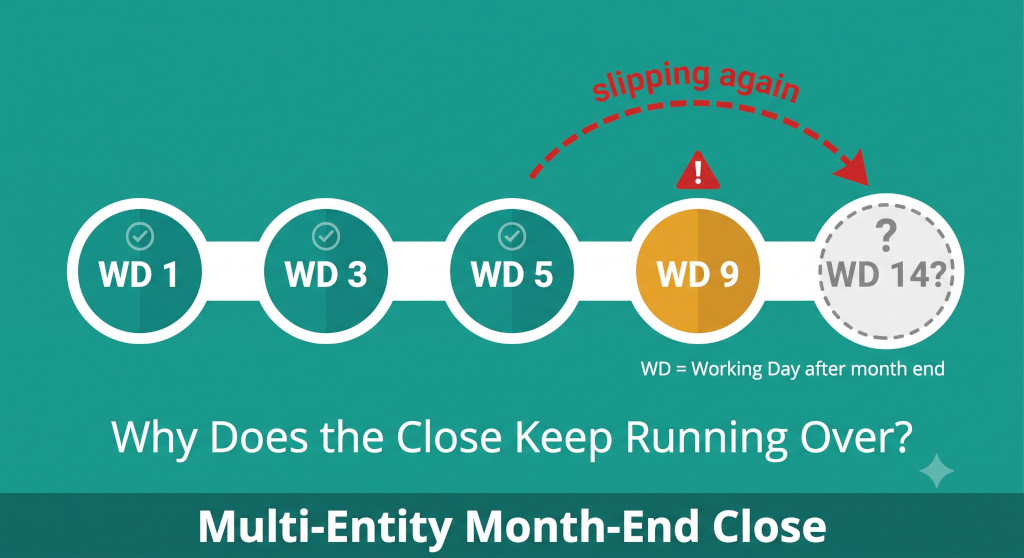
It was day nine of what was supposed to be a five-day close. The group financial controller of a seven-entity logistics business had sent the same chasing email to the Malaysian subsidiary for the third time. The Sydney entity had submitted its trial balance two days late with a note that the intercompany balance with the Singapore entity “still needed to be confirmed.” The UK holding company’s bank reconciliation had been done, but a £23,000 discrepancy in the intercompany loan account had generated three versions of the same journal entry from three different people, none of them reconciling. The board pack was due in four days. It was not going to be ready.
The controller was not incompetent. The team was not lazy. The problem was structural: the group had grown from two entities to seven over four years, and the close process had never been rebuilt to match. What worked with two subsidiaries — an informal phone call, a shared spreadsheet, a two-day consolidation — had become a nine-day fire drill at seven entities, and it was getting worse every quarter as the business added headcount and complexity without adding process.
If your close is consistently overrunning, the cause is almost never a shortage of people. It is almost always one of six process failures that compound each other — each one adding a day or two, and together turning a week-long close into a fortnight of stress. This post diagnoses each failure, shows you where it shows up in practice, and tells you exactly what to change.
Close your books faster every month.
BrizoConsol streamlines your month-end consolidation so your team spends less time on manual work.
The Six Reasons the Close Keeps Slipping
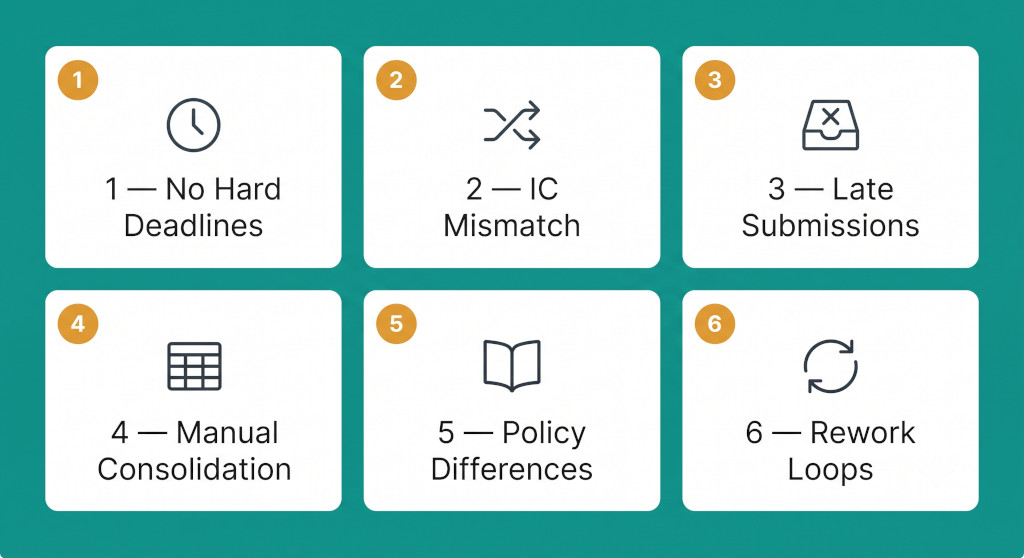
1. No Hard Deadlines — Only Soft Expectations
The most common cause of a slow close is also the most preventable: there are no firm deadlines for entity submissions, only an approximate expectation that data will arrive “around the third” or “early in the week.” When deadlines are soft, they slip. The Sydney entity submits on the fourth because it always has. The Singapore entity submits on the fifth because it’s waiting for Sydney to confirm an intercompany balance. The UK holding company can’t start the consolidation until both are in. By the time the controller has everything, it’s the eighth.
The fix is a published, non-negotiable close calendar with hard submission deadlines for each entity — not “early in the week” but “9am on Working Day 3 after month end, in the group consolidation template, with the intercompany confirmation attached.” Deadlines that have consequences (escalation to the CFO, a formal late flag in the board pack) are met. Deadlines that have no consequences are treated as suggestions.
2. Intercompany Mismatches Discovered During the Consolidation
Intercompany reconciliation is the single biggest source of close delays in multi-entity groups. When entity A records an intercompany receivable of £420,000 and entity B records the corresponding payable as £417,500, someone has to find the £2,500 difference before the consolidation can proceed. If the discrepancy runs across multiple entity pairs — and in a group of seven entities there are up to twenty-one possible intercompany relationships — the investigation phase alone can consume two or three days.
The problem is that most groups discover intercompany mismatches during the consolidation, which is too late. By that point the subsidiary ledgers are nominally closed, making corrections operationally difficult and politically charged. The fix is to move intercompany reconciliation before the close, not during it — typically to two or three working days before the entity submission deadline. Each entity pair confirms their intercompany balances match before either submits. Differences are resolved at source. The consolidation team receives matched data, not a set of figures that need to be reconciled from scratch.
3. Each Entity Submits Data in a Different Format
One subsidiary exports a trial balance from Xero with account codes that bear no resemblance to the group chart of accounts. Another sends a manually prepared Excel file with subtotals mixed into the data rows. A third provides a PDF of its management accounts and leaves it to the group team to rekey the numbers. Each submission requires a different translation process before it can be fed into the consolidation. Multiply that by seven entities and the data-wrangling phase alone takes a day and a half before any actual consolidation work has begun.
The fix is a standardised submission template: a single format that all entities populate in the same way, mapped to the group chart of accounts, with defined cells for each balance sheet and income statement line. The template should be locked — entities do not rearrange rows or add their own columns — and it should include the intercompany disclosure in a consistent format so the reconciliation step above can be automated rather than manual.
4. The Consolidation Is Built in a Spreadsheet That Someone Owns
In many SME groups the consolidation model is a large Excel workbook that one person — typically the group controller or a senior management accountant — built over time and is the only person who fully understands. When that person is on leave, the close slips. When a formula breaks, the close slips. When a new entity joins the group and needs to be added to the model, the close slips while the workbook is restructured. The model is simultaneously the group’s most important financial tool and its most significant operational risk.
Spreadsheet consolidations also have a ceiling: beyond five or six entities with multiple intercompany relationships, the model becomes difficult to audit, prone to circular reference errors, and slow to update when prior-period corrections are needed. The result is a close process that is intrinsically fragile — dependent on a single person, a single file, and a set of formulas that no one has reviewed since they were written.
5. Accounting Policy Differences Requiring Manual Adjustment
When group entities use different accounting policies — different depreciation methods, different revenue recognition cut-offs, different treatment of lease obligations — the group team must manually adjust each submission to bring it onto a consistent basis before the consolidation can proceed. These adjustments are often undocumented, applied inconsistently from month to month, and renegotiated informally when the subsidiary accountant disagrees. They are also cumulative: an adjustment made in January must carry forward correctly into February, or the comparative position will be wrong.
Policy differences are most acute when entities operate under different frameworks — an IFRS parent with an FRS 102 subsidiary, for example, or a US GAAP entity in the group alongside IFRS entities. But they also arise within a single framework: two subsidiaries that are both FRS 102 may have elected different treatments for financial instruments or investment property. The fix requires two steps: documenting the differences explicitly, and then either aligning the policies (which requires a policy change at entity level) or building the adjustment into the submission template so it is applied consistently and automatically rather than remembered each month.
6. Post-Close Adjustments Reopening the Prior Month
Perhaps the most demoralising pattern in a slow close is the discovery, three days after the close is nominally complete, that an adjustment is needed that reopens the prior month. A VAT assessment arrives. An invoice dated in the previous month comes to light. A subsidiary updates its stage-of-completion on a long-term contract. The group controller posts a catch-up entry, the consolidation is rerun, and the board pack changes. If this happens consistently, the team learns not to trust the first version of the accounts — and stops trying to hit the original deadline, because they know it will move anyway.
The fix has two parts. First, establish a hard cut-off rule: items below a materiality threshold do not reopen the prior month — they are posted in the current period with a period note if necessary. Second, track the volume and source of post-close adjustments each month. If the same subsidiary generates post-close adjustments repeatedly, that is a process problem at that entity level, not an accounting problem at group level, and it should be addressed there.
A consolidation that doesn’t depend on one spreadsheet
BrizoConsol connects directly to each entity’s accounting system, applies your group policies automatically, and produces the consolidated accounts — without the Excel model that breaks every quarter.See It in Action
Building a Hard Close Calendar That Actually Works
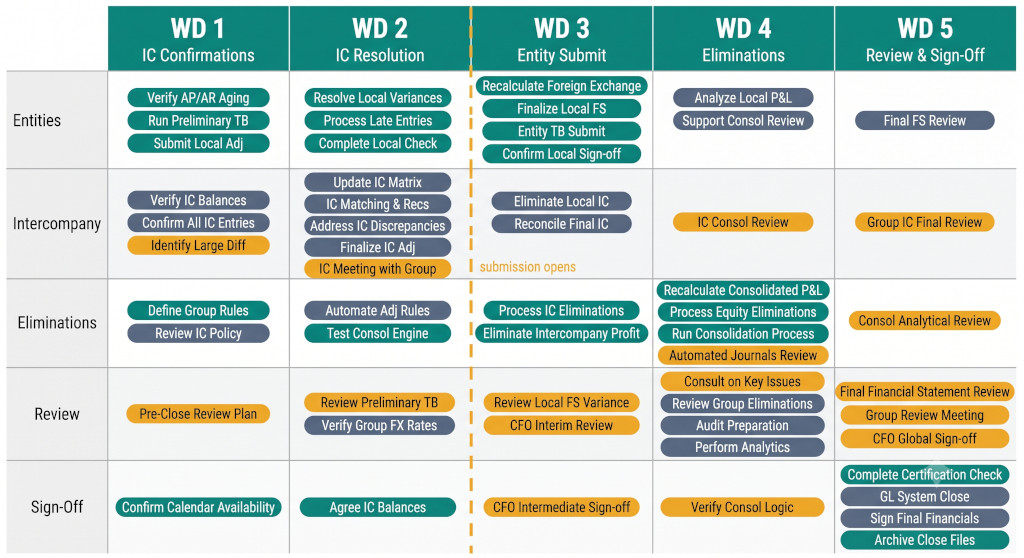
The close calendar is the structural fix that addresses failures one and two simultaneously: it forces entity submissions to a hard deadline and moves intercompany reconciliation to before the consolidation starts. Below is a five-working-day close calendar that works for a group of five to ten entities — all days are counted from the last day of the month. Adjust the day count based on your group’s complexity, but the sequencing logic holds regardless of scale.
WD 1
Intercompany confirmation exchange
First working day after month end. Each entity sends its intercompany balances to all counterparties. Pairs confirm by end of day or flag discrepancies for resolution. No submission is accepted without a signed-off intercompany confirmation.
WD 2
Intercompany discrepancy resolution deadline
All intercompany mismatches must be resolved and correcting journals posted at entity level. Any unresolved difference above the materiality threshold is escalated to the group controller before entity submissions open.
WD 3
Entity submission deadline — 9am sharp
All entities submit their trial balance in the standard group template, with bank reconciliations completed, accruals posted, and intercompany balances matching the confirmed figures from WD 1. Late submissions trigger an immediate escalation notification to the CFO.
WD 4
Consolidation eliminations and policy adjustments
Group team runs intercompany eliminations, posts consolidation-layer adjustments, and applies any policy alignment entries. All eliminations should be from a pre-prepared schedule — nothing should be invented at this stage.
WD 5
Review, sign-off and distribution
Group controller reviews the draft consolidated accounts. Variance explanations are prepared for each material movement. CFO approves. Management accounts distributed. The close is complete by end of WD 5. Post-close adjustments below the materiality threshold are held for the following month.
Two features of this calendar are non-negotiable. First, the intercompany reconciliation must happen before entity submissions — not during the consolidation. If entities submit with unreconciled intercompany balances, the consolidation team is effectively doing the subsidiaries’ reconciliation work for them, under time pressure, at the worst possible moment. Second, the entity submission deadline must be hard. The group controller cannot unilaterally waive it for an entity that is perennially late — the waiver sets a precedent that the deadline is in fact a suggestion, and the pattern repeats.
The biggest resistance to a hard submission deadline comes from subsidiaries that argue their own close process cannot be completed earlier. This is usually true — and it is a signal that the subsidiary’s close process also needs improvement, not that the group deadline should move. Running a group close improvement project without simultaneously addressing entity-level close efficiency is addressing the symptom, not the cause. Work with each late-submitting entity to identify their specific bottleneck and resolve it at source.
Fixing the Intercompany Problem Permanently
Intercompany mismatches have a small number of root causes, and most of them are structural rather than accidental. Understanding which type of mismatch your group has is the fastest route to eliminating it.
Cut-off differences are the most common. Entity A records an intercompany sale on the 30th; entity B records the receipt on the 2nd of the following month. The transaction is in two different periods. The fix is a group-wide cut-off rule: intercompany transactions are recorded in the period of the originating entity (the seller or service provider), and the receiving entity must match that date. Any intercompany invoice dated in the period must be accrued by the receiving entity even if cash has not yet moved.
Rate differences affect foreign currency intercompany balances. Entity A translates the intercompany loan at the month-end rate; entity B uses the rate on the day the loan was drawn down. The fix is a group FX policy: intercompany monetary balances are retranslated at the period-end rate by all entities, regardless of the date of the original transaction. The exchange difference is posted at entity level, not absorbed into the intercompany account balance.
Scope differences occur when entities have different understandings of which transactions are intercompany. A management fee charge that one entity treats as intercompany and another entity treats as a third-party cost because the fee is routed through an intermediate holding company. The fix is an intercompany transaction register: a definitive list, maintained at group level, of all recurring intercompany charges, their direction, their amount, and their period. Entities post from the register, not from their own interpretation of what is intercompany.
| Mismatch Type | Typical Symptom | Root Fix |
|---|---|---|
| Cut-off difference | Intercompany balance differs by exactly the value of one transaction; the same difference appears reversed the following month | Group cut-off rule: record in the originating entity’s period; receiver accrues if not yet posted |
| FX rate difference | Small residual difference on foreign currency intercompany balances that changes every period | Group FX policy: all intercompany monetary balances retranslated at period-end rate by all entities |
| Scope difference | One entity has a balance; the counterparty has nil | Intercompany transaction register maintained at group level; entities post from the register |
| Posting error | Differences that change each month with no pattern | Pre-close intercompany confirmation exchange with a mandatory sign-off before submissions open |
| Dividend / intercompany loan confusion | Parent records a dividend receivable; subsidiary records a loan payable | Formalise intercompany transactions in writing before they are posted; classify consistently across both entities |
Measuring Whether the Fix Is Working
A close improvement project without measurement produces anecdote, not accountability. Track three metrics from the month you make the changes, and report them to the CFO every quarter:
Days-to-close — measured from the first day of the new month to the date the consolidated accounts are approved. Track the trend, not just the current month. A close that improved from fourteen days to nine days in three months is progressing well; one that improved in month one and then drifted back is signalling a compliance failure in the new process.
Entity submission compliance rate — the percentage of entities that submitted on time, in the correct format, in a given month. Anything below 100% is a flag. Track by entity so the same offenders don’t hide in an aggregate metric.
Post-close adjustment volume — the number and aggregate value of adjustments posted after the close sign-off. A declining trend means the close quality is improving; a stable or rising trend means the close is completing on time but producing less reliable accounts.
Hitting the deadline by cutting corners is not a fixed close: Groups under pressure to report faster sometimes achieve a shorter close by deferring accruals, skipping reconciliations, or accepting entity submissions with known errors and fixing them “next month.” The days-to-close number improves; the quality of the accounts deteriorates. Track post-close adjustments alongside days-to-close — if one falls while the other rises, the close process has not improved, it has just shifted where the work gets done.
Getting from Reactive to Predictable: A Seven-Step Action Plan
- Map your current close and time each step. Before changing anything, document exactly what happens in your current close and how long each step takes. Interview the people doing the work, not just the controller. You will typically find that 60–70% of the elapsed time is waiting — for data, for confirmations, for approvals — not doing work. That waiting time is where the interventions go.
- Identify your single biggest constraint. Which step, if it were faster, would allow everything after it to start earlier? In most groups it is either entity submissions or intercompany reconciliation. Fix the constraint first before optimising anything else.
- Publish a hard close calendar with named owners. Assign a named individual at each entity who is responsible for the submission. Publish the calendar group-wide so everyone sees the same deadlines and understands the dependencies. Include escalation contacts for late submissions.
- Move intercompany reconciliation before submissions. Implement the D−5 intercompany confirmation exchange described above. Start with your highest-volume entity pairs and expand. Accept that the first month will be imperfect — the discipline builds over two to three close cycles.
- Standardise the submission template. Design a single group submission template mapped to the group chart of accounts. Include an intercompany section with counterparty-level disclosure. Roll it out to entities one by one, providing training where needed. Enforce the format from the first month, even if submissions are slightly late while entities adapt.
- Define and enforce a materiality threshold for post-close adjustments. Set a threshold (for example, items below 0.5% of group revenue or £50,000, whichever is lower) below which post-close items are held for the following month rather than reopening the close. Communicate this to the board so they understand why occasional small prior-period items appear in the current month.
- Review the metrics quarterly and hold the line. Report days-to-close, entity submission compliance, and post-close adjustment volume to the CFO every quarter. Use the data to identify which entities need process support and which are structurally non-compliant. A subsidiary that misses the submission deadline every month for three months has a management problem, not an accounting problem.
For the detailed task-by-task checklist of what needs to happen at each stage of the close — from bank reconciliations at entity level to eliminations at consolidation level — our multi-entity month-end close checklist covers the full sequence. For the intercompany elimination mechanics specifically — what to eliminate, in what order, and how to handle the unrealised profit step — see our guides on intercompany eliminations. The process changes above will reduce the time lost to waiting; the technical guides ensure the work done in that time is correct.
A close that runs on a calendar, not on chaos
BrizoConsol automates the intercompany matching, pulls entity data directly from Xero, QuickBooks, MYOB, and Zoho Books, and runs your eliminations automatically — so the consolidation stage of the close takes hours, not days. Start free, no credit card required. Start Free Trial