Zoho Books Consolidation: Reporting Across Multiple Entities
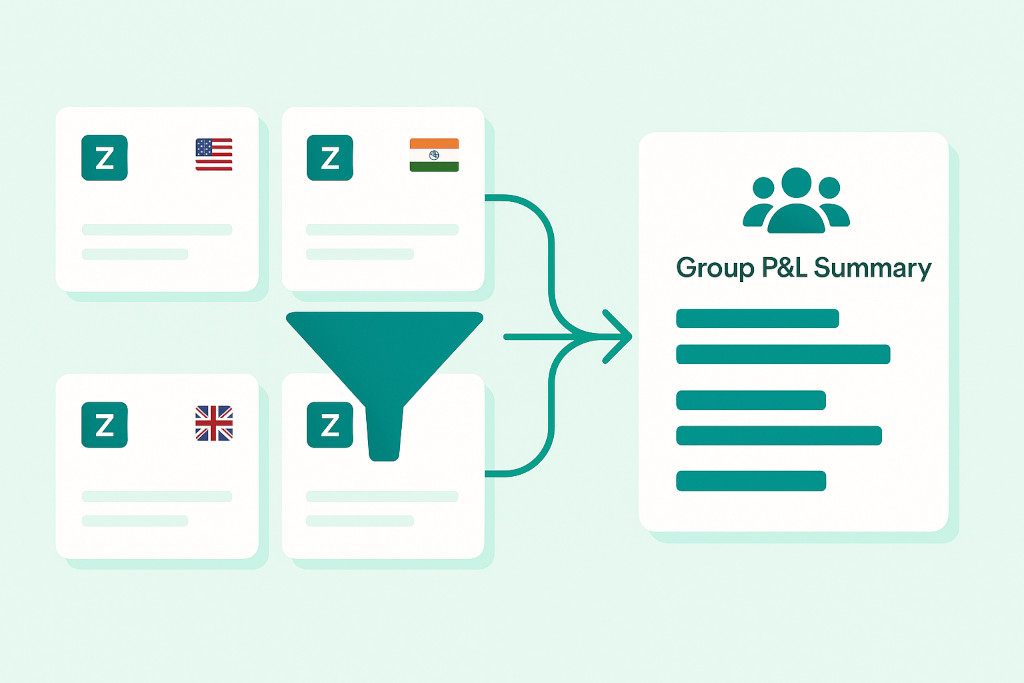
Zoho Books has built a strong reputation as an affordable, capable accounting platform — particularly for growing SMEs and businesses already embedded in the Zoho ecosystem alongside Zoho CRM, Zoho People, or Zoho Inventory. But when a Zoho Books business grows to include a second entity, a subsidiary in another country, or a holding company structure, it confronts a gap that is built into the platform’s architecture: Zoho Books was designed for single-organisation accounting, and its native tools for Zoho Books consolidation across multiple organisations are limited in ways that matter for group reporting.
This article examines exactly what Zoho Books can and cannot do natively for multi-entity groups, where the gaps become material, and what finance teams running Zoho Books groups need to add to produce a genuine consolidated set of financial statements.
How Zoho Books Handles Multi-Entity Accounting Natively
It is worth starting with what Zoho Books does provide, because the platform has more multi-entity capability than some of its competitors. Within a single Zoho Books organisation, the platform supports:
Group consolidation for Zoho Books — fast and accurate.
Connect your Zoho Books organisations and consolidate into one clean group view.
- Multiple branches — Zoho Books allows tracking of transactions across different branches within a single organisation, with branch-level reporting for P&L and Balance Sheet.
- Multi-currency transactions — individual organisations can handle transactions in multiple currencies, with automatic exchange rate handling at the transaction level.
- Intercompany module (limited) — within the Zoho Finance Plus bundle, some intercompany transaction tracking is available between organisations connected to the same Zoho account.
These capabilities are genuinely useful for businesses with a single primary legal entity and operational complexity — branches, cost centres, multiple currencies within one ledger. But they are not consolidation in the accounting sense. When a group has two or more separate legal entities, each requiring its own audited financial statements and tax returns, the structural separation between Zoho Books organisations means group-level reporting requires a different approach.
Where Zoho Books Falls Short for Group Consolidation
The following table summarises the key consolidation requirements and how Zoho Books addresses each natively.
| Consolidation requirement | Zoho Books native | Notes |
|---|---|---|
| Cross-organisation trial balance pull | ✗ Not available | Each Zoho Books org is an isolated ledger; no native cross-org reporting |
| Consolidated P&L / Balance Sheet | ✗ Not available | Reports are always scoped to a single organisation |
| Intercompany elimination | ⚡ Partial | Zoho Finance Plus has limited intercompany tracking; no automated elimination engine |
| Currency translation at consolidation (IAS 21) | ✗ Not available | Multi-currency within a single org only; no group-level FX translation |
| Non-controlling interest (NCI) calculation | ✗ Not available | No concept of partial ownership at consolidation |
| Group chart of accounts mapping | ✗ Not available | Each org maintains its own independent chart of accounts |
| IFRS / GAAP compliant consolidated statements | ✗ Not available | Individual entity reports only; no group-standard tagging |
| Audit trail on consolidation adjustments | ✗ Not available | No consolidation layer within the platform to audit |
The pattern is consistent with other SME accounting platforms. Zoho Books excels at entity-level accounting; it was not designed as a consolidation engine. This is not a criticism — the vast majority of Zoho Books users have a single entity and have no need for consolidation features. The gap only becomes relevant when a business grows into a group structure.
What Zoho Books Groups Actually Need for Multi-Entity Reporting
When a Zoho Books group reaches the point where spreadsheet consolidation is creating unacceptable risk or consuming too much finance team time, the requirements for a proper solution become clear. Genuine financial consolidation software for a Zoho Books group must deliver the following:
Direct API integration with Zoho Books
The consolidation layer must connect to each Zoho Books organisation via API and pull trial balance data automatically — no manual data exports, no CSV uploads, no risk of stale data. Changes made in Zoho Books should be reflected in the consolidation without any manual intervention.
Persistent chart of accounts mapping
Each Zoho Books organisation will have its own account structure. The consolidation layer needs a maintained mapping from subsidiary account codes to group reporting codes, configured once and applied automatically on every run. New or unmapped accounts should be flagged immediately rather than silently excluded.
Automated intercompany elimination
Elimination rules configured per entity pair — which accounts represent intercompany receivables, payables, revenues, and costs — applied automatically on every consolidation run, with discrepancy reporting when the two sides of an intercompany position do not match.
IAS 21 currency translation
For groups with foreign currency Zoho Books entities, the consolidation layer must translate financial statements at the correct rates — closing rate for balance sheet items, average rate for P&L — and calculate the Currency Translation Adjustment (CTA) automatically.
Consolidated financial statements on demand
A consolidated P&L, Balance Sheet, and Cash Flow Statement available at any point in the month, compliant with the relevant accounting standard — IFRS, US GAAP, UK GAAP, or local GAAP — with drill-through to entity-level and transaction-level detail.
Intercompany Eliminations Across Zoho Books Organisations
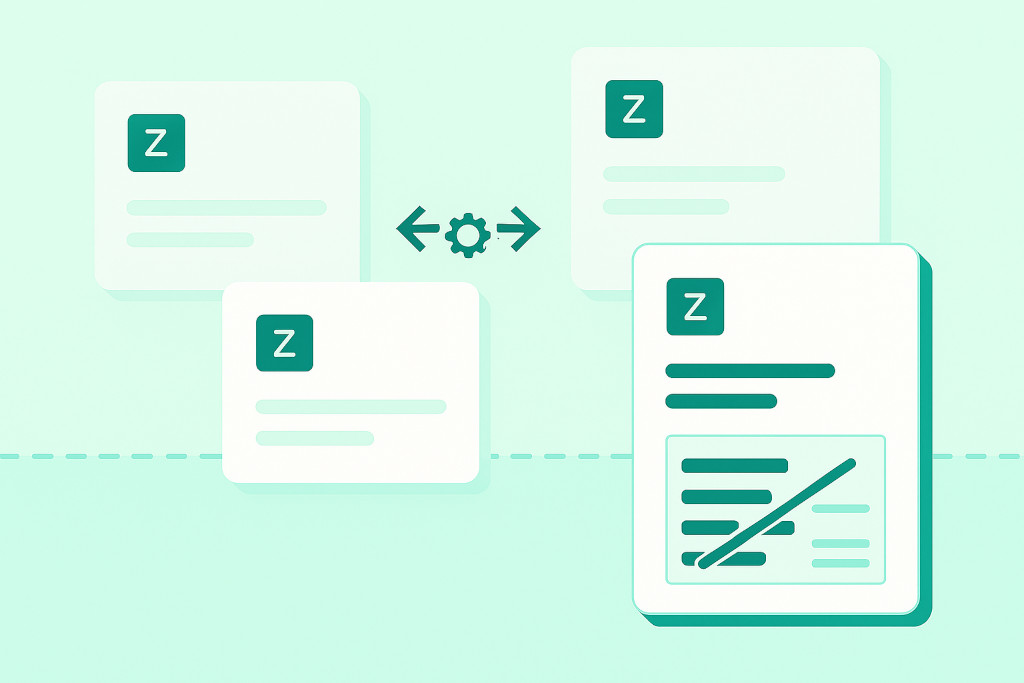
Intercompany elimination is the consolidation step that consumes the most time for Zoho Books groups working without dedicated consolidation software. Understanding why it is complex — and what proper automation looks like — helps in evaluating whether a given solution is genuinely solving the problem.
Why intercompany elimination is hard in Zoho Books groups
Each Zoho Books organisation records its own side of an intercompany transaction independently. Entity A records an intercompany receivable; Entity B records the corresponding payable. In theory these balances match. In practice, they often do not — because one entity processes the transaction a day later, because the amounts are posted in different currencies and translated differently, or because a recharge has been posted in one entity but not yet in the other.
The consolidation requirement is to eliminate both sides — the receivable and the payable — from the group Balance Sheet, and to eliminate the corresponding intercompany revenue and cost from the group P&L. When the two sides do not match, the difference must be identified, investigated, and resolved before the consolidated statements will balance.
In a four-entity group with intercompany management fee recharges, shared service cost allocations, intercompany loans, and intragroup sales, the number of intercompany relationships to reconcile each month can easily reach fifteen to twenty pairs. Doing this manually in a spreadsheet is the single biggest source of month-end close delay in most Zoho Books groups.
What automated elimination looks like
BrizoConsol connects directly to each Zoho Books organisation via the Zoho Books API. Intercompany elimination rules are configured once: for each entity pair, you specify which accounts represent the intercompany relationship (e.g., “Intercompany Receivable” in Entity A matches “Intercompany Payable” in Entity B). On every consolidation run, BrizoConsol applies those rules, matches the positions, posts the elimination entries automatically, and surfaces any discrepancies — with the exact amount and account shown on both sides.
The result is a consolidated Balance Sheet where all intercompany positions have been eliminated, with every elimination entry carrying a full audit trail. Discrepancies that previously took a day to track down are resolved in minutes, because the platform identifies exactly where the mismatch sits.
Multi-Currency Zoho Books Groups: Translation at Consolidation
Zoho Books handles multi-currency transactions well at the entity level — individual organisations can record transactions in any currency and Zoho Books applies the exchange rate at the transaction date. But when consolidating a Zoho Books group that spans multiple countries and functional currencies, a different and more demanding set of currency requirements applies.
IAS 21 — the international standard for foreign currency translation, equivalent to ASC 830 under US GAAP and Section 30 of FRS 102 under UK GAAP — requires that a foreign subsidiary’s entire set of financial statements be translated into the group presentation currency using specific rates for different account types. Balance sheet items translate at the closing rate. Income statement items translate at the average rate for the period. Equity items carry forward at historical rates. The difference between these rates — the Currency Translation Adjustment — is posted to Other Comprehensive Income in equity.
None of this is something Zoho Books performs natively at the group level. The translation must happen in the consolidation layer — and it must happen correctly every period, with a maintained rate history, to avoid accumulated errors in the equity section that become difficult to explain to auditors.
Group reporting software that integrates with Zoho Books handles this automatically: pulling functional currency trial balances from each Zoho Books organisation, applying the IAS 21 translation methodology, and accumulating the CTA balance with a complete period-by-period history.
BrizoConsol for Zoho Books Groups: What the Integration Looks Like
BrizoConsol connects to Zoho Books via the official Zoho Books API. The integration is read-only from the Zoho Books perspective — BrizoConsol pulls trial balance data; it never writes to or modifies the Zoho Books ledger. Each connected Zoho Books organisation’s data is available in the consolidation layer within minutes of authorising the connection.
For groups that use Zoho Books alongside other accounting platforms — Xero for the UK entity, QuickBooks for the US subsidiary, MYOB for the Australian operation — BrizoConsol handles all simultaneously. There is no requirement to migrate all entities to a single accounting platform. The consolidation layer sits above the individual systems and normalises the data into a single group view regardless of which platform each entity uses.
Key capabilities relevant to Zoho Books groups include:
- Direct API connection to each Zoho Books organisation — no CSV exports required
- AI Auto-Map for initial chart of accounts mapping across organisations
- Automated intercompany elimination with configurable rules per entity pair
- IAS 21 currency translation with CTA calculation and full rate history
- Non-controlling interest (NCI) support for partially-owned subsidiaries
- Consolidated P&L, Balance Sheet, and Cash Flow on demand
- Virtual Groups for segment or regional reporting cuts
- Full audit trail on all consolidation adjustments — eliminations, CTA postings, and manual journals
- IFRS, US GAAP, UK GAAP, and local GAAP tagging
The setup process for a typical four-entity Zoho Books group — connecting the organisations, running AI-assisted account mapping, and configuring intercompany elimination rules — takes between four and eight hours of finance team time. The first automated consolidated close typically follows within the same week.
For Zoho Books users who have outgrown the spreadsheet consolidation model, Zoho Books consolidation via BrizoConsol provides the group reporting layer the platform itself does not offer — without requiring any change to the underlying Zoho Books setup or disrupting the entity-level accounting that is already working well.
Conclusion: Zoho Books Is the Right Tool for Your Entities — Not Your Group
Zoho Books does what it was designed to do exceptionally well: manage the accounting records of a single legal entity, accurately and efficiently. The gap is not in the platform — it is in what multi-entity group reporting requires above and beyond entity-level bookkeeping.
For Zoho Books groups that have outgrown spreadsheet consolidation, the path forward is a dedicated consolidation layer that connects directly to each organisation, handles account mapping, currency translation, intercompany eliminations, and NCI automatically — and delivers consolidated financial statements without manual preparation.
BrizoConsol provides that layer for Zoho Books groups of any size, without requiring any change to the underlying Zoho Books setup that is already working well at the entity level.