Zoho Books Multi-Currency Consolidation: How Groups with Foreign Subsidiaries Produce Accurate Group Accounts
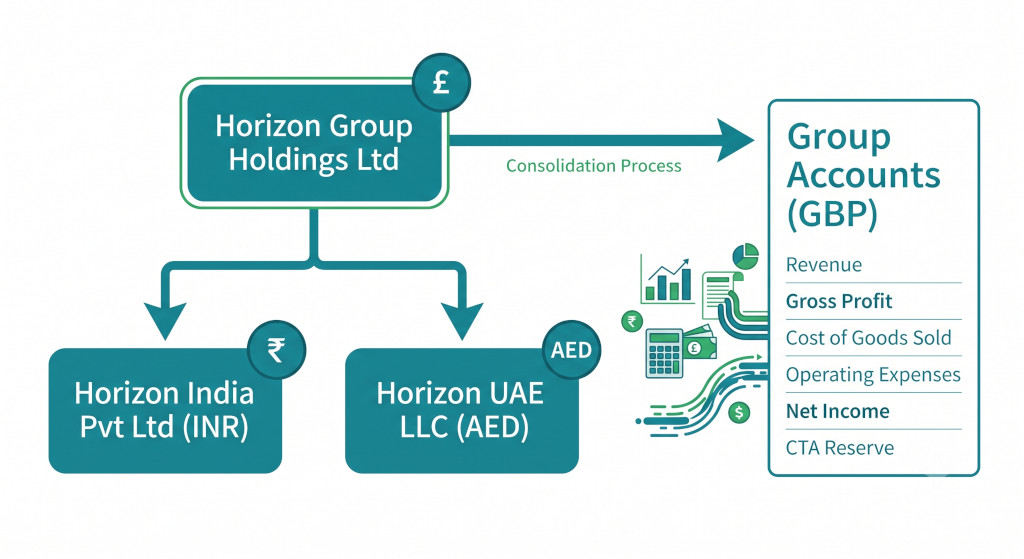
Priya is Group Finance Manager at a business services group headquartered in the UK. The parent runs on Zoho Books. Three years ago the group incorporated a subsidiary in India to serve South Asian clients; last year it opened a trading entity in Dubai. Both overseas entities also run on Zoho Books, in INR and AED respectively. Each month, Priya exports trial balances from three Zoho Books organisations, translates the overseas figures into GBP in a spreadsheet, and then spends the better part of a day reconciling a balance sheet that never quite balances — almost always because one of the three translation rates has been applied incorrectly.
Zoho Books multi-currency consolidation is one of the more under-documented challenges for growing international groups running on Zoho. Zoho Books handles foreign currency transactions well within a single organisation. What it does not do is consolidate multiple Zoho Books organisations in different currencies into a single group set of accounts. That translation and consolidation step has to happen outside Zoho Books — and doing it correctly requires applying three different exchange rates to three different types of accounts, then calculating a cumulative translation adjustment that accumulates on the consolidated balance sheet every period.
This guide explains the translation rules, works through a practical example for a Zoho Books group, and shows how BrizoConsol automates the process from end to end.
Group consolidation for Zoho Books — fast and accurate.
Connect your Zoho Books organisations and consolidate into one clean group view.
What Zoho Books Can and Can’t Do for Multi-Currency Groups
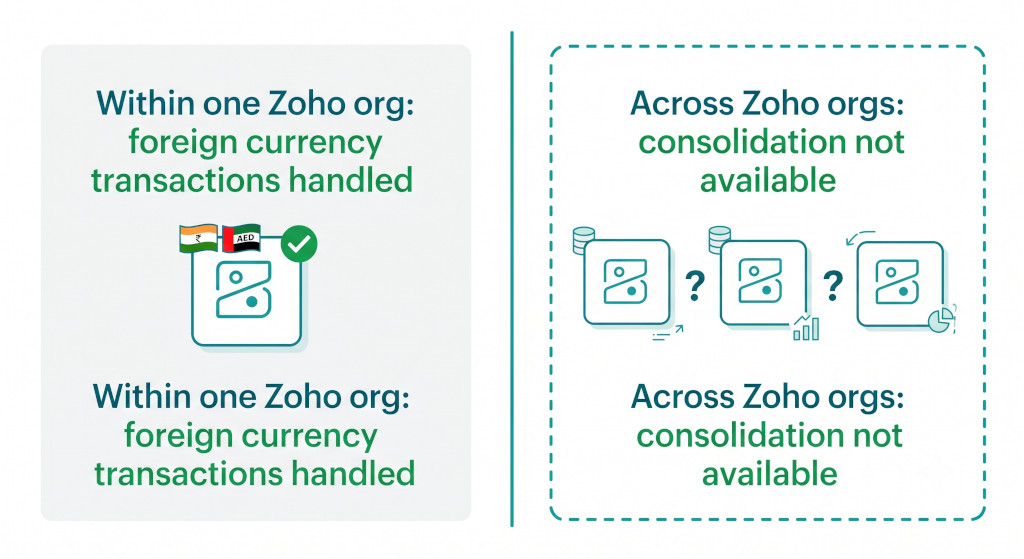
Zoho Books supports multi-currency within a single organisation. You can raise invoices in USD, pay suppliers in EUR, maintain bank accounts in AED, and Zoho Books will track the resulting foreign exchange gains and losses at the entity level. For a single trading entity with international customers and suppliers, this works well.
The limitation is at the group level. Each Zoho Books organisation is a standalone set of books. There is no native Zoho Books feature that pulls trial balances from multiple organisations, translates the overseas entities into the group presentation currency, eliminates intercompany transactions, and produces a consolidated P&L and balance sheet. Zoho Books does offer some cross-organisation reporting in its higher-tier plans, but this provides a combined view of data rather than a technically correct consolidation — intercompany eliminations are not applied, and currency translation does not follow the three-rate methodology required under IAS 21.
For groups that need consolidated accounts for a bank covenant, an investor report, a statutory audit, or simply an accurate picture of the group’s financial position, the consolidation must happen in a dedicated platform connected to the Zoho Books data.
Zoho Books’ cross-organisation reporting is a useful tool for getting a quick combined view of revenues and costs across the group. It is not a substitute for a proper consolidation. The two most obvious signs that a group has outgrown combined reporting are: the combined P&L includes intercompany income that does not represent an external sale, and the combined balance sheet carries intercompany receivables and payables that inflate the total asset and liability figures.
The Three Translation Rates Every Zoho Books Group Must Apply
When a Zoho Books group has overseas subsidiaries, those subsidiaries’ accounts must be translated into the group presentation currency before consolidation. Under IAS 21 (The Effects of Changes in Foreign Exchange Rates), three different rates apply to three different types of accounts. Applying the wrong rate to any category will produce a misstated consolidated balance sheet.
Closing rate — all balance sheet assets and liabilities
Every asset and liability — cash, receivables, inventory, fixed assets, payables, loans, deferred revenue — translates at the spot rate on the last day of the reporting period. If Horizon India Pvt Ltd closes its June year-end with a GBP/INR rate of 106.40, every balance sheet item translates at 106.40, regardless of when during the year it arose.
Average rate — all income statement items
Revenue, cost of sales, staff costs, and all other P&L items translate at the average rate for the reporting period — typically the average of the opening and closing rates, or a weighted average if rates moved sharply during the period. The average rate approximates the blended rate at which transactions actually occurred throughout the year.
Historical rate — equity items
Share capital, share premium, and retained earnings brought forward from prior periods translate at historical rates — the rates in force when those amounts were first recognised. Share capital translates at the rate on the date of incorporation; opening retained earnings remain at whatever rate applied when they were last translated; only current-year profit translates at the average rate. Equity items are never retranslated at the current closing rate.
The mathematical difference between translating the balance sheet at the closing rate and translating equity at historical rates produces the cumulative translation adjustment (CTA). This sits in equity — in the foreign currency translation reserve — and does not pass through the consolidated P&L. It represents the accumulated effect of exchange rate movements on the translated net assets of the overseas subsidiary.
A Worked Translation Example: Horizon Group
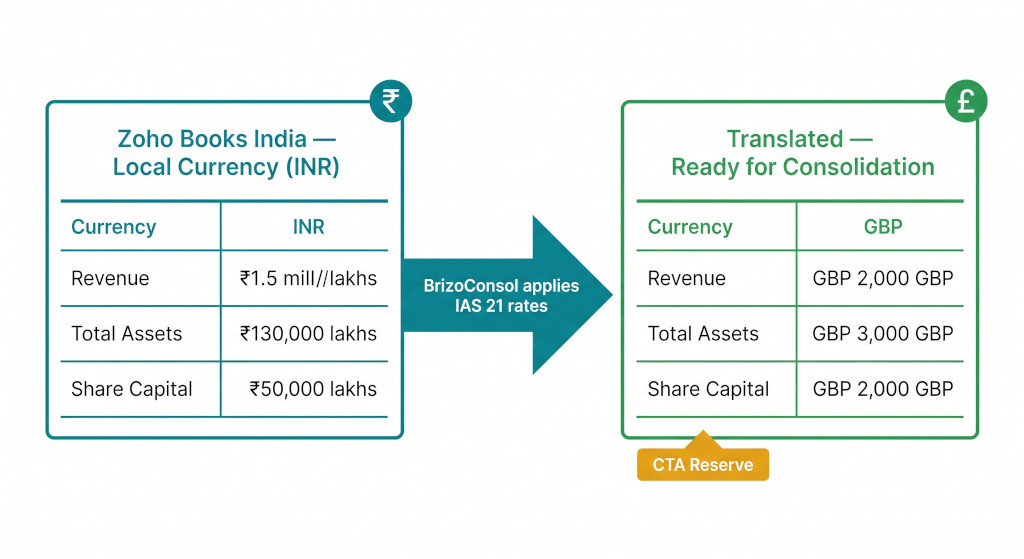
Horizon Group Holdings Ltd (GBP presentation currency) owns Horizon India Pvt Ltd, which reports in INR. At the 30 June year-end, the relevant rates are:
| Rate | GBP/INR | Applied to |
|---|---|---|
| Closing rate (30 June) | 106.40 | All balance sheet assets and liabilities |
| Average rate (full year) | 103.50 | All P&L items |
| Historical rate (at incorporation) | 98.20 | Share capital and opening retained earnings |
Horizon India’s Zoho Books trial balance in INR, and the GBP translated figures, are as follows:
| Account | INR | Rate used | GBP |
|---|---|---|---|
| INCOME STATEMENT | |||
| Revenue | 103,500,000 | Average (103.50) | 1,000,000 |
| Cost of Sales | (51,750,000) | Average (103.50) | (500,000) |
| Operating Expenses | (31,050,000) | Average (103.50) | (300,000) |
| Net Profit for the Year | 20,700,000 | 200,000 | |
| BALANCE SHEET | |||
| Total Assets | 127,680,000 | Closing (106.40) | 1,200,000 |
| Total Liabilities | (74,480,000) | Closing (106.40) | (700,000) |
| Net Assets | 53,200,000 | 500,000 | |
| EQUITY | |||
| Share Capital | 9,820,000 | Historical (98.20) | 100,000 |
| Opening Retained Earnings | 19,640,000 | Historical (98.20) | 200,000 |
| Profit for the Year | 20,700,000 | Average (103.50) | 200,000 |
| CTA Reserve (balancing figure) | — | Derived | 0 |
| Total Equity | 50,160,000 | 500,000 | |
In this simplified example the CTA rounds to zero, which occurs when the average rate and historical rate produce a translated equity figure that precisely equals the closing-rate net assets. In practice, with rates moving throughout the year and prior-period CTA balances carried forward, the CTA will almost always be a non-zero figure. For Horizon India in its second and subsequent years of operation, the CTA will accumulate as INR continues to move against GBP.
The Horizon UAE LLC in AED adds a second CTA calculation — its own set of three rates, its own closing balance, its own roll-forward. Each overseas Zoho Books organisation requires an independent translation schedule, and the consolidated CTA reserve is the sum of all individual entity balances.
The CTA Roll-Forward: Where Groups Most Often Go Wrong
The CTA is not a static figure. It changes every period as exchange rates move, as the overseas subsidiaries earn profit, and as the group potentially distributes dividends or makes capital adjustments. Each period the finance team must carry forward the opening CTA, calculate the current-period movement, and reconcile to the closing balance — for every overseas entity.
In a spreadsheet, this means a separate tab for each overseas Zoho Books organisation, updated every period. The most common errors are carrying forward the wrong opening balance (because a prior-period correction was not reflected), applying the closing rate to an equity item (causing the balance sheet to appear to balance but with an incorrect CTA), and omitting the CTA entirely (producing a consolidated balance sheet that simply does not balance and whose out-of-balance difference nobody can explain).
For a Zoho Books group operating in INR and AED, the CTA will compound meaningfully over time. Both currencies have historically been more volatile against GBP than, say, AUD or NZD, which means the CTA reserve can grow to represent a significant proportion of the overseas subsidiaries’ net assets within three to four years. Tracking it accurately from the first period is far easier than reconstructing it retrospectively when an auditor asks for the roll-forward.
Intercompany Transactions in a Zoho Books Multi-Currency Group
Most Zoho Books groups with overseas subsidiaries have at least one intercompany flow — a management fee from the UK parent, a loan to fund the overseas entity’s working capital, or a recharge for shared services. In a multi-currency context these flows add complexity at consolidation.
If the UK parent charges Horizon India a management fee denominated in GBP, the parent records GBP income and a GBP receivable. Horizon India records an INR payable — the INR equivalent of the GBP fee at the rate on the invoice date. If that rate differs from the closing rate, the translated GBP value of the INR payable will not exactly equal the GBP receivable in the parent. The difference must be allocated either to the P&L (for short-term trading balances) or to the CTA reserve (for long-term balances that form part of the net investment in the subsidiary under IAS 21).
Getting this right requires a clear policy on which intercompany balances qualify for net investment treatment, applied consistently from the date each balance arose. It is one of the technical details that tends to be handled inconsistently in spreadsheet-based Zoho Books consolidations, and one that auditors typically probe at year-end.
How BrizoConsol Handles Zoho Books Multi-Currency Consolidation
BrizoConsol connects directly to all your Zoho Books organisations via the Zoho Books API. It pulls each organisation’s trial balance in its local currency each period — no export, no reformatting. The consolidation of multiple Zoho Books organisations happens within BrizoConsol, on top of the live Zoho data.
Exchange rates are maintained centrally. Each period, the finance team enters the closing and average rates for each currency pair; historical rates are stored permanently from setup. BrizoConsol applies the correct rate to each account type automatically — closing rate to balance sheet items, average rate to P&L items, historical rate to equity — without any manual intervention.
The CTA is calculated automatically as the balancing figure for each overseas entity and tracked in a roll-forward that updates each period. There is no separate schedule to maintain. The consolidated statement of changes in equity — with each entity’s CTA movement correctly presented as other comprehensive income — is available as a standard report alongside the P&L and balance sheet.
Intercompany eliminations, including the correct treatment of net investment loans and their exchange differences, are configured once and run automatically. The month-end close for Horizon Group — three Zoho Books organisations in GBP, INR, and AED — that previously took Priya most of a day in a spreadsheet runs in under two hours in BrizoConsol, with the CTA always current and the consolidated balance sheet balancing first time.
Getting Started: What Zoho Books Multi-Currency Groups Need
To set up multi-currency consolidation in BrizoConsol for a Zoho Books group, three inputs are required for each overseas organisation: the functional currency, the historical exchange rate at the date the entity was incorporated or first capitalised, and the opening CTA balance for any entity that has been trading for more than one period.
BrizoConsol connects to each Zoho Books organisation via OAuth. No data needs to be exported from Zoho Books. Once connected, BrizoConsol pulls the trial balance and applies the translation rules immediately. For most Zoho Books groups, the first translated and consolidated output — eliminated and reconciled — is available on the same day as setup.
Stop translating Zoho Books foreign subsidiaries by hand.
BrizoConsol connects to all your Zoho Books organisations, applies the three IAS 21 translation rates automatically, calculates and tracks the CTA, and produces consolidated accounts in minutes. Start Free Trial