Zoho Books Multi-Entity Consolidation: How Group CFOs Get Consolidated Accounts Across Multiple Organisations
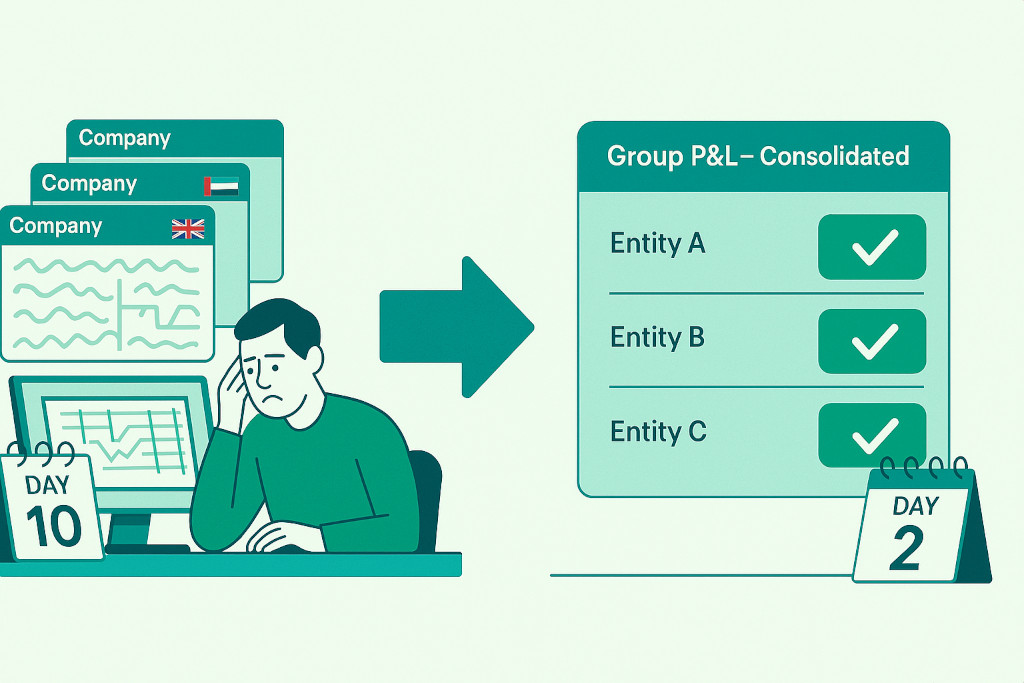
The CFO of a trading group operating across the UAE, the UK, and India had built a clean accounting operation. Each entity ran Zoho Books, properly maintained, with local charts of accounts, local tax compliance sorted, and management reporting that worked well at the entity level. The problem arrived every quarter when the group’s private equity investors asked for consolidated accounts. Three Zoho Books organisations. Three currencies. Intercompany management fees flowing from the UAE holding company to both subsidiaries. No native way to combine them. The finance team spent eight days producing consolidated accounts that should have taken two — and spent the remaining time defending the methodology to auditors who wanted to see the elimination workings.
Zoho Books multi-entity consolidation is not a feature Zoho has built into its platform. Like QuickBooks and Xero, Zoho Books is designed around the single-organisation model. Understanding where the gap sits — and how groups with multiple Zoho organisations solve it — is what this article covers.
Why Multi-Organisation Zoho Books Groups Are Common
Zoho Books has a strong user base across the Middle East, South Asia, and increasingly in the UK and Australia — markets where holding structures and cross-border operations are the norm rather than the exception. A UAE-based trading group will typically have a UAE holding company, a UK distribution entity, and one or more operational entities in India or Southeast Asia. Each entity requires local tax compliance, local currency accounts, and local reporting. Zoho Books handles all of this well at the individual organisation level.
Group consolidation for Zoho Books — fast and accurate.
Connect your Zoho Books organisations and consolidate into one clean group view.
The multi-organisation problem is structural. Zoho Books does allow you to switch between organisations within the same account, but it provides no mechanism to consolidate them — no combined P&L, no group balance sheet, no intercompany elimination engine. Every group-level report must be built outside the platform.
What Zoho Books Can’t Do Across Multiple Organisations
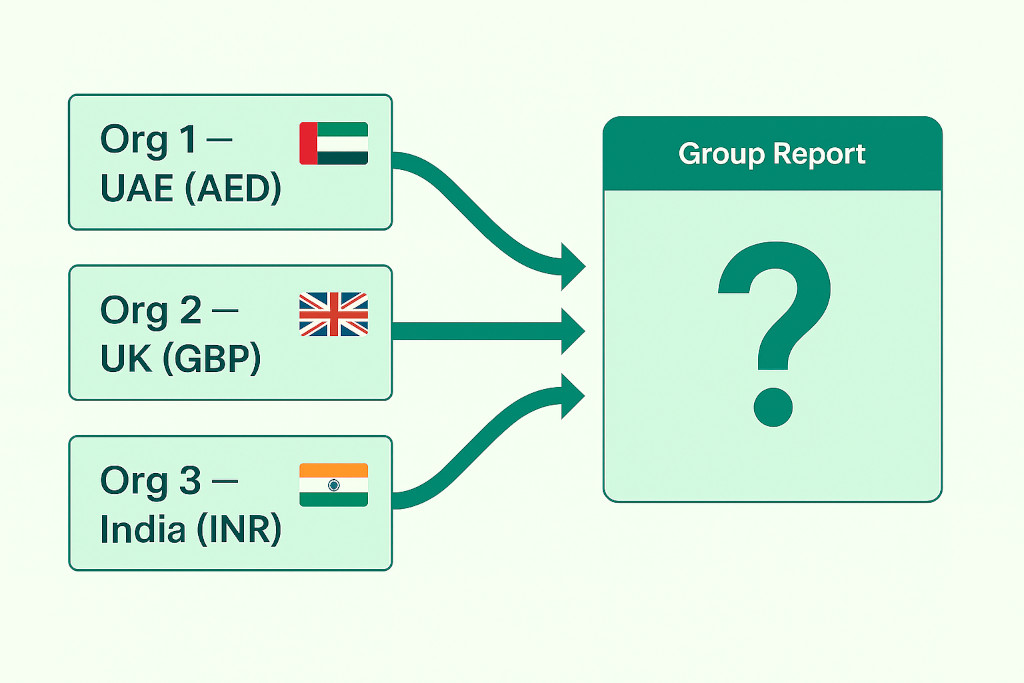
The four gaps that create the most friction for Zoho Books groups are consistent regardless of the industry or geography involved.
| Capability | Zoho Books (native) | What groups actually need |
|---|---|---|
| Consolidated P&L and balance sheet | ✗ Not available | A single set of financial statements combining all organisations after eliminations |
| Intercompany elimination | ✗ Not available | Automated removal of intragroup management fees, loans, dividends and intercompany sales from the consolidated accounts |
| Multi-currency translation (IAS 21) | ✗ Not available at group level | Translation of each foreign org’s statements at closing/average rates with CTA posted to group equity |
| Group chart of accounts | ✗ Each org is independent | A single account structure that maps all org-level codes to consistent group lines for consolidation |
The consequence is that every group-level reporting cycle begins with manual data extraction — exporting trial balances from each Zoho organisation, mapping the account codes, building elimination schedules, running currency translations in a spreadsheet — before a single consolidated figure can be presented. For groups closing monthly or quarterly, this overhead compounds quickly.
A Practical Example: Three-Organisation Zoho Books Group
Consider a services group with three Zoho Books organisations: a UAE holding company (AED), a UK subsidiary (GBP), and an India subsidiary (INR). The holding company charges a monthly management fee of AED 15,000 to each subsidiary. At the end of Q1, the group needs consolidated accounts for its board and its bank.
| Holdco — Dubai | OpCo — London | OpCo — Mumbai | |
|---|---|---|---|
| Currency | AED | GBP | INR |
| Revenue | AED 180k (management fees) | GBP 420k | INR 28m |
| Total assets | AED 2.4m | GBP 890k | INR 64m |
| Translated to | AED (presentation currency) | AED at closing rate | AED at closing rate |
Before the consolidated accounts can be produced, the following adjustments must be made:
| Adjustment | Debit | Credit | Amount |
|---|---|---|---|
| Eliminate mgmt fee income — Holdco | Management fee revenue | — | AED 90,000 |
| Eliminate mgmt fee expense — OpCos | — | Management fee expense | AED 90,000 |
| Translate UK entity (GBP → AED) | OpCo UK P&L at avg rate | OpCo UK B/S at closing rate | Per IAS 21 |
| Translate India entity (INR → AED) | OpCo India P&L at avg rate | OpCo India B/S at closing rate | Per IAS 21 |
| Post CTA to group equity | Other comprehensive income | CTA reserve | Calculated |
Note: After these adjustments, the consolidated accounts reflect only third-party revenue, expenses, assets and liabilities — with all intercompany positions removed and foreign entities translated correctly at period-end rates.
Illustrative consolidation adjustments for a three-organisation Zoho Books group. Exchange rates applied at period-end closing and average rates per IAS 21.
Done manually in a spreadsheet, the currency translation alone requires three separate rate lookups per entity, a CTA calculation, and a reconciliation to ensure the balance sheet still balances. With two foreign entities updating every quarter, the risk of a rate error — applied to the wrong period, the wrong line, or the wrong entity — is not theoretical. It is what happens under time pressure.
Our guide on how to calculate the cumulative translation adjustment in group consolidation covers the IAS 21 mechanics in detail — it is the calculation that most Zoho Books groups find hardest to automate in Excel.
How Zoho Books Group Reporting Works With Consolidation Software
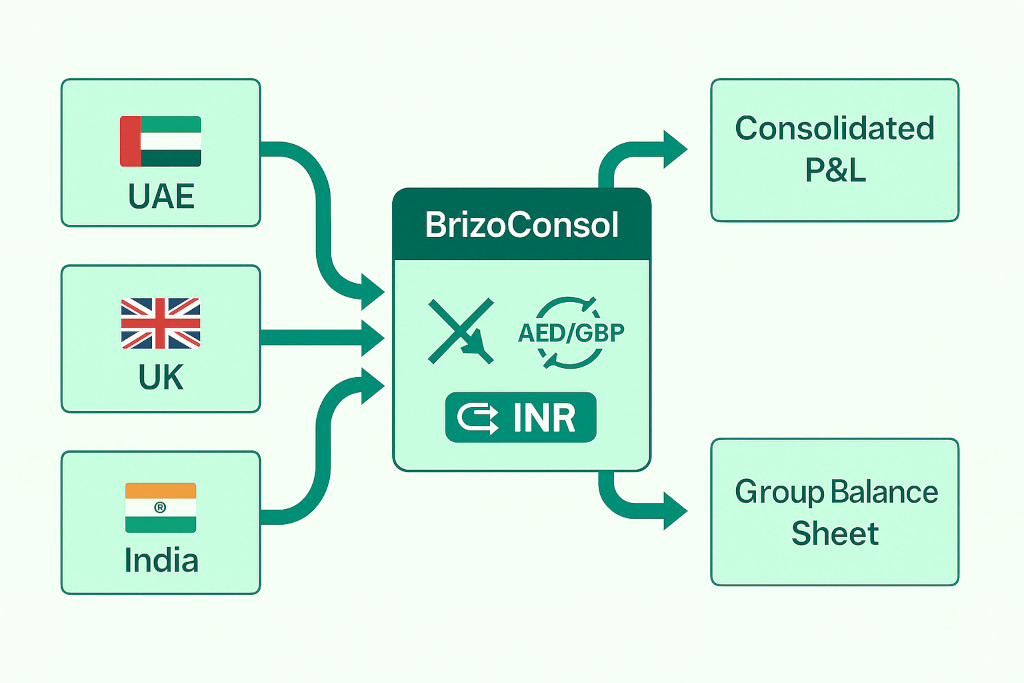
BrizoConsol connects directly to Zoho Books via live API — pulling each organisation’s trial balance automatically, without CSV exports or manual data entry. For a group with three Zoho organisations across three currencies, this is what changes:
Automatic intercompany eliminations
The management fee charges flowing from the Dubai holdco to the UK and India subsidiaries are identified automatically and eliminated from both sides of the consolidated accounts. No manual elimination schedule is required. Every adjustment is logged with a full audit trail — when the auditor asks for the source of each elimination, the system provides it. For a detailed explanation of why eliminations matter and how they work, see our practical guide to intercompany eliminations.
Multi-currency translation with CTA
The UK (GBP) and India (INR) organisations are translated into the group presentation currency (AED) at the correct closing and average rates, with the cumulative translation adjustment calculated and posted to group equity automatically — in line with IAS 21. No spreadsheet, no manual rate application, no risk of applying last quarter’s rate to this quarter’s balance sheet.
AI Auto-Map for chart of accounts
Where the three organisations use different account codes — common in groups that set up each Zoho Books org independently or at different times — BrizoConsol’s AI mapping engine aligns them to a group chart of accounts. Set up once; applied automatically to every subsequent period. Account code changes in any Zoho organisation are flagged for review rather than silently dropped.
Consolidated statements on demand
Once connected, the consolidated P&L, balance sheet, and cash flow statement are available on demand, updated automatically as each Zoho Books organisation refreshes. The group’s quarterly board pack — which previously took eight days to assemble — is produced in hours.
Zoho Books + BrizoConsol in practice: A typical three-to-five organisation Zoho Books group goes live on BrizoConsol in under a day. The first consolidation run surfaces any intercompany mismatches and unmapped account codes. Resolve them once — they do not recur in subsequent months.
When Is It Time to Move Beyond Excel?
For a Zoho Books group of two organisations with no intercompany transactions and identical charts of accounts, a manual consolidation in Excel is manageable — though even then the version-control and audit-trail risks are real.
The case for dedicated Zoho Books consolidation software becomes clear when any of the following apply:
- Three or more Zoho Books organisations
- Any intercompany transactions — management fees, loans, intragroup sales or services
- Any organisation reporting in a currency other than the group presentation currency
- Board, investor or bank reporting requirements on a fixed monthly or quarterly schedule
- IFRS reporting obligations at group level — common for UAE-headquartered groups
- Organisations with different charts of accounts — acquired entities or orgs set up independently
Most multi-organisation Zoho Books groups tick at least three of those boxes. The question is usually not whether to automate, but how long to continue without doing so.
Conclusion: The Group View Zoho Books Cannot Produce
Zoho Books is the right accounting platform for entities that need reliable, affordable, cloud-based bookkeeping. It is not designed to be a consolidation engine — and for groups that need one, trying to force that capability through manual exports and spreadsheet models is where the time and risk compound fastest.
The solution is a consolidation layer that connects directly to each Zoho Books organisation, handles the account mapping, currency translation, intercompany eliminations, and NCI calculations automatically, and delivers consolidated financial statements without manual preparation.
For Zoho Books groups ready to close that gap, the full guide to Zoho Books consolidation covers the broader landscape — and BrizoConsol’s Zoho Books integration is the direct path to getting there.