AASB 112 Income Taxes in Group Consolidation: A Practical Guide for Australian Multi-Entity Groups
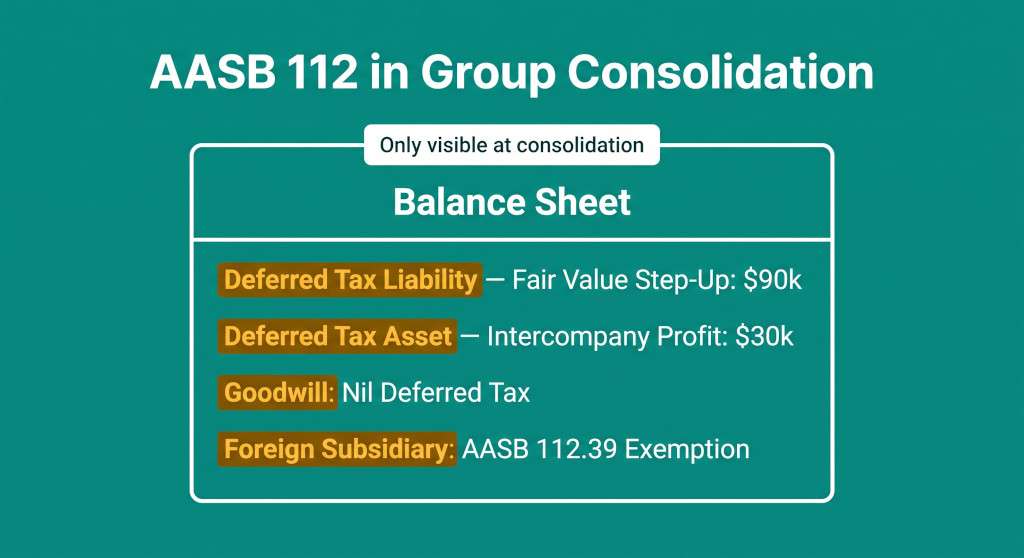
Chen is the finance director of a Sydney-based manufacturing group with four entities. Three years ago, the group formed a tax consolidated group (TCG) — a common arrangement for Australian corporate groups under Division 703 of the Income Tax Assessment Act 1997. At year end, Chen’s reporting accountant exports the deferred tax balances from each entity’s MYOB or Xero file and uses them directly in the consolidation model. The auditor reviews the consolidated deferred tax note and raises two issues.
First: there is a deferred tax liability that should appear in the consolidated accounts — arising from the fair value step-up on plant and equipment when the group acquired Subsidiary 2 — but it exists in none of the entity accounts. It was created by the purchase price allocation at acquisition and has been unwinding through the consolidated P&L ever since, but no one has been carrying it forward in the consolidation model.
Second: because the group formed a TCG, the subsidiary entities’ deferred tax balances are, technically, the head entity’s obligation for tax purposes. Some of the DTA balances that individual entities have recognised in their own accounts may not be appropriate to carry forward at the consolidated level under AASB 112 — because the recognition test applies to the group’s ability to generate future taxable profit, not each entity’s individually.
Stop building consolidations in spreadsheets.
BrizoConsol automates multi-entity consolidation — setup in minutes, reports the same day.
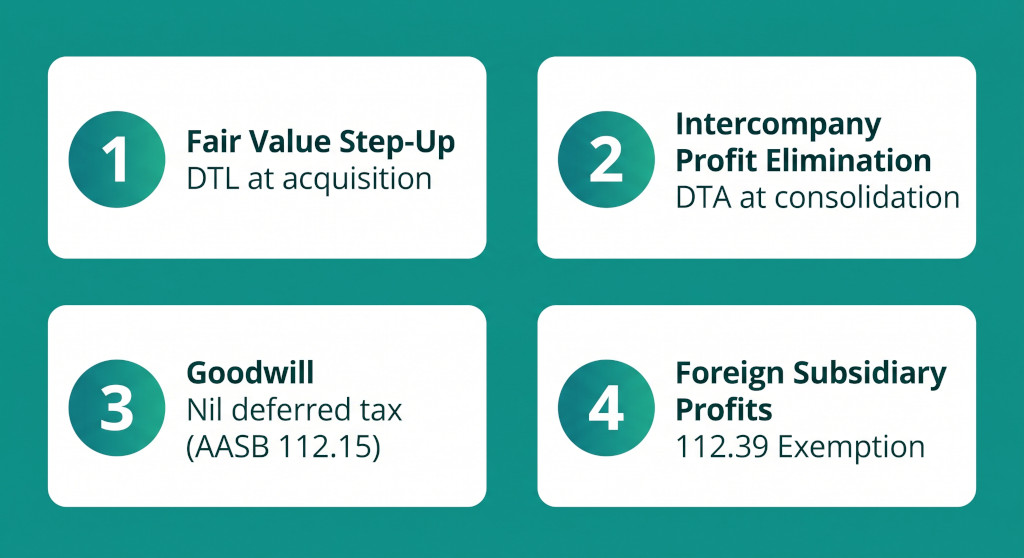
Both issues arise from applying AASB 112 at the consolidated level, where the rules interact with consolidation mechanics in ways that entity-level accounting does not. This guide explains the four deferred tax adjustments that AASB 112 requires at consolidation and how each one should be calculated and presented in Australian multi-entity group accounts.
Why Consolidated Deferred Tax Is Not the Sum of Entity Deferred Tax
At entity level, each group company applies AASB 112 to its own temporary differences — the gaps between its accounting carrying values and the tax bases of its assets and liabilities. Each entity recognises DTAs and DTLs based on its own taxable profit history and forecast. When those entity accounts are brought together at consolidation, the deferred tax position changes for four reasons that are specific to the consolidation process.
For the general mechanics of how consolidation adjustments create deferred tax, see Deferred Tax in Group Consolidation: How Consolidation Adjustments Create Tax Differences. This guide focuses specifically on the Australian application of AASB 112 and the four adjustments that most frequently require attention in Australian group accounts.
Adjustment 1 — Fair Value Step-Up at Acquisition Creates a Deferred Tax Liability
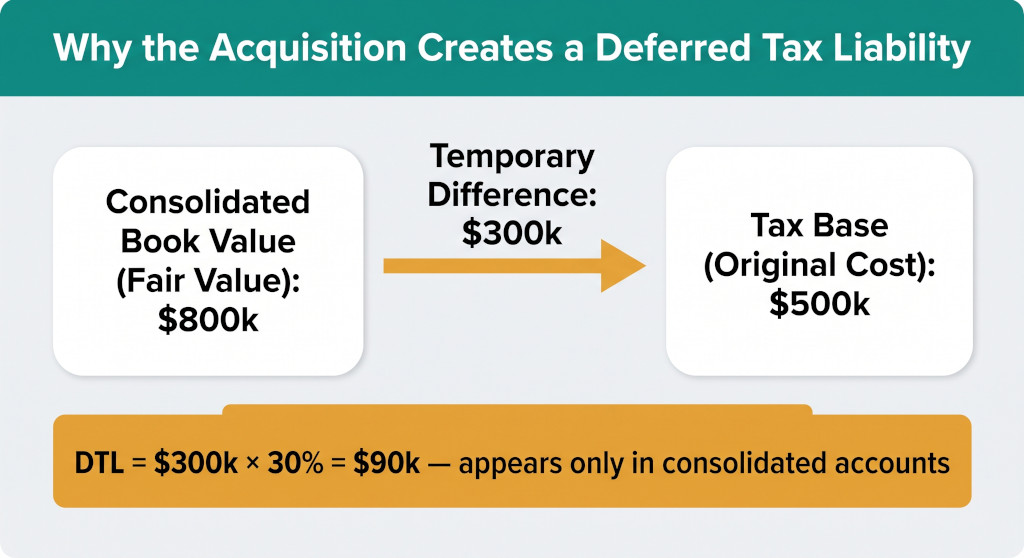
When Chen’s group acquired Subsidiary 2, the purchase price allocation (PPA) under AASB 3 identified that a piece of manufacturing plant had a fair value of $800,000 — $300,000 higher than its carrying value in Subsidiary 2’s own accounts of $500,000. At consolidation, the plant is recognised at fair value ($800,000). The tax base of the plant remains at $500,000 — the tax authority allows depreciation based on original cost, not the group’s acquisition fair value.
This $300,000 difference between the consolidated book value and the tax base is a temporary difference. Under AASB 112.15, a deferred tax liability must be recognised for temporary differences (with specific exceptions — see goodwill below). At a 30% Australian corporate tax rate, the DTL is $90,000. This DTL exists only in the consolidated accounts — Subsidiary 2’s entity accounts still show the plant at $500,000 with no step-up and no corresponding DTL. It is entirely a consolidation-level adjustment.
| Plant — Consolidated book value (fair value at acquisition) | $800,000 |
| Plant — Tax base (original cost, unchanged by acquisition) | ($500,000) |
| Temporary difference | $300,000 |
| Deferred Tax Liability = $300,000 × 30% | $90,000 |
The DTL is posted in the consolidation working paper at acquisition date and then reverses over the plant’s remaining useful life as the higher consolidated depreciation charge reduces the temporary difference. The reversal of the DTL reduces consolidated tax expense each period. This is why Chen’s auditor flagged the omission — without the DTL (and its reversal), the consolidated tax charge and the tax note are both misstated.
Consolidation adjustment — Acquisition date
| Account | Dr | Cr |
|---|---|---|
| Plant and Equipment (fair value step-up) | $300,000 | |
| Deferred Tax Liability (AASB 112) | $90,000 | |
| Goodwill (balancing item, net) | $210,000 |
The DTL reduces goodwill at acquisition date — it is part of the PPA, not a post-acquisition P&L item. The goodwill figure shown above is the net amount after the DTL has been deducted from the gross goodwill. As the step-up depreciates, the reversal goes through consolidated tax expense.
Adjustment 2 — Intercompany Profit Elimination Creates a Deferred Tax Asset
During the year, Entity 3 sold manufacturing equipment to Entity 2 at a profit of $100,000. Entity 3 paid $30,000 tax on this profit in its entity accounts. At consolidation, the intercompany profit is eliminated — the equipment is restated to its original cost in Entity 3’s hands, and the $100,000 gain is removed from consolidated profit.
Entity 3 has now paid $30,000 tax on a profit that the group has not recognised. From the consolidated perspective, the tax was paid before the profit was earned. This creates a deferred tax asset at the consolidation level — the group will recognise the benefit of the tax paid when Entity 2 eventually depreciates the equipment to the group’s lower cost base or disposes of it.
Consolidation adjustment — Intercompany profit elimination
| Account | Dr | Cr |
|---|---|---|
| Profit on Sale of Equipment (eliminate gain, P&L) | $100,000 | |
| Plant and Equipment (reduce to original cost) | $100,000 |
Profit elimination entry — reduces consolidated P&L and restates asset to original cost.
Deferred tax on intercompany profit elimination
| Account | Dr | Cr |
|---|---|---|
| Deferred Tax Asset | $30,000 | |
| Income Tax Expense (consolidation adjustment) | $30,000 |
The DTA reflects the $30,000 tax already paid on the eliminated profit. It reduces consolidated tax expense and increases the group’s deferred tax asset. This entry exists only in the consolidation working paper — neither Entity 2 nor Entity 3 records it.
Adjustment 3 — Goodwill: Nil Deferred Tax Under AASB 112.15(b)
AASB 112.15(b) specifically prohibits the recognition of a deferred tax liability on goodwill arising from a business combination. This is one of the two exceptions to the general rule that DTLs must be recognised on all taxable temporary differences (the other being the initial recognition exception in AASB 112.15(a)).
The rationale: goodwill is not tax-deductible in Australia. The tax base of goodwill arising from a business combination is nil — the ATO does not recognise a deductible asset corresponding to accounting goodwill from an asset acquisition structured as a share purchase (which is the most common structure). The temporary difference between the accounting carrying value of goodwill and its nil tax base would normally generate a DTL. AASB 112.15(b) prohibits this recognition because recognising a DTL on goodwill would simultaneously increase goodwill (since the DTL acquisition debit must go somewhere), creating a circular calculation.
Goodwill impairment under AASB 136 also has no deferred tax consequence for the same reason — the charge reduces carrying value toward nil, but since the initial temporary difference was never recognised, there is no DTL to reverse and no DTA to recognise. Consolidated income tax expense is unaffected by goodwill impairment. This is covered in more detail in AASB 136 Goodwill Impairment Testing: A Practical Guide for Australian Multi-Entity Groups.
Preparing Consolidated Accounts for an Australian Multi-Entity Group?
BrizoConsol handles consolidation-level deferred tax adjustments automatically — fair value step-up DTLs, intercompany profit elimination DTAs, goodwill nil-tax treatment, and AASB 112.39 outside-basis difference assessments — so your consolidation model captures every AASB 112 requirement without manual tracking. See It In Action
Adjustment 4 — Foreign Subsidiaries and the AASB 112.39 Exemption
When a group has foreign subsidiaries, the parent controls when those subsidiaries remit profits to Australia. If the parent intends to remit profits from a foreign subsidiary, Australian withholding tax (or the foreign jurisdiction’s dividend withholding tax, reduced by tax treaty) may apply. This creates an outside-basis difference — the tax cost of extracting the profits from the foreign subsidiary exceeds the parent’s accounting carrying value of its investment.
Under AASB 112.39, a deferred tax liability for outside-basis differences on investments in subsidiaries is not recognised if the parent is able to control the timing of the reversal of the temporary difference and it is probable that the temporary difference will not reverse in the foreseeable future. For most Australian groups with foreign subsidiaries they intend to hold long-term, this exemption applies — profits accumulating in the foreign subsidiary do not trigger a DTL until a dividend is actually declared.
The assessment must be made at each reporting date. If the group’s intention changes — for example, if the group plans to wind up the foreign subsidiary or extract a significant dividend in the near term — the AASB 112.39 exemption no longer applies and the DTL must be recognised. Finance teams should document the basis for claiming the exemption at each period end and retain it as part of the audit evidence for the consolidated accounts.
The Tax Consolidated Group and Its Impact on Consolidation Deferred Tax
Australia’s tax consolidation regime (Divisions 703–721 of ITAA 1997) allows wholly-owned Australian corporate groups to elect to be treated as a single taxpayer for income tax purposes. The head entity files one tax return covering all TCG members; subsidiary entities cease to be taxable entities for Australian income tax purposes while they remain in the group.
For AASB 112 in consolidated accounts, this creates a specific consideration: the DTA recognition test. Under AASB 112.24, a DTA is recognised only to the extent it is probable that sufficient future taxable profit will be available to utilise the temporary difference. In a TCG, the taxable profit that matters is the head entity’s consolidated taxable profit — not each subsidiary’s individual taxable profit. A subsidiary that has historically reported losses may have its DTAs fully utilised against group-wide profits. Conversely, a subsidiary’s deferred tax losses that were recognised at entity level may not be independently utilisable outside the TCG.
Important: If a subsidiary entity exits the tax consolidated group — through disposal, partial ownership change, or group restructuring — its deferred tax position resets under the “leaving rules” in Division 711 of ITAA 1997. The departing entity’s tax values for assets are recalculated, and the consolidated deferred tax position may change significantly. This is a common source of unexpected deferred tax adjustments in consolidated accounts following group restructurings.
The Four AASB 112 Consolidation Adjustments: Summary
| Adjustment | Nature | In Entity Accounts? | AASB 112 Reference |
|---|---|---|---|
| Fair value step-up at acquisition | Deferred Tax Liability | No — consolidation only | AASB 112.15 (general rule; exceptions listed) |
| Intercompany profit elimination | Deferred Tax Asset | No — consolidation only | AASB 112.24 (recognition test) |
| Goodwill | Nil deferred tax | N/A — goodwill is consolidation-only | AASB 112.15(b) (specific prohibition) |
| Foreign subsidiary outside-basis differences | DTL (if 112.39 exemption not met) | Partial — entity records investment at cost | AASB 112.39 (exemption condition) |
Practical Checklist: AASB 112 in Australian Group Consolidation
- Review the purchase price allocation for every acquisition. Identify all fair value step-ups on assets and confirm the corresponding DTLs have been recognised at acquisition date and are being unwound correctly in subsequent periods.
- Identify all intercompany asset transfers in the current period. For each transfer where a profit was recognised at entity level, calculate the DTA and post the deferred tax adjustment in the consolidation model.
- Confirm nil deferred tax on goodwill. No DTL should be recognised on accounting goodwill, and no DTA or DTL should arise from goodwill impairment. Review the consolidated deferred tax note to confirm goodwill is excluded.
- Assess the AASB 112.39 exemption for each foreign subsidiary. Document whether the group controls the timing of dividend remittance and whether remittance is probable in the foreseeable future. Update the assessment annually or when intentions change.
- Review the DTA recognition test in the context of the tax consolidated group. Confirm that DTAs recognised at entity level are still supportable based on the head entity’s consolidated taxable profit forecast, not individual entity forecasts.
- Check for TCG entry and exit events during the period. Any entity entering or leaving the tax consolidated group requires a review of the consolidated deferred tax position.
- Reconcile the consolidated effective tax rate. The rate should be explainable by reference to the standard 30% rate (or 25% for small business entities where applicable), adjusted for permanent differences including nil-tax goodwill, exempt dividends, and research and development tax offsets. Unexplained rate differences often indicate a missing or incorrectly calculated consolidation deferred tax adjustment.
Australian Multi-Entity Group With Complex Deferred Tax?
BrizoConsol produces consolidated deferred tax schedules, fair value step-up roll-forwards, and effective tax rate reconciliations as part of every consolidated close — with all four AASB 112 consolidation adjustments tracked automatically. Start Free Trial