AASB 136 Goodwill Impairment Testing: A Practical Guide for Australian Multi-Entity Groups
Sarah took over as group financial controller for a Melbourne-based healthcare group fourteen months ago. Shortly after she started, she inherited the consolidated balance sheet from her predecessor — including $480,000 of goodwill from the acquisition of a dental practice chain two years earlier. Patient numbers at two of the three clinics have been declining. Costs are up. The practices are profitable, but the picture is weaker than the original acquisition forecast. When the external auditor asks Sarah to walk them through the goodwill impairment test for the year, she realises she has never prepared one.
What her predecessor left behind was an annual note saying “goodwill reviewed — no impairment identified.” There was no supporting calculation, no CGU allocation schedule, and no estimate of recoverable amount. It is not a test — it is a conclusion without evidence. Under AASB 136, that is not acceptable. The standard requires Australian groups to perform a formal, documented impairment test for goodwill at least annually, regardless of whether indicators of impairment are present.
This guide walks through the test Sarah needs to prepare: how to allocate goodwill to the right cash-generating unit, how to calculate value in use using discounted cash flows, how to compare that figure to the carrying amount, and how to post the impairment entry if the test fails. The worked example uses Sarah’s dental group — with numbers that produce an impairment — because the mechanics of a passing test are trivial; the mechanics of a failing one are what groups need to understand.
Stop building consolidations in spreadsheets.
BrizoConsol automates multi-entity consolidation — setup in minutes, reports the same day.
What AASB 136 Requires: Annual Testing, Not Annual Amortisation
Australia adopted the non-amortisation model for goodwill when it moved to AASB-equivalent standards in 2005. Under AASB 136 (which is substantively identical to IAS 36), goodwill is not amortised over a useful life. Instead, it is tested for impairment annually and whenever there are indicators that it may be impaired. The test must be performed at the same time each year, and the comparison period must be consistent.
This is one of the most significant differences between AASB and the old UK GAAP approach (FRS 10), where goodwill was amortised over its useful economic life. Australian groups transitioning from an AASB-equivalent framework should not be amortising goodwill. Groups that are amortising it have an error on their consolidated balance sheet and income statement that will need to be corrected retrospectively.
AASB 136.10 requires goodwill to be tested for impairment annually, irrespective of whether there is any indication of impairment. For all other non-financial assets, the annual test only applies if there is an indicator. This makes goodwill uniquely demanding: the test cannot be skipped in a “good year”.
Step 1: Allocate Goodwill to Cash-Generating Units
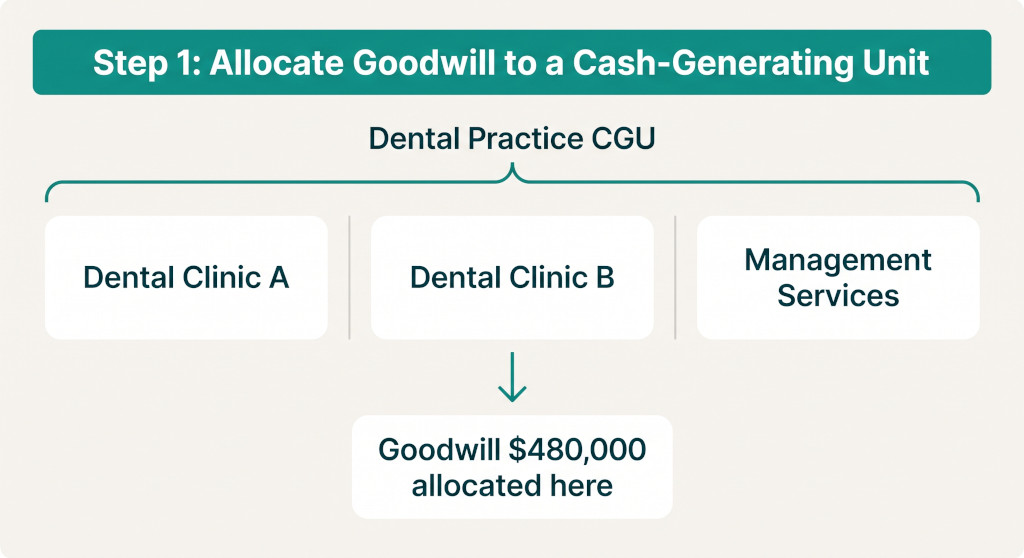
Goodwill cannot be tested in isolation. It does not generate cash flows on its own — it attaches to the operations that were acquired. AASB 136 requires goodwill to be allocated to the cash-generating units (CGUs) or groups of CGUs that are expected to benefit from the synergies of the acquisition. A CGU is the smallest identifiable group of assets that generates cash inflows largely independent of other assets.
For Sarah’s group, the dental practice acquisition brought in three clinics and a management services entity. All four entities operate as an integrated business — the management entity supports the three clinics, and none of the clinics operates truly independently. Sarah allocates the entire $480,000 of goodwill to a single CGU comprising all four entities: the “Dental Practice CGU”.
Common mistake: Groups sometimes allocate goodwill to a CGU that is larger than an operating segment, which is not permitted under AASB 136.80. The CGU to which goodwill is allocated cannot be larger than an operating segment as defined under AASB 8. For most SME groups, the CGU is typically a subsidiary or a cluster of related subsidiaries — not the entire group.
CGU allocation is a judgment that must be documented and applied consistently from year to year. If the CGU structure changes — for example, because the group reorganises or disposes of part of the dental business — goodwill must be reallocated based on the relative fair values of the retained and disposed portions.
Step 2: Determine the Carrying Amount of the CGU
Once the CGU is identified, the carrying amount of the CGU must be established. This is the total net book value of all assets and liabilities that have been allocated to the CGU, including the goodwill itself.
| Net identifiable assets of Dental Practice CGU (per consolidated balance sheet) | $620,000 |
| Goodwill allocated to Dental Practice CGU | $480,000 |
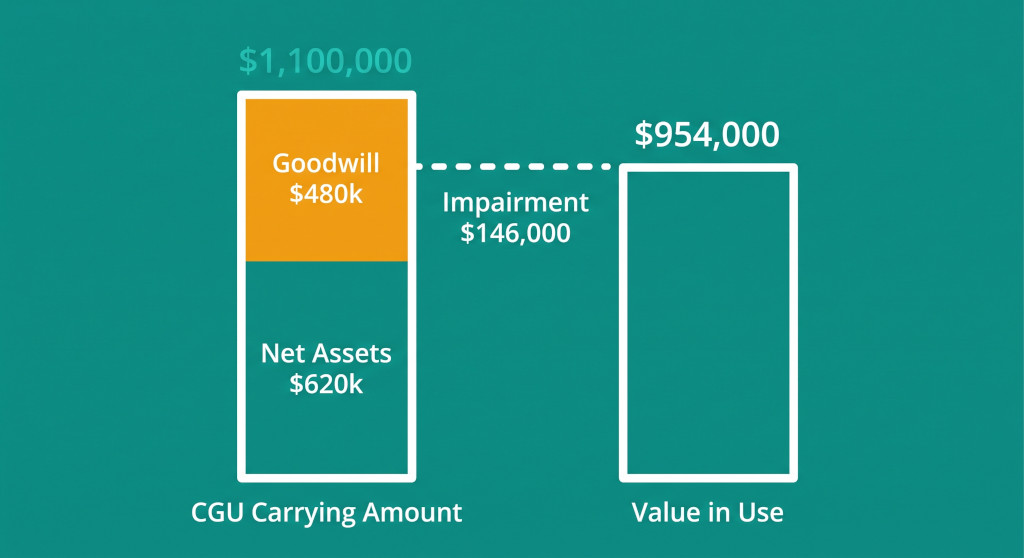
| Total carrying amount of CGU | $1,100,000 |
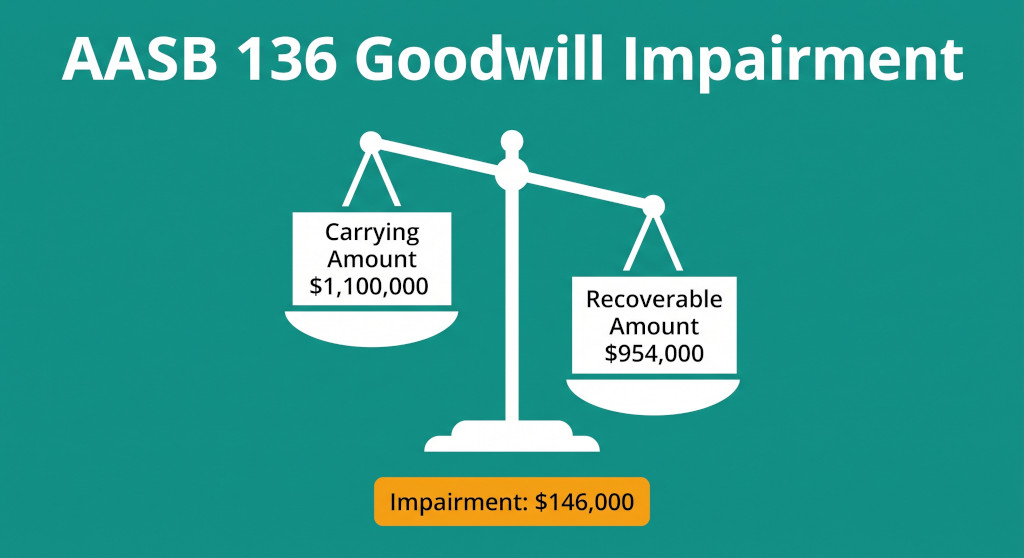
The carrying amount of $1,100,000 is the benchmark. If the recoverable amount — which Sarah calculates next — is below this figure, an impairment loss must be recognised for the difference.
Step 3: Calculate the Recoverable Amount
The recoverable amount of a CGU is the higher of (a) fair value less costs of disposal and (b) value in use. Sarah does not have access to a recent market transaction or broker’s valuation for the dental group, so she calculates value in use — the present value of the future cash flows expected from the CGU.
Preparing the value in use calculation
Value in use is a discounted cash flow calculation. It requires five inputs: forecast cash flows for an explicit projection period (typically five years), a long-run terminal value assumption, and a discount rate that reflects the pre-tax risks specific to the CGU.
Sarah bases her forecasts on management’s approved budget, adjusted for realistic assumptions about the dental market. Given the underperformance of two clinics, the forecast shows declining cash flows over the first three years before stabilising. She uses a pre-tax discount rate of 12%, derived from the weighted average cost of capital for comparable healthcare businesses.
| Period | Forecast cash flow | Discount factor (12%) | Present value |
|---|---|---|---|
| Year 1 | $160,000 | 0.8929 | $142,857 |
| Year 2 | $145,000 | 0.7972 | $115,591 |
| Year 3 | $130,000 | 0.7118 | $92,527 |
| Year 4 | $115,000 | 0.6355 | $73,087 |
| Year 5 | $100,000 | 0.5674 | $56,746 |
| Terminal value ($100,000 ÷ 12%) | $833,333 | 0.5674 | $472,832 |
| Value in Use (Recoverable Amount) | $953,640 | ||
The terminal value assumes no long-run growth in cash flows — a conservative assumption given the current performance of the clinics. Sarah rounds the VIU to $954,000 for the impairment comparison.
Watch out: AASB 136.50 requires the cash flow projections to be based on reasonable and supportable assumptions consistent with past performance and external evidence. Projections cannot include restructuring cash flows the group has not yet committed to, expected improvements from planned capital expenditure not yet approved, or synergies not yet realised. An impairment test that reverses underperformance with optimistic assumptions will not survive audit scrutiny.
Step 4: Compare and Post the Impairment Entry
The impairment comparison is straightforward:
| Carrying amount of Dental Practice CGU | $1,100,000 |
| Recoverable amount (Value in Use) | ($954,000) |
| Impairment loss to be recognised | $146,000 |
AASB 136.104 requires the impairment loss to be allocated to the assets of the CGU in a specific order. Goodwill absorbs the loss first, before any impairment is allocated to other assets. This means the $146,000 impairment reduces goodwill in full — there is no need to write down any of the identifiable net assets, because the goodwill balance ($480,000) is large enough to absorb the entire impairment.
| Account | Dr | Cr |
|---|---|---|
| Impairment loss — Goodwill (P&L) | $146,000 | |
| Accumulated impairment — Goodwill (Balance sheet) | $146,000 |
The impairment is posted in the consolidated accounts only — goodwill does not appear in any entity’s individual financial statements. The debit typically appears in the consolidated P&L as a separate line item or within administrative expenses, depending on the group’s presentation policy. Under AASB 136, goodwill impairment losses cannot be reversed in future periods.
After this entry, the goodwill balance on the consolidated balance sheet is:
| Goodwill at cost | $480,000 |
| Accumulated impairment | ($146,000) |
| Goodwill — net carrying amount | $334,000 |
The revised CGU carrying amount ($620,000 net assets + $334,000 goodwill = $954,000) now equals the recoverable amount. The consolidated balance sheet correctly reflects the economic value of the dental group. For a broader treatment of goodwill accounting across the full consolidation lifecycle, see Goodwill in Group Consolidation: Calculation, Impairment, and Common Errors.
Managing Goodwill Impairment Across Multiple CGUs?
BrizoConsol tracks goodwill balances at CGU level across your consolidated group and maintains the impairment history your auditor needs. See how it works in a 20-minute live demo. See It In Action
NCI and Goodwill Impairment: Who Bears the Loss?
The treatment of goodwill impairment changes depending on whether the group used the full goodwill method or the partial goodwill method at acquisition. This is a choice under AASB 3, made acquisition by acquisition. The distinction is significant at impairment time.
Under the partial goodwill method, only the parent’s share of goodwill is recognised on the consolidated balance sheet — the NCI’s “implicit goodwill” is not included. When an impairment occurs, the full impairment loss is absorbed by the parent’s interest. The NCI is not affected, because no goodwill was attributed to it in the first place. Sarah’s dental group used the partial goodwill method, so the $146,000 impairment reduces the parent’s consolidated retained earnings entirely.
Under the full goodwill method, both the parent’s and NCI’s shares of goodwill appear on the consolidated balance sheet. An impairment of the CGU’s goodwill must be allocated between the parent and NCI in proportion to their ownership interests. If Sarah’s group had used the full goodwill method and held 80% of the dental group (with a 20% NCI), the $146,000 impairment would be allocated $116,800 to the parent and $29,200 to NCI — reducing both the parent’s retained earnings and the NCI balance on the consolidated balance sheet.
The full implications of this choice — and why it affects the impairment test outcome — are explored in Full Goodwill vs Partial Goodwill.
Impairment Indicators: When Annual Testing Is Not Enough
AASB 136 requires the annual goodwill test regardless of indicators — but it also requires an additional test whenever there is an indication that a CGU may be impaired. Indicators can be external (market conditions, interest rates, competitor activity, regulatory change) or internal (significant underperformance against forecast, staff departures, restructuring plans, asset obsolescence). For Sarah’s group, the declining patient numbers at two clinics and the miss against the acquisition business plan are both internal indicators that would trigger an interim test even if the annual test date had not yet arrived.
Groups that only test at year-end and ignore mid-year indicators will struggle to explain to their auditors why an impairment was not recognised until twelve months after the triggering event became evident. The documentation of indicator assessments — even when no impairment results — is part of the AASB 136 compliance record.
Deferred Tax and the Goodwill Impairment
One complication that catches many groups by surprise: goodwill impairment does not generally create a deferred tax asset. Under AASB 112, the tax base of goodwill for Australian income tax purposes is nil — there is no tax deduction for goodwill impairment under the Australian income tax regime. The deductible temporary difference from the goodwill write-down is zero, and no deferred tax asset is recognised. The impairment loss passes through the P&L without a corresponding tax benefit.
This means the goodwill impairment line item has a 0% effective tax rate, which will often increase the group’s effective tax rate for the year. Finance teams should flag this to management and the board well before the accounts are finalised so the tax rate movement does not appear unexplained. For a broader treatment of deferred tax mechanics in consolidation, see Deferred Tax in Group Consolidation.
Key AASB 136 Disclosure Requirements
AASB 136 disclosure requirements for goodwill are extensive and tend to be scrutinised closely by auditors and, for listed groups, by ASIC. The following are mandatory for each CGU (or group of CGUs) to which a significant amount of goodwill has been allocated:
- Carrying amount of goodwill allocated to each CGU and a description of how the CGU has been identified.
- Basis for recoverable amount — whether the test used fair value less costs of disposal or value in use, and the key assumptions.
- For value in use: the discount rate(s) applied (pre-tax), the growth rate used to extrapolate cash flow projections beyond the explicit forecast period, and the period over which cash flows were projected.
- Sensitivity analysis: if a reasonably possible change in a key assumption would cause the carrying amount to exceed the recoverable amount, the standard requires disclosure of the assumption, the value needed to result in a break-even, and the change in that value.
- The amount of impairment loss recognised during the period, the line item of the income statement in which it is included, and the segment to which it relates (if applicable).
For unlisted Australian groups, the sensitivity disclosure is often the most challenging to prepare. Many preparers omit it or present it in vague terms — which invites audit questions. A specific, quantified sensitivity (e.g., “an increase in the discount rate to 14.8% would reduce the recoverable amount to the carrying amount”) is both compliant and easier to defend than a generic statement that the test is sensitive to assumptions.
Practical Checklist: AASB 136 Goodwill Impairment Test
- Confirm the CGU allocation. Review which CGUs goodwill has been allocated to. Confirm the allocation has not changed since acquisition and that each CGU does not exceed an operating segment.
- Determine the CGU carrying amount. Aggregate the net book value of all assets and liabilities allocated to each CGU, including the goodwill balance.
- Prepare the cash flow forecast. Base projections on approved management budgets. Exclude cash flows from uncommitted restructuring or unapproved capital expenditure. Document all key assumptions.
- Select and support the discount rate. Use a pre-tax rate that reflects the specific risks of the CGU. Retain evidence of how the rate was derived — comparable company WACC data, industry risk premiums, or adviser input.
- Calculate value in use. Discount the explicit period cash flows and the terminal value to present value. Sum to produce the recoverable amount.
- Compare to carrying amount. If recoverable amount exceeds carrying amount, no impairment — document and retain the workings. If below, calculate the impairment loss.
- Allocate and post the impairment. Reduce goodwill first. If the impairment exceeds the goodwill balance, reduce other assets pro-rata. Post the consolidation journal entry.
- Address NCI. If full goodwill method was used, allocate the goodwill impairment between parent and NCI. Adjust both the parent’s retained earnings and the NCI balance on the consolidated balance sheet.
- Prepare the disclosures. Draft the AASB 136 note including CGU description, key assumptions, discount rate, projection period, sensitivity analysis, and impairment amount.
- Confirm no deferred tax asset is recognised on the goodwill impairment. Document the nil tax base reasoning in the deferred tax working papers.
Ready to Put Your Goodwill Impairment Testing on a Solid Footing?
BrizoConsol maintains goodwill and impairment records at CGU level, tracks historical impairment charges, and keeps the audit trail your AASB 136 test requires. Start your free trial today. Start Free Trial