Acquiring a SaaS Business: Why the Deferred Revenue Write-Down Means Your Consolidated Revenue Will Be Lower Than You Expect
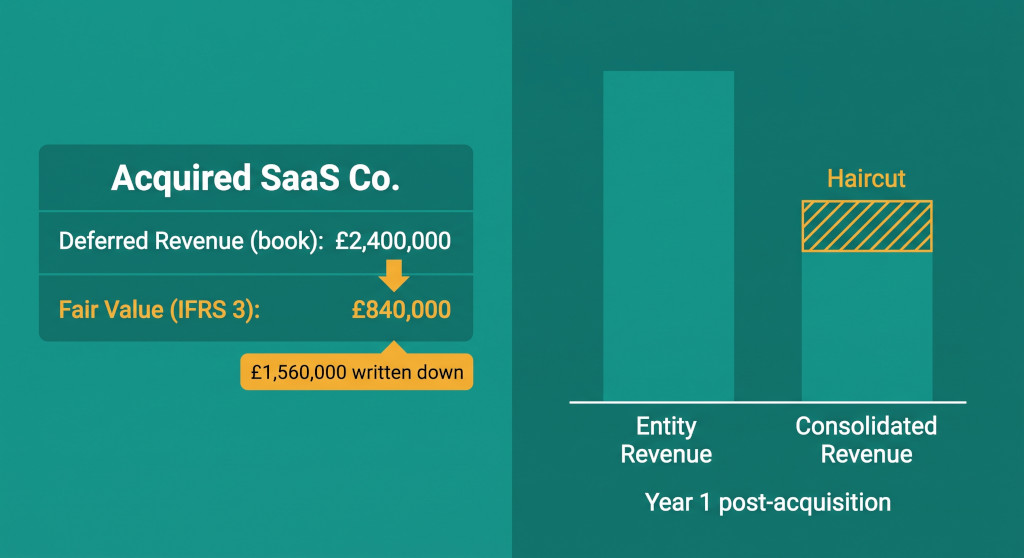
Sophie is the group CFO of Nexus Technologies, a UK-based software group that acquired CloudPay Ltd — a payroll SaaS business — on 1 April. The acquisition made strategic sense: CloudPay had 340 customers on annual contracts, strong retention, and an ARR of £3.2 million. The deal was priced at £4.2 million. At the time of signing, Nexus’s board agreed a post-acquisition revenue budget that assumed CloudPay would contribute approximately £2.4 million of subscription revenue in the nine months from April to December — the unearned portion of annual subscriptions that CloudPay’s customers had already paid upfront.
When Sophie presents the Q2 consolidated accounts three months after closing, the board notices a problem. CloudPay’s own management accounts for April to June show subscription revenue of £800,000 — exactly on budget. The consolidated group accounts show CloudPay contributing only £280,000 of subscription revenue for the same period. The gap is £520,000, and it is entirely absent from the acquisition model anyone prepared at the time of the deal.
The explanation is IFRS 3. When a business combination is accounted for under the acquisition method, all identifiable assets and liabilities of the acquired company must be recognised at fair value on the acquisition date. Deferred revenue — the liability representing subscriptions paid in advance by customers, for which CloudPay has not yet delivered the service — is not exempt from this requirement. And the fair value of deferred revenue under IFRS 3 is almost always significantly lower than its book value.
Stop building consolidations in spreadsheets.
BrizoConsol automates multi-entity consolidation — setup in minutes, reports the same day.
Why Deferred Revenue Is a Liability — and Why Its Fair Value Is Much Lower Than Its Book Value
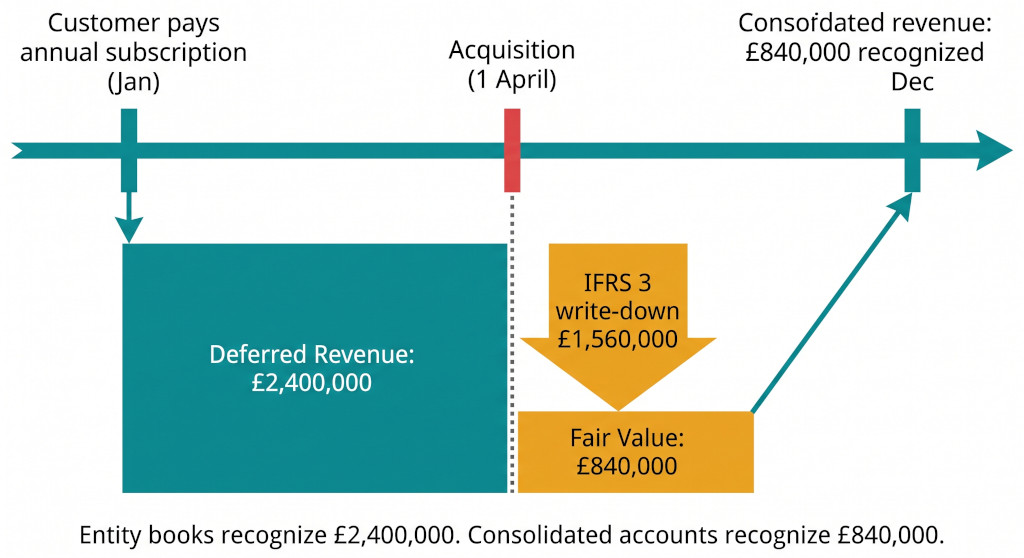
In a SaaS business, annual subscription customers typically pay twelve months of fees upfront at the start of their contract year. The SaaS company receives the cash but has not yet earned it — it has an obligation to deliver software access and support for the remaining months of the contract. Until that service is delivered, the received cash sits as a liability on the balance sheet: deferred revenue (also called contract liabilities under IFRS 15).
At CloudPay’s balance sheet date of 31 March, customers who had started annual contracts in January had already paid for a full year. Three months of service had been delivered. Nine months of service remained. CloudPay’s deferred revenue balance — representing the obligation to serve those customers for nine more months — was £2,400,000.
Under a straightforward revenue recognition model, this £2,400,000 would flow through to revenue over the next nine months, month by month, as the service is delivered. This is exactly what happens in CloudPay’s own management accounts.
But from an IFRS 3 perspective, a potential acquirer is not buying a liability of £2,400,000. They are buying an obligation — the right and responsibility to serve those customers for nine months. The question IFRS 3 asks is: what would a market participant pay (or require to be paid) to assume that obligation? The answer is determined using a cost-to-fulfil model: what does it actually cost to provide the service, plus a reasonable return for doing so?
The fair value of deferred revenue is not “how much revenue the acquiree will recognize” — it is “how much it costs the acquirer to fulfil the remaining service obligation, plus a market participant’s margin.” These are very different numbers in a SaaS business with high gross margins.
Calculating the Fair Value: The Cost-to-Fulfil Approach
Nexus’s acquisition team, working with their valuation advisers, estimated the cost of fulfilling CloudPay’s remaining service obligation for the nine months post-acquisition. This involved identifying the direct and indirect costs of running the CloudPay platform and supporting its customers:
| Hosting and infrastructure costs (9 months) | £210,000 |
| Customer support staff costs (9 months) | £280,000 |
| Maintenance and security patching (9 months) | £80,000 |
| Allocated overhead (9 months) | £130,000 |
| Total estimated cost to fulfil | £700,000 |
| Market participant margin (20%) | £140,000 |
| Fair value of deferred revenue | £840,000 |
The fair value of £840,000 compares to the book value of £2,400,000. The difference — £1,560,000 — is the deferred revenue write-down. This amount is posted as part of the purchase price allocation on the acquisition date and does not flow through either CloudPay’s P&L or Nexus’s consolidated P&L as an expense. It is, in effect, erased at acquisition.
Common mistake in deal modelling: Building post-acquisition revenue forecasts from the acquired company’s own projected revenue, without adjusting for the IFRS 3 deferred revenue write-down. The acquired company’s own projections assume the full deferred revenue balance unwinds into revenue over the remaining contract period. The consolidated P&L only recognises the fair-valued amount. The shortfall can be material in any SaaS deal where customers pay annually upfront.
How the Write-Down Appears in the Purchase Price Allocation
At the acquisition date, Nexus accounts for the business combination by recognising all of CloudPay’s identifiable assets and liabilities at fair value. The deferred revenue write-down increases CloudPay’s fair value net assets (because the liability is smaller than its book value), which in turn reduces the goodwill recognised on acquisition.
| PPA — CloudPay Ltd at 1 April | Book Value | Fair Value Adj. | Fair Value |
|---|---|---|---|
| Net assets (other) | £2,200,000 | £100,000 | £2,300,000 |
| Deferred revenue (contract liability) | (£2,400,000) | £1,560,000 | (£840,000) |
| Identified intangibles (customer list, IP) | — | £800,000 | £800,000 |
| Net identifiable assets at fair value | £2,260,000 | ||
| Consideration paid | £4,200,000 | ||
| Goodwill recognised | £1,940,000 |
If the deferred revenue write-down had not been applied — if the deferred revenue had been kept at book value — the net identifiable assets at fair value would have been £700,000 lower (£1,560,000 less in assets, already netted against the higher £2,400,000 deferred revenue liability = no, wait: keeping it at book reduces net assets by the difference of £1,560,000), and goodwill would have been £700,000 higher at approximately £2,500,000… actually, the accounting mechanics work as follows: remeasuring deferred revenue from (£2,400,000) to (£840,000) increases net assets by £1,560,000, which reduces goodwill by £1,560,000. The deferred revenue write-down is therefore goodwill-reducing — the purchase price is the same, but more of the value is attributed to identifiable net assets rather than to goodwill.
The journal to record the acquisition in the consolidation accounts on 1 April is, in simplified form:
| Account | Dr | Cr |
|---|---|---|
| Net assets acquired at fair value (various) | £3,100,000 | |
| Identified intangibles | £800,000 | |
| Goodwill | £1,940,000 | |
| Deferred revenue (at fair value) | £840,000 | |
| Cash consideration paid | £4,200,000 | |
| Pre-acquisition retained earnings (eliminated) | £800,000 |
Acquisition entry at 1 April. Deferred revenue is recognised at its IFRS 3 fair value of £840,000, not CloudPay’s book value of £2,400,000. The £1,560,000 difference is absorbed within the PPA — it reduces the goodwill that would otherwise be recognised, and it reduces the revenue that flows into the consolidated P&L over the nine post-acquisition months.
Consolidating a SaaS acquisition for the first time?
BrizoConsol handles acquisition accounting, purchase price allocation adjustments, and post-acquisition consolidation across all your entities — so your group accounts are audit-ready from day one.See It In Action
The Revenue Gap — Quarter by Quarter
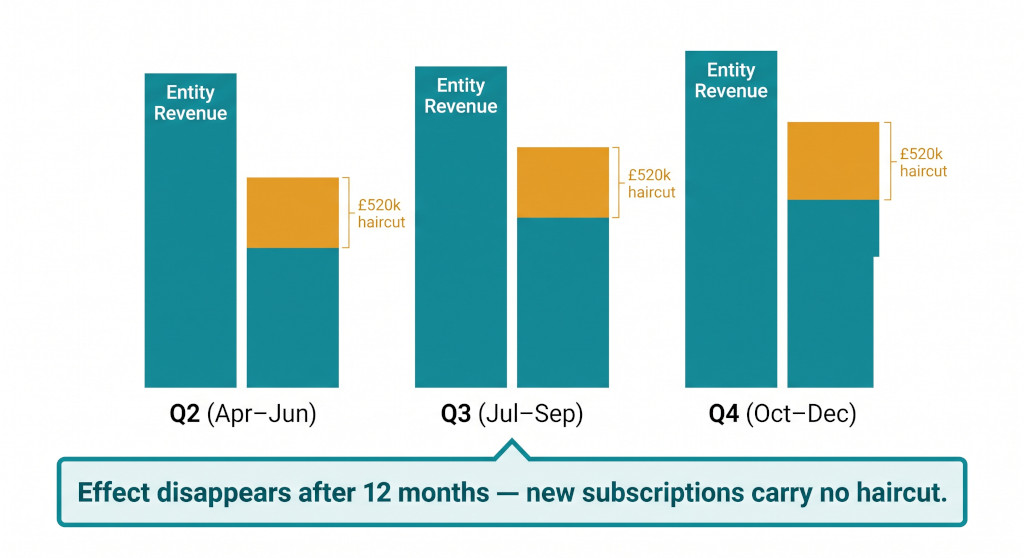
Once the PPA is posted, the consolidated accounts carry CloudPay’s deferred revenue at £840,000 on 1 April. CloudPay’s own accounts carry it at £2,400,000. Each quarter, both balances unwind as the subscription service is delivered — but at very different rates. The result is a persistent revenue gap in the consolidated P&L for every quarter of the post-acquisition year:
| Period | CloudPay Entity Revenue | Consolidated Revenue* | Revenue Gap |
|---|---|---|---|
| Q2 (Apr–Jun): pre-acquisition deferred | £800,000 | £280,000 | (£520,000) |
| Q3 (Jul–Sep): pre-acquisition deferred | £800,000 | £280,000 | (£520,000) |
| Q4 (Oct–Dec): pre-acquisition deferred | £800,000 | £280,000 | (£520,000) |
| New subscriptions (Apr–Dec, approx.) | £720,000 | £720,000 | — |
| Total Apr–Dec | £3,120,000 | £1,560,000 | (£1,560,000) |
*Consolidated revenue from pre-acquisition deferred = £840,000 ÷ 9 months × number of months in period = £93,333/month. New subscriptions carry no IFRS 3 adjustment.
Three things emerge from this analysis. First, the gap is exactly £1,560,000 over the nine-month period — equal to the deferred revenue write-down posted on acquisition. This is not a coincidence; it is mechanical. The write-down exactly equals the revenue that CloudPay’s entity accounts will recognise from pre-acquisition subscriptions but the consolidated accounts will not. Second, the gap is evenly distributed across quarters. The deferred revenue unwinds on a straight-line basis in both the entity and consolidated accounts — the percentage haircut is therefore constant each month. Third, new subscriptions signed after 1 April carry no haircut whatsoever. They are recognised in both the entity and consolidated accounts at full value, because they were entered into after the acquisition date and were never subject to IFRS 3 remeasurement.
The deferred revenue haircut is largest in the quarter immediately after acquisition, when the pre-acquisition deferred balance is at its biggest. It diminishes to zero over the remaining term of the acquired contracts, then disappears entirely. New subscriptions written post-acquisition gradually replace pre-acquisition revenue with “clean” revenue — no adjustment, no haircut.
Explaining the Gap to the Board
The board expectation that CloudPay would contribute £800,000 of revenue in Q2 was based on CloudPay’s own management accounts. The consolidated contribution was £280,000 from pre-acquisition deferred revenue, plus new subscription revenue recognized in the period — a substantially lower number that looks like underperformance but is not.
The most effective way to explain this to a board is to separate the two revenue streams explicitly: pre-acquisition deferred revenue (which carries the IFRS 3 haircut and will fully normalize within twelve months) and post-acquisition new subscription revenue (which carries no adjustment and reflects the true commercial performance of the business under Nexus’s ownership). Presenting these separately in board reporting prevents the IFRS 3 accounting effect from being mistaken for a sales shortfall.
Many SaaS acquirers introduce a non-GAAP performance metric — often called “Adjusted Revenue” or “Organic Revenue” — that adds back the deferred revenue write-down for the post-acquisition period. This metric is common in tech sector M&A reporting precisely because the IFRS 3 effect distorts like-for-like comparisons. If used, it should be clearly reconciled to the IFRS revenue line in any board or investor document.
What Happens After Twelve Months
The deferred revenue write-down effect is temporary. Once the pre-acquisition contract cohort has fully served out its subscription year — for CloudPay, by the end of December — the deferred revenue balance carried at fair value (£840,000) has been fully recognized. From January of the following year, CloudPay’s subscription revenue in the consolidated accounts is driven entirely by post-acquisition subscriptions, which carry no IFRS 3 adjustment. Entity accounts and consolidated accounts converge.
From Year 2 onwards, CloudPay’s revenue contribution to the consolidated P&L will equal what its own accounts show, subject only to normal intercompany eliminations and any ongoing PPA amortisation charges on the identified intangibles (the customer list and IP valued at £800,000 in the acquisition). The revenue haircut is a Year 1 phenomenon, and it is bounded precisely by the deferred revenue balance that existed on the acquisition date.
This is why the size of the deferred revenue balance on a SaaS target’s balance sheet matters so much at deal stage. A target with high annual upfront billing will have a large deferred revenue balance — and therefore a large Year 1 revenue haircut. A target with monthly billing will have a near-zero deferred revenue balance and a negligible haircut. The billing cadence of the acquired business directly determines the accounting impact of the acquisition on Year 1 consolidated revenue. For a full walkthrough of how to account for a new subsidiary acquired mid-year — including PPA mechanics — see How to Consolidate a New Subsidiary Acquired During the Year, and for the IFRS 3 acquisition accounting framework in full, see Acquisition Accounting in Group Consolidation: A Step-by-Step Guide to IFRS 3.
Due Diligence and Deal Modelling Implications
The deferred revenue write-down needs to enter the acquisition model before signing, not after closing. In due diligence, the right questions to ask of the target are: what is the deferred revenue balance as at the expected completion date, broken down by contract start date and remaining term; what is the estimated cost to fulfil the remaining service obligations; and what is a market-appropriate margin to apply to that cost base?
The answers produce a fair value estimate for deferred revenue that can be incorporated into the pro-forma consolidated P&L. Any post-acquisition revenue budget built without this adjustment will overstate Year 1 consolidated revenue by the full amount of the write-down — and create the exact board conversation that Sophie found herself having.
The write-down also has implications for the valuation itself. Some acquirers negotiate a price adjustment for the deferred revenue haircut — arguing that they are effectively buying a liability that will generate less consolidated revenue than it appears to. Others build the effect into their return calculations without seeking a price change. Either way, a deal team that models the IFRS 3 deferred revenue treatment before signing avoids the surprise that Sophie’s board experienced after closing.
Checklist: Managing Deferred Revenue in a SaaS Acquisition
- Identify the deferred revenue balance at the expected completion date. Request a schedule from the target’s finance team showing deferred revenue by customer, contract start date, contract end date, and subscription value. The balance at completion date is the starting point for the fair value calculation.
- Estimate the cost to fulfil. For each revenue stream (software access, support, implementation services if any), estimate the direct and indirect costs of delivering the remaining service obligation. Include hosting, support headcount, maintenance, and a reasonable overhead allocation.
- Apply a market participant margin. Add a reasonable margin — typically 15–25% for a SaaS business — to arrive at the fair value of the deferred revenue. Document the margin assumption and its basis; auditors will scrutinise this.
- Calculate the write-down and build it into the acquisition model. The write-down (book value minus fair value) equals the Year 1 consolidated revenue suppression from pre-acquisition subscriptions. Build this into the post-acquisition P&L forecast before the deal is signed.
- Separate new subscription revenue from pre-acquisition deferred in post-acquisition reporting. Track the two streams independently in management reporting. This allows the board to evaluate commercial performance (new subscriptions) separately from the accounting effect (pre-acquisition deferred revenue unwinding at fair value).
- Post the PPA journal at acquisition date with deferred revenue at fair value. The deferred revenue in the opening consolidated balance sheet must be at fair value, not the target’s book value. If an interim consolidation is run at the acquisition date, confirm this adjustment is in the opening position before any post-acquisition trading is added.
- Amortise identified intangibles separately from the deferred revenue effect. The customer list and acquired IP valued in the PPA will generate an amortisation charge in each post-acquisition period — separate from, and in addition to, the deferred revenue haircut. Model both charges when forecasting post-acquisition consolidated EBIT.
- Monitor the deferred revenue balance monthly until it reaches zero. The fair-valued deferred revenue should reach zero by the end of the first anniversary of acquisition. If it has not, investigate whether new pre-acquisition contract customers have been incorrectly added to the balance.
Get your SaaS acquisition consolidation right from day one
BrizoConsol handles PPA adjustments, mid-year acquisitions, and multi-entity SaaS consolidation — giving your board accurate group accounts without the manual spreadsheet work. Start Free Trial