GAAP Journals and Consolidation Journals Are Now Separate — and Month End Status Reflects It
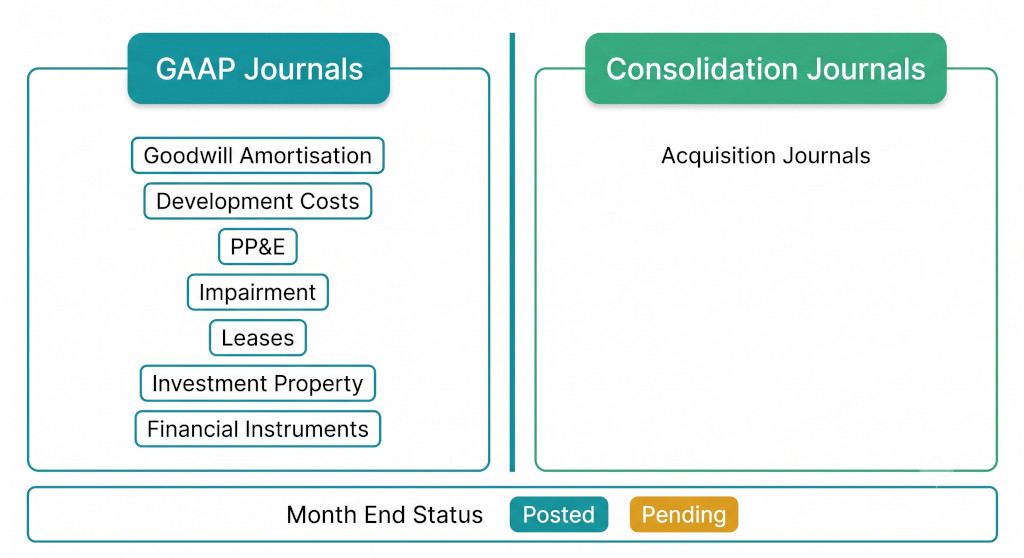
Groups that consolidate entities across different accounting frameworks — IFRS subsidiaries into a US GAAP parent, for example, or SFRS(I) entities into a UK group — need to make two distinct types of journal adjustments at month end. The first type converts the subsidiary’s accounts from its local accounting standard to the group’s standard: these are GAAP conversion journals. The second type handles purely consolidation-level entries that exist only in the group accounts: acquisition accounting, intercompany eliminations processing, and similar. The two should never be mixed up — they serve different purposes and are signed off by different people.
Until now, both types lived under the same Adjustments section in BrizoConsol, which made month-end navigation harder than it needed to be. We have separated them.
What Has Changed
The Adjustments section in the sidebar now has two clearly labelled journal sub-sections: GAAP Journals and Consolidation Journals. CTA / FCTR remains as its own item alongside them.
Close your books faster every month.
BrizoConsol streamlines your month-end consolidation so your team spends less time on manual work.
The Month End Status page has been updated to match — the Group-level Adjustments section now shows GAAP Journals and Consolidation Journals as distinct line items, each with their own entry count and posted/pending status. You can see at a glance which type of adjustment work is complete and which still needs attention.
GAAP Journals: Typed by Accounting Area
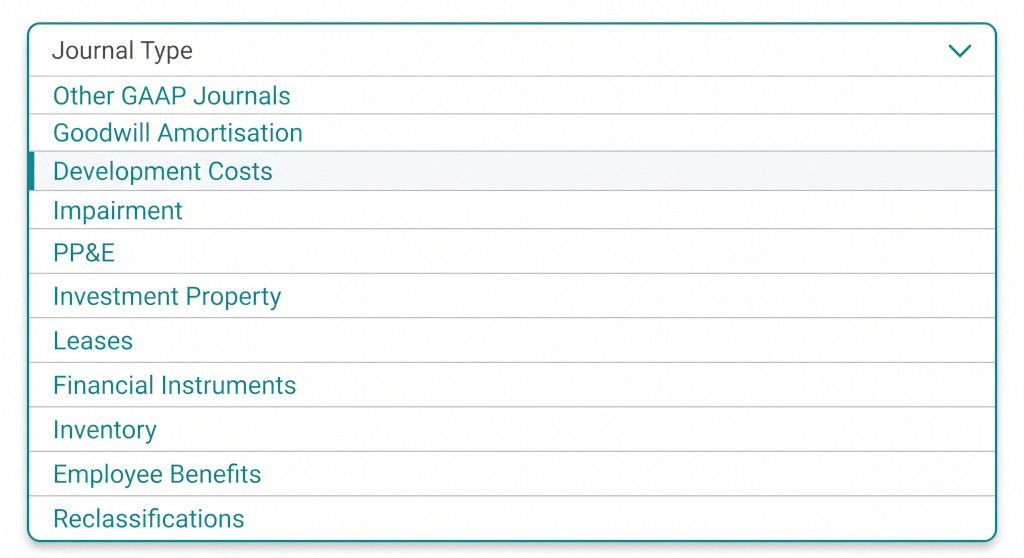
When you create a new entry under GAAP Journals, you now assign it a journal type from a structured list. Each type corresponds to a specific accounting difference between standards — the same areas covered in our cross-standard consolidation guides. The available types are:
Goodwill Amortisation
For groups where the subsidiary amortises goodwill under its local standard (e.g. FRS 102) but the group does not.
Development Costs
For reversing capitalised development costs when converting from IFRS to US GAAP, where R&D must be expensed.
Impairment
For adjustments related to impairment recognition and reversal differences across standards.
PP&E
For reverting PP&E from the revaluation model to cost model when converting to US GAAP.
Investment Property
For converting investment property from fair value (IFRS IAS 40) to the cost model required under US GAAP.
Leases
For reclassifying lease expense presentation between IFRS 16 finance treatment and US GAAP ASC 842 operating lease line.
Financial Instruments
For measurement category differences between IFRS 9 and US GAAP ASC 815 / 825.
Inventory
For LIFO reserve adjustments when a US GAAP parent uses LIFO and the IFRS subsidiary uses FIFO or weighted average.
Employee Benefits
For pension and post-employment benefit differences between IAS 19 and US GAAP ASC 715.
Reclassifications
For presentation reclassifications required to align the subsidiary’s line items with the group’s reporting structure.
Other GAAP Journals
Catch-all for any GAAP conversion adjustment that does not fit a named category above.
Typing each entry makes it much easier to review GAAP journals as a set, filter by accounting area, and confirm that all known conversion differences for the period have been addressed.
The journal type is also visible in the Eliminations & Journals Report, so reviewers and auditors can filter the group’s adjustment entries by type without having to read through every description manually.
Consolidation Journals: Separate and Distinct
Consolidation Journals covers entries that exist only at the group level and have nothing to do with GAAP conversion — acquisition accounting journals (fair value adjustments on acquisition, goodwill recognition), purchase price allocation entries, and any other consolidation-only adjustment that does not correspond to a local entity’s accounting policy difference.
Keeping these separate from GAAP journals matters at month end. GAAP journals are typically the responsibility of the subsidiary finance team or the group accountant closest to the entity’s books — they require knowledge of the local standards. Consolidation journals are a group-level responsibility, typically owned by the group FC or CFO. Separating them in BrizoConsol reflects how the work is actually divided.
Month End Status: A Clearer View
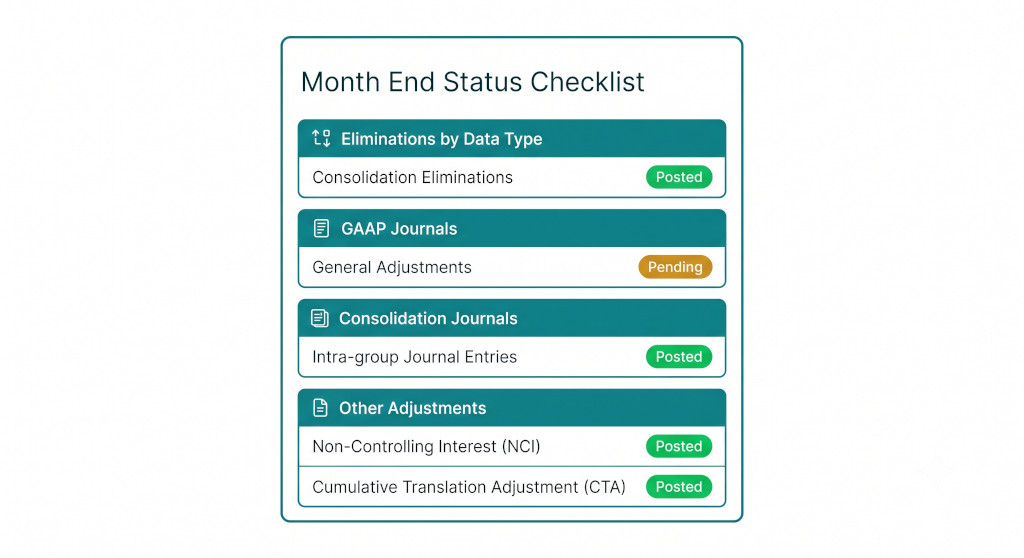
The Month End Status page now breaks out Group-level Adjustments into four clearly labelled sections:
Group-level Adjustments
Eliminations by Data Type
Trade receivables / payables, intercompany loans, etc.
● Posted
GAAP Journals
GAAP conversion entries
Development costs, PP&E, goodwill amortisation, leases…
● Pending
Consolidation Journals
Acquisition journals
Acquisition accounting journals
● Posted
Other Adjustments
NCI
Non-controlling interest
● Posted
CTA
Currency translation adjustment
● Posted
A Pending status on GAAP Journals means the period’s conversion adjustments have not yet been posted — you can go directly to GAAP Journals to add and confirm the missing entries. Posted means all entries for the period are confirmed and the group accounts reflect the conversion. This makes the month-end close review significantly faster: one page tells you exactly where the outstanding work is.
Learning Resources: Cross-Standard Consolidation Guides
To help finance teams understand which GAAP journal types apply to their specific group structure, we have published a series of practical guides covering the key cross-standard consolidation scenarios:
📚 Cross-Standard Consolidation Guides
How to Consolidate an IFRS Subsidiary into a US GAAP ParentJournals, fiscal alignment, and GBP/EUR to USD currency translation — with worked examples for development costs, PP&E, investment property, and impairment reversals.How to Consolidate a Singapore SFRS(I) Subsidiary into a US GAAP ParentGAAP conversion journals in SGD, fiscal year differences, and SGD to USD translation — with a full equity reconciliation and CTA calculation.SFRS vs US GAAP: Key DifferencesThe conceptual differences that drive most GAAP journal entries — inventory, development costs, goodwill, leases, and the VIE consolidation scope question.SFRS vs IFRS: Key DifferencesHow Singapore’s SFRS(I) compares to full IFRS — for groups with both Singapore and international IFRS entities.
Where to Find These Features
Navigate to Adjustments in the left sidebar. You will see GAAP Journals and Consolidation Journals listed as separate items under Journals, with CTA / FCTR alongside them. The updated Month End Status view is available under Review → Month End Status.
New to BrizoConsol?
Set up your group consolidation, manage GAAP conversions, and close your group accounts faster — all from one platform connected to Xero, QuickBooks, MYOB, and Zoho Books. Start Free Trial