IFRS 16 Leases in Group Consolidation: What Multi-Entity Groups Need to Know
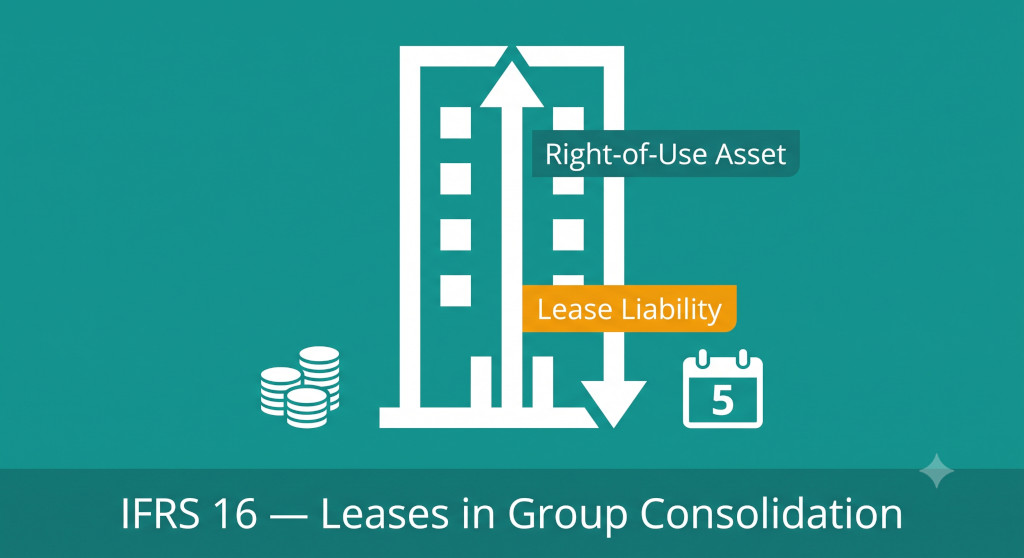
When the group finance director sat down to prepare the first IFRS 16 consolidated accounts, she had expected the hardest part to be the initial calculations — working out the present value of each entity’s lease commitments, applying the incremental borrowing rate, and posting the opening right-of-use assets and liabilities. What she had not anticipated was the intercompany lease between the parent company and two of its subsidiaries, where the parent owned the group’s head office building and charged a monthly lease payment to the subsidiaries that occupied it. Under the old operating lease model, that arrangement had been a simple management fee charge, eliminated on consolidation. Under IFRS 16, each subsidiary had recognised a right-of-use asset and a lease liability; the parent had recognised rental income and a corresponding receivable. Eliminating all of that on consolidation — correctly, without leaving ghost assets on the group balance sheet — took most of a Friday afternoon.
IFRS 16, which replaced IAS 17 for annual periods beginning on or after 1 January 2019, fundamentally changed the way lessees account for leases. The old distinction between finance leases (on-balance-sheet) and operating leases (off-balance-sheet) was abolished for lessees. Under IFRS 16, almost all leases — with narrow exemptions for short-term leases and leases of low-value assets — must be recognised on the balance sheet as a right-of-use (ROU) asset and a corresponding lease liability measured at the present value of future lease payments.
For a single-entity business, IFRS 16 is primarily a balance sheet and P&L presentation exercise. For a multi-entity group preparing consolidated accounts, it introduces additional complexity: each subsidiary calculates its own IFRS 16 positions independently, those positions must be aggregated correctly at the group level, and any intercompany leases must be identified and eliminated. This guide works through the mechanics at both the entity and group level, with a worked example and journal entries.
Stop building consolidations in spreadsheets.
BrizoConsol automates multi-entity consolidation — setup in minutes, reports the same day.
What IFRS 16 Requires: The Lessee Model
Under IFRS 16, a lessee recognises a right-of-use asset and a lease liability at the commencement date of the lease — the date on which the underlying asset is available for use. The lease liability is measured at the present value of lease payments not yet made, discounted using the interest rate implicit in the lease if that rate can be readily determined, or the lessee’s incremental borrowing rate (IBR) if it cannot.
For most SME groups, the implicit rate is not readily determinable — it requires knowledge of the lessor’s assumptions about residual value, which are typically not disclosed. The IBR — the rate the lessee would pay to borrow funds to purchase a similar asset over a similar term and in a similar economic environment — is therefore the most commonly used discount rate in practice. In a multi-entity group, each entity may have a different IBR depending on its credit quality, jurisdiction, and the currency in which its leases are denominated.
In a group context, a practical approach is to establish a group IBR policy: the parent’s treasury function determines an IBR for each currency and lease term combination, and subsidiaries apply the relevant rate consistently. This avoids each entity independently deriving different rates for economically similar leases and improves comparability across the group.
The lease payments included in the measurement of the lease liability are: fixed payments (less any lease incentives receivable), variable lease payments that depend on an index or rate (initially measured using the index or rate at commencement date), amounts expected to be payable under residual value guarantees, the exercise price of purchase options if the lessee is reasonably certain to exercise them, and payments for penalties for terminating the lease if the lease term reflects the lessee exercising a termination option.
The right-of-use asset is initially measured at the amount of the lease liability, plus any lease payments made at or before commencement, plus any initial direct costs incurred, less any lease incentives received. After initial recognition, the ROU asset is depreciated on a straight-line basis (unless another systematic basis better represents the pattern of consumption) over the shorter of the asset’s useful life and the lease term.
The Exemptions: When IFRS 16 Does Not Apply
IFRS 16 provides two practical expedients that allow lessees to avoid recognising an ROU asset and lease liability. Both are accounting policy elections that must be applied consistently to an entire class of underlying asset.
Short-term leases: leases with a lease term of twelve months or less at commencement date. Payments are recognised as an expense on a straight-line basis over the lease term. A lease that contains a purchase option cannot qualify as short-term.
Leases of low-value assets: leases where the underlying asset has a low value when new — IFRS 16 gives examples of tablet computers, personal computers, small items of office furniture, and telephones. The IASB had in mind assets with an undiscounted value when new of around USD 5,000 or less, though this is a guideline rather than a bright-line threshold. The low-value assessment is made on an absolute basis — it is not affected by whether the lease is material to the lessee.
Common mistake: Applying the low-value exemption to a class of similar leases in aggregate rather than individually. IFRS 16 requires the low-value assessment to be made on a lease-by-lease basis. A portfolio of 200 laptop leases at $800 each qualifies for the exemption; a single lease for a commercial vehicle at $45,000 does not, even if the vehicle is not material to the group.
Calculating the Lease Liability and ROU Asset: A Worked Example
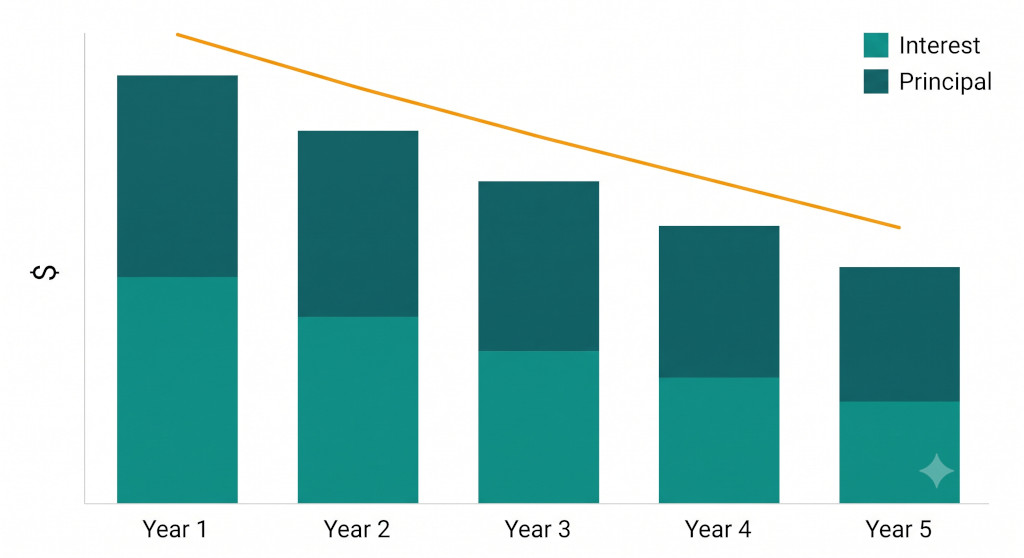
A subsidiary enters a five-year office lease with annual payments of $120,000 payable in arrears. The subsidiary’s IBR is 5%. There are no lease incentives, initial direct costs, or purchase options. The lease does not qualify as short-term or low-value.
The present value of the lease payments is calculated as follows:
Year 1 payment: $120,000 ÷ (1.05)^1 = $114,286
Year 2 payment: $120,000 ÷ (1.05)^2 = $108,844
Year 3 payment: $120,000 ÷ (1.05)^3 = $103,661
Year 4 payment: $120,000 ÷ (1.05)^4 = $98,725
Year 5 payment: $120,000 ÷ (1.05)^5 = $94,024
Initial lease liability (= initial ROU asset) $519,540
At commencement, the subsidiary posts:
Dr Right-of-use asset 519,540
Cr Lease liability 519,540
Commencement date — recognition of 5-year office lease at PV of future payments discounted at 5% IBR.
In Year 1, the lease liability accrues interest at 5% ($519,540 × 5% = $25,977) and the first annual payment of $120,000 is made. The ROU asset is depreciated over the five-year lease term ($519,540 ÷ 5 = $103,908 per year). The P&L impact in Year 1 is:
| Item | Year 1 ($) |
|---|---|
| Depreciation of ROU asset | 103,908 |
| Interest on lease liability | 25,977 |
| Total P&L charge | 129,885 |
| vs. straight-line operating lease expense (old IAS 17) | 120,000 |
Two features of this comparison are worth noting. First, the total P&L charge in Year 1 ($129,885) is higher than the straight-line lease expense under old IAS 17 ($120,000). This is because interest on the lease liability is front-loaded — it is higher in early years when the outstanding liability is larger. Over the full five-year term the total charge is the same ($600,000), but the profile is different: IFRS 16 charges more in early years and less in later years. Second, the nature of the charge changes: what was a single “operating lease expense” line becomes depreciation (typically in operating expenses) plus interest (in finance costs), which affects EBITDA and operating profit metrics even though total pre-tax profit over the lease term is identical.
IFRS 16 across multiple entities — without the manual calculations
BrizoConsol aggregates each subsidiary’s IFRS 16 positions at consolidation, handles intercompany lease eliminations automatically, and keeps your group balance sheet clean. Connect your entities and see the consolidated accounts the same day. See It in Action
IFRS 16 in Group Consolidation: The Additional Layer
In a group context, each entity applies IFRS 16 independently in its own accounts. The consolidation then aggregates those entity-level positions — but with one category of lease requiring specific attention: intercompany leases between entities within the same group.
Third-Party Leases
Where subsidiaries hold leases with external landlords or lessors, those leases are simply aggregated into the consolidated accounts alongside all other subsidiary balances. The consolidated balance sheet shows the sum of all ROU assets and lease liabilities across all entities in the group. No special consolidation adjustment is required for third-party leases other than ensuring consistent accounting policies are applied across the group (same IBR framework, same approach to lease term determination for renewal options).
Intercompany Leases
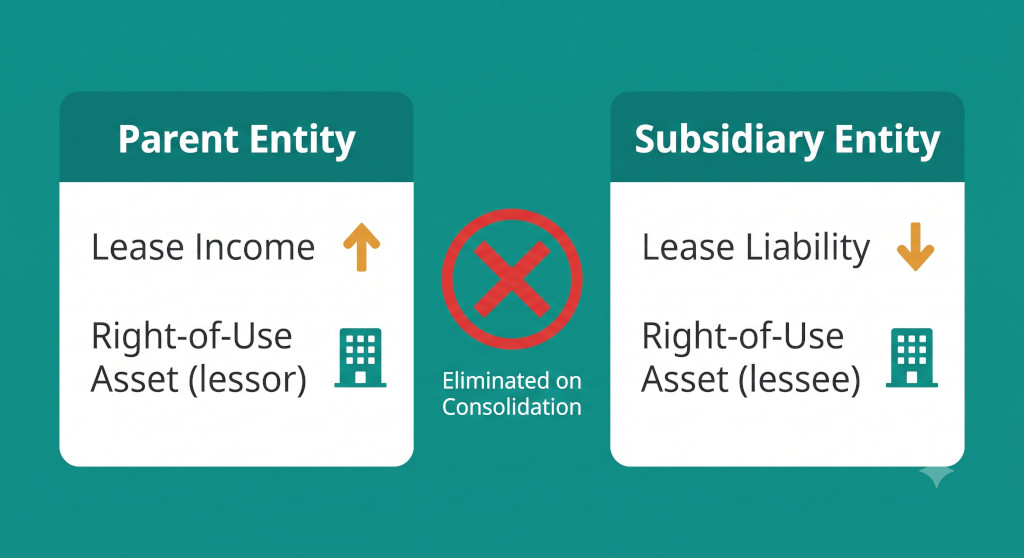
Where one group entity leases an asset to another group entity — the common scenario being a parent that owns property and subleases it to operating subsidiaries — both entities have IFRS 16 entries in their own accounts that must be eliminated on consolidation.
From the lessee subsidiary’s perspective: it has recognised an ROU asset (representing its right to use the property) and a corresponding lease liability. From the lessor parent’s perspective: if the parent itself leases the property from a third party and subleases it to the subsidiary, the parent will classify the sublease as either a finance lease or an operating lease under IFRS 16’s lessor model (which is substantially unchanged from IAS 17). If the parent owns the property outright, the intercompany arrangement is a straightforward intercompany rental.
On consolidation, the intercompany lease is eliminated. The subsidiary’s ROU asset and lease liability are removed, the parent’s intercompany rental income and the subsidiary’s lease depreciation and interest charges are eliminated, and any intercompany balance (accrued rent payable / receivable) is cancelled. The net result is that the consolidated accounts show only the group’s relationship with the external world — if the property is owned by the parent, it sits on the consolidated balance sheet as property, plant and equipment at cost less depreciation, with no ROU asset or lease liability alongside it.
Common mistake: Failing to eliminate the subsidiary’s ROU asset and lease liability when consolidating, on the basis that the arrangement was treated as an operating expense before IFRS 16. Post-IFRS 16, the subsidiary has balance sheet entries that must be removed on consolidation — leaving them in produces inflated total assets and total liabilities at the group level, since the consolidated accounts should reflect the group owning the asset outright, not leasing it from itself.
Lease Term Judgements Across the Group
One of the most significant sources of divergence in IFRS 16 accounting across a multi-entity group is the determination of the lease term where renewal options exist. IFRS 16 requires lessees to include optional periods in the lease term if they are “reasonably certain” to exercise the renewal option. This is a high bar — the IASB intended it to reflect only situations where there is an economic incentive that makes exercise highly probable — but it is a judgement call, and different subsidiaries may reach different conclusions for economically similar leases.
For group finance teams, establishing a consistent group-wide policy on lease term determination is both a practical necessity and an audit requirement. A subsidiary that treats a five-year lease with a five-year renewal option as a five-year lease will produce a materially different balance sheet entry from one that treats it as a ten-year lease. Multiplied across dozens of leases in a multi-entity group, inconsistent lease term judgements undermine the comparability of the consolidated accounts and create unnecessary audit friction.
IFRS 16 vs FRS 102: The Consolidation Implication for Mixed-Framework Groups
For groups that consolidate entities reporting under different frameworks — an IFRS parent with UK GAAP (FRS 102) subsidiaries, for example — the lease accounting difference between IFRS 16 and current FRS 102 is one of the most material adjustments required at the consolidation layer.
| Area | IFRS 16 | FRS 102 (current) |
|---|---|---|
| Operating lease model | Abolished — all material leases on balance sheet | Retained — operating leases remain off-balance-sheet |
| Finance lease model | Single on-balance-sheet model for all leases | Finance leases on balance sheet; operating leases off |
| Balance sheet impact | ROU asset + lease liability for all material leases | No balance sheet entry for operating leases |
| P&L presentation | Depreciation + interest (front-loaded) | Straight-line operating lease expense |
| EBITDA impact | Lease payments excluded from EBITDA (only interest below the line) | Lease payments included in operating expenses (reduce EBITDA) |
| Pending changes | Already in force (effective 1 Jan 2019) | FRC amendments proposed — effective date TBC |
Where an IFRS parent consolidates an FRS 102 subsidiary that has material operating leases, the consolidation requires an adjustment to convert the subsidiary’s FRS 102 lease accounting to IFRS 16: recognising an ROU asset and lease liability in the consolidated accounts that do not appear in the subsidiary’s own accounts. This adjustment must be calculated each period using the subsidiary’s lease data (remaining term, payment schedule, applicable IBR) and posted as a consolidation-layer journal entry.
Our guide to IFRS vs UK GAAP key differences in financial reporting covers this and other cross-framework adjustments in the broader context of mixed-standard group consolidations.
Practical Steps for Multi-Entity Groups
- Build a group lease register. Collect all lease contracts across every entity in the group — property, vehicles, equipment. Record the commencement date, lease term, renewal options, payment schedule, and whether any exemption (short-term or low-value) applies.
- Establish group IBR rates. Define IBRs by currency and lease term. Document the methodology so it can be applied consistently across entities and defended to auditors.
- Apply the lease term policy. Set a group-wide policy for how renewal options are assessed. Document the rationale for each material lease where an option exists.
- Calculate entity-level ROU assets and liabilities. Each subsidiary applies IFRS 16 in its own accounts. Use consistent templates and IBRs to produce comparable outputs.
- Identify all intercompany leases. Map every arrangement where one group entity charges another for the use of an asset. Determine whether it meets the definition of a lease under IFRS 16.
- Eliminate intercompany leases on consolidation. Remove the subsidiary’s ROU asset and lease liability; cancel the intercompany income/expense and any accrued intercompany balance. Ensure the underlying asset (if owned by the parent) sits in PP&E, not duplicated as an ROU asset.
- Adjust for mixed-framework subsidiaries. For FRS 102 subsidiaries consolidated into an IFRS group, calculate and post the IFRS 16 conversion adjustment — ROU asset and lease liability — at the group consolidation layer.
- Reassess at each reporting date. Update lease liabilities for any new leases, modifications, lease term reassessments, or changes in variable payments tied to an index. Post remeasurement adjustments against the ROU asset.
The volume of data that flows through a thorough IFRS 16 process — payment schedules, IBRs, amortisation tables, remeasurement triggers — makes it one of the more demanding parts of the multi-entity close. BrizoConsol holds the consolidation-layer adjustments including IFRS 16 cross-framework entries, applying them automatically at each period close without requiring manual journal re-entry. The broader picture of what consolidation software automates in the close process is covered in our guide to financial consolidation software and what it does, and the month-end sequence for multi-entity groups — including where IFRS 16 fits in the close checklist — is set out in our multi-entity month-end close checklist.
Ready to close faster across all your entities?
BrizoConsol connects to Xero, QuickBooks, MYOB, and Zoho Books — consolidating your group accounts, handling IFRS 16 adjustments, and eliminating intercompany leases without manual journals. Start free, no credit card required. Start Free Trial