Best Group Reporting Software in 2026: BrizoConsol, OneStream, Joiin, Reach Reporting, and Konsolidator Compared
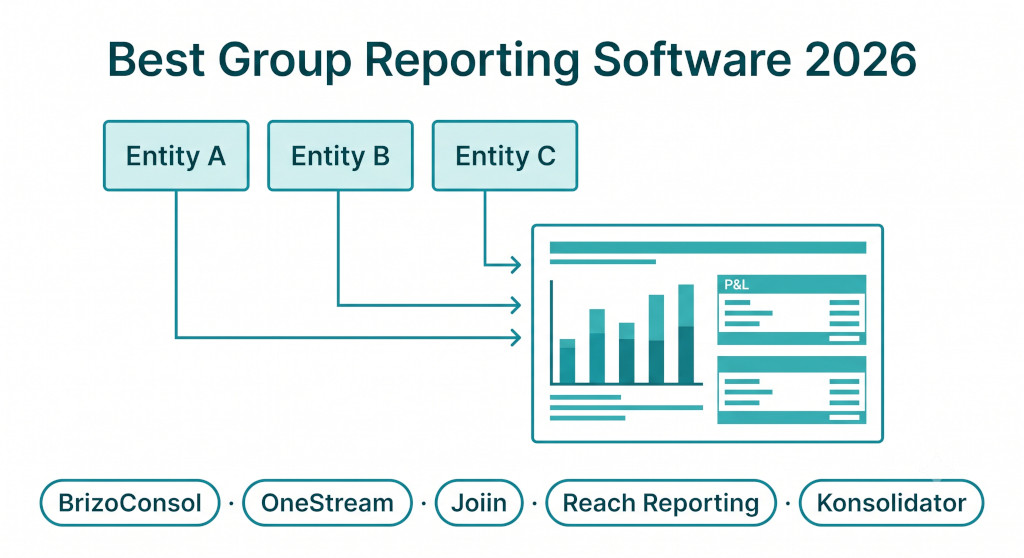
Group reporting software sits at the intersection of two requirements: consolidating financial data across multiple entities, and presenting that data in reports that boards, auditors, clients, and management teams can act on. Different tools weight these requirements differently — and the gap between a tool built primarily for report presentation and one built primarily for compliance-grade consolidation is wider than most buyers expect before they start evaluating.
This comparison covers five tools across the full price and complexity range: BrizoConsol, OneStream, Joiin, Reach Reporting, and Konsolidator. A companion post covering the same tools through the consolidation accounting lens is at Best Financial Consolidation Software 2026.
⚡ Quick Reference — Top Picks by Use Case
Selections are based on the evaluation criteria outlined below.
Stop building consolidations in spreadsheets.
BrizoConsol automates multi-entity consolidation — setup in minutes, reports the same day.
- Best for client-facing group report packs: Reach Reporting
- Best for management reporting across entities: Joiin
- Best for compliance-backed statutory group reports: BrizoConsol
- Best budget statutory group reporting: Konsolidator
- Best enterprise group reporting platform: OneStream
Scope of This Comparison
These five tools were selected to represent the full spectrum from SME-focused reporting tools through to enterprise CPM platforms, at a range of price points relevant to accounting firms and mid-market finance teams. Tools not covered in this comparison include enterprise-tier solutions — such as Fluence, Planful, CCH Tagetik, Workiva, and Lucanet — which typically target larger organisations with more complex reporting hierarchies and higher implementation budgets. General-purpose BI platforms (Power BI, Looker, Tableau) are also outside the scope; they are analytics tools rather than finance-specific group reporting systems. Buyers shortlisting for enterprise-scale requirements or BI-driven reporting should evaluate those categories alongside the tools below.
Two Types of Group Reports
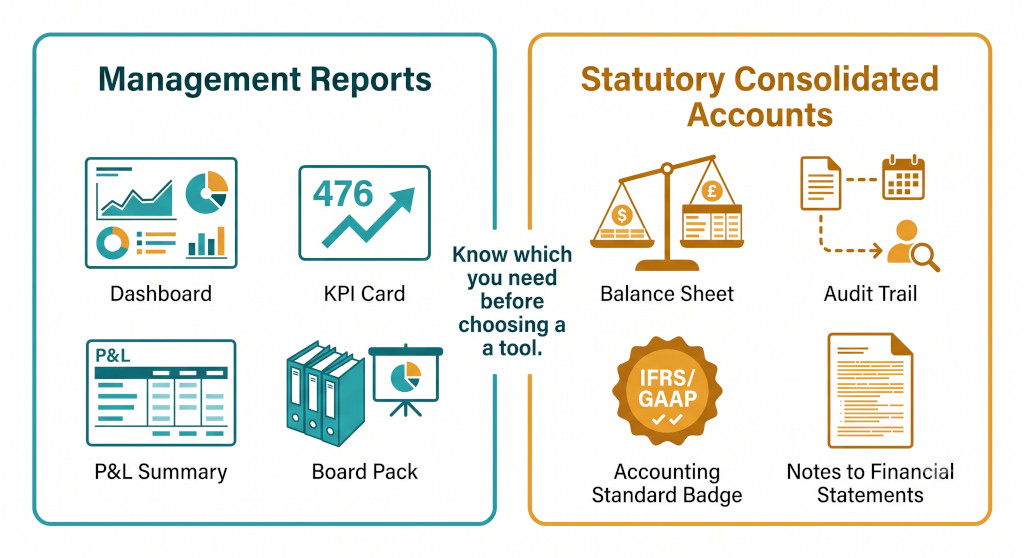
Management group reports are produced for internal stakeholders — board, CEO, department heads — or for clients of accounting firms. They aggregate financial data across entities into a consolidated view: a P&L, a KPI dashboard, a budget-versus-actual pack. Speed, visual quality, and customisation matter most. The numbers should be accurate and consistent, but the report does not need to follow a prescribed accounting standard format.
Statutory consolidated accounts are produced for external stakeholders — auditors, regulators, shareholders — and must comply with an accounting standard (IFRS, US GAAP, UK GAAP, or local GAAP). They require formal intercompany eliminations, correct minority interest disclosures, and currency translation reserve accounting, with an audit trail supporting each adjustment. The format is largely prescribed; what matters is that the numbers behind it are produced through a compliant consolidation process.
How We Evaluated These Tools
We evaluated each tool against seven criteria relevant to multi-entity groups and accounting firms producing group-level financial reports:
| Criterion | What we looked at |
|---|---|
| Report types | Whether the tool supports management report packs, board dashboards, segment reporting, KPI views, and statutory consolidated financial statements |
| Customisation and branding | Ability to tailor report layouts, apply company or firm branding, build custom metrics, and create reusable templates across entities or clients |
| Stakeholder sharing | Whether reports can be scheduled, distributed automatically, shared via a client portal, or exported in presentation-ready formats |
| Multi-entity aggregation | How the tool handles data consolidation — whether it automates intercompany eliminations and currency translation, or aggregates raw figures from source systems |
| Data reliability | Whether the consolidation process is GAAP-compliant and whether the tool provides an audit trail for consolidation adjustments |
| Accounting system integration | Which source systems the tool connects to natively versus requiring manual data import |
| Ease of implementation | Typical time from sign-up to first group report; whether self-service onboarding is feasible or professional implementation is required |
Pricing figures are based on publicly available pricing information at the time of publication.
Comparison at a Glance
| Tool | Primary focus | Customisation | Stakeholder sharing | Consolidation depth | Implementation | Best company size | Pricing |
|---|---|---|---|---|---|---|---|
| BrizoConsol | Statutory group reports + management reporting | Custom report builder; Excel-like grid | Export; report packs | GAAP-native engine — CTA, NCI, eliminations automated | Days to weeks; self-service | SME to mid-market; accounting firms | From $15/entity/month (Standard); $35/entity/month (Pro) |
| OneStream | Enterprise close, consolidation, and reporting | Highly configurable; Microsoft Office integration | Enterprise distribution; dashboards | Advanced multi-GAAP consolidation engine | Months; professional implementation typically required | Large enterprise | ~USD 178K/year avg [1] |
| Joiin | Management report packs; KPI and group dashboards | Custom builder; branded layouts; AI insights | Scheduled delivery; client reports | Multi-entity aggregation; elimination journals available | Hours to days; self-service | SME; accounting firms | From $23/month; volume pricing for 100+ companies |
| Reach Reporting | Client-facing report packs; board dashboards | Drag-and-drop; branded templates; white-label option | Client portal; scheduled delivery; export | Multi-company consolidation; currency conversion; eliminations | Hours to days; self-service | SME; accounting firms | From USD 149/month [2] |
| Konsolidator | Statutory consolidated financial statements | Standard formats; BI integration via API | Export; BI layer for dashboards | Automated statutory consolidation — CTA, NCI, eliminations | Days to weeks; self-service | SME to mid-market | From €200/month; unlimited users [3] |
BrizoConsol
Best for: multi-entity groups and accounting firms needing statutory group reports backed by a GAAP-compliant consolidation engine
Group reporting built on a consolidation accounting engine — reports draw from the same data the consolidation engine has already verified.
Strengths
- Custom report builder with an Excel-like grid — create group P&L, balance sheet, and cash flow layouts that match how the group actually thinks about its business
- Reports draw from a GAAP-native consolidation engine — intercompany eliminations, CTA, and NCI are resolved before the report is generated, removing a reconciliation step between consolidation model and report output
- Per-entity accounting standard selection across IFRS, US GAAP, UK GAAP (FRS 102), and SFRS — enables group reports that consolidate entities reporting under different frameworks
- AI-assisted account mapping (BrizoMapster) aligns charts of accounts across entities before report generation
- Native integrations with Xero, QuickBooks, MYOB, and Zoho Books — data flows from source accounting systems directly into the consolidation engine
- Designed for accounting firms managing multiple client group structures alongside in-house finance teams with formal reporting obligations
Limitations
- Report presentation tooling is functional rather than design-led — firms whose primary deliverable is a visually polished client report pack may find Reach Reporting or Joiin better suited to that specific output
- No budgeting or forecasting modules — groups needing consolidated budget vs actual reporting across future periods need a separate planning tool
- Direct ERP connectors (SAP, Oracle) are not available; cloud accounting platform integrations only
Pricing: from $15/entity/month — Standard plan; $35/entity/month — Pro plan
BrizoConsol’s group reports are produced downstream of a consolidation engine that handles the accounting mechanics — which means the numbers in the report reflect properly eliminated intercompany balances, correctly translated foreign currency positions, and formally calculated minority interests. For groups with statutory reporting obligations, this removes a risk that arises when the consolidation model and the report are maintained separately: the report and the consolidation process share the same data.
OneStream
Best for: large enterprises needing group reporting unified with financial close, FP&A, and planning on a single platform
An enterprise CPM platform where group reporting is one output of a unified financial close, consolidation, and planning process.
Strengths
- Group reporting, financial close, planning, budgeting, and forecasting all within a single platform — report outputs draw from a shared unified data model rather than separate systems
- Configurable reporting hierarchies — produce reports by legal entity, segment, geography, or custom dimension without exporting to a separate tool
- Microsoft Office integration enables group reports to be distributed in familiar Excel and PowerPoint formats
- Native dashboarding capabilities that users describe as a replacement for standalone BI tools in many cases [12]
- Named a Leader in the 2025 Gartner Magic Quadrant for Financial Close and Consolidation Solutions for the third consecutive year [4]; named Exemplary with the highest overall rating in the 2025 ISG Buyers Guide for Record to Report [13]
- G2 rating: 4.6/5 from 154 verified reviews; ideal customer profile (per Gartner): global enterprises with revenue USD 300M–USD 10B+ [5] [12]
Limitations
- Average contract cost of approximately USD 178,000 per year, with contracts reaching up to USD 290,000 annually based on Vendr’s transaction data [1] — cost that positions it for enterprise buyers
- Steep learning curve is a commonly noted limitation in G2 reviews; professional implementation is typically required [12]
- Complexity and configuration overhead reflect the platform’s enterprise CPM scope; groups whose primary need is group reporting rather than unified FP&A may find the implementation heavier than their use case warrants
- Not designed for accounting firms managing multiple separate client group structures under one subscription
Pricing: enterprise contract — ~USD 178K/year average; quote required [1]
OneStream’s group reporting strength comes from its unified data model — when consolidation, planning, and close all run on the same platform, the group report is a natural output of the same process rather than a separate downstream step. For large enterprises where that full platform scope is in use, this architectural advantage is real. For groups whose reporting requirement does not extend to FP&A and close management, the platform scope may exceed the actual need.
Joiin
Best for: accounting firms and SME groups producing consolidated management report packs and KPI dashboards from Xero, QuickBooks, or Sage
A group reporting platform built for speed and report quality — automates consolidated management reports across multiple accounting systems with AI-powered insights and scheduled delivery.
Strengths
- Connects to Xero, QuickBooks, Sage, and spreadsheets and produces consolidated group reports typically within a day of setup — among the faster options in this comparison for initial deployment
- Custom report builder with branded layouts; report packs created once and scheduled for recurring automated delivery
- AI-powered analytics and anomaly detection — highlights performance trends and variance insights directly in the reporting interface
- Supports financial, sales, and KPI data in a single consolidated group view, covering operational metrics alongside financial statements
- Excel Add-in allows Joiin data to populate live into Excel-based reporting workflows
- Winner of the Xero Global App Awards 2025 — Small Business App of the Year (Canada) [6]; Intuit Platinum App Partner [7]
- G2 rating: 4.7/5 from 79 verified reviews; primary segment: small business (62% of reviewers) [11]
- 14-day free trial; scales to unlimited entities
Limitations
- Primarily positioned around management reporting — groups with formal statutory consolidated account requirements should evaluate whether the consolidation depth and audit trail meet their obligations
- CTA and NCI mechanics are limited relative to accounting-layer tools — consolidations involving minority interests or complex foreign currency structures may require additional handling
- Off-the-shelf P&L and balance sheet templates are generic; groups with non-standard reporting layouts typically need to build custom report structures
Pricing: from $23/month; volume pricing for 100+ companies; 14-day free trial
Joiin is a strong option for the management reporting use case. The combination of fast cloud accounting integration, branded report packs, AI-generated insights, scheduled delivery, and the Excel Add-in makes it well-suited to accounting firms producing monthly consolidated reports for business-owner clients, and to in-house finance teams that need a clean group view without the overhead of a full consolidation accounting system.
Reach Reporting
Best for: accounting firms focused on producing professional, branded, client-facing financial report packs and dashboards
A financial reporting platform built around the report as a product — drag-and-drop design, multi-company consolidation, client portal, and white-label delivery.
Strengths
- Drag-and-drop report builder with pre-built templates and an Excel-like interface — well-suited for producing professionally formatted, client-ready group report packs with minimal setup
- White-label option: replace Reach Reporting branding with the firm’s own — relevant for accounting firms presenting reports under their name
- Client portal with access controls and scheduled delivery — reports reach the right people automatically without manual distribution each period
- AI-enhanced analysis converts raw financial data into charts, trend commentary, and visual variance analysis within the report output
- 3-way budgeting and forecasting (P&L, balance sheet, cash flow projections) available within the same platform
- Pricing decreases per company as more entities are added — scales cost-effectively for firms managing large client portfolios
- G2 rating: 4.9/5 from 27 verified reviews; primary segment: small business and accounting (60% and 48% of reviewers respectively) [10]
Limitations
- Primary positioning is report presentation — intercompany eliminations are available but the platform’s core competency is report design and delivery rather than the consolidation accounting engine
- Multi-dimensional reporting is not available in the financial form spreadsheet module, as noted in user reviews [8]
- Groups with formal statutory consolidated account requirements should evaluate whether the consolidation depth meets their obligations before relying on Reach Reporting as the sole system of record
Pricing: from USD 149/month (all features); pricing decreases per company at volume [2]
Reach Reporting is the tool in this comparison most directly built around the report as a deliverable. Its report design tooling, white-label option, and client portal delivery workflow are oriented more directly around client-facing report delivery than those of the consolidation-first tools in this comparison. For an accounting firm whose primary product is a well-presented monthly report pack distributed to clients through a professional portal, Reach Reporting is well-suited to that specific workflow.
Konsolidator
Best for: SME to mid-market groups needing GAAP/IFRS-compliant statutory consolidated financial statements at a predictable monthly cost
A statutory consolidation platform that produces audit-compliant group financial statements — P&L, balance sheet, cash flow, eliminations, and minority interests — from imported trial balance data.
Strengths
- Automated production of consolidated P&L, balance sheet, and cash flow statement across groups and sub-groups — covering actuals, budget, and forecast [3]
- Intercompany eliminations, minority interest calculations, and full currency translation included as standard in the consolidation engine
- GAAP and IFRS compliance embedded in the consolidation process, with audit trail output supporting statutory accounts
- SaaS model with unlimited users — no per-seat pricing; straightforward to upgrade or downgrade
- BI and visualisation tools connect via API — groups needing polished management dashboards alongside statutory reports can route Konsolidator data to a separate BI layer
- Self-service implementation; users report onboarding without external consultants
- Starts at €200/month — the lowest statutory-consolidation price point in this comparison [3]
Limitations
- Native integration with Xero, Sage, and QuickBooks (1-click sync via Xero App Store); for entities on other systems such as SAP, Oracle, or Dynamics, trial balance data is imported via file upload
- Reporting and visualisation layer is functional rather than design-led; groups wanting polished management dashboards typically connect Konsolidator output to a separate BI tool
- Intercompany transaction handling has been noted as an area for improvement by users with high intercompany volumes [9]
Pricing: from €200/month; unlimited users; free trial available [3]
Konsolidator’s primary output is the statutory consolidated financial statement — a compliance-grade document supported by an audit trail. For mid-market groups that need exactly that, at a predictable price without an enterprise contract, Konsolidator covers the compliance requirement directly. The trade-off is on the data input side (import rather than live sync) and the management reporting side (BI tool required for polished dashboards).
Which Tool Is Right for Your Group?
| Buyer profile | Recommended tool | Why |
|---|---|---|
| Accounting firm producing branded monthly report packs for business-owner clients | Reach Reporting | Report design, white-label option, and client portal delivery are particularly well suited to this use case; G2 4.9/5 |
| Accounting firm producing consolidated management accounts from cloud accounting platforms | Joiin | Among the faster deployments in this comparison; AI-powered report packs; strong Xero and QuickBooks integrations; G2 4.7/5 |
| Multi-entity group needing group reports backed by a GAAP-compliant consolidation process (IFRS, US GAAP, UK GAAP, or SFRS) | BrizoConsol | Reports draw from a consolidation engine with CTA, NCI, and elimination mechanics built in; per-entity accounting standard configuration |
| Mid-market group needing GAAP/IFRS-compliant statutory accounts without live cloud accounting integration | Konsolidator | Statutory consolidation at €200/month with unlimited users; produces audit-compliant P&L, balance sheet, and cash flow from imported trial balance data |
| Large enterprise needing group reporting unified with FP&A, close, and planning | OneStream | The only tool in this comparison where consolidated reporting, planning, and financial close run on a shared data model; G2 4.6/5 from 154 reviews |
The clearest decision filter is the primary output type. Management report packs for boards and clients — Joiin and Reach Reporting are optimised for this. Statutory consolidated accounts under an accounting standard — BrizoConsol and Konsolidator are the two tools in this comparison most directly built for that output. Enterprise scope covering reporting, planning, and close — OneStream. Most groups eventually need both types of report; the tool decision comes down to which is the primary obligation and whether the secondary requirement can be served by the same platform or needs a separate tool.
Group Reporting Software vs Financial Consolidation Software
The two terms overlap significantly, and vendors use them interchangeably. In practice, “group reporting software” emphasises the output — the report delivered to a board, a client, or an auditor — while “financial consolidation software” emphasises the process — the accounting adjustments that produce the numbers inside that report. A tool can be strong at both (BrizoConsol, Konsolidator, OneStream), or primarily strong at the reporting output (Joiin, Reach Reporting), or primarily strong at the consolidation mechanics with reporting as a secondary output (Konsolidator). For groups whose statutory reporting obligations require an auditable consolidation process, this distinction determines fit; for groups whose primary need is management reporting, it matters less. The companion post at Best Financial Consolidation Software 2026 covers the same five tools from the consolidation accounting angle.
How to Choose Group Reporting Software
✅ Buyer Evaluation Checklist
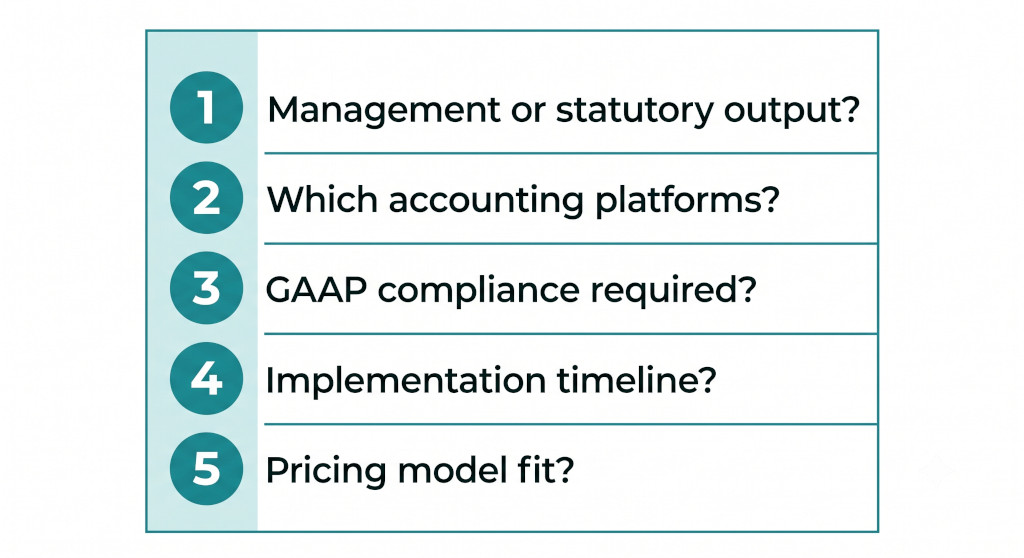
- Identify your primary output. Is the report a management pack for a board or client, or a statutory consolidated account for an auditor or regulator? This single question narrows the tool category significantly.
- List your entities and accounting platforms. Tools like Joiin, Reach Reporting, and BrizoConsol connect natively to Xero, QuickBooks, and Sage. Konsolidator integrates natively with Xero, Sage, and QuickBooks, and also accepts file imports from any other source. OneStream connects via ERP connectors. Confirm your platforms are supported before shortlisting.
- Determine whether GAAP compliance in the consolidation engine is required. For statutory accounts, the consolidation adjustments — intercompany eliminations, CTA, NCI — need to be produced by an accounting-standard-aware engine, not assumed correct from source data.
- Set your implementation timeline. Joiin and Reach Reporting are typically live within hours to a day. BrizoConsol and Konsolidator take days to weeks for a full setup. OneStream typically takes months and requires professional implementation services.
- Match the pricing model to your entity structure. BrizoConsol charges per entity; Joiin charges per company with volume discounts; Reach Reporting charges per data connection with volume discounts; Konsolidator charges a flat monthly fee with unlimited users; OneStream requires an enterprise contract.
Common implementation mistakes: Choosing a management reporting tool when the requirement is a statutory consolidated account (the report will look right but may not satisfy an auditor); buying an enterprise CPM platform when only group reporting is in scope (the overhead of implementation and cost is unlikely to be justified); assuming that any tool that connects to Xero or QuickBooks automatically produces GAAP-compliant consolidated accounts (connection to source systems and GAAP-compliant consolidation are different things).
Frequently Asked Questions
What is group reporting software?
Group reporting software aggregates financial data from multiple entities — subsidiaries, divisions, or joint ventures — and produces reports at the group level. This covers management report packs (board packs, KPI dashboards, consolidated P&L and balance sheet) and, in some tools, statutory consolidated financial statements that comply with an accounting standard. The category overlaps with financial consolidation software; the difference in emphasis is that group reporting tools may focus on the presentation and distribution of reports, while consolidation tools focus on the accounting mechanics that produce the correct numbers inside them.
Which group reporting software integrates with Xero or QuickBooks?
Of the five tools compared here, Joiin, Reach Reporting, and BrizoConsol offer native integration with Xero and QuickBooks. Joiin also connects to Sage and spreadsheets. BrizoConsol additionally integrates with MYOB and Zoho Books. Konsolidator integrates natively with Xero, Sage, and QuickBooks via 1-click sync (Xero App Store), and also accepts trial balance file imports from any other accounting system or ERP. Oracle Cloud EPM connects primarily via Oracle’s ERP family and non-Oracle systems via adapters.
How much does group reporting software cost?
Joiin starts at $23/month with volume pricing for larger company counts. Reach Reporting starts at USD 149/month with all features included, and pricing decreases per company at higher entity volumes. BrizoConsol is priced per entity — from $15/entity/month on the Standard plan and $35/entity/month on the Pro plan. Konsolidator starts at €200/month with unlimited users. OneStream is enterprise-contracted, averaging approximately USD 178,000 per year based on published procurement data, with contracts reaching USD 290,000 annually.
What group reporting software is best for accounting firms?
It depends on the firm’s primary deliverable. Firms producing branded client report packs — polished P&Ls, KPI dashboards, board-ready layouts — are typically best served by Reach Reporting or Joiin, which are optimised for that output. Firms producing GAAP-compliant consolidated statutory accounts for clients are better served by a tool with a compliance-grade consolidation engine; BrizoConsol is designed for this use case, with per-entity accounting standard selection and native integration with the cloud accounting platforms most firm clients use.
Can group reporting software replace a financial consolidation tool?
For management reporting purposes, yes — tools like Joiin and Reach Reporting produce consolidated group views that are accurate enough for board packs and management accounts. For statutory purposes, the answer depends on whether the tool’s consolidation engine produces GAAP-compliant adjustments with an audit trail. BrizoConsol, Konsolidator, and OneStream are designed for compliance-focused consolidation and group reporting. Joiin and Reach Reporting are primarily positioned around management reporting rather than compliance-grade statutory consolidation — groups with audit obligations should evaluate their specific requirements against each tool’s consolidation capabilities before relying on them for statutory output.
Conclusion
The five tools in this comparison reflect how wide the “group reporting software” category has become. Reach Reporting and Joiin are strong management reporting products — Reach Reporting is particularly strong in report design and client portal delivery, Joiin is particularly strong in AI-powered insights and cloud accounting integration speed. Both are optimised for the management report as a deliverable. Konsolidator, BrizoConsol, and OneStream all include compliance-grade consolidation engines capable of producing statutory consolidated accounts — the difference is scale and scope: Konsolidator integrating with Xero, Sage, and QuickBooks plus accepting file imports from any ERP at a flat monthly rate, BrizoConsol with native cloud accounting integration across Xero, QuickBooks, MYOB, and Zoho Books with per-entity GAAP configuration, and OneStream as an enterprise platform where consolidation sits within a broader unified finance function covering close, planning, and FP&A.
The decision most buyers face is not “which tool is best” but “which tool matches the output I actually need to produce and the accounting platforms I already use.” A group producing monthly management accounts from Xero entities has a different requirement from a group producing IFRS consolidated statutory accounts for a foreign-subsidiary structure — and those two requirements point toward different parts of this comparison.
Sources
- Vendr, “OneStream Software Pricing & Plans” — vendr.com/buyer-guides/onestream-software (average annual cost ~USD 178,000; maximum up to USD 290,000; based on Vendr transaction data)
- Reach Reporting, “Limelight vs. Reach Reporting” — reachreporting.com/blog/limelight (pricing from USD 149/month, all features included; decreases per company at volume)
- Konsolidator on G2 / Sourceforge — sourceforge.net/software/product/Konsolidator/ (subscription from €200/month, unlimited users; P&L, balance sheet, cash flow, eliminations, minority interests, currency translation included)
- OneStream Press Release via PRNewswire, 1 April 2025 — prnewswire.com (Gartner Magic Quadrant Leader for Financial Close and Consolidation Solutions, third consecutive year)
- Gartner Magic Quadrant for Financial Close and Consolidation Solutions, 25 March 2025 (via gartneronestream.com) — ideal customer profile: global enterprises with revenue USD 300M to USD 10B+
- EINPresswire, “Joiin Wins FinTech of the Year at the Tech South West Awards 2025”, 26 November 2025 — einpresswire.com (Winner, Xero Global App Awards 2025 — Small Business App of the Year, Canada)
- EINPresswire via CBInsights, “Joiin Recognised as Platinum Partner in Intuit’s App Program”, 24 February 2026 — cbinsights.com/company/joiin
- SoftwareAdvice user reviews for Reach Reporting — softwareadvice.com (multi-dimensional reporting limitation in financial form spreadsheet module)
- SoftwareAdvice user reviews for Konsolidator — softwareadvice.com (intercompany section improvement noted by users with high transaction volumes)
- G2, Reach Reporting product page — g2.com (4.9/5, 27 verified reviews; 60% small-business segment; 48% accounting industry)
- G2, Joiin product page — g2.com (4.7/5, 79 verified reviews; 62.3% small-business segment)
- G2, OneStream product page — g2.com (4.6/5, 154 verified reviews; steep learning curve noted as a common limitation)
- OneStream, “OneStream Recognized as Exemplary in ISG Record to Report Buyers Guide”, October 2025 — onestream.com (highest overall rating in Financial Close, Consolidation, and overall Record to Report, 2025 ISG Buyers Guide)
Multi-entity group with IFRS, US GAAP, UK GAAP, or SFRS subsidiaries?
BrizoConsol produces group reports from a consolidation engine that automates intercompany eliminations, currency translation, and non-controlling interest calculations — connecting directly to Xero, QuickBooks, MYOB, and Zoho Books. See It in Action